BTech Lateral Entry 2026 offers diploma and eligible BSc graduates a fast-track route to earn a full engineering degree by entering directly into the second year of BTech. Approved by AICTE, this pathway saves one academic year while opening the same academic and career doors as a regular four-year BTech. Admissions are conducted through state-level and university-level exams such as LEET, JELET, AP ECET, TS ECET, and TNEA Lateral Entry, along with direct admission options in several private and deemed universities. Candidates can pursue popular branches like Computer Science, Mechanical, Electrical, Civil, and emerging fields such as AI and Data Science, depending on eligibility and seat availability.
The blog provides a complete roadmap for aspirants, covering eligibility criteria, admission process, entrance exams, syllabus, counselling, state quotas, and top government and private colleges across India. It also explains branch options, career scope, salary growth, and opportunities in private sector jobs, PSUs, higher studies, and entrepreneurship after completing BTech through lateral entry. Overall, it serves as a practical, all-in-one guide for diploma holders planning a strategic and confident transition from diploma to degree in 2026.
In this detailed guide, you’ll learn everything about eligibility, admission process, top colleges, exam schedules, and career scope for BTech Lateral Entry — so you can plan your diploma-to-degree upgrade strategically and confidently.
What Is Lateral Entry in BTech? (Diploma to Degree Explained)
BTech Lateral Entry is a special admission route that allows Diploma or BSc graduates to enter directly into the second year (third semester) of a BTech program. Instead of studying all four years, eligible candidates skip the first year — saving time and effort while still earning the same engineering degree as regular students.
This system, approved by the AICTE (All India Council for Technical Education), bridges the academic gap between polytechnic studies and a full-fledged BTech degree. It’s especially designed for students who have completed a 3-year Diploma in Engineering or Technology and want to expand their career scope or pursue higher studies, such as MTech or MBA, in the future.
Most states and universities in India conduct separate entrance exams for lateral entry admission — collectively known as LEET exams (Lateral Entry Entrance Tests). Popular examples include:
LEET (Haryana, Punjab, Delhi)
JELET (West Bengal)
AP ECET (Andhra Pradesh)
TS ECET (Telangana)
TNEA Lateral Entry (Tamil Nadu)
KCET Lateral Entry (Karnataka)
These exams help Diploma holders secure second-year BTech seats in both government and private colleges under state or management quotas.
BTech Lateral Entry Eligibility: Who Qualifies for Lateral Entry?
Before applying for any BTech Lateral Entry exam, it’s crucial to understand who can apply and under what conditions. The eligibility requirements are defined by AICTE and state technical universities, ensuring that only qualified Diploma or BSc graduates can enter the 2nd year of BTech.
Below is a summary of the BTech Lateral Entry eligibility criteria for 2026:
Criteria
Details (As per 2026 Guidelines)
Educational Qualification
3-Year Diploma in Engineering/Technology (AICTE-approved) or BSc Degree (with Mathematics as a subject in Class 12).
Minimum Marks Required
Minimum 50% aggregate (45% for SC/ST/OBC/Reserved categories).
Eligible Branches
Admission allowed in equivalent or related streams – CSE, Mechanical, Electrical, Civil, Electronics, IT, etc.
Age Limit
Generally between 20–25 years (varies slightly by state/university).
Admission Level
Direct admission to the 2nd Year (3rd Semester) of BTech program.
Entrance Requirement
Must qualify for a state-level or university-level Lateral Entry Exam such as LEET, JELET, AP ECET, or TNEA Lateral Entry.
Many universities also allow lateral entry for BSc graduates, provided they have studied Mathematics at the 10+2 level.
This route ensures academic continuity — helping students move seamlessly. From practical Diploma training to advanced engineering theory and specialisation.
Admission Process for BTech Lateral Entry 2026
The BTech Lateral Entry admission process allows Diploma and BSc holders to enter directly into the second year (third semester) of engineering programs. While the general pattern is similar across India, the exact procedure varies between state-level, university-level, and private institutes.
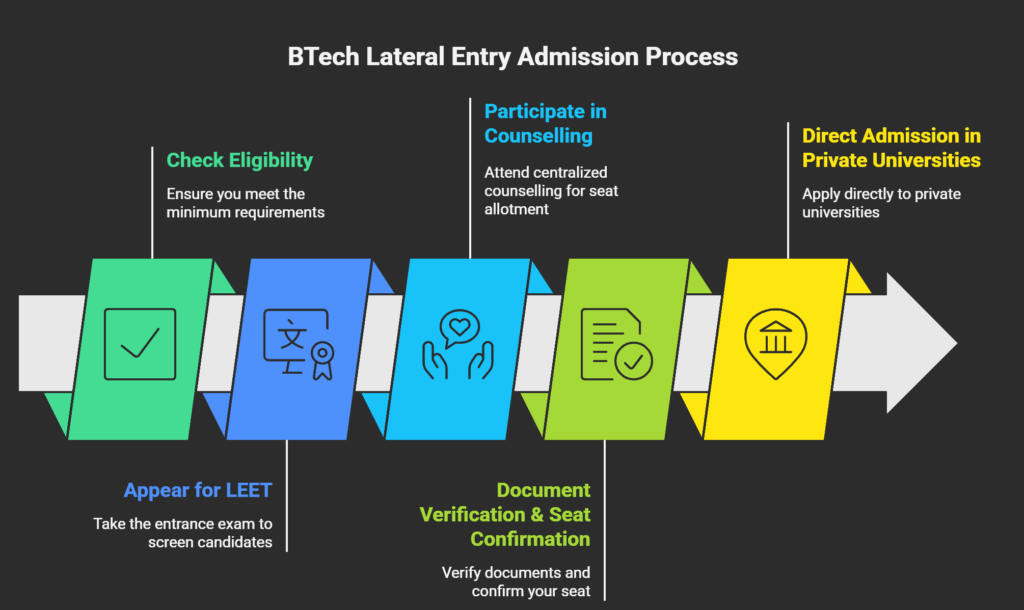
Here’s a clear step-by-step guide to the process:
Step 1: Check Eligibility
Before applying, ensure you meet the minimum eligibility — a 3-year Diploma or BSc degree with at least 50% marks. Candidates must have completed their course from an AICTE-approved or recognised university.
Step 2: Appear for a Lateral Entry Entrance Exam (LEET)
Most states and universities conduct a Lateral Entry Entrance Test (LEET) or equivalent exam to screen candidates. Popular exams include:
Delhi CET (LEET)
Haryana LEET
WB JELET
AP ECET
TNEA Lateral Entry
UPCET Lateral Entry
These exams test the candidate’s Diploma-level knowledge. These focus on subjects like Engineering Mathematics, Mechanics, Computer Basics, and Applied Physics.
Step 3: Participate in Counselling
After clearing the exam, candidates must attend centralised counselling organised by the respective state technical university (e.g., HSTES for Haryana, WBJEEB for West Bengal). Seats are allotted based on:
Entrance exam rank
Choice of college and branch
Category and reservation criteria
Step 4: Document Verification & Seat Confirmation
Shortlisted candidates must verify documents like:
Diploma/BSc marksheets
LEET admit card and rank
Transfer and migration certificates
ID proof and photographs
Once verified, candidates can confirm their seat by paying the admission fee and completing the college registration process.
Step 5: Direct Admission in Private Universities (Alternative Route)
Some private and deemed universities offer direct lateral entry admissions (without a common entrance exam). Admission here is based on Diploma marks or university-specific tests. Examples:
Lovely Professional University (LPU)
Amity University
Chandigarh University (CU)
SRM Institute of Science & Technology
These institutes usually open applications early, between January and May 2026.
Eligible Diploma Streams for BTech Lateral Entry
Diploma Branch
Eligible BTech Branch Options
Diploma in Civil Engineering
BTech in Civil / Construction Engineering
Diploma in Mechanical Engineering
BTech in Mechanical / Automobile / Industrial Engineering
Diploma in Electrical / Electronics
BTech in Electrical / ECE / EEE / Mechatronics
Diploma in Computer Science / IT
BTech in CSE / IT / AI & Data Science
Diploma in Chemical / Petroleum
BTech in Chemical / Petroleum Engineering
Lateral Entry for BSc Graduates
Apart from diploma holders, some universities also allow BSc (Mathematics) graduates to enter the BTech 2nd year via lateral entry.
Eligibility:
Must have completed BSc with Physics, Chemistry, and Mathematics.
Minimum 45–50% aggregate marks.
Must clear the respective LEET / CUET exam.
Top BTech Lateral Entry Exams in India 2026
S. No.
Exam Name
Conducting Body
Tentative Exam Date (2026-27)
Key Admission Coverage
1
LEET (Lateral Entry Entrance Test)
State Technical Education Boards
May–June 2026
Used by many state universities like DTU, Punjab Technical Univ, etc.
2
JELET (Joint Entrance for Lateral Entry Test)
WBJEE Board
July 2026
For admission into 2nd-year BTech/B.E. in West Bengal colleges
3
AP ECET (Engineering Common Entrance Test)
JNTU Anantapur on behalf of APSCHE
May 2026
For diploma/BSc candidates seeking BTech in Andhra Pradesh
4
TS ECET
JNTU Hyderabad on behalf of TSCHE
May 2026
For Telangana-based diploma holders and BSc graduates
5
Haryana LEET
Haryana State Technical Education Society (HSTES)
June 2026
For admission into the 2nd-year BTech across Haryana colleges
6
Punjab LEET
I.K. Gujral Punjab Technical University
June 2026
For diploma students seeking degree upgrades in Punjab
7
TNEA Lateral Entry
Directorate of Technical Education, Tamil Nadu
June–July 2026
Admission based on merit in diploma marks (no separate test)
8
Odisha LEET (O-JEE LE)
Odisha Joint Entrance Examination Committee
May 2026
For entry into the 2nd-year BTech/B.Pharm programs
9
Kerala LET (Lateral Entry Test)
Directorate of Technical Education, Kerala
June 2026
Admission to govt and private engineering colleges
10
Goa CET (LE)
Directorate of Technical Education, Goa
May 2026
For lateral entry seats in state engineering institutes
11
Delhi CET (LE)
Department of Training and Technical Education (DTTE)
May–June 2026
Used for DTU, NSUT, and other Delhi-based institutions
12
LPU NEST (LE)
Lovely Professional University
May–July 2026
National-level private university test for 2nd-year entry
13
CU Lateral Entry Test
Chandigarh University
May–June 2026
Internal exam for direct admission to 2nd year BTech
14
SRMJEEE (LE)
SRM Institute of Science & Technology
June 2026
Separate slot for diploma holders seeking BTech entry
15
VITEEE (LE)
VIT University
May 2026
Offers limited lateral entry seats in core branches
Why do these exams matter?
These entrance exams ensure that diploma students from all technical backgrounds—Mechanical, Electrical, Civil, Computer Science, etc.—can continue their higher education in recognised universities. Many states reserve 10–20% of total BTech seats for lateral entry students, making this one of the most efficient pathways from diploma to degree.
The BTech Lateral Entry Entrance Exam (LEET / JELET / ECET / CUET-UG Engineering route) tests the technical and analytical skills that diploma holders acquire during their 3-year course. The exam evaluates whether candidates are ready to enter directly into the 2nd year (3rd semester) of a BTech program.
The BTech Lateral Entry syllabus typically covers three major sections:
Engineering Mathematics & Applied Sciences
Fundamentals of Engineering (Branch-specific)
General Awareness & Analytical Ability
Section
Key Topics Covered
Weightage (Approx.)
A. Engineering Mathematics
Algebra, Differential Calculus, Integral Calculus, Differential Equations, Probability & Statistics, Matrices, Laplace Transform, Fourier Series
C. Diploma Stream Subjects (Core Engineering Concepts)
Based on the candidate’s diploma branch. Examples: • Civil – Surveying, Strength of Materials, Fluid Mechanics • Mechanical – Thermodynamics, Machine Design, Production • Electrical – DC/AC Machines, Circuits, Power Systems • Electronics – Analogue/Digital Circuits, Microprocessors • Computer Science – Programming, DBMS, OS, Networks
40–45%
D. General Awareness & Reasoning
Logical reasoning, quantitative aptitude, analytical ability, current affairs (technical awareness)
10–15%
Branch-Wise Subject Focus
Diploma Branch
Important Topics for LEET/ECET/JELET 2026
Civil Engineering
Surveying, Building Materials, Strength of Materials, Hydraulics, Estimation, Concrete Technology
Mechanical Engineering
Thermodynamics, Theory of Machines, Fluid Mechanics, Manufacturing, Machine Design
Electrical Engineering
Electrical Circuits, Machines, Power Systems, Control Systems, Basic Electronics
Electronics & Communication
Electronic Devices, Analogue & Digital Circuits, Microprocessors, Communication Systems
Computer Science / IT
Programming in C/C++, Data Structures, DBMS, OS, Computer Networks
Automobile / Mechatronics
Vehicle Dynamics, Strength of Materials, Sensors & Actuators, Control Engineering
Exam Pattern
While the syllabus and pattern differ slightly by state or university, most tests follow a technical aptitude-based format focused on core diploma subjects.
Parameter
Details (Typical)
Mode of Exam
Online or Offline (varies by state/university)
Total Questions
90–120 MCQs
Duration
90–120 minutes
Marking Scheme
+4 for correct answer, –1 for wrong (varies by exam)
Difficulty Level
Moderate — based on diploma-level understanding
Recommended Books for Preparation
Engineering Mathematics by B.S. Grewal
Objective Electrical Technology by V.K. Mehta
A Textbook of Strength of Materials by R.S. Khurmi
LEET & JELET Previous Year Papers (Arihant / MTG)
Diploma-level Notes (Branch-wise)
Lateral Entry in BTech in Government Colleges & State Engineering Colleges
Government colleges are ideal for students seeking affordable fees and a solid academic reputation. Admission is typically through state LEET or ECET exams.
College Name
Admission Mode
Key Highlights
Delhi Technological University (DTU), Delhi
Delhi CET (LEET)
Among India’s top-ranked state universities for lateral entry
Punjab Engineering College (PEC), Chandigarh
LEET Punjab
High placement record, especially in core branches
Thapar Institute of Engineering & Technology, Patiala
Direct/LEET
Renowned for CSE, Mechanical, and Civil branches
JNTU Kakinada, Andhra Pradesh
AP ECET
Leading state college for diploma-to-degree transitions
Private and deemed universities provide flexible admissions, modern infrastructure, and better placement training for lateral entry students.
University Name
Admission Mode
Highlights
VIT Vellore
VITEEE (LE)
Industry-integrated programs with global internship tie-ups
SRM Institute of Science and Technology
SRMJEEE (LE) / Direct
Offers strong placement support for diploma holders
Chandigarh University (CU)
Direct / CU Lateral Entry Test
Excellent record in CSE and AI-based programs
Lovely Professional University (LPU), Punjab
LPU NEST (LE)
National-level test for direct second-year entry
Amity University, Noida
Direct / Merit-Based
Accepts diploma candidates based on marks or internal exam
Top BTech Lateral Entry Colleges: State-Wise Options
Here’s a snapshot of leading state-wise choices for lateral entry engineering aspirants:
State
Top Colleges / Universities
Maharashtra
COEP Technological University, VIT Pune, MIT-WPU
Tamil Nadu
PSG College of Technology, SRMIST, Sathyabama University
Karnataka
RV College of Engineering, BMS College, PES University
Uttar Pradesh
AKTU-affiliated colleges, Galgotias University, Sharda University
West Bengal
Jadavpur University, MAKAUT colleges, IEM Kolkata
Telangana & Andhra Pradesh
JNTU Hyderabad, JNTU Kakinada, KL University
Punjab & Haryana
Thapar University, CU, LPU, Deenbandhu Chhotu Ram University
BTech Lateral Entry Colleges in Delhi
Delhi NCR is one of India’s top destinations for BTech Lateral Entry programs, offering a wide range of government and private colleges that accept diploma holders and BSc graduates directly into the second year of engineering. With access to top infrastructure projects, strong industry partnerships, and excellent placements, Delhi colleges are ideal for students upgrading from Diploma to Degree pathways.
Top Government Colleges for BTech Lateral Entry in Delhi
College Name
Admission Mode
Key Highlights
Delhi Technological University (DTU)
Admission via LEET / JEE Main (Laterals)
Offers lateral entry for diploma holders into 2nd year; strong placement cell and industry collaborations.
Netaji Subhas University of Technology (NSUT)
Through JEE Main / LEET quota
Renowned for high-quality labs, focus on core and emerging tech; one of Delhi’s best lateral entry options.
Indira Gandhi Delhi Technical University for Women (IGDTUW)
JEE Main / CUET (UG)
Exclusively for women; offers lateral entry in CSE, ECE, and IT branches.
Guru Gobind Singh Indraprastha University (GGSIPU)
IPU CET (Lateral Entry Stream)
Conducts its own CET for lateral entry; wide range of affiliated colleges under IPU offering lateral BTech programs.
Jamia Millia Islamia (JMI)
CUET / JEE Main / Institutional Test
Offers LEET-equivalent entry for diploma holders in select branches.
Top Private Colleges for BTech Lateral Entry in Delhi NCR
College Name
Admission Mode
Special Features
Amity University, Noida
Amity JEE / Direct Entry (Lateral)
Offers lateral admission in CSE, Civil, Mechanical, and ECE; industry-based projects and strong placement network.
Manav Rachna International Institute of Research & Studies (MRIIRS)
MRNAT / CUET / Direct Entry
AICTE-approved; known for its smart campus, industrial training, and practical-based teaching.
Galgotias University, Greater Noida
CUET / Direct Counselling
Offers BTech lateral entry in multiple disciplines; great corporate tie-ups and placement rate.
Sharda University, Greater Noida
SUAT / CUET / Direct Admission
Offers flexible learning paths, internship programs, and global exposure.
KR Mangalam University, Gurugram
Direct / CUET / State LEET
Modern labs, excellent faculty, and scholarships for diploma holders.
Dronacharya College of Engineering, Gurgaon
Haryana LEET / Management Quota
Popular for mechanical and computer engineering laterals; strong linkages with industries.
BTech Lateral Entry in AKTU
With over 700+ affiliated institutes, AKTU’s lateral entry system provides opportunities in top branches such as Computer Science, Mechanical, Civil, Electrical, and Electronics Engineering, making it an ideal route for diploma students to upgrade their qualifications.
Entrance Exam for AKTU Lateral Entry — CUET/UPCET (Formerly UPSEE/UPLEEE)
Admission to BTech Lateral Entry in AKTU is conducted through the Common University Entrance Test (CUET-UG) or UPCET (UP Combined Entrance Test), depending on the admission cycle and centralization status for 2025.
Exam Name
Conducting Body
Mode of Exam
Level
UPCET (UP Combined Entrance Test)
National Testing Agency (NTA)
Online (Computer-Based Test)
State Level
Alternate Mode (CUET-UG 2025)
NTA
Online
National (for select AKTU-affiliated institutes)
Exam Pattern Highlights:
Sections: Engineering Mathematics, Basic Engineering, Branch-Specific Diploma Subjects, General Aptitude
Question Type: Multiple-choice (MCQs)
Duration: 2 hours
Marking Scheme: +4 marks per correct answer; no negative marking (subject to official guidelines).
Participating Colleges under AKTU Lateral Entry
Top AKTU-Affiliated Colleges Offering Lateral Entry
Location
Dr. A.P.J. Abdul Kalam Technical University (Main Campus)
Lucknow
KIET Group of Institutions
Ghaziabad
Ajay Kumar Garg Engineering College
Ghaziabad
ABES Engineering College
Ghaziabad
GL Bajaj Institute of Technology & Management
Greater Noida
Galgotias College of Engineering & Technology
Greater Noida
IMS Engineering College
Ghaziabad
Raj Kumar Goel Institute of Technology
Ghaziabad
IET Lucknow (Institute of Engineering and Technology)
Lucknow
Branch Options for Lateral Entry Students
One of the biggest benefits of the BTech Lateral Entry system is flexibility — diploma holders can either continue in their core specialisation or switch to trending fields such as Computer Science, Artificial Intelligence, or Data Science. The branch you choose shapes not just your degree but also your future career path, job opportunities, and salary potential.
Here’s a detailed look at the most popular and rewarding branches available for lateral entry aspirants in 2026.
Branch
Ideal for Diploma In
Top Recruiters
Average Salary (Fresher)
Why Choose This Branch
Computer Science & Engineering (CSE)
Computer, IT, Electronics
TCS, Infosys, Amazon, Google, Wipro
₹5 – ₹8 LPA
Highest placement demand, remote jobs, strong global scope
Hardware + software integration roles in tech firms
Mechatronics / Robotics Engineering
Mechanical, Electrical, Electronics
Bosch, ABB, Mitsubishi, Fanuc
₹5 – ₹7 LPA
Interdisciplinary, future-ready field (automation, robotics)
Automobile Engineering
Mechanical, Automobile
Maruti Suzuki, Mahindra, Hyundai
₹3.5 – ₹5 LPA
Core design and manufacturing roles in the auto sector
Other Core Branches (Chemical, Metallurgy, Textile, Environmental)
Relevant diploma streams
IOCL, BHEL, NTPC, Reliance
₹3 – ₹4.5 LPA
Strong PSU opportunities and industrial relevance
Career Scope After BTech Lateral Entry
Completing your BTech through lateral entry opens up the same career opportunities as a regular 4-year BTech graduate. The degree is AICTE and UGC-approved, which means diploma holders who upgrade to BTech through LEET or other entrance exams can apply for private sector jobs, government exams, PSUs, and even pursue MTech or MBA afterwards.
Let’s explore the diverse career avenues available:
1. Private Sector & IT Jobs
Most lateral entry graduates, especially from Computer Science, IT, and Electronics branches, find abundant opportunities in the private and tech sectors. Roles include:
Software Developer / Web Developer
Network Engineer / Systems Analyst
Data Analyst / Machine Learning Engineer
CAD Design Engineer / Production Engineer
Top Hiring Companies: TCS, Infosys, Accenture, Capgemini, Wipro, L&T, Tech Mahindra, Bosch, and Amazon. Average Starting Salary: ₹4–7 LPA (depending on branch and college).
With the 2025 placement season leaning heavily toward AI, automation, and digital systems, CSE, IT, and ECE graduates enjoy especially strong prospects.
2. Government Jobs & PSUs
Lateral entry BTech graduates are eligible for central and state government recruitments that require a full engineering degree. Key Options Include:
PSUs (Public Sector Units): ONGC, BHEL, NTPC, IOCL, DRDO, ISRO, and BEL recruit engineers through GATE or direct entry.
State Government Departments: PWD, Jal Nigam, Power Corporations, and Irrigation Departments.
Central Exams: SSC JE, UPSC Engineering Services (IES), and other technical officer roles.
Tip: Students from core branches (Civil, Electrical, Mechanical) have an edge in PSU and government sector jobs.
3. Higher Studies: M.Tech, MBA & Abroad Options
A BTech via lateral entry doesn’t limit your academic future — you can pursue:
M.Tech / ME: Through GATE (valid for lateral entry graduates too).
MBA: For leadership or management-oriented roles.
MS Abroad: Many universities accept Indian lateral-entry BTech degrees for postgraduate admissions.
Career Boost Example: A diploma-holder-turned-BTech engineer who completes M.Tech from an IIT or NIT can easily see salary growth of 150–200% within a few years.
4. Startups & Entrepreneurship
Many lateral entry engineers use their practical diploma training + engineering degree as a launchpad to build startups or freelance careers. Fields like product design, robotics, automation, and app development are particularly favourable for self-starters. With access to incubation centres in universities like SRM, VIT, and CU, diploma graduates are finding new paths to entrepreneurship.
5. Salary Growth & Long-Term ROI
The average salary growth curve for lateral entry graduates follows the same path as standard BTech students. Here’s a quick estimate based on 2025 hiring trends:
Experience Level
Average Salary Range (₹ LPA)
Growth Trend
0–1 years
3.5 – 6 LPA
Entry-level placements
2–5 years
6 – 12 LPA
Mid-level promotions, domain specialisation
6–10 years
10 – 20 LPA
Project management or senior engineer roles
10+ years
20+ LPA
Leadership / international positions
State Quotas & Counselling 2026
In India, most BTech Lateral Entry admissions are conducted through state-level entrance exams and counselling processes, commonly known as LEET (Lateral Entry Entrance Test) or Direct Second-Year Admission schemes. Each state follows its own set of eligibility rules, reservation quotas, and centralised counselling systems.
This system ensures fair opportunities for diploma holders within their home state while also allowing seats for other-state candidates under open categories.
1. What Is the State Quota in Lateral Entry?
The State Quota refers to the percentage of seats reserved in engineering colleges (both government and private) for students who hold domicile status or have completed their diploma within that state. Typically, 85% of total seats in government colleges are reserved for state-domicile students, while 15% are open for candidates from other states or national-level exams (like JEE or AICTE-approved LEET exams).
Example:
In Haryana, 85% seats in DTU/State colleges are for Haryana-domicile LEET candidates.
In Maharashtra, 80% of seats are for Maharashtra diploma holders under DTE counselling.
In Uttar Pradesh (UPLEET), 85% seats are state quota, and 15% are open for other-state students.
2. Key State Lateral Entry Exams & Counselling Authorities (2026)
Here’s a quick look at the major state-level lateral entry counselling exams for 2026:
State
Entrance Exam / Counselling Body
Eligibility
Admission Website
Haryana
Haryana LEET (HSTES)
3-Year Diploma with 45%+
hstes.org.in
Uttar Pradesh
UPLEET (JEECUP Lateral Entry)
3-Year Diploma / B.Sc.
jeecup.admissions.nic.in
Maharashtra
DTE Lateral Entry (CAP Round)
Diploma from MSBTE / Equivalent
dtemaharashtra.gov.in
Tamil Nadu
DOTE / Lateral Entry Counselling
Diploma in Engineering
tneaonline.org
Karnataka
DCET (KEA)
Diploma with 45%+
kea.kar.nic.in
Delhi
DTU / NSUT LEET
Diploma with 60%+
jacdelhi.admissions.nic.in
Punjab
PTU LEET
Diploma from PSBTE
ptu.ac.in
West Bengal
JELET (WBJEEB)
Diploma or B.Sc.
wbjeeb.nic.in
These exams are typically held between April and July, with centralised online counselling rounds in July–August 2026.
3. Counselling Process Overview
Once results are declared, candidates must participate in state counselling for seat allotment. While details vary by state, the general steps are similar across India:
Online Registration – Candidates register on the state counselling portal and upload their diploma mark sheets.
Choice Filling – Select preferred colleges and branches based on your exam rank.
Document Verification – Usually conducted online or at designated centres.
Seat Allotment Round 1 – Based on merit, preferences, and category.
Seat Confirmation & Reporting – Pay the admission fee and report to the allotted institute.
Subsequent Rounds – Additional rounds are held for vacant seats or better options.
4. Reservation & Domicile Rules
Most states follow reservation policies for SC/ST/OBC/PwD and female candidates as per state government norms. For example:
UP: 21% OBC, 2% ST, 7% SC reservation under JEECUP.
Haryana: 20% reserved for categories within HSTES LEET.
Karnataka: Category-wise reservations under KEA norms.
Domicile Requirement: To claim a state quota seat, candidates usually need:
Domicile certificate or proof of residence in the state.
Completion of a diploma (or 10th + 12th) from a recognised state board or institution.
5. All-India vs. State-Level Admission
Candidates can apply for multiple state counselling rounds (e.g., UP + Haryana + Punjab) to maximise seat chances. However, seats under the All India Quota (AIQ) — generally 15% — are open to non-domicile students and may have higher competition but broader college options.
6. Important Tips for 2026 Counselling
Keep documents ready: Diploma mark sheets, domicile certificate, caste certificate, and migration certificate (if applicable).
Participate in multiple states: You can register for more than one LEET exam to improve your odds.
Check institute-specific counselling: Private universities like LPU, Chandigarh University, SRM, and Amity often conduct their own LEET-based admission alongside state rounds.
Stay updated: Each state’s official counselling website releases seat matrices, cut-offs, and schedule PDFs — essential for strategic choice filling.
Final Takeaway
State-level counselling remains the most accessible route for diploma holders to secure direct second-year BTech admission in 2026. With proper planning — applying in multiple states, tracking round-wise seat allotments, and maintaining document accuracy — you can easily land a seat in a top government or private engineering college.
For many, this state quota system is the gateway from a diploma to a full engineering degree, paving the way to IT jobs, PSUs, or postgraduate studies.
FAQs
What is BTech Lateral Entry?
BTech Lateral Entry is a direct admission process that allows diploma or B.Sc. holders to join a BTech program in the 2nd year (3rd semester). It’s designed to help technical diploma graduates upgrade to a full engineering degree without starting from the first year.
Who is eligible for BTech Lateral Entry in 2026?
Candidates must have completed a 3-year Diploma in Engineering (or B.Sc. with Mathematics) with at least 45–50% aggregate marks. The age limit is generally 20–25 years, though it may vary by state or university.
What are the top lateral entry exams in India?
Major exams include LEET (Haryana, Punjab, Delhi), JELET (West Bengal), UPLEET (Uttar Pradesh), DCET (Karnataka), DTE CAP (Maharashtra), and university-level tests like LPU NEST, SRMJEEE (LE), and CU-Lateral Entry Test.
Can I change my branch in BTech through lateral entry?
Yes, many universities allow branch change if the chosen branch is related to your diploma stream. For example, a Diploma in Electronics holder may shift to Computer Engineering or Electrical, depending on seat availability and institutional rules.
Is lateral entry valid for government and private colleges?
Yes. Lateral entry is accepted in both government engineering colleges (through state counselling like HSTES, DTE, or KEA) and private universities (like Amity, LPU, or Chandigarh University) under AICTE guidelines.
What is the career scope after BTech Lateral Entry?
After completing BTech via lateral entry, students have equal job opportunities as regular BTech graduates. They can join IT companies, core industries, PSUs, or pursue M.Tech, MBA, or government exams like GATE, SSC JE, and ISRO recruitment.
Nishit Kumar is a senior EdTech industry leader with over a decade of experience in building and scaling education platforms. He was instrumental in building Collegedunia from the ground up, shaping its product, content, and growth strategy. At FindMyCollege, Nishit oversees content and editorial strategy, guiding topic selection, content frameworks to ensure accuracy, relevance, and student-first value across the website.