
Last Updated on December 3, 2025 by amay mathur
The Bachelor of Technology (B.Tech) in Mechanical Engineering is a comprehensive four-year (eight-semester) undergraduate program. It is often called the “evergreen branch” of engineering because its principles are fundamental to virtually every industry and technology. At its core, this degree focuses on the design, analysis, manufacturing, and maintenance of mechanical systems. It’s the discipline that applies the core principles of physics, mathematics, and materials science to create solutions that involve motion, energy, and force—from the smallest micro-sensors and medical devices to massive power plants, automobiles, and spacecraft.
If you are curious about how things work—how a car engine generates power, how a plane stays in the air, or how a robotic arm can build a product with precision—this field is for you.
B.Tech Mechanical Engineering: A Complete Guide to Syllabus, Colleges, and Career Scope
Part 1: What is B.Tech Mechanical Engineering? The Evergreen Branch Explained
The Bachelor of Technology (B.Tech) in Mechanical Engineering is a comprehensive four-year (eight-semester) undergraduate program. It is often called the “evergreen branch” of engineering because its principles are fundamental to virtually every industry and technology. At its core, this degree focuses on the design, analysis, manufacturing, and maintenance of mechanical systems. It’s the discipline that applies the core principles of physics, mathematics, and materials science to create solutions that involve motion, energy, and force—from the smallest micro-sensors and medical devices to massive power plants, automobiles, and spacecraft.
If you are curious about how things work—how a car engine generates power, how a plane stays in the air, or how a robotic arm can build a product with precision—this field is for you.
Why Choose Mechanical Engineering in the Modern Era?
While new-age branches like computer science and AI are in the spotlight, they all run on physical hardware that mechanical engineers design. The future of mechanical engineering is not in decline; it is evolving.
- Unmatched Versatility: A B.Tech in Mechanical Engineering opens doors to an unparalleled range of industries. Graduates are not confined to one sector. They are essential in automotive, aerospace, robotics, power generation, manufacturing, biomechanics, and even in data centers (for thermal management).
- Fundamental Problem-Solving: You learn to see the world from a first-principles perspective. This analytical mindset—how to break down a complex physical problem, model it, and design a solution—is a highly transferable skill valued in technical and management roles.
- Tangible & Impactful Work: Unlike purely digital fields, mechanical engineering gives you the satisfaction of creating tangible, physical products. You can design a more efficient wind turbine, develop a new prosthetic limb, or create the next generation of electric vehicle (EV) battery systems.
- Future-Proof & Evolving: Modern mechanical engineering is at the heart of cutting-edge technology. The field is rapidly integrating automation, robotics (Mechatronics), 3D printing (Additive Manufacturing), and computational analysis (Simulation) to solve complex new challenges.
BTech Mechanical Application Deadlines –
We are currently in October 2025. This is the exact time when applications for the next academic year (2026-27) begin. You must act fast.
Understanding Your Admission Deadlines (For 2026-27 Entry)
For government colleges (IITs, NITs), you don’t apply to the college directly; you apply for the entrance exam. For private colleges, you apply for their specific exam.
| Entrance Exam | For Admission Into | Application Window (Tentative) |
| JEE Main 2026 | NITs, IIITs, GFTIs, and is the qualifier for JEE Advanced. | Session 1: Oct – Dec 2025 Session 2: Feb – Mar 2026 |
| VITEEE 2026 | VIT (Vellore, Chennai, etc.) | Applications OPEN (Oct 24, 2025) Ends: March 31, 2026 |
| SRMJEEE 2026 | SRM (Kattankulathur, etc.) | Applications OPEN (Nov 2025) Ends: April 2026 |
| MET 2026 | Manipal Institute of Technology (MAHE) | Applications OPEN (Sep 30, 2025) Ends: April 2026 |
| BITSAT 2026 | BITS Pilani, Goa, Hyderabad | Session 1: Jan – Apr 2026 |
| JEE Advanced 2026 | All 23 IITs | April – May 2026 (Only for JEE Main qualified candidates) |
| WBJEE 2026 | Jadavpur University, etc. | Dec 2025 – Feb 2026 |
| MHT-CET 2026 | COEP, Pune, etc. | Dec 2025 – Feb 2026 |
BTech Mechanical Engineering College Selection –
ROI is the most important factor for many families. It measures your average starting salary against the total fees you paid.
ROI = (Average Placement Salary) / (Total 4-Year Fees)
The “Best ROI” Public Institutions (IITs & NITs)
These are the gold standard. They combine moderate government-subsidized fees with the highest placement packages, offering an unmatched ROI.
These are the gold standard. They combine moderate government-subsidized fees with the highest placement packages, offering an unmatched ROI.
| College | 4-Year B.Tech Fees (Approx.) | Avg. Salary (Mech) (Approx.) | ROI Analysis | Admission Portal |
| IIT Bombay (IITB) | ~ ₹10.0 – 11.5 Lakhs | ~ ₹23.50 LPA (Overall) | Outstanding. High fees are justified by one of the highest average salaries in the country. | jeeadv.ac.in |
| IIT Madras (IITM) | ~ ₹9.0 – 10.0 Lakhs | ~ ₹18.50 LPA (Mechanical) | Outstanding. A top-tier IIT with a slightly lower fee and fantastic placement outcomes. | jeeadv.ac.in |
| NIT Trichy (NITT) | ~ ₹6.0 – 8.0 Lakhs | ~ ₹12.50 LPA (Mechanical) | Excellent. Lower fees than IITs with a very strong core placement record. | jeemain.nta.nic.in |
| NIT Surathkal (NITK) | ~ ₹6.0 – 8.0 Lakhs | ~ ₹16.25 LPA (Mechanical) | Excellent. A top-3 NIT that often competes with and even beats newer IITs in placements. | jeemain.nta.nic.in |
Note on Govt. Fees: All IITs and NITs have a full tuition fee waiver for SC/ST/PwD students and for General/OBC students whose family income is < ₹1 Lakh/annum. A partial waiver is given for incomes between ₹1 Lakh and ₹5 Lakhs.
The “Hidden Gems” (Exceptional State-Level ROI)
These colleges offer an ROI that is arguably better than most IITs because their fees are incredibly low, while their placements remain strong due to their established reputation.
| College | 4-Year B.Tech Fees (Approx.) | Avg. Salary (Mech) (Approx.) | ROI Analysis | Admission Portal |
| Jadavpur University (JU), Kolkata | ~ ₹40,000 – ₹50,000 (Total) | ~ ₹10.0 – 12.0 LPA | Exceptional (Best in India). The fees are almost zero. The ROI is practically infinite. | wbjeeb.nic.in |
| COEP, Pune | ~ ₹3.5 – 4.5 Lakhs | ~ ₹8.88 LPA (Mechanical) | Exceptional. A highly respected, old, and powerful state-govt. college with very low fees. | cetcell.mahacet.org |
Top-Tier Private Institutes
These colleges have significantly higher fees, but they justify it with modern infrastructure, flexible curriculum, and strong brand recognition, leading to good placements.
| College | 4-Year B.Tech Fees (Approx.) | Avg. Salary (Overall) (Approx.) | ROI Analysis | Admission / Prospectus Link |
| BITS Pilani | ~ ₹22.0 – 24.0 Lakhs | ~ ₹19.71 LPA (Mech) | Good. The fees are highest, but the placement average is on par with top IITs. A top-tier brand. | bitsadmission.com |
| VIT, Vellore | ~ ₹8.0 – 12.0 Lakhs (Category 1-2) | ~ ₹9.23 LPA (Overall) | Good. Fees are tiered by your exam rank. A good rank (Category 1-2) offers a solid ROI. | vit.ac.in |
| Manipal (MIT) | ~ ₹17.0 – 19.0 Lakhs | ~ ₹8.0 – 9.0 LPA | Moderate. A premium experience and good education, but the high fees mean the direct ROI is lower. | manipal.edu/apply |
| SRM (Kattankulathur) | ~ ₹11.0 – 12.0 Lakhs | ~ ₹7.0 – 8.0 LPA | Moderate. Good infrastructure and massive placement drives, but a very large student intake. | srmist.edu.in |
Before you use these tables, you must understand these three points:
- Placement Data: The “Average Package” listed is almost always the Overall College Average (Median or Mean). This number is heavily inflated by Computer Science placements. For B.Tech Mechanical Engineering, the core placement average will typically be lower than this figure, while placements in IT/Analytics roles will be similar.
- Fees: The “Approx. 4-Year Fees” are for the General Category B.Tech (Tuition Fee only) and are based on the latest available (2024-2025) data. This amount does not include hostel, mess, exam, or one-time charges, which can add ₹1.5 – ₹2.5 Lakhs per year. Fees are subject to change by the college administration.
- Entrance Exams: Admission is only through the mentioned entrance exams. You must check the official website for exact application deadlines for the 2026-27 session.
The “National Premier” Private Colleges
This is a collection of the most popular, highly-ranked private universities that attract students from all over India. They are known for their brand value, strong placements, and modern infrastructure.
| College Name | Location | Entrance Exam | Approx. 4-Year Fees | Avg. Placement (Overall) |
| BITS Pilani – Pilani Campus | Pilani, Rajasthan | BITSAT | ~ ₹20.8 Lakhs | ~ ₹19.7 LPA (Mech) |
| BITS Pilani – Goa Campus | Goa | BITSAT | ~ ₹20.8 Lakhs | ~ ₹18.0 – 20.0 LPA |
| BITS Pilani – Hyderabad Campus | Hyderabad, TS | BITSAT | ~ ₹20.8 Lakhs | ~ ₹18.0 – 20.0 LPA |
| VIT Vellore | Vellore, TN | VITEEE | ~ ₹7.8 Lakhs (Cat 1) | ~ ₹9.23 LPA |
| Manipal Inst. of Tech. (MAHE) | Manipal, KA | MET | ~ ₹17.0 Lakhs | ~ ₹8.5 LPA |
| Thapar Inst. (TIET) | Patiala, Punjab | JEE Main / Board Merit | ~ ₹14.0 – 16.0 Lakhs | ~ ₹10.0 – 11.0 LPA |
| Amrita Vishwa Vidyapeetham | Coimbatore, TN | AEEE / JEE Main | ~ ₹12.0 – 16.0 Lakhs | ~ ₹9.2 LPA |
| BIT Mesra | Ranchi, Jharkhand | JEE Main | ~ ₹13.4 Lakhs | ~ ₹11.66 LPA |
| SRMIST (Kattankulathur) | Chennai, TN | SRMJEEE | ~ ₹11.0 – 14.0 Lakhs | ~ ₹8.0 LPA |
| PES University (Ring Road) | Bangalore, KA | PESSAT / KCET | ~ ₹16.0 Lakhs | ~ ₹8.0 – 9.0 LPA |
| RV College of Engineering | Bangalore, KA | KCET / COMEDK | ~ ₹9.0 – 16.0 Lakhs | ~ ₹9.0 – 11.0 LPA |
| BMS College of Engineering | Bangalore, KA | KCET / COMEDK | ~ ₹9.0 – 16.0 Lakhs | ~ ₹8.24 LPA |
The “High ROI” Champions
This collection focuses on colleges where the fees are significantly lower compared to the placement packages, offering the best “bang for your buck.” Many are state-level private or autonomous colleges.
| College Name | Location | Entrance Exam | Approx. 4-Year Fees | Avg. Placement (Overall) |
| PSG College of Technology | Coimbatore, TN | TNEA | ~ ₹2.0 – 4.0 Lakhs | ~ ₹7.58 LPA |
| DJ Sanghvi (DJSCE) | Mumbai, MH | MHT-CET / JEE Main | ~ ₹7.7 Lakhs | ~ ₹8.1 LPA (Mech: ~₹7 LPA) |
| Chaitanya Bharathi (CBIT) | Hyderabad, TS | TS EAMCET | ~ ₹5.6 Lakhs | ~ ₹6.3 LPA |
| Heritage Inst. of Tech. (HIT) | Kolkata, WB | WBJEE / JEE Main | ~ ₹5.5 – 6.0 Lakhs | ~ ₹4.8 LPA |
| Inst. of Engg. & Mgmt. (IEM) | Kolkata, WB | WBJEE / IEMJEE | ~ ₹9.4 Lakhs | ~ ₹6.0 LPA |
| BMS College of Engineering | Bangalore, KA | KCET (State Quota) | ~ ₹4.0 – 5.0 Lakhs | ~ ₹8.24 LPA |
| RV College of Engineering | Bangalore, KA | KCET (State Quota) | ~ ₹4.0 – 5.0 Lakhs | ~ ₹9.0 – 11.0 LPA |
| M.S. Ramaiah (MSRIT) | Bangalore, KA | KCET (State Quota) | ~ ₹4.0 – 5.0 Lakhs | ~ ₹7.66 LPA |
Zonal List – North India (NCR, Punjab, UP, Rajasthan)
| College Name | Location | Entrance Exam | Approx. 4-Year Fees | Avg. Placement (Overall) |
| Jaypee Inst. (JIIT) – Sec 62 | Noida, UP | JEE Main | ~ ₹14.0 Lakhs | ~ ₹9.0 LPA |
| Manipal University Jaipur | Jaipur, RJ | MET / JEE Main | ~ ₹13.0 Lakhs | ~ ₹8.5 LPA |
| Amity University | Noida, UP | Amity JEE / JEE Main | ~ ₹11.7 Lakhs | ~ ₹6.3 LPA |
| Lovely Professional Univ. (LPU) | Jalandhar, PB | LPUNEST / JEE Main | ~ ₹11.2 Lakhs | ~ ₹7.0 LPA |
| Chandigarh University | Mohali, PB | CUCET | ~ ₹8.0 – 10.0 Lakhs | ~ ₹8.0 LPA |
| KIET Group of Institutions | Ghaziabad, UP | JEE Main / UPCET | ~ ₹5.5 – 6.0 Lakhs | ~ ₹5.0 LPA |
| Galgotias University | Gr. Noida, UP | GEEE / JEE Main | ~ ₹6.0 Lakhs | ~ ₹5.25 LPA |
| Sharda University | Gr. Noida, UP | SUAT / JEE Main | ~ ₹7.0 – 8.0 Lakhs | ~ ₹5.0 LPA |
| ABES Engineering College | Ghaziabad, UP | JEE Main / UPCET | ~ ₹5.0 – 6.0 Lakhs | ~ ₹4.5 LPA |
| JSS Academy | Noida, UP | JEE Main / UPCET | ~ ₹5.0 – 6.0 Lakhs | ~ ₹4.5 – 5.0 LPA |
| UPES | Dehradun, UK | UPESEAT / JEE Main | ~ ₹14.0 – 16.0 Lakhs | ~ ₹7.0 LPA |
Collection 4: Zonal List – South India (Karnataka, Tamil Nadu, AP/Telangana)
| College Name | Location | Entrance Exam | Approx. 4-Year Fees | Avg. Placement (Overall) |
| SSN College of Engineering | Chennai, TN | TNEA | ~ ₹2.0 – 4.0 Lakhs | ~ ₹7.5 LPA |
| SASTRA (Deemed) University | Thanjavur, TN | JEE Main + Board % | ~ ₹6.0 – 7.0 Lakhs | ~ ₹7.5 LPA |
| M.S. Ramaiah Inst. (MSRIT) | Bangalore, KA | KCET / COMEDK | ~ ₹9.0 – 16.0 Lakhs | ~ ₹7.66 LPA |
| Siddaganga Inst. (SIT) | Tumkur, KA | KCET / COMEDK | ~ ₹4.0 – 10.0 Lakhs | ~ ₹6.0 LPA |
| Vardhaman College of Engg. | Hyderabad, TS | TS EAMCET | ~ ₹5.0 – 6.0 Lakhs | ~ ₹5.5 LPA |
| Gokaraju Rangaraju (GRIET) | Hyderabad, TS | TS EAMCET | ~ ₹4.5 – 5.5 Lakhs | ~ ₹5.0 LPA |
| KL University (Koneru) | Guntur, AP | KLEEE / JEE Main | ~ ₹9.8 Lakhs | ~ ₹7.8 LPA |
| SRM University – AP | Amaravati, AP | SRMJEEE / JEE Main | ~ ₹10.0 – 12.0 Lakhs | ~ ₹8.0 LPA |
| Amrita School of Engg. | Bangalore, KA | AEEE / JEE Main | ~ ₹12.0 – 16.0 Lakhs | ~ ₹9.2 LPA |
| R.M.K. Engineering College | Chennai, TN | TNEA | ~ ₹2.0 – 4.0 Lakhs | ~ ₹5.0 LPA |
| B.N.M. Institute of Tech. | Bangalore, KA | KCET / COMEDK | ~ ₹4.0 – 10.0 Lakhs | ~ ₹5.5 LPA |
| The National Inst. of Engg. | Mysore, KA | KCET / COMEDK | ~ ₹4.0 – 10.0 Lakhs | ~ ₹6.5 LPA |
| C V Raman Global Univ. | Bangalore, KA | CGET / JEE Main | ~ ₹6.0 – 7.0 Lakhs | ~ ₹4.5 LPA |
Collection 5: Zonal List – West India (Maharashtra, Gujarat)
| College Name | Location | Entrance Exam | Approx. 4-Year Fees | Avg. Placement (Overall) |
| MIT-World Peace Univ. (WPU) | Pune, MH | MHT-CET / JEE Main | ~ ₹13.2 Lakhs | ~ ₹7.0 LPA |
| Nirma University | Ahmedabad, GJ | JEE Main / GUJCET | ~ ₹9.6 Lakhs | ~ ₹7.0 LPA (Mech: ~₹4.5 LPA) |
| Symbiosis Inst. (SIT) Pune | Pune, MH | SITEEE / JEE Main | ~ ₹12.0 – 13.0 Lakhs | ~ ₹8.0 LPA |
| Vishwakarma Inst. (VIT) | Pune, MH | MHT-CET / JEE Main | ~ ₹7.0 – 8.0 Lakhs | ~ ₹6.0 LPA |
| Cummins College of Engg. (Women) | Pune, MH | MHT-CET / JEE Main | ~ ₹7.0 – 8.0 Lakhs | ~ ₹6.5 LPA |
| Pandit Deendayal Energy Univ. | Gandhinagar, GJ | JEE Main | ~ ₹10.0 – 12.0 Lakhs | ~ ₹7.0 LPA |
| Pune Inst. of Comp. Tech. (PICT) | Pune, MH | MHT-CET / JEE Main | ~ ₹4.0 – 5.0 Lakhs | ~ ₹11.0 LPA (Mainly IT) |
| Thadomal Shahani (TSEC) | Mumbai, MH | MHT-CET / JEE Main | ~ ₹7.0 – 8.0 Lakhs | ~ ₹10.0 LPA (Mainly IT) |
| Walchand College (WCE) | Sangli, MH | MHT-CET | ~ ₹3.5 Lakhs | ~ ₹7.0 LPA |
Collection 6: Zonal List – East & Central India (WB, Odisha, MP, Jharkhand)
| College Name | Location | Entrance Exam | Approx. 4-Year Fees | Avg. Placement (Overall) |
| KIIT (Kalinga Institute) | Bhubaneswar, OD | KIITEE | ~ ₹14.0 Lakhs | ~ ₹8.0 LPA |
| Siksha ‘O’ Anusandhan (SOA) | Bhubaneswar, OD | SAAT / JEE Main | ~ ₹10.0 – 11.0 Lakhs | ~ ₹6.0 LPA |
| Techno Main Salt Lake | Kolkata, WB | WBJEE / JEE Main | ~ ₹4.5 – 5.5 Lakhs | ~ ₹4.5 LPA |
| Haldia Institute of Tech. | Haldia, WB | WBJEE / JEE Main | ~ ₹4.5 – 5.0 Lakhs | ~ ₹4.5 LPA |
| Lakshmi Narain College (LNCT) | Bhopal, MP | JEE Main | ~ ₹5.0 – 5.5 Lakhs | ~ ₹5.5 LPA |
| Medi-Caps University | Indore, MP | JEE Main | ~ ₹4.0 – 5.0 Lakhs | ~ ₹4.5 LPA |
| Acropolis Institute | Indore, MP | JEE Main | ~ ₹3.0 – 4.0 Lakhs | ~ ₹4.0 LPA |
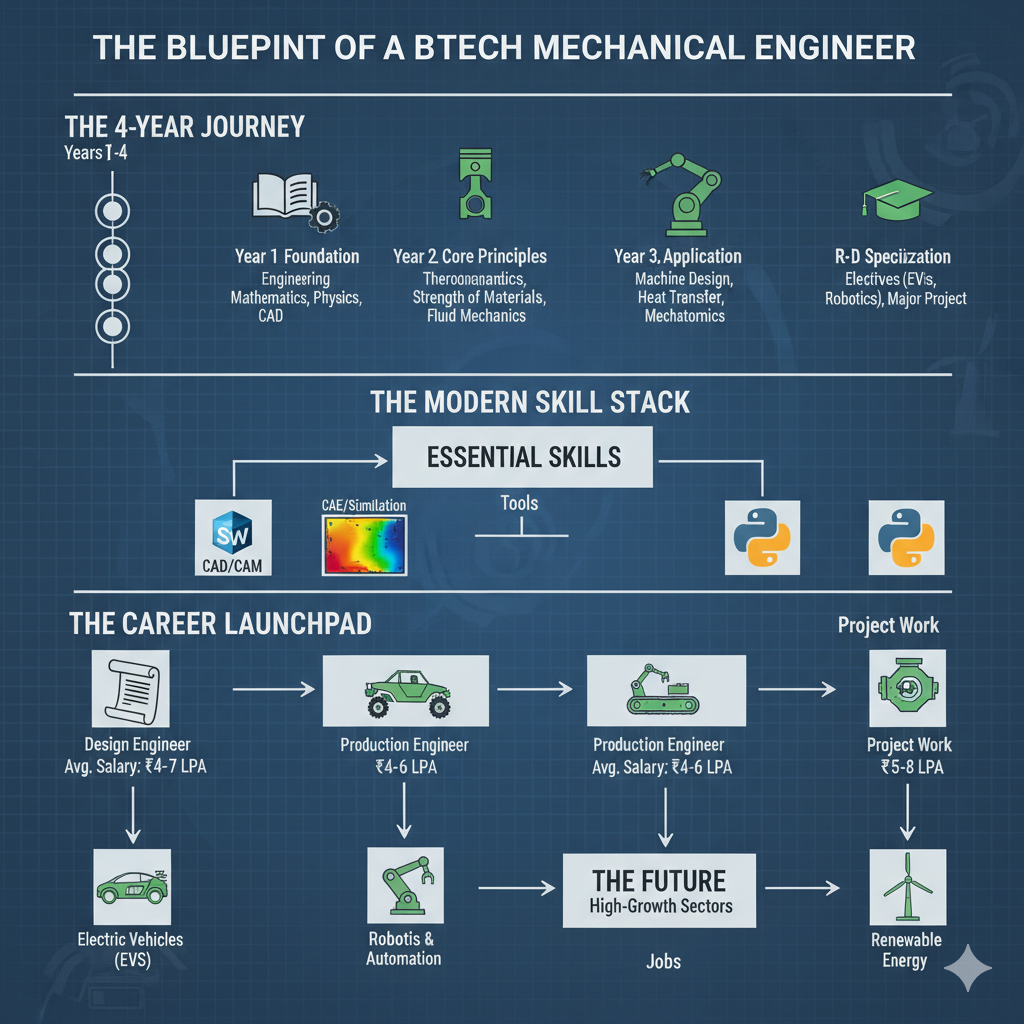
B.Tech Mechanical Engineering Syllabus: Your 4-Year Academic Blueprint
The B.Tech Mechanical Engineering curriculum is designed to build knowledge progressively. It starts with a broad foundation in science and mathematics and then systematically drills down into the core principles of the discipline. The final year is dedicated to specialization, where you apply your accumulated knowledge to advanced topics and a major project.
While the exact subjects may vary slightly between universities (like IITs, NITs, or private institutions), the core structure is standardized.
Year-by-Year Subject & Lab Breakdown
Here is a clear, semester-wise roadmap of what you will study.
| Year | Semester | Key Theory Subjects (Typical) | Key Practical Labs & Workshops |
| First Year (Foundation) | Sem 1 & 2 | • Engineering Mathematics I & II • Engineering Physics • Engineering Chemistry • Basic Electrical/Electronics Engineering • Computer Programming (Python/C++) • Engineering Graphics & Drawing (CAD) |
• Physics Lab • Chemistry Lab • Programming Lab • Engineering Workshop: (Foundry, Welding, Machining) • Basic Electrical Lab |
| Second Year (Core Principles) | Sem 3 & 4 | • Strength of Materials • Engineering Thermodynamics • Fluid Mechanics • Material Science & Metallurgy • Theory of Machines I (Kinematics) • Manufacturing Processes I |
• Strength of Materials Lab • Fluid Mechanics Lab • Material Testing Lab • Machine Drawing Practice • Thermodynamics Lab |
| Third Year (Advanced Application) | Sem 5 & 6 | • Theory of Machines II (Dynamics) • Machine Design I & II • Heat and Mass Transfer • Manufacturing Processes II • IC Engines & Gas Turbines • Control Systems |
• Theory of Machines Lab • Heat Transfer Lab • CAD/CAM Lab • IC Engines Lab • Metrology & Measurement Lab |
| Fourth Year (Specialization) | Sem 7 & 8 | • Operations Research • Refrigeration & Air Conditioning (RAC) • Elective Subjects (See list below) • Engineering Economics & Management • Major Project / Thesis |
• RAC Lab • Dynamics & Vibrations Lab • Major Project (Design, Fabrication, and Testing) • Industrial Internship (Mandatory) |
Understanding the Practical Labs: Where Theory Meets Reality
The labs are the soul of a mechanical engineering degree. This is where you move from equations on a page to tangible, measurable results.
- Workshop Practice: Your first hands-on experience. You will physically use a lathe to shape metal, weld joints, and make sand-casting molds.
- Strength of Materials Lab: You will use a Universal Testing Machine (UTM) to pull steel rods apart, measuring the exact force at which they bend and break (their “yield strength”).
- Fluid Mechanics Lab: You will verify core principles like Bernoulli’s theorem by measuring water flow through different pipe shapes (Venturi meters) and test the efficiency of turbines.
- IC Engines Lab: You will run actual diesel and petrol engines, measure their fuel consumption, emissions, and power output (Brake Horsepower), and analyze their performance.
- CAD/CAM Lab: You will move beyond 2D drawing to create complex 3D models in software like SolidWorks or AutoCAD. You will then connect this to a CAM (Computer-Aided Manufacturing) system, generating code to run a CNC machine that automatically cuts your designed part.
Choosing Your Path: Popular Elective Specializations
In your third and fourth years, you get to shape your career path by choosing elective subjects. These allow you to specialize in a high-demand area.
- Robotics & Mechatronics: This is the most popular modern specialization. It combines mechanical engineering with electronics and computer programming to design, build, and control smart machines and automated systems.
- Automotive Engineering: A classic specialization focusing on vehicle dynamics, chassis design, IC engine performance, and the new frontier of Electric Vehicle (EV) technology, including battery thermal management.
- Thermal Engineering & Energy Systems: For those interested in power generation and sustainability. This stream covers power plant design, renewable energy (solar, wind), and the science of Refrigeration and Air Conditioning (HVAC).
- Advanced Manufacturing & Materials: This stream focuses on the future of making things. You’ll study 3D Printing (Additive Manufacturing), advanced composite materials, and industrial automation (Industry 4.0).
- Aerospace Engineering: A specialized field (often its own degree, but offered as an elective stream) focusing on aerodynamics, fluid dynamics, and propulsion systems for aircraft and spacecraft.
- Biomechanics: A growing field that applies mechanical principles to biological systems, such as designing advanced prosthetic limbs, artificial organs, and new medical diagnostic tools.
Your choice of electives, combined with your final-year major project, will be your strongest selling point when applying for your first job or internship.
Top Colleges for Mechanical Engineering & The Admission Blueprint
Choosing the right college is the single most important decision in your engineering journey. It dictates the quality of education, the peer group you’ll have, the research opportunities available, and, most critically, your career launchpad. The admission process in India is a tiered, exam-based system.
The Admission Gauntlet: How to Get In
First, understand the entrance exams. Your admission is almost entirely dependent on your rank in one of these key tests.
- JEE Main (Joint Entrance Examination Main): This is the gateway to all NITs (National Institutes of Technology), IIITs (Indian Institutes of Information Technology), and other government-funded technical institutions (GFTIs). It also serves as the qualifying exam for JEE Advanced. Most top private universities also accept JEE Main scores.
- JEE Advanced (Joint Entrance Examination Advanced): This is the only exam for admission into the IITs (Indian Institutes of Technology). You must first qualify (clear the cutoff) in JEE Main to be eligible to even sit for this exam. It is widely regarded as one of the most challenging engineering entrance exams globally.
- Private University Exams: Top-tier private institutions conduct their own entrance tests. The most prominent ones are:
- BITSAT: For BITS Pilani, Goa, and Hyderabad campuses.
- VITEEE: For Vellore Institute of Technology (VIT).
- SRMJEEE: For SRM Institute of Science and Technology.
- MET: For Manipal Institute of Technology (MAHE).
The process is straightforward: Prepare -> Give Exam -> Get Rank -> Attend Centralized Counselling (like JoSAA for IITs/NITs) -> Get Seat.
College Collections: The Best in Mechanical Engineering
Here is a breakdown of the best institutions, categorized by their tier, reputation, and approximate fees.
Tier 1: The IITs (Institutes of Eminence)
These are the premier institutions in the country. They offer the best faculty, unparalleled research infrastructure, and the strongest brand value. Admission is exclusively through JEE Advanced.
| Institute | Why It’s a Top Choice for Mechanical | Approx. 4-Year B.Tech Fees (Tuition + Other) |
| IIT Madras | Consistently ranked #1 in India. Exceptional research in thermal engineering, manufacturing, and automotive. Strong industry ties. | ~ ₹8.5 Lakh – ₹10 Lakh |
| IIT Delhi | Renowned for design and production engineering. Excellent labs and a strong start-up culture, benefiting interdisciplinary projects. | ~ ₹8.5 Lakh – ₹10 Lakh |
| IIT Bombay | A powerhouse in robotics, mechatronics, and thermal-fluid sciences. Its location in India’s financial capital offers huge industry exposure. | ~ ₹8.5 Lakh – ₹10 Lakh |
| IIT Kanpur | Known for its rigorous academic curriculum and a strong focus on core fundamentals. Excellent in solid mechanics and fluid dynamics. | ~ ₹8.5 Lakh – ₹10 Lakh |
| IIT Kharagpur | One of the oldest IITs with a vast, established mechanical department. Strong in traditional manufacturing and industrial engineering. | ~ ₹8.5 Lakh – ₹10 Lakh |
| IIT Roorkee | Has a rich history (oldest technical institute) with deep expertise in machine design, welding (material science), and industrial engineering. | ~ ₹8.5 Lakh – ₹10 Lakh |
Note on IIT/NIT Fees: The tuition fee is heavily subsidized for SC/ST/PwD students and partially waived for students from EWS and OBC-NCL categories, based on family income.
Tier 2: The Top NITs (Institutes of National Importance)
NITs are the next-best choice, offering fantastic value for money. They have excellent faculty, strong alumni networks, and great placement records, often rivaling the newer IITs. Admission is through JEE Main.
| Institute | Why It’s a Top Choice for Mechanical | Approx. 4-Year B.Tech Fees (Tuition + Other) |
| NIT Trichy (Tiruchirappalli) | Universally considered the #1 NIT. Its mechanical department is legendary, with superb placements in core and analytics sectors. | ~ ₹6.0 Lakh – ₹7.0 Lakh |
| NIT Surathkal | Known for its beautiful campus and strong academics. The mechanical department has excellent facilities for material science and thermal engineering. | ~ ₹6.0 Lakh – ₹7.0 Lakh |
| NIT Warangal | A top-tier NIT with a great reputation in manufacturing and machine design. Strong core placements and a robust alumni base. | ~ ₹6.0 Lakh – ₹7.0 Lakh |
| NIT Rourkela | Excellent in industrial design and automation. Offers a great blend of core mechanical and modern mechatronics. | ~ ₹6.0 Lakh – ₹7.0 Lakh |
| NIT Calicut | A rapidly rising NIT with a strong focus on research, thermal sciences, and industrial engineering. | ~ ₹6.0 Lakh – ₹7.0 Lakh |
Tier 3: The Best Private Universities (The Premium Choice)
These universities offer state-of-the-art infrastructure, flexible curricula, and modern specializations. They are significantly more expensive but are a fantastic option if you don’t get into a top IIT/NIT. Admission is via their own entrance exams (BITSAT, VITEEE, etc.).
| Institute | Why It’s a Top Choice for Mechanical | Approx. 4-Year B.Tech Fees (Tuition Only) |
| BITS Pilani | Considered equal to the top IITs in terms of student quality, faculty, and “zero-attendance” academic freedom. Very strong in robotics. | ~ ₹20 Lakh – ₹22 Lakh |
| VIT, Vellore | Known for its massive campus, huge student intake, and wide range of specializations. Offers a “Category” based fee system (lower rank = higher fees). | ~ ₹7.0 Lakh – ₹8.0 Lakh (Category 1) |
| Manipal Institute of Technology (MAHE) | Excellent all-around university life with good labs and facilities. Strong in automotive and manufacturing. | ~ ₹10.5 Lakh – ₹17 Lakh (Varies) |
| SRM Institute (Kattankulathur) | Boasts impressive infrastructure and strong international collaborations. Good focus on automotive and mechatronics. | ~ ₹11.0 Lakh |
| Institute | Why It’s a Top Choice for Mechanical | Approx. 4-Year B.Tech Fees (Tuition Only) |
| BITS Pilani | Considered equal to the top IITs in terms of student quality, faculty, and “zero-attendance” academic freedom. Very strong in robotics. | ~ ₹20 Lakh – ₹22 Lakh |
| VIT, Vellore | Known for its massive campus, huge student intake, and wide range of specializations. Offers a “Category” based fee system (lower rank = higher fees). | ~ ₹7.0 Lakh – ₹8.0 Lakh (Category 1) |
| Manipal Institute of Technology (MAHE) | Excellent all-around university life with good labs and facilities. Strong in automotive and manufacturing. | ~ ₹10.5 Lakh – ₹17 Lakh (Varies) |
| SRM Institute (Kattankulathur) | Boasts impressive infrastructure and strong international collaborations. Good focus on automotive and mechatronics. | ~ ₹11.0 Lakh |
Financial Outlook: A Quick Comparison
| College Tier | 4-Year Tuition Fee (Approx. General) | Primary Admission Exam |
| Top IITs | ₹8.5 Lakh – ₹10 Lakh | JEE Advanced |
| Top NITs | ₹6.0 Lakh – ₹7.0 Lakh | JEE Main |
| Top Private (BITS) | ~ ₹21.0 Lakh | BITSAT |
| Top Private (VIT/SRM) | ~ ₹7.0 Lakh – ₹11.0 Lakh | VITEEE / SRMJEEE |
Internships: Your First Step into the Core Industry
For a B.Tech Mechanical student, an internship is not just a resume-builder; it is the single most critical bridge between your academic knowledge and the real-world industry. It’s where you discover what you actually enjoy—be it the roar of an engine test rig, the quiet precision of a 3D model, or the complex logic of a production line.
For a student yet to take admission, it’s crucial to understand how and when to get these opportunities. Internships are typically secured in the 3rd year (after the 5th or 6th semester) for a summer or a 6-month winter role.
There are two primary paths to secure an internship:
- On-Campus (The TPO Route): This is the most common and structured path. Core companies (like the ones listed below) have formal relationships with college Training & Placement Offices (TPOs). They visit the campus (or conduct online drives) to hire interns, usually targeting pre-final year students. Your job is to maintain a good CGPA and be ready for their tests and interviews.
- Off-Campus (The “Go-Getter” Route): This involves applying directly through company career portals, networking on platforms like LinkedIn, or participating in government/PSU-run programs. This requires more effort but gives you access to a wider range of companies.
Key Internship Opportunities & Application Timelines
While exact deadlines for many private companies are not publicly declared (as they depend on campus-specific schedules or are open year-round), a clear pattern emerges. Here is a collection of top internships and their typical application windows.
| Company / Organization | Internship Program / Type | Who Can Apply | Typical Application Window | Stipend (Approx.) |
| Maruti Suzuki | GET STEP Internship | Pre-final year (3rd Year) B.Tech students | March – May: This is often an on-campus drive. Check with your TPO. | ~ ₹25,000 / month |
| Larsen & Toubro (L&T) | Undergraduate Internship | 3rd or 4th-year B.Tech students (Mechanical, Civil, etc.) | Year-round: L&T accepts applications continuously via their career portal. The best time is 4-6 months before your intended start. | Varies (₹15,000 – ₹25,000) |
| Bajaj Auto | Summer Internship (R&D) | Pre-final year B.Tech Mechanical/Electrical students | Jan – March: Primarily an on-campus program at premier institutes (IITs/NITs). | ~ ₹30,000 / month |
| Tata Motors | Engineering Internship | Final year engineering students (for 6-month projects) | Varies (Campus-driven): Your TPO is the best source. Applications often happen in the 6th or 7th semester. | ~ ₹20,000 – ₹30,000 |
| DRDO (e.g., NSTL) | Summer/Project Internship | B.Tech Mechanical students (Pre-final/Final year) | Declared Deadlines: e.g., for an August start, the deadline is often in July. Watch the DRDO website. | ₹5,000 / month |
| ISRO (e.g., MCF) | Internship / Project Work | B.Tech (Completed 6th sem) | Declared Deadlines: Applications are often accepted in August – October or March – April. Check the specific ISRO center’s website. | Unpaid |
| AICTE Internship Portal | Various (Govt. & Private) | All B.Tech students | Year-round: This is a government portal. The key is to register and apply as opportunities are posted. | Varies by company |
A Note for Aspiring Students: Do not be discouraged by the lack of “public deadlines” for companies like Tata Motors or L&T. This is by design. Their main talent pipeline is through campus placements. Your primary task in your first two years will be to build a strong academic record and a good project portfolio to be eligible when these companies arrive at your college
Core vs. IT/Analytics” Debate: A Practical View
This is the most significant career decision you will face. It is a fact that a large percentage of mechanical engineers, even from top IITs, opt for jobs in IT, data analytics, and finance.
- Why they do it: These sectors (like IT consulting at HCLTech or Data Analytics) often offer higher starting salaries (₹6-10 LPA) compared to many core engineering roles.
- The “Core” Side: The starting salary for a mechanical engineer in a core company (e.g., L&T, Tata Motors) is typically lower (₹4.5-8 LPA). However, the work is tangible and builds deep technical expertise. The long-term (10-15 years) growth for a skilled technical manager in the core industry is exceptionally high, often leading to leadership roles (like Plant Head or R&D Director) that are both financially and professionally rewarding.
Your B.Tech degree’s true power is that its intense analytical and mathematical training makes you a prime candidate for both paths. You have the choice.
Salary Outlook: What Does a Fresher Mechanical Engineer Earn?
Your starting salary is not one single number; it depends entirely on the college tier and the sector you enter.
| Company / Sector Type | Average Starting Salary (per annum) | Who Hires Here |
| Top-Tier Core Companies (Hiring from IITs/NITs/BITS) | ₹7 LPA – ₹12 LPA | Tata Motors (R&D), L&T, Bajaj Auto, Maruti Suzuki, General Electric, Bosch |
| Public Sector Units (PSUs) (Requires GATE exam) | ₹10 LPA – ₹18 LPA (Includes all perks) | ONGC, NTPC, IOCL, GAIL, BHEL, DRDO, ISRO |
| Standard Core Companies (Hiring from Tier 2/3 colleges) | ₹3.5 LPA – ₹6 LPA | Manufacturing plants, local automotive suppliers, construction firms. |
| IT & Tech Services (Hiring for engineering services) | ₹4 LPA – ₹7 LPA | HCLTech (Engineering Services), TCS, Infosys, Wipro |
| Analytics & Consulting (Hiring for analyst roles) | ₹6 LPA – ₹12 LPA | Consulting firms, banks, data science startups (they hire for analytical skills). |
Top Core Recruiters (On-Campus)
These are the “dream companies” for mechanical engineers that hire consistently from good engineering colleges:
- Automotive:
- Tata Motors
- Mahindra & Mahindra
- Maruti Suzuki India
- Bajaj Auto
- Hero MotoCorp
- Ashok Leyland
- Manufacturing & Engineering, Procurement, Construction (EPC):
- Larsen & Toubro (L&T) – The single largest recruiter of core engineers.
- Tata Steel
- Siemens
- Bosch India
- General Electric (GE)
- Public Sector (PSUs) – via GATE:
- NTPC (National Thermal Power Corporation)
- ONGC (Oil and Natural Gas Corporation)
- IOCL (Indian Oil Corporation Ltd.)
- BHEL (Bharat Heavy Electricals Limited)
- DRDO (Defence Research and Development Organisation)
- ISRO (Indian Space Research Organisation)
Part 6: The Future of Mechanical Engineering: Why It’s Not What You Think
The most common misconception about mechanical engineering is that it’s a “declining” field of engines and factories. This is factually incorrect. The field isn’t dying; it is evolving. A modern B.Tech in Mechanical Engineering is the new backbone for the most exciting, high-growth industries of the 21st century.
The fundamental principles you learn—thermodynamics, fluid mechanics, and material science—are now being applied to problems that didn’t exist a decade ago. Here is the industry outlook.
1. The Electric Vehicle (EV) Revolution
The shift from internal combustion engines (ICE) to electric vehicles is the biggest disruption in the automotive world, and mechanical engineers are at the center of it.
- Battery Thermal Management: The single most important factor in an EV’s performance, range, and safety is its battery. This is a pure thermodynamics and heat transfer problem. Mechanical engineers design the complex cooling and heating systems (using liquid or air) to keep the battery pack at its optimal temperature.
- Structural & Lightweight Design: To maximize range, EVs must be as light as possible. Mechanical engineers use advanced materials (composites, aluminum alloys) and advanced simulation (Finite Element Analysis) to design chassis and bodies that are both extremely light and safe in a crash.
- Powertrain Integration: The electric motor, gearbox, and differential still need to be designed, integrated, and optimized for vibration and efficiency. This is a classic machine design and dynamics challenge.
2. Robotics & Mechatronics (Industry 4.0)
The “Fourth Industrial Revolution,” or Industry 4.0, is the complete automation of manufacturing using smart, interconnected systems. This is the domain of Mechatronics, which is the direct fusion of mechanical engineering with electronics and computer control.
- Automation: As a mechanical engineer, you will design the robotic arms (kinematics), the gripper mechanisms (actuators), and the conveyor systems (dynamics) that form the automated assembly line.
- “Cobots”: You will work with “collaborative robots” (cobots) that work safely alongside humans, requiring advanced knowledge of sensor technology and mechanical design.
- Smart Systems: Your curriculum’s focus on Control Systems is the key. You’ll be the one who understands both the physical machine and the software logic (PLCs) that controls its motion, making you invaluable in any “smart factory.”
3. Additive Manufacturing (3D Printing)
This is a complete paradigm shift in manufacturing. Instead of subtracting material (like in machining), you are adding it layer-by-layer. This is a core mechanical process.
- Rapid Prototyping: Instead of spending weeks to machine a prototype, you can now 3D print a complex part (like an engine manifold or a custom prosthetic) in hours to test its design and fluid flow.
- Complex Design: 3D printing allows for the creation of “impossible” shapes, such as internal cooling channels or lightweight lattice structures, that are a mechanical designer’s dream.
- Future Roles: Companies in aerospace (like Boeing and Airbus) and the medical field (for custom implants) are hiring mechanical engineers to be Additive Manufacturing Specialists, focusing on material properties and process optimization for these advanced machines.
4. Renewable Energy & Sustainability
The global push for decarbonization is a massive opportunity for mechanical engineers.
- Wind Energy: Designing a wind turbine blade is one of the most complex challenges in engineering. It requires a mastery of aerodynamics (fluid mechanics), material science (composites), and structural analysis (solid mechanics).
- Solar Energy: While the panels are photovoltaic, the power plants are mechanical. Engineers design the automated tracking systems that follow the sun and, in concentrated solar power (CSP), design the fluid-based systems (using molten salt) to store and transfer the sun’s heat to drive a turbine.
- Energy Storage: Beyond batteries, mechanical engineers are designing “sand batteries” (thermal storage) and kinetic energy storage systems (flywheels) to solve the problem of energy intermittency.
Your B.Tech in Mechanical Engineering is not just a degree; it’s a foundational science toolkit that makes you eligible to build the next generation of technology, from EVs and robots to sustainable power plants.
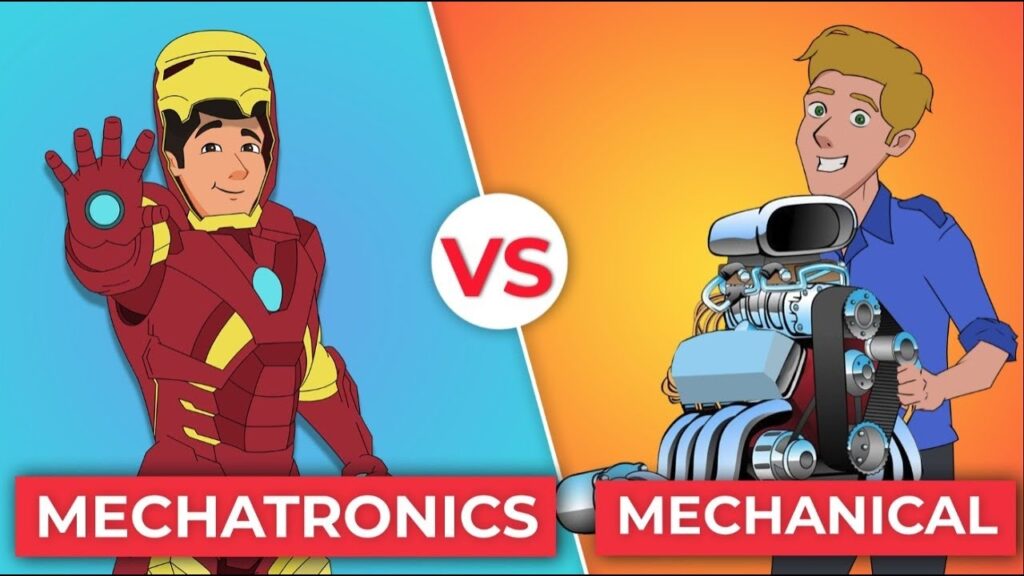
B.Tech vs. B.E. in Mechanical Engineering: Does It Really Matter?
As you begin your research, you will immediately encounter two different degree titles: B.Tech (Bachelor of Technology) and B.E. (Bachelor of Engineering). This is a common point of confusion for aspiring students.
Here is a direct, no-nonsense breakdown of the difference and, more importantly, why you shouldn’t worry about it.
The Historical & Theoretical Difference
Historically, the distinction between these two degrees was based on their academic focus:
- B.E. (Bachelor of Engineering): This degree was traditionally more theoretical and knowledge-based. The curriculum was designed to build a strong foundation in the “science” of engineering—the fundamental principles, theories, and derivations. The focus was on why things work.
- B.Tech (Bachelor of Technology): This degree was designed to be more practical and application-oriented. The curriculum focused on the “technology” and skills required for the industry. The focus was on how to make things work, with a greater emphasis on lab work, workshops, and practical application.
The Modern Reality in India: They Are (Almost) Identical
Today, in the Indian context, this distinction is almost entirely irrelevant. The All India Council for Technical Education (AICTE), which governs technical education, does not differentiate between the two.
Here’s a comparative breakdown of the reality:
| Aspect | B.E. (Bachelor of Engineering) | B.Tech (Bachelor of Technology) |
| Full Form | Bachelor of Engineering | Bachelor of Technology |
| Core Focus (Traditional) | Theory-oriented. Strong on fundamental science and principles. | Application-oriented. Strong on practical skills and technology. |
| Core Focus (Modern Reality) | Both degrees have a mandatory mix of deep theory, advanced labs, workshops, and final-year projects. The curriculum is 99% similar. | |
| Internships | Both programs require mandatory industrial internships, usually in the 3rd or 4th year. | |
| Admission Process | Admission is through the same entrance exams (JEE Main, JEE Advanced, BITSAT, etc.). | |
| Offered By | Tends to be offered by Universities that also have non-engineering faculties (like Arts & Science). Ex: Jadavpur University, many State Universities. | Tends to be offered by Institutes of Technology and technical universities. Ex: All IITs and NITs. |
| Industry Value & Recognition | Completely Equal. Employers do not have a preference for one over the other. | |
| Job Opportunities | Identical. A B.E. graduate and a B.Tech graduate can apply for and get the same job roles (Design, Manufacturing, R&D). | |
| Higher Education (GATE/MS) | Identical. Both degrees make you equally eligible for M.Tech/M.S. programs in India and abroad. |
The Final Verdict: What Should You Focus On?
Do not waste time and energy deciding between “B.E. Mechanical” and “B.Tech Mechanical.” The title of the degree makes no difference to your career.
What actually matters is the reputation and tier of the institution you graduate from.
- A B.E. in Mechanical Engineering from a top institution like Jadavpur University or BITS Pilani is infinitely more valuable than a B.Tech from a lesser-known private college.
- A B.Tech from any NIT or IIT is the gold standard, and its value comes from the institute’s brand and academic rigor, not the “Tech” in its name.
Your decision-making process should be:
- Perform your best in the entrance exams (JEE Main/Advanced, BITSAT, etc.).
- Based on your rank, select the best possible college you can get into.
- Accept whichever degree (B.E. or B.Tech) that college offers for its mechanical program.
Part 8: Beyond B.Tech: Essential Skills & Higher Education Paths
Your four-year B.Tech degree provides the core engineering foundation, but to truly excel and future-proof your career, you must build a portfolio of modern skills. A B.Tech is also the perfect launchpad for advanced degrees that open doors to specialized R&D, high-level management, or a career in research.
The Modern Mechanical Engineer’s Skill Stack
Your college curriculum teaches you the “why.” These skills teach you the “how” and make you immediately valuable to an employer.
- Design & Simulation (CAD/CAE) Software: This is non-negotiable. You are expected to know these as a bare minimum.
- CAD (Computer-Aided Design): Software to create 3D models.
- SolidWorks: The most common in general manufacturing and machine design.
- AutoCAD: Essential for 2D layouts (plant design, component drawings).
- CATIA / Siemens NX: The industry standard in high-end automotive and aerospace sectors.
- CAE (Computer-Aided Engineering): Software to simulate and test your designs digitally.
- ANSYS / HyperMesh: Used for Finite Element Analysis (FEA) to test structural strength, vibration, and thermal stress.
- MATLAB: A powerful tool for mathematical modeling, control system design, and data analysis.
- CAD (Computer-Aided Design): Software to create 3D models.
- Programming & Data Analysis: This is what separates a good engineer from a great one.
- Python: The most valuable programming language for a mechanical engineer today. It is used for automating repetitive design tasks, analyzing lab data, and is the backbone of machine learning and AI.
- C++: Essential if you plan to work in Mechatronics, Robotics, or embedded systems, as it’s used to program microcontrollers.
- SQL: Knowing how to query databases is a surprisingly valuable skill, especially in large-scale manufacturing (Industry 4.0) where you need to analyze production and quality data.
Your Next Move: Higher Education Pathways
After your B.Tech, you have three primary pathways for career acceleration.
| Pathway | Degree | Focus | How to Get In |
| 1. Technical Specialization | M.Tech (Master of Technology) | Deep technical specialization in one field (e.g., Robotics, Thermal, Design). Prepares you for core R&D roles. | GATE (Graduate Aptitude Test in Engineering): A high GATE score is required for admission into IITs, NITs, and IISc. |
| 2. Global Research | M.S. (Master of Science) | A research-focused degree from a foreign university (primarily USA/Europe). Ideal for a global R&D career or a Ph.D. | GRE (Graduate Record Examinations): Required for most US and many European universities. |
| 3. Management & Leadership | MBA (Master of Business Admin.) | Shifts your career from pure engineering to management. Leads to roles in Operations, Supply Chain, Finance, or Consulting. | CAT (Common Admission Test): Required for IIMs and most top Indian B-schools. |
The GATE Exam: Your Key to the Best Core Jobs
For a mechanical engineer, the GATE (Graduate Aptitude Test in Engineering) is arguably the most important competitive exam after your B.Tech. It serves two critical functions:
- M.Tech Admission: It is the only gateway to a Master’s program at the IITs, IISc Bangalore, and NITs. An M.Tech from a top IIT in a specialized field (like Mechatronics or EV technology) makes you one of of the most sought-after engineers in the country.
- PSU Recruitment: This is a direct path to a high-paying, stable government job. Public Sector Undertakings (PSUs) like ONGC, IOCL, NTPC, GAIL, and DRDO do not visit campuses for B.Tech placements. They hire exclusively through GATE scores. A good rank can land you a job with a starting package (including all benefits) of ₹10 LPA to ₹18 LPA.
Is an MBA a Good Idea?
Yes, but for a different reason. An MBA is not a “better” M.Tech; it’s a career pivot. A mechanical engineer with an MBA is the ideal candidate for a role like:
- Operations Manager: Running a complex manufacturing plant.
- Supply Chain Manager: Managing the global logistics of a company like Tata Motors.
- Product Manager: Deciding the features and strategy for a new technical product.
- Management Consultant: Using your analytical engineering mind to solve business problems for other companies.
The combination of a technical B.Tech and a management MBA is one of the most powerful and financially rewarding career paths available.
Best CAD Software for Mechanical Engineers https://www.youtube.com/watch?v=e5w2boS2T18
Beyond the Curriculum: A 4-Year Strategy to Maximize Your B.Tech
Attending a B.Tech program is not a passive activity. Simply passing your exams will not land you a top job. The students who get the best placements—whether in a core company, a PSU, or an IT giant—are those who build a strategic profile over their four years.
This is your year-by-year, actionable plan for success.
| Year of Study | Academic Focus (The “Must-Do”) | Strategic Action (The “Game-Changer”) |
| Year 1: The Foundation | Master the Fundamentals: Do not neglect Engineering Mathematics, Physics, and Engineering Mechanics. They are the foundation for everything that follows. | Join a Technical Club: This is the single most important action of your first year. Join your college’s chapter of SAE (Society of Automotive Engineers), the Robotics Club, or an Aeromodelling Club. |
| Year 2: The Skill Stack | Dominate the Core: This is when you meet Thermodynamics, Fluid Mechanics, and Strength of Materials. Your core technical interviews will come from these subjects. | Build a Project & Learn CAD: Your club will likely start building its vehicle/robot. This is your first real project. Start learning SolidWorks or AutoCAD on your own. This makes you instantly hirable for an internship. |
| Year 3: The Proving Ground | Excel in Electives: Choose your specialization (Mechatronics, Automotive, Thermal) and build deep knowledge in it. | Secure a Core Internship: This is your primary goal. Use your college TPO, apply off-campus, and leverage your club/project experience. Your 3rd-year summer internship is your audition for a PPO (Pre-Placement Offer). |
| Year 4: The Launchpad | The Major Project: This is the capstone of your degree. Do not copy a project. Build something that solves a real problem. This will be the main topic of discussion in your final interviews. | Choose Your Path: Your 7th semester is “placement season.” You must decide: 1. Placements: Prepare for Aptitude Tests, Technical Interviews, and HR rounds. 2. Higher Studies: Dedicate all your time to GATE, CAT, or GRE preparation. |
The Power of Student Competitions: BAJA & Formula Bharat
If you are serious about a career in the automotive or manufacturing sector, participating in competitions like SAE BAJA or Formula Bharat is the closest you can get to real-world engineering.
- What they are: These are inter-university design competitions where teams of students design, fabricate, and race their own vehicles (an all-terrain buggy for BAJA, a formula-style race car for Formula Bharat).
- Why they matter: You are not just a student; you are a design engineer, a production manager, and a finance team all in one. You learn:
- Practical Design: Applying theory to build a real-world, functional vehicle.
- Manufacturing: Hands-on experience with welding, machining (lathe, mill), and composites.
- Teamwork & Management: Working with 50+ team members to meet a critical deadline.
- The Placement Advantage: Recruiters from Tata Motors, Mahindra, Maruti, and Bosch specifically target students from these teams. The BAJA HR Meet is an exclusive career event where companies interview participants, knowing they already have the practical skills they need.
Understanding the Final Placement Process
Your B.Tech culminates in the campus placement drive, which typically has three main hurdles:
- Online Assessment / Aptitude Test: The first filter. Companies test your quantitative aptitude, logical reasoning, and verbal ability. This is to check your general problem-solving skills.
- The Technical Interview: This is where they test your engineering knowledge. You will be asked questions directly from your core subjects (like “Explain the 2nd Law of Thermodynamics”) and, most importantly, about your internship and your final year project. They want to see what you did and why you did it.
- The HR Interview: The final round. This is a behavioral interview to see if you are a good fit for the company. They will ask questions like, “Tell me about a time you faced a conflict in your team” or “Where do you see yourself in 5 years?”
Your goal across all four years is to build the experiences, projects, and skills that give you compelling, factual answers for these three rounds.
Part 10: Myths vs. Reality & Final FAQs
As you consider this B.Tech, you will hear many opinions—some outdated, some misleading. It is critical to separate fact from fiction.
Myths vs. Reality: Debunking Common Misconceptions
| Myth | Reality (The Facts) |
| Myth 1: Mechanical Engineering is a “Boys’ Club.” | This is an outdated stereotype. While the field is historically male-dominated, this is changing fast. Companies are actively seeking to hire diverse teams, and women in mechanical engineering are leading R&D, design, and management. Your skill, not your gender, determines your success. |
| Myth 2: The only job is in a greasy, loud factory. | False. This is a 1980s view. A modern mechanical engineer is just as likely to be in an air-conditioned office designing a product on CAD, in a clean-room lab developing medical devices, or writing Python scripts to analyze simulation data. |
| Myth 3: Salaries are low and can’t compete with IT. | Partially false. While starting salaries in IT can be higher, the core sector offers immense long-term growth. A skilled technical manager, R&D head, or PSU Chief Engineer (after 15-20 years) has an earning potential that often surpasses their IT counterparts. Furthermore, a B.Tech in Mechanical is a top choice for high-paying analytics and consulting jobs. |
| Myth 4: It’s all about cars and engines. | False. The automotive sector is just one of many. Mechanical engineers are essential in: • Aerospace: Designing satellites and aircraft. • Energy: Building wind turbines and solar plants. • Biomechanics: Creating prosthetic limbs and surgical robots. • Robotics: Designing automated systems for all industries. |
| Myth 5: It’s “harder” and requires you to be a math genius. | It’s challenging, but so is every other branch of engineering. It requires a good grasp of physics and math, but it’s more about logical problem-solving than genius-level calculus. If you are curious about how physical things work, you have the right mindset. |
Frequently Asked Questions (FAQs) for Aspiring Students
- Is B.Tech Mechanical Engineering a good choice in the age of AI? Yes, it’s one of the best. AI and mechanical engineering are not competitors; they are partners. AI needs physical systems (like robots, drones, and self-driving cars) to interact with the world. Mechanical engineers design and build those physical systems. The future is in Mechatronics—the integration of mechanical, electrical, and AI-driven control systems.
- What is the day-to-day life of a B.Tech Mechanical student? It’s a balance of theory and practice. A typical day involves:
- Lectures: Learning the theory of subjects like Thermodynamics or Machine Design.
- Labs: Going to a practical lab (like the IC Engines lab or CAD lab) to apply that theory.
- Workshop/Projects: Spending time with your team (e.g., the BAJA team) to design, fabricate, or test your vehicle/project.
- Self-Study: Solving complex problem sets and preparing for quizzes. It is a demanding but rewarding schedule.
- Should I choose Mechanical Engineering or Computer Science? This is the most common question. The answer depends on your core interest:
- Choose Computer Science if your passion is purely digital—writing code, developing apps, building algorithms, and working with data and AI in a virtual space.
- Choose Mechanical Engineering if your passion is in the physical world—if you want to build the tangible hardware that code runs on. If you want to design a rocket, a new car, or a robotic arm, this is the field for you.
Final Verdict: Who Should Study B.Tech Mechanical Engineering?
This degree is not for everyone. It is for the curious, the practical, and the problem-solvers.
You should choose B.Tech Mechanical Engineering if:
- You have a strong curiosity about how physical objects work.
- You enjoy physics and mathematics as tools to explain the real world.
- You want a versatile degree that does not lock you into one single industry.
- You want to design and build tangible things that people use every day.
The B.Tech Mechanical Engineering degree is a passport to a vast, evolving, and fundamentally essential field. It is the discipline that builds the world around us, and it is actively shaping our future.