BTech Salary in India 2026: Branch-Wise Freshers Package, Top Recruiters & Growth Trends
How much do engineers really earn in 2026? With India’s tech economy booming and core industries reviving, BTech graduates remain among the most sought-after professionals in the job market. From AI engineers at top IT firms to mechanical designers in manufacturing giants, salaries for engineering graduates now vary widely — depending on branch, college tier, skills, and market demand.
In 2026, the average BTech fresher salary in India ranges between ₹4–12 LPA, but top-tier institutions like IITs, NITs, and BITS Pilani see packages crossing ₹20–40 LPA through campus placements. Meanwhile, traditional branches like Civil, Mechanical, and Electrical continue to offer stable growth with PSU and infrastructure openings.
This article breaks down the branch-wise salary trends, highlights the CSE vs core branch gap, lists top recruiters for 2026, and maps out long-term growth opportunities for engineering graduates. Whether you’re choosing a branch or preparing for placement season, this guide gives you a complete look at engineering graduate pay in India 2026 — and what to expect in the years ahead.
Average BTech Salary in India 2026 (Overall Overview)
In 2026, engineering graduate pay in India continues to rise — powered by tech expansion, startup hiring, and renewed core industry growth. However, salaries vary sharply depending on your college tier, specialisation, and placement channel (campus vs off-campus).
On average, BTech freshers earn between ₹4–12 LPA, but this range widens across different institution types:
| College Type | Average Fresher Salary (2026) | Top 10% Range | Placement Highlights |
| IITs & Top NITs | ₹12–18 LPA | ₹25–50 LPA | Premium tech & consulting roles (Google, Amazon, McKinsey) |
| Other NITs, IIITs, BITS, Deemed Univ. | ₹6–10 LPA | ₹15–25 LPA | IT services, product, and R&D roles |
| Tier-2/Private Colleges | ₹3–6 LPA | ₹8–12 LPA | Mix of IT, manufacturing & startup opportunities |
| State Govt. & Core Colleges | ₹3–5 LPA | ₹6–10 LPA | Public sector and industrial placements |
Branch-Wise BTech Salary in India
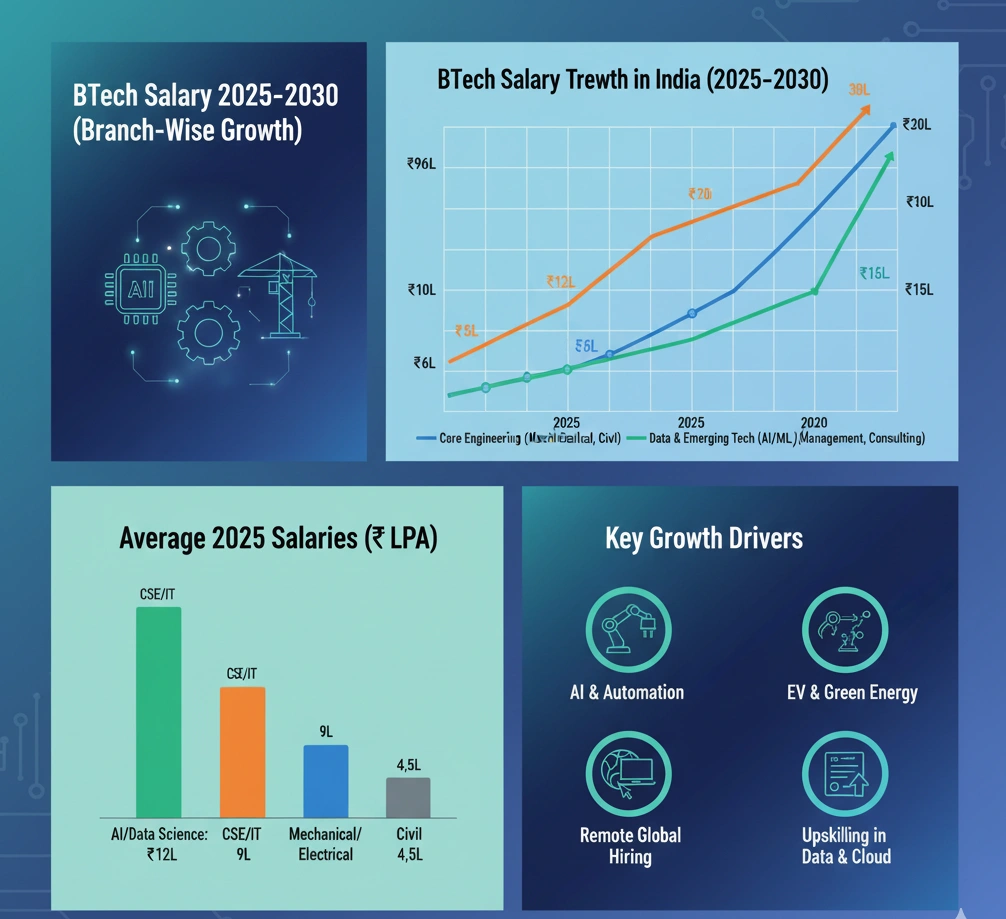
In 2026, salary trends for BTech graduates clearly show a divide between technology-driven and core engineering streams. While Computer Science, AI-ML, and Data Science lead the charts with record-breaking packages, Mechanical, Civil, and Electrical remain reliable for long-term career stability and PSU opportunities.
Let’s look at how each major branch performs in terms of fresher salary, recruiters, and growth scope:
| BTech Branch (2026) | Average Fresher Salary (₹ LPA) | Top Recruiters | Growth Outlook (Next 5 Years) |
| Computer Science Engineering (CSE) | 10–15 | Google, Amazon, TCS, Infosys, Microsoft | Very High – AI, software, data jobs booming |
| Artificial Intelligence & Machine Learning (AI-ML) | 12–18 | NVIDIA, IBM, Oracle, Zoho | Very High – Core to automation & analytics |
| Electronics & Communication (ECE) | 7–12 | Qualcomm, Intel, Samsung, Texas Instruments | High – 5G, IoT, chip design in demand |
| Information Technology (IT) | 6–10 | Accenture, Wipro, HCL, Tech Mahindra | High – Software & service-based hiring steady |
| Electrical Engineering (EE) | 5–8 | Siemens, NTPC, Tata Power, ABB | Moderate – Stable with renewable energy growth |
| Mechanical Engineering (ME) | 4–7 | Tata Motors, L&T, Mahindra, BHEL | Moderate – Consistent demand in manufacturing |
| Civil Engineering | 4–6 | L&T, GMR, NBCC, PWD, PSUs | Stable – Infra & smart city projects ongoing |
| Chemical Engineering | 5–8 | Reliance, IOCL, HPCL, Dr. Reddy’s | Steady – Strong PSU & chemical sector hiring |
| Biotechnology / Biomedical | 5–7 | Biocon, Serum Institute, GE Healthcare | Growing – Post-COVID healthcare boom |
| Data Science | 10–16 | Accenture, Deloitte, PwC, Capgemini | Very High – Data-centric roles expanding fast |
| Mechatronics / Robotics | 7–12 | Bosch, ABB, Tesla India, Tata Elxsi | Rising – EVs, automation, robotics industry surge |
| Aerospace Engineering | 6–9 | ISRO, HAL, Boeing, DRDO | Moderate – Govt & private aerospace growth |
CSE vs Core Branches: Salary & Scope Difference
The 2026 placement season has made one thing clear: Computer Science and related tech fields are far ahead in average salary. While core branches continue to anchor India’s industrial backbone with steady, long-term opportunities.
Let’s decode the real difference between CSE and core engineering branches in terms of pay, job roles, and growth.
People Also Read

1. Salary Comparison: The Growing Pay Gap
In 2026, CSE graduates earn nearly 2x more than most core branch freshers. The boom in AI, data analytics, and cloud computing has pushed tech firms to offer aggressive packages even to Tier-2 college students.
| Category | Average Fresher Salary (₹ LPA) | Top Companies Hiring |
| CSE / IT / AI / DS | 10–15 | Google, Amazon, Microsoft, TCS, Infosys, Deloitte |
| ECE / EE (Semi-Core) | 6–10 | Qualcomm, Intel, Bosch, Samsung, L&T Tech Services |
| Mechanical / Civil / Chemical (Core) | 4–7 | L&T, Tata Steel, ONGC, IOCL, BHEL, PSUs |
However, core engineers often see better job security and career longevity — with promotions and skill-based increments over time, particularly in PSUs and government roles.
2. Skill and Role Differences
- CSE graduates work in fast-moving domains: coding, AI development, product design, and software systems. Their roles evolve rapidly with new technologies.
- Core branch engineers handle tangible systems: machines, energy plants, roads, structures — offering deep technical learning and specialization.
- In 2026, many core engineers are pivoting into tech-adjacent roles like IoT, robotics, data-driven design, and industrial automation, merging both worlds.
3. Career Growth & Industry Outlook
| Parameter | CSE & Allied Branches | Core Engineering Branches |
| Early Career Pay | High (₹10–15 LPA average) | Moderate (₹4–7 LPA average) |
| Learning Curve | Fast-paced, evolving tech stack | Deep, domain-specific expertise |
| Job Stability | Depends on skill updates | High in PSUs & infra sectors |
| Future Growth (2025–2030) | Exponential (AI, Cloud, Cybersecurity) | Moderate but steady (Energy, Infra, Manufacturing) |
| Top Recruiters | Tech giants & startups | PSUs, manufacturing, R&D firms |
4. The Convergence: Where the Lines Blur
The boundary between “tech” and “core” is fading fast. Modern industries now need software-driven mechanical systems, smart grids, and data-based construction planning.
A mechanical engineer with Python or MATLAB, or an electrical engineer skilled in IoT, can now command salaries close to a CSE graduate.
In 2026, the winners are not from one branch, they’re engineers who combine domain knowledge with digital skills.
Takeaway
CSE may offer the fastest salary growth, but core engineering offers the strongest foundation. The best strategy? Pick a branch that excites you, and add tech skills on top — because the future belongs to cross-disciplinary engineers.
Top Recruiters for BTech Graduates in 2026
In 2026, India’s engineering placement ecosystem has become more dynamic than ever. It’s driven by tech transformation, startup hiring, and infrastructure expansion. While IT and product companies dominate the salary charts, core sector giants. And public enterprises continue to provide stable opportunities for graduates across disciplines.
Let’s explore the major recruiters by category, their average packages, and hiring domains.
1. Tech & Product Companies (High Packages)
These are the dream destinations for CSE, IT, AI-ML, ECE, and Data Science students. They offer some of the highest fresher salaries in India and provide exposure to advanced technologies.
| Company | Average Fresher Salary (₹ LPA) | Hiring Roles |
| Google, Microsoft, Amazon | 25–45 | Software Engineer, AI Developer, Data Analyst |
| Adobe, Atlassian, ZS Associates | 15–25 | Product Engineer, Data Scientist, Consultant |
| Infosys, TCS, Wipro, Accenture | 6–10 | Systems Engineer, Cloud Analyst, DevOps |
| Deloitte, PwC, Capgemini | 8–12 | Analyst, Cybersecurity, Business Tech Consultant |
2026 Trend: Product-based roles and AI–data–cloud engineers are the top hiring categories.
2. Core Engineering & Manufacturing Companies
Mechanical, Civil, Electrical, and Chemical engineers continue to find strong placements in the industrial and energy sectors. PSUs and major conglomerates offer steady pay growth and long-term career stability.
| Company | Average Fresher Salary (₹ LPA) | Hiring Roles |
| L&T, Tata Steel, Mahindra | 5–8 | Design Engineer, Production Engineer |
| Siemens, ABB, Bosch | 6–10 | Electrical Systems, Automation, Maintenance |
| ONGC, IOCL, HPCL, BHEL | 6–12 | PSU Engineer, Project Manager |
| Adani, GMR, Reliance Infra | 5–9 | Construction, Energy Management |
2026 Trend: EV manufacturing, green energy, and automation are creating new openings for core engineers.
3. New-Age Startups & Emerging Tech Firms
Startups in fintech, EV, robotics, and data analytics are hiring aggressively in 2026, offering flexible roles with fast-paced growth potential.
| Company / Sector | Average Fresher Salary (₹ LPA) | Popular Roles |
| Ola Electric, Zepto, Swiggy, Zomato | 7–12 | Operations Analyst, Product Engineer |
| Razorpay, PhonePe, Groww | 10–15 | Software Developer, Data Engineer |
| Tata Elxsi, GreyOrange Robotics | 8–14 | AI Robotics Engineer, IoT Engineer |
| Byju’s, UpGrad, Unacademy | 6–10 | EdTech Developer, Data Analyst |
2026 Trend: Startups reward multi-skilled graduates — those blending coding with analytics, or hardware with AI.
4. PSU & Government Recruiters
PSUs remain the dream employers for core branch engineers due to job stability, perks, and steady promotions.
| Organization | Average Fresher Salary (₹ LPA) | Recruitment Mode |
| ONGC, IOCL, NTPC, GAIL | 6–12 | GATE-based recruitment |
| ISRO, DRDO, BARC | 8–15 | Written + interview selection |
| SAIL, BHEL, HPCL | 6–10 | PSU exams or GATE scores |
2026 Trend: Government projects in green energy, space, and infrastructure are opening new roles for engineers.
Salary Trends & Growth Factors (2025–2030 Outlook)
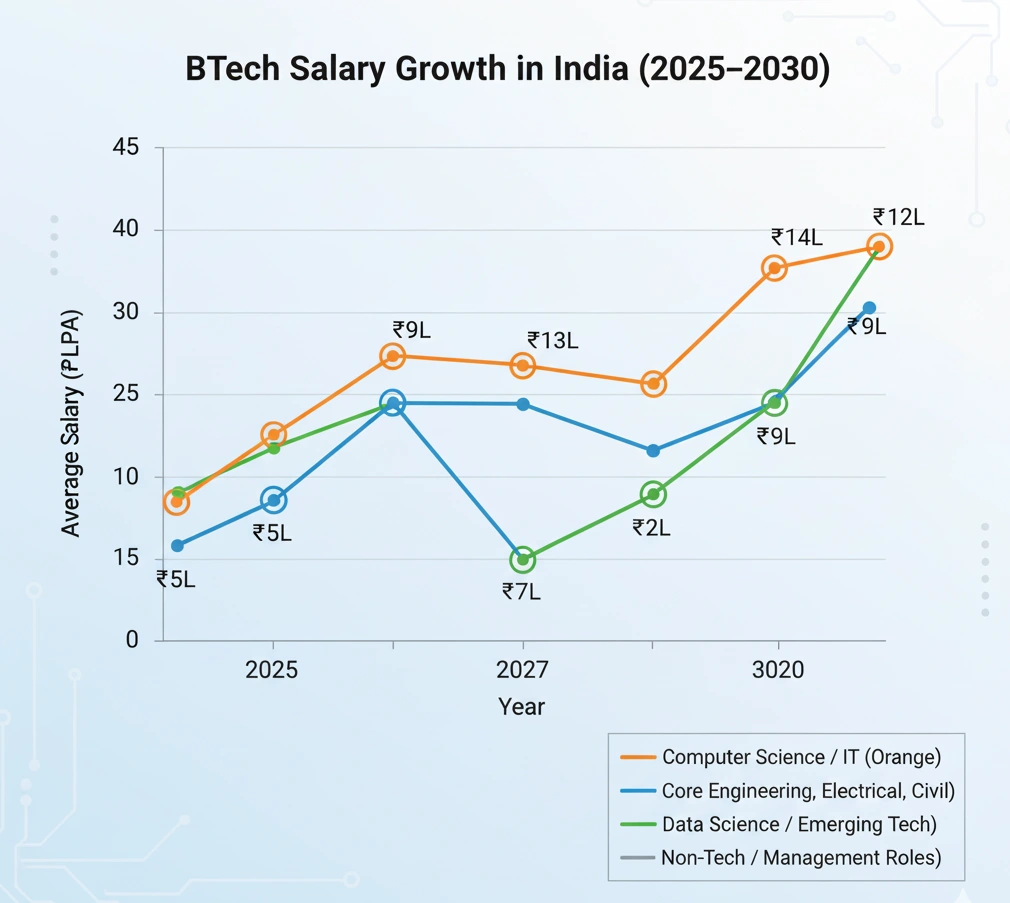
The engineering salary landscape in India is evolving faster than ever. With AI, automation, and sustainability reshaping industries, the gap between traditional and digital branches is widening — but every specialisation is finding its own growth curve.
From 2025 to 2030, experts predict a 15–25% annual salary growth for engineers who keep upskilling in data, cloud, or design-driven roles. Let’s break down the trends shaping the next decade.
1. CSE & IT: Soaring in the AI-Driven Economy
Computer Science and IT graduates will remain the top earners through 2030, with roles in AI/ML, cloud, cybersecurity, and blockchain seeing the steepest hikes.
| Year | Average Entry-Level Salary (₹ LPA) | Mid-Level (5–7 Yrs) |
| 2025 | 8–10 | 20–25 |
| 2027 | 10–13 | 25–30 |
| 2030 | 12–15 | 30–40 |
Key Drivers: Generative AI adoption, global SaaS expansion, and high-value startup hiring.
2. Core Engineering: Stable Growth with New Frontiers
Mechanical, Electrical, and Civil engineers will see steady but moderate salary growth, especially with new opportunities in EVs, green tech, and robotics.
| Year | Average Entry-Level Salary (₹ LPA) | Mid-Level (5–7 Yrs) |
| 2025 | 4.5–6 | 10–14 |
| 2027 | 6–8 | 12–16 |
| 2030 | 8–10 | 15–20 |
Key Drivers: Infrastructure modernization, renewable energy, and Make-in-India manufacturing expansion.
3. Data & Emerging Tech Roles: The Fastest Climbers
Fields like Data Science, AI/ML, IoT, and Cloud Computing will continue to dominate high-paying segments across industries.
| Year | Average Entry-Level Salary (₹ LPA) | Mid-Level (5–7 Yrs) |
| 2025 | 10–14 | 25–30 |
| 2027 | 12–16 | 30–35 |
| 2030 | 15–20 | 35–45 |
Key Drivers: Demand for automation, predictive analytics, and AI-powered business intelligence.
4. Non-Tech Roles for Engineers: Expanding Horizons
A growing share of engineers are entering consulting, product management, finance, and data-driven business roles. These roles blend technical knowledge with management insight, often yielding faster salary jumps.
| Year | Average Entry-Level Salary (₹ LPA) | Mid-Level (5–7 Yrs) |
| 2025 | 6–8 | 15–20 |
| 2027 | 8–10 | 18–25 |
| 2030 | 10–13 | 25–30 |
Key Drivers: Rise of analytics consulting, digital finance, and MBA+Tech hybrid career paths.
5. Global Hiring Outlook
Indian BTech graduates are increasingly being recruited for remote international roles, especially in the US, EU, and Singapore.
Average Global Entry Salary (2025–2030 Projection):
- Tech roles: USD 70,000–120,000
- Core engineering roles: USD 50,000–90,000
Trend Insight: By 2030, over 30% of Indian engineers may work in cross-border hybrid roles, collaborating remotely with global firms.
Key Takeaway
Between 2025 and 2030, the engineering pay landscape in India will be defined by adaptability and innovation. The engineers who combine strong technical skills with continuous learning in AI, automation, or design thinking will see the steepest salary growth trajectories.
FAQs
1. What is the average BTech salary in India for freshers in 2026?
The average BTech fresher salary in India (2026) ranges from ₹4 LPA to ₹10 LPA, depending on the branch and college tier. Graduates from top institutes like IITs and NITs can earn ₹12–20 LPA, especially in software and AI-related roles.
2. Which BTech branch gives the highest salary in India?
In 2026, Computer Science Engineering (CSE) and Artificial Intelligence & Data Science offer the highest average starting packages — typically ₹8–14 LPA. Emerging fields like Cybersecurity, Cloud Computing, and Robotics are also seeing rapid salary growth.
3. How do core branches like Mechanical and Civil compare in salary?
Core branches such as Mechanical, Electrical, and Civil Engineering generally start with ₹4–6 LPA packages. However, with experience or specialisation in areas like EV design, renewable energy, or project management, salaries can rise significantly to ₹10–15 LPA or more within 5 years.
4. Do private college graduates earn less than IIT or NIT students?
Initially, yes — graduates from top institutes tend to secure higher packages due to better campus placements and brand value. However, after 2–3 years of experience, salary differences narrow as skills, certifications, and performance become the primary growth drivers.
5. What factors affect an engineer’s salary growth in India?
Major factors include:
- Specialisation or domain (CSE vs. Core Engineering)
- College ranking and placement network
- Technical skills and certifications (AI, Cloud, ML, etc.)
- Industry demand and project exposure
- Geographic location (metro vs. Tier-2 cities)
6. What is the future salary trend for engineers in India by 2030?
By 2030, BTech graduates in high-demand tech roles (AI, ML, Cloud, and Data) are expected to earn ₹30–40 LPA at mid-level positions, while core engineering roles could reach ₹15–20 LPA, driven by growth in green tech, EV manufacturing, and smart infrastructure.