CA Syllabus: Course Structure & Subjects for All Levels
The CA syllabus is governed by the Institute of Chartered Accountants of India (ICAI) and is structured into three progressive levels: Foundation (4 papers), Intermediate (6 papers across 2 groups), and Final (6 papers across 2 groups plus 4 self-paced online modules), alongside mandatory 2-year practical training (articleship).
Total course expenditure ranges between ₹80,000 and ₹1,00,000 including registration and mandatory training fees. Prospective candidates will find a complete breakdown below covering level-wise subjects, paper structures, exam patterns, practical training rules, recommended reference books, and step-by-step admission procedures for 2026.
| Parameter | Details |
|---|---|
| Regulating Body | Institute of Chartered Accountants of India (ICAI) |
| Course Levels | 3 Levels: Foundation, Intermediate, Final |
| Total Exam Papers | 16 Papers (4 Foundation + 6 Intermediate + 6 Final) |
| Practical Training (Articleship) | 2 Years mandatory training |
| Total Course Duration | 4.5 to 5 years (Foundation route) / 3 to 3.5 years (Direct Entry route) |
| Overall Course Fee Range | ₹80,000 to ₹1,00,000 |
| Passing Criteria | 40% in each paper and 50% aggregate in each group |
Chartered Accountant (CA) Subjects Year-wise
| Paper Number | Paper Name | Total Marks | Question Type & Format |
|---|---|---|---|
| Paper 1 | Accounting | 100 Marks | – |
| Paper 2 | Business Laws | 100 Marks | – |
| Paper 3 | Quantitative Aptitude (Business Math: 40, LR: 20, Stats: 40) | 100 Marks | Objective (MCQ with 25% negative marking) |
| Paper 4 | Business Economics | 100 Marks | Objective (MCQ with 25% negative marking) |
CA Foundation is the entry-level examination comprising 4 papers worth 100 marks each. The Foundation exams are conducted thrice a year in May, September, and January.
| Group | Paper Number | Subject Name | Marks Breakdown |
|---|---|---|---|
| Group 1 | Paper 1 | Advanced Accounting | 100 Marks |
| Group 1 | Paper 2 | Corporate Laws | 100 Marks |
| Group 1 | Paper 3 | Cost and Management Accounting | 100 Marks |
| Group 2 | Paper 4 | Taxation (Income Tax & Indirect Tax/GST) | 100 Marks |
| Group 2 | Paper 5 | Auditing and Code of Ethics | 100 Marks |
| Group 2 | Paper 6 | Paper 6A: Financial Management & Paper 6B: Strategic Management | 100 Marks (50 + 50) |
CA Intermediate requires a mandatory study period of 8 months after clearing Foundation or entering directly. The curriculum consists of 6 papers divided into Group 1 and Group 2, with exams conducted twice a year.
| Group | Paper Number | Subject Name | Marks Allocation |
|---|---|---|---|
| Group 1 | Paper 1 | Financial Reporting | 100 Marks |
| Group 1 | Paper 2 | Advanced Financial Management | 100 Marks |
| Group 1 | Paper 3 | Advanced Auditing, Assurance & Professional Ethics | 100 Marks |
| Group 2 | Paper 4 | Direct Tax Laws & International Taxation | 100 Marks |
| Group 2 | Paper 5 | Indirect Tax Laws (GST & Customs/FTP) | 100 Marks |
| Group 2 | Paper 6 | Integrated Business Solutions (Multidisciplinary Case Study) | 100 Marks |
CA Final comprises 6 papers divided into Group 1 and Group 2, alongside 4 self-paced online modules. Candidates must qualify these self-paced modules before becoming eligible for the CA Final examination.
Chartered Accountant (CA) Practicals and Projects
Practical exposure is a core component of the ICAI curriculum. Candidates are required to undertake a mandatory 2-year full-time practical training period (Articleship) post-clearing both groups of CA Intermediate. This training provides direct workplace learning in auditing, direct taxation, GST compliance, financial reporting, and corporate advisory services under a practicing CA firm or registered corporate organization.
In addition to Articleship, candidates must undergo compulsory orientation and computer modules run by ICAI. The Integrated Course on Information Technology and Soft Skills (ICITSS) must be completed before commencing practical training. During Articleship, candidates complete the Advanced ICITSS (AICITSS) and pass the self-paced online modules (SETS) to earn full eligibility for the CA Final examination.
| Training Course | Mandatory Timing | Key Contents / Coverage | Prerequisite For |
|---|---|---|---|
| ICITSS | Before starting Articleship | Information Technology & Soft Skills orientation | Commencement of Practical Training |
| Articleship | Post clearing both Inter Groups | 2 Years full-time practical training in firm/industry | CA Final Exam Eligibility |
| AICITSS | During Practical Training | Advanced IT & Soft Skills training | CA Final Exam Appearance |
| Self-Paced Online Modules (SETS) | After Intermediate clearance | Online evaluation in Economic Laws, Strategic Cost Mgmt, etc. | CA Final Exam Appearance |
CA Exam Assessment Pattern and Passing Rules
- Question Pattern: CA Intermediate exam question pattern consists of 30% case-study based MCQs and 70% descriptive questions in all papers.
- Individual Passing Marks: Candidates must secure at least 40% in each individual paper.
- Group Aggregate: Candidates must achieve a 50% aggregate score across the group to pass.
- Paper Exemption: Scoring 60% or more in any paper grants an exemption for that paper for the immediate next 3 exam attempts.
Objective MCQs in CA Foundation Paper 3 and Paper 4 carry 25% negative marking for wrong answers.
How to Apply for Chartered Accountant (CA) Admission in 2026: Step by Step
- Check Eligibility: Ensure Class 12 completion for Foundation route, or Graduation (55% Commerce / 60% Non-Commerce) for Direct Entry route.
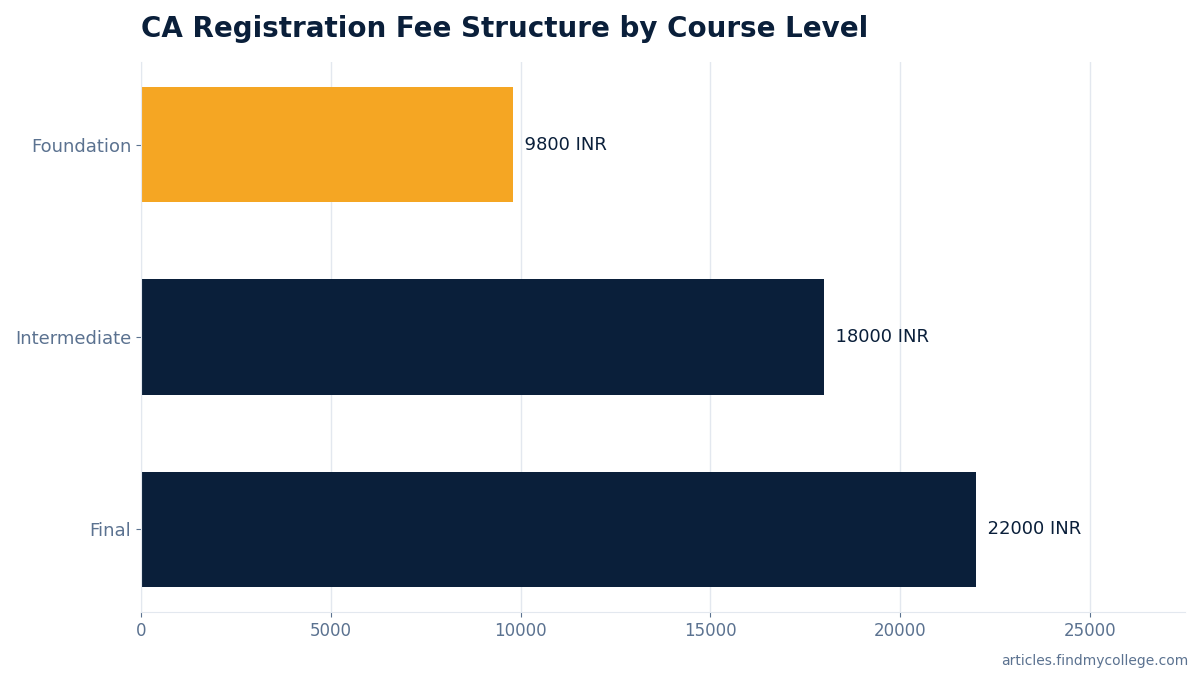
- Register for CA Foundation: Enroll with ICAI Board of Studies after Class 10/12 and pay the ₹9,800 registration fee at least 4 months prior to exams.
- Appear for CA Foundation Examination: Clear all 4 Foundation papers with a minimum of 40% in each paper and 50% aggregate.
- Register for CA Intermediate & Complete ICITSS Training: Pay ₹18,000 registration fee, fulfill 8-month study period, and undergo ICITSS soft skills & IT training.
- Pass CA Intermediate & Begin 2-Year Practical Training (Articleship): Pass both groups of CA Intermediate and register for mandatory 2-year articleship in a firm or industry.
- Complete Self-Paced Modules (SETS) & AICITSS Training: Qualify four self-paced online modules and undergo AICITSS training during practical training.
- Register for and Clear CA Final Examination: Pay ₹22,000 registration fee and clear both Group 1 and Group 2 of CA Final to qualify as a Chartered Accountant.
| What to do | Where | Link |
|---|---|---|
| Compare colleges, fees and cutoffs | Chartered Accountant (CA) colleges in India | findmycollege.com |
Completing all mandatory exam levels and practical training modules through ICAI allows candidates to successfully qualify as Chartered Accountants.
FAQs
What is the syllabus of CA exams?
The CA syllabus spans 3 levels: Foundation (4 papers in accounting, law, math, economics), Intermediate (6 papers across 2 groups in advanced accounting, tax, law, audit, FM & SM), and Final (6 papers across 2 groups plus 4 self-paced online modules).
How many subjects are in CA chartered accountant?
There are 16 core exam papers in total: 4 in CA Foundation, 6 in CA Intermediate (2 groups), and 6 in CA Final (2 groups), plus 4 self-paced online evaluation modules.
What are the fees for CA courses in India?
Registration fees are ₹9,800 for Foundation, ₹18,000 for Intermediate, and ₹22,000 for Final. Total expenditure including training ranges from ₹80,000 to ₹1,00,000.
Which book is best for CA?
Key recommended books include Tulsian & Taxmann for Foundation Accounting, Girish Ahuja & Ravi Gupta for Direct/Indirect Taxes, and B Saravana Prasath for CA Final Cost Management.
Is CA Intermediate easy or hard?
CA Intermediate is considered moderately tough as it requires mastering 6 core technical subjects with a 30% MCQ and 70% descriptive assessment format, requiring 8 months of mandatory study.
Can I crack CA in 1 year?
No, you cannot complete the entire CA course in 1 year. The full course takes 4.5 to 5 years via the Foundation route and 3 to 3.5 years via Direct Entry due to mandatory study periods and 2 years of practical training.