CUET UG 2026 May 26 LIVE: Shift 1 & 2 Subject-Wise Analysis (Soon) & Memory-Based Questions
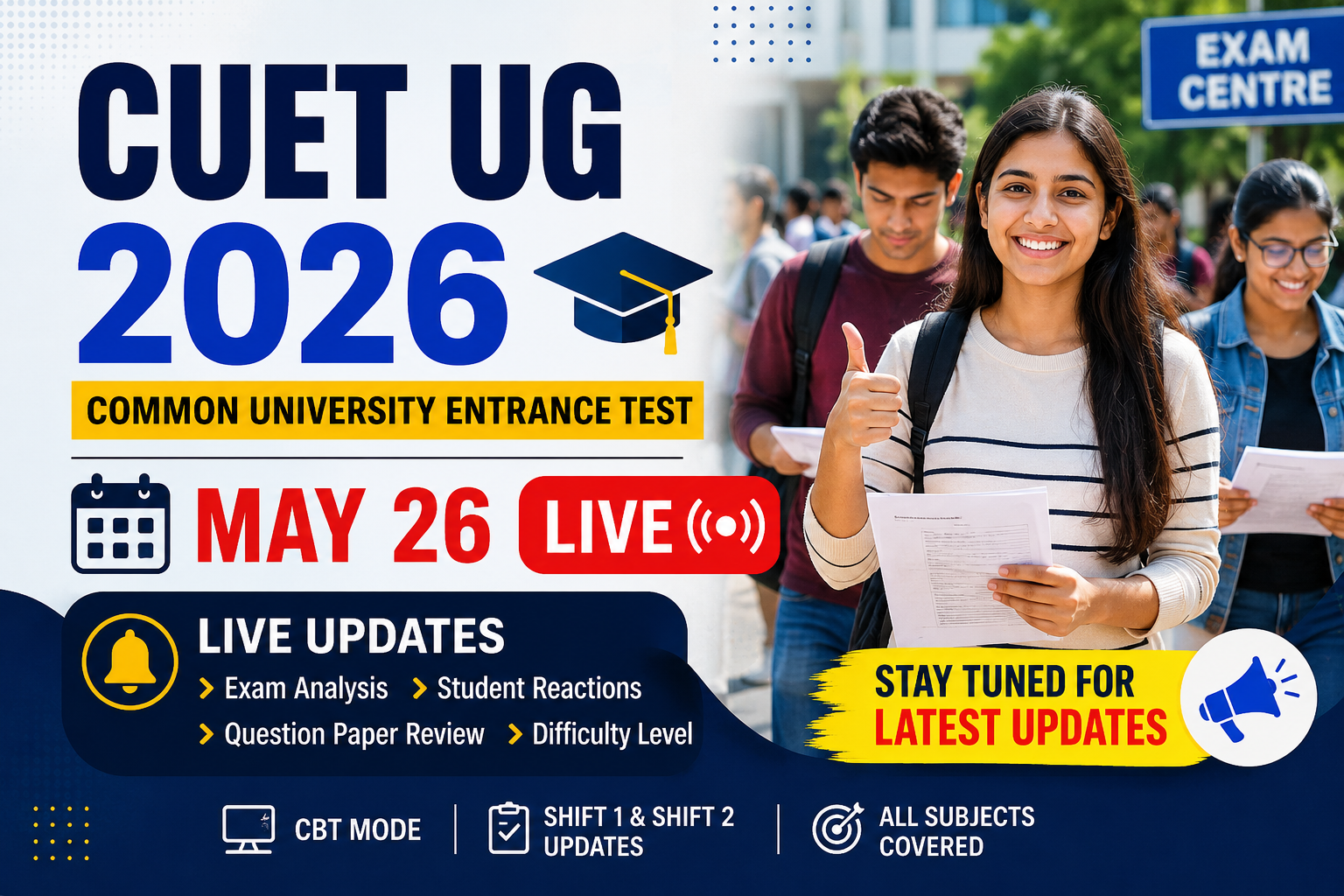
The Common University Entrance Test Undergraduate or CUET UG 2026 continued on May 26 with thousands of students appearing for Shift 1 and Shift 2 examinations across the country. The National Testing Agency (NTA) conducted the examination in Computer-Based Test mode at various centres in India. Candidates appeared for multiple domain subjects, language papers, and the General Test as part of the university admission process for central universities and other participating institutions.
Students who appeared in today’s exam are now waiting for the detailed subject-wise analysis, difficulty level review, and memory-based questions shared by experts and coaching institutes. Initial reactions from candidates suggest that most papers were moderate in difficulty, although some sections were lengthy and time-consuming.
The CUET UG 2026 examination is one of the biggest undergraduate entrance tests in India. Scores obtained in the examination will be used for admission to undergraduate courses in universities such as the University of Delhi, Banaras Hindu University, Jawaharlal Nehru University, Aligarh Muslim University, and many other institutions.
CUET UG 2026 May 26 Shift Timings
The examination on May 26 was conducted in two shifts.
Shift 1: Morning Session
Shift 2: Afternoon Session
Candidates were advised to reach the examination centres well before reporting time to complete biometric verification and document checking procedures.
The examination included questions from:
- Language papers
- Domain subjects
- General Test
Students were required to attempt multiple-choice questions within the prescribed duration.
CUET UG 2026 Shift 1 Analysis
As per the first reactions received from candidates and subject experts, Shift 1 papers were mostly balanced. Several students said that the overall paper pattern was similar to previous CUET exams. Questions were mainly based on NCERT concepts, especially in science and commerce subjects.
English Language Analysis
Students who appeared for the English paper shared that the section was moderate in difficulty. Reading comprehension passages were manageable, but some vocabulary questions were slightly tricky.
Important topics included:
- Reading comprehension
- Synonyms and antonyms
- Para jumbles
- Vocabulary
- Grammar usage
- Sentence correction
Experts noted that candidates with strong reading habits could complete the section comfortably within time.
General Test Analysis
The General Test was considered moderate to difficult by many students. Quantitative aptitude questions were calculative, while logical reasoning required careful reading.
Major topics asked:
- Number series
- Percentage
- Profit and loss
- Blood relations
- Coding-decoding
- Current affairs
- Static GK
Students said the current affairs section included questions related to recent national and international events.
Physics Analysis
The Physics paper was reported to be moderate but lengthy. Numerical questions took more time compared to theory-based questions.
Important chapters included:
- Electrostatics
- Current electricity
- Magnetism
- Modern physics
- Semiconductor electronics
Some students said assertion-reason type questions were also included.
Chemistry Analysis
The Chemistry paper was considered easier than Physics by many candidates. Organic chemistry had direct NCERT-based questions, while physical chemistry involved formulas and calculations.
Topics asked included:
- Chemical bonding
- Coordination compounds
- Organic reactions
- Electrochemistry
- Biomolecules
Experts suggested that students who revised NCERT thoroughly would perform well in this section.
Mathematics Analysis
The Mathematics paper was moderate to difficult. Students found the calculus section slightly challenging.
Important topics included:
- Matrices
- Determinants
- Probability
- Integration
- Differentiation
- Vector algebra
Several candidates stated that time management was important due to lengthy calculations.
CUET UG 2026 Shift 2 Analysis
The second shift examination also witnessed a large turnout of students. Initial reactions suggest that Shift 2 was similar in pattern to Shift 1.
Biology Analysis
The Biology paper was largely NCERT-based. Most students described the paper as easy to moderate.
Topics covered included:
- Genetics
- Human physiology
- Ecology
- Reproduction
- Biotechnology
Direct theoretical questions dominated the paper.
Economics Analysis
Students found the Economics paper moderate in difficulty. Both microeconomics and macroeconomics sections carried conceptual questions.
Key topics asked:
- National income
- Market equilibrium
- Money and banking
- Consumer behaviour
- Government budget
Some questions were application-based and required careful interpretation.
Business Studies Analysis
The Business Studies paper was considered easy by many students. Most questions were direct and theory-oriented.
Important topics included:
- Principles of management
- Marketing management
- Financial management
- Staffing
- Business environment
Students who revised NCERT textbooks thoroughly were able to answer most questions confidently.
Accountancy Analysis
The Accountancy paper included a mix of theory and numerical questions. Some students said the calculations were lengthy but manageable.
Topics included:
- Partnership accounts
- Cash flow statement
- Company accounts
- Ratio analysis
Experts stated that conceptual clarity was important to avoid mistakes.
History Analysis
The History paper was moderate. Questions were mostly factual and NCERT-oriented.
Topics asked included:
- Harappan civilisation
- Mughal Empire
- National movement
- Colonialism
- Post-independence India
Students found map-based questions easy.
Memory-Based Questions Shared by Students
Coaching institutes and students have started sharing memory-based questions from the May 26 examination. These questions help future shift candidates understand the exam pattern and expected difficulty level.
Some memory-based questions reported by students include:
English
- Identify the synonym of “resilient.”
- Rearrange the sentence sequence correctly.
- Answer comprehension questions based on a passage about climate change.
General Test
- Simplify percentage-based numerical problems.
- Identify the next term in the number series.
- Current affairs question related to international summits.
Physics
- Question based on Ohm’s law.
- Numerical from electrostatics.
- Semiconductor diode application question.
Chemistry
- Question from coordination compounds.
- Organic chemistry reaction mechanism.
- Electrochemistry formula-based problem.
Mathematics
- Integration-based problem.
- Matrix determinant question.
- Probability application question.
Biology
- Genetics inheritance question.
- Human digestive system concept.
- Biotechnology application-based question.
Economics
- National income calculation.
- Demand elasticity question.
- Government budget-related MCQ.
Students’ Reactions After the Exam
Many candidates who appeared for the exam shared mixed reactions outside examination centres. While some students found the papers easier than expected, others said time pressure was a major challenge.
A student from Delhi said the English paper was straightforward, but the General Test consumed more time due to lengthy reasoning questions.
Another candidate appearing for the science subjects mentioned that Chemistry was easier than Physics and Mathematics.
Commerce students also reported that Accountancy required careful calculations, while Business Studies was relatively simple.
Several students appreciated the smooth conduct of the examination at centres.
Expected Difficulty Level
Based on initial reactions and expert reviews, the overall difficulty level of the CUET UG 2026 May 26 exam can be considered:
| Subject | Difficulty Level |
|---|---|
| English | Moderate |
| General Test | Moderate to Difficult |
| Physics | Moderate |
| Chemistry | Easy to Moderate |
| Mathematics | Moderate to Difficult |
| Biology | Easy to Moderate |
| Economics | Moderate |
| Business Studies | Easy |
| Accountancy | Moderate |
| History | Moderate |
The final analysis may vary after detailed feedback from more students and experts.
CUET UG 2026 Marking Scheme
The CUET UG examination follows a standard marking pattern.
- Correct answer: +5 marks
- Incorrect answer: -1 mark
- Unattempted question: 0 marks
Candidates are advised to calculate tentative scores carefully using memory-based answer keys once they become available.
What Happens After the CUET UG 2026 Exam?
After completion of all examination shifts, the NTA is expected to release:
- Provisional answer key
- Response sheet
- Question papers
- Objection window
Candidates will be allowed to challenge the provisional answer key by paying the required fee per question. After reviewing objections, the agency will publish the final answer key and result.
The CUET UG 2026 scorecard will be used by participating universities for counselling and admission processes.
CUET UG 2026 Result Date Expected Soon
Although the official result date has not yet been announced, students can expect the CUET UG 2026 results a few weeks after the completion of examinations. Candidates are advised to regularly check the official website for the latest updates regarding answer keys, objections, and results.
The scorecard will mention:
- Candidate’s name
- Subject-wise marks
- Percentile score
- Overall performance
Universities will later release separate cut-off lists and counselling schedules.
Important Advice for Upcoming Shift Candidates
Students appearing in upcoming CUET UG 2026 shifts should focus on:
- Revising NCERT textbooks
- Practising mock tests
- Improving time management
- Revising formulas and important facts
- Reading current affairs daily
Experts also advise candidates to remain calm during the examination and avoid spending too much time on difficult questions.
The CUET UG 2026 examination remains highly competitive due to the large number of applicants seeking admission to top universities. A balanced preparation strategy and smart time management can significantly improve performance.

📰 More Education News
- VITEEE 2026 Phase II Advance Fee Payment Window Closes Tomorrow; Check Important DetailsMay 26, 2026 • Simran
- Plus 2 Result 2026 Kerala Announced: 77.97% Overall Pass Percentage Recorded; Girls Outshone Boys with 86.81% ScoresMay 26, 2026 • Simran
- MET Result 2026 for Phase 2 Released at manipal.edu; Check Steps to Know ScoresMay 26, 2026 • Simran
- JEECUP 2026 Admit Card (Tomorrow) Live: UP Polytechnic Hall Ticket Download Link, Steps, DetailsMay 26, 2026 • Simran