Diploma in Journalism: Eligibility, Colleges, Fees & Salary in India
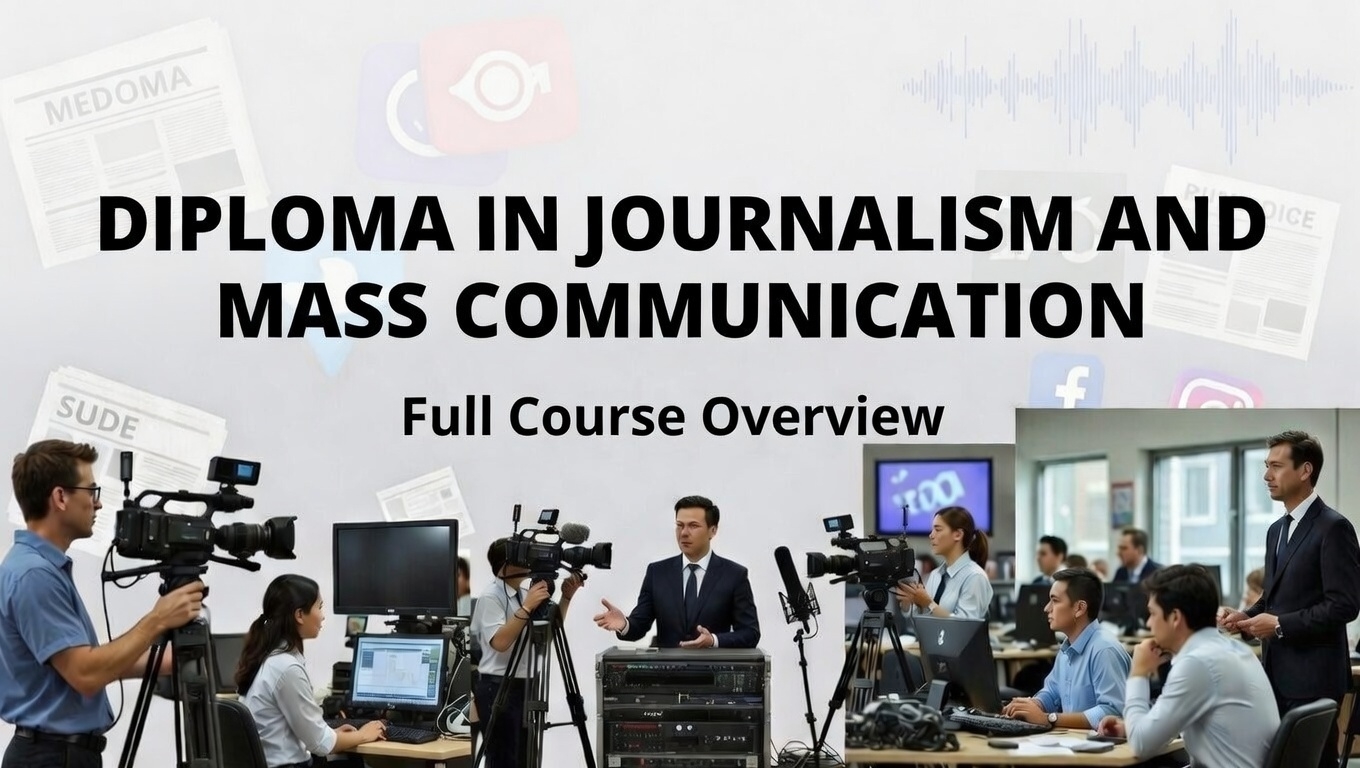
India’s dynamic media and entertainment industry is projected for substantial growth in 2026, driven significantly by digital platforms, multimedia storytelling, and the rise of OTT content. A Diploma in Journalism and Mass Communication offers a practical, career-focused pathway for students to acquire skills and enter this expanding sector rapidly. This one-year program typically provides foundational knowledge in media, communication, and digital practices. The Diploma in Journalism and Mass Communication is a specialized course designed to equip students with core competencies required for various roles in the media industry. IT focuses on practical training in areas like news gathering, reporting, editing, and content creation across different media formats. For the 2026 academic session, this Diploma an accessible entry point for both recent high school graduates and career changers. Choosing a Diploma in Journalism and Mass Communication course in 2026 offers several strategic advantages, particularly given the evolving media . The program’s concise duration and industry-relevant curriculum make IT an attractive option for students seeking quick entry into the workforce. The table below outlines key reasons to consider this Diploma for the upcoming academic year.
| Key Benefit | Details for 2026 |
|---|---|
| Rapid Industry Growth | India’s media industry is projected for fast growth in 2026, fueled by digital platforms, multimedia storytelling, podcasts, OTT platforms, and social media reporting. |
| Demand for Digital & Multimedia Skills | The market shows rising demand for professionals in online reporting, fact-checking, podcasting, video content creation, and digital journalism roles. |
| Practical Skill Development | Diploma programs focus on foundational and practical skills such as writing, reporting, editing, production, broadcast news, layout, and digital photography. |
| Quick Career Entry | Typically a shorter duration (1 year) compared to undergraduate or postgraduate degrees, offering a faster pathway into the media industry. |
| Diverse Employment Avenues | Graduates can find opportunities across print, television, radio production, advertising, public relations, event management, social media, and film studies. |
| Strong Foundational Knowledge | The curriculum provides components of journalism, media, communication, and digital media, including journalistic principles and methodologies. |
| Accessibility for Career Changers | Many Diploma programs, including the Diploma in Journalism, accept graduates from any stream, enabling individuals from non-media backgrounds (e.g., mechanical engineering) to transition into the field. |
| Focus on Current Trends | Courses are often updated to include modules on growing media trends, social media, digital marketing, and the objective of brands in communication. |
The Diploma’s emphasis on practical skills and its alignment with current industry trends ensures graduates are well-prepared for immediate employment in a dynamic media environment. This makes IT a strategic choice for those aiming to enter the media sector by 2027.
Types of Journalism & Mass Communication Diplomas: PG vs UG & Specializations
🔔 Admission Alerts 2026
- Application Open: JNU MA Journalism Mass Communication Distance Education 2026-27.
- Deadline Nearing: JNU MAJMC Distance Learning applications close February 5, 2026.
- Apply Now: JMI Entrance Exam for PG Diploma Courses 2026.
- Internship Alert: Hawaii SPJ Summer Journalism Internship applications due April 13, 2026.
As of 2026, there are numerous types of Journalism and Mass Communication diplomas available in India, catering to different educational backgrounds and career aspirations. The Indian Institute of Mass Communication (IIMC) offers a Post Graduate Diploma in Journalism (English) with 68 seats, while the Symbiosis Centre for Distance Learning (SCDL) provides a PG Diploma in Journalism and Mass Communication with a duration of 1 year. The eligibility criteria for these courses vary, with some requiring a bachelor’s degree and others accepting 10+2 qualifications.
| Type of Diploma | Duration | Key Focus Areas | Typical Eligibility |
|---|---|---|---|
| PG Diploma in Journalism (English) | 1 Year | Journalism, Mass Communication | Graduation |
| PG Diploma in Journalism and Mass Communication | 1 Year | Media Law, Ethics, Reporting, Editing | Bachelor’s Degree |
| Diploma in Journalism and Mass Communication | 1 Year | Radio and Television Journalism, Reporting, Editing | 10+2 |
| Post Graduate Diploma in Broadcast Journalism and Mass Communication | 1 Year | Broadcast Journalism, Mass Communication | Graduation |
| Post Graduate Diploma in Mass Communication | 1 Year | Mass Communication, Journalism | Bachelor’s Degree |
| Bachelor of Journalism and Mass Communication (BJMC) | 3 Years | Journalism, Mass Communication | 10+2 |
| Master of Journalism and Mass Communication (MJMC) | 2 Years | Journalism, Mass Communication | Graduation |
| Ph.D. In Journalism and Mass Communication | 3-5 Years | Journalism, Mass Communication | Master’s Degree |
| PG Diploma in Journalism and Mass Communication (PGDJMC) | 1 Year | Journalism, Mass Communication | Graduation |
| Diploma in Mass Communication, Advertising and Journalism | 1 Year | Mass Communication, Advertising, Journalism | 10+2 |
| Post Graduate Diploma in Journalism (Hindi) | 1 Year | Journalism, Mass Communication | Graduation |
| MA in Media Business Studies | 2 Years | Media Business, Journalism | Graduation |
| MA in Strategic Communication | 2 Years | Strategic Communication, Journalism | Graduation |
| MA in New Media Communications | 2 Years | New Media, Journalism | Graduation |
| MA in Health Communication | 2 Years | Health Communication, Journalism | Graduation |
| MA in Media and Communication Governance | 2 Years | Media Governance, Journalism | Graduation |
| MA in Corporate Communication and Brand Management | 2 Years | Corporate Communication, Brand Management | Graduation |
Program Durations in Journalism & Mass Communication
The table above the various types of Journalism and Mass Communication diplomas available in India, along with their duration, key focus areas, and typical eligibility criteria. Students can choose from a range of courses, including PG diplomas, bachelor’s degrees, master’s degrees, and Ph.D. Programs, depending on their educational background and career goals.
For more information on Journalism and Mass Communication courses, you can visit the Diploma in Journalism Course Details page or explore the MA Journalism and Mass Communication Course Overview to learn more about the curriculum, fees, and career prospects.
Diploma in Journalism & Mass Communication: Key Statistics & Trends for 2026
As of 2026, the Indian media industry is growing rapidly due to digital platforms, multimedia storytelling, podcasts, OTT platforms, and social media reporting. The average fee for a Diploma in Journalism and Mass Communication course in India ranges from ₹12,000 to ₹4.75 lakhs for the full course, depending on the institution. For instance, the one-year total fee of IIJNM Bangalore PG Diploma programme is around ₹3.75 Lacs to ₹4.75 Lacs for the full course, including tuition, confirmation fee, and housing/meal charges for Indian and foreign students.
| College | Course | Fee | Eligibility | Entrance Exam |
|---|---|---|---|---|
| Indian Institute of Mass Communication | PG Diploma Programmes | ₹3.75 Lacs to ₹4.75 Lacs | General Category candidates should be born on 1.8.2001 or later (maximum 25 years as on August 1, 2026) | IIMC entrance exam |
| IIJNM Bangalore | PG Diploma programme | ₹3.75 Lacs to ₹4.75 Lacs | Graduation | CUET UG and PG, JEECUP, JMI Entrance (some colleges) |
| Rabindranath Tagore University Bhopal | PG Diploma Journalism And Mass Communication | ₹17,500 (first year tuition fee) + ₹5,500 (other miscellaneous fees) + ₹72,000 (hostel fee) | Graduation | Merit-based Admission |
| Banaras Hindu University (BHU) | PG Diploma (Journalism And Mass Communication) | ₹30,000 (previous year’s fee) | 10+2 | CUET UG, IPU CET, LPU NEST, SET, JET, CUET PG |
| Indira Gandhi National Open University (IGNOU) | Post Graduate Diploma in Journalism and Mass Communication (PGJMC) | Varies | No age limit | Online application via official website |
| International Institute of Mass Media (IIMM) | Diploma in Journalism & Mass Communication (Specialization in Radio & TV) | Varies | No specific eligibility mentioned | Registration open for Session 2026-2027 |
| IMTS Institute | Diploma in Journalism and Mass Communication course | Varies | No specific eligibility mentioned | Application deadline: 19th February 2026 |
| Makhanlal Chaturvedi National University of Journalism and Communication | PG Diploma in Journalism and Mass Communication | Varies | Graduation | CUET UG, CUET PG |
| Asian College of Journalism | PG courses Journalism | Varies | Graduation | Asian College of Journalism Entrance Exam (ACJ) |
| Xavier Institute of Communications | Diploma in Journalism and Mass Communication, PG Diploma in Mass Communication | Varies | Graduation | Xavier’s Institute of Communication Entrance Exam |
| Symbiosis Institute of Mass Communication | Mass Communication courses | Varies | Graduation | Symbiosis National Aptitude Test (SNAP) and MA (MC) online entrance exam |
| Indian Institute of Mass Communication (IIMC) New Delhi Campus | PG Diploma Programmes, MA Programs, Ph.D. Programme | Varies | Graduation | Common University Entrance Test (CUET) – PG |
The key statistics and trends for Diploma in Journalism and Mass Communication in 2026 indicate a growing demand for skilled professionals in the media industry, with various institutions offering courses with different fee structures and eligibility criteria. Students can choose from a range of courses, including PG Diploma programs, MA programs, and Ph.D. Programs, with various specializations and entrance exams.
Diploma in Journalism & Mass Communication Syllabus & Skills Developed
The Diploma in Journalism and Mass Communication syllabus covers a wide range of topics, including media law, reporting, editing, and production. The course duration is typically 1 year, with eligibility criteria requiring a minimum of 50% marks at the 10+2 level and English as a subject. The skills developed through this course include journalistic principles, tactics, and methodologies, with career opportunities in print journalism, television and radio production, advertising, and public relations. For example, the Indian Institute of Mass Communication (IIMC) offers a Post-Graduate Diploma in Journalism with a fee structure of around ₹3.75 Lacs to ₹4.75 Lacs for the full course.
- The course curriculum includes subjects like communication theory, history of journalism, media laws, and ethics, with a focus on practical skills like reporting, editing, and production.
- Students learn about media management, advertising, and public relations, with an emphasis on developing strong writing, editing, and communication skills.
- The course also covers emerging areas like digital media, social media, and online journalism, with a focus on multimedia storytelling and content creation.
- Some colleges, like the Symbiosis Centre for Distance Learning (SCDL), offer a PG Diploma in Journalism and Mass Communication with specializations in media law, reporting, editing, and production.
- Other colleges, like the International Institute of Mass Media (IIMM), offer a range of courses, including a UG course in mass communication, a master’s degree course in mass communication, and a PG Diploma course in journalism and mass communication.
- The Indira Gandhi National Open University (IGNOU) offers a Post Graduate Diploma in Journalism and Mass Communication with a duration of 1 year and eligibility criteria requiring a bachelor’s degree in any discipline.
- The course fees for a Diploma in Journalism and Mass Communication can range from ₹12,000 to ₹4.75 Lacs, depending on the institution and location.
- Graduates of this course can expect to earn an average salary of ₹2.5 LPA to ₹4 LPA, depending on the job profile and industry.
- Some of the top recruiters for mass communication graduates include media houses, advertising agencies, public relations firms, and digital media companies.
- The job profiles for mass communication graduates include reporter, editor, content writer, social media manager, and public relations executive, among others.
the Diploma in Journalism and Mass Communication syllabus is designed to provide students with a full understanding of the media industry and equip them with the skills and knowledge required to succeed in this field. For more information on this course, you can visit the Diploma in Journalism and Mass Communication course details page.
Diploma Vs. UG/PG Degrees in Journalism: Which Path is Right for You?
Students considering a career in journalism and mass communication in 2026 can choose between Diploma, Bachelor’s (BJMC), and Master’s (MJMC) degrees, each offering distinct advantages in duration, eligibility, and career focus. For instance, a PG Diploma in Journalism and Mass Communication at institutes like IIMC typically has an age limit of 25 years (as on August 1, 2026), whereas MA programs at the same institute have no age restriction. These programs also vary significantly in their average annual fees, ranging from ₹17,500 for a PG Diploma at Rabindranath Tagore University Bhopal to ₹4.75 lakh for a full PG Diploma course at IIJNM Bangalore. The table below outlines a detailed comparison of Diploma, Bachelor’s, and Master’s degrees in Journalism and Mass Communication for students in India.
| Feature | Diploma in Journalism & Mass Communication | Bachelor’s Degree (BJMC) | Master’s Degree (MJMC) |
|---|---|---|---|
| Duration | 6 months to 1 year (UG Diploma); 1 year (PG Diploma) | 3 Years (Full-Time) | 2 Years (Full-Time) |
| Eligibility | 10+2 (UG Diploma); Bachelor’s Degree (PG Diploma) | 10+2 with minimum 50% marks | Bachelor’s Degree with minimum 50% marks |
| Primary Focus | Practical skills, industry-specific training, quick entry | Foundational theories, broad media understanding, practical exposure | Advanced theories, research, specialization, leadership roles |
| Admission Mode | Merit-based or entrance exams (e.g., IIMC Entrance, XIC OET, CUET PG for PG Diplomas) | Entrance exams (e.g., CUET UG, IPU CET, SET, JET) or merit | Entrance exams (e.g., CUET PG, SNAP, ACJ, JMI Entrance, XIC OET) |
| Average Annual Fees (2026) | ₹17,500 – ₹4.75 lakh (e.g., RNTU Bhopal: ₹17,500; IIJNM Bangalore: ₹3.75-4.75 lakh total) | ₹50,000 – ₹3.5 lakh | ₹80,000 – ₹5 lakh |
| Age Limit (IIMC 2026) | 25 years (as on August 1, 2026 for PG Diploma) | Generally no specific age limit | No age limit |
| Career Path | Entry-level roles: Reporter, Content Creator, Social Media Manager, News Reader | Entry to mid-level roles: Journalist, PR Executive, Advertising Professional, Media Planner | Advanced roles: Media Researcher, Professor, Media Consultant, Editor, Director |
| Average Starting Salary (2026) | ₹1.5-3.4 LPA (entry-level) | ₹2.5-6 LPA | ₹4-10 LPA |
| Knowledge Depth | Concentrated, hands-on, job-oriented | full, balanced theory and practical | In-depth, analytical, research-driven |
| Academic Progression | Can pursue BJMC or MJMC later | Can pursue MJMC or other PG degrees | Can pursue PhD in Mass Communication |
| Ideal For | Career changers, graduates seeking quick skill upgrade, 10+2 students for vocational entry | Students seeking a broad undergraduate foundation in media | Graduates aiming for specialization, leadership, or academia |
The choice between a Diploma, BJMC, or MJMC depends on a student’s career goals, academic background, and desired depth of study. While diplomas offer quick, practical entry into the media industry, bachelor’s and master’s degrees provide more full theoretical foundations and advanced career opportunities.
Top Colleges for Diploma in Journalism & Mass Communication in India 2026: Fees & Placements
India offers several prominent institutions for a Diploma in Journalism and Mass Communication, with fees varying significantly based on the institution type and program duration. For instance, IIJNM Bangalore’s PG Diploma program costs ₹3.75-4.75 lakh (total), while Rabindranath Tagore University (RNTU) Bhopal offers its PG Diploma for ₹17,500 (1st year) for the 2026 academic session.
| College Name | City | Diploma Type | Avg. Fees (INR) | Admission Mode | Median Salary (2023) |
|---|---|---|---|---|---|
| IIJNM Bangalore | Bangalore | PG Diploma Programme | ₹3.75-4.75 lakh (total) | Application & Interview | ₹2-10.5 LPA |
| Rabindranath Tagore University (RNTU) | Bhopal | PG Diploma Journalism And Mass Communication | ₹17,500 (1st year) | Merit-based on Graduation | ₹2-10.5 LPA |
| Banaras Hindu University (BHU) | Varanasi | PG Diploma (Journalism And Mass Communication) | ₹30,000 (total) | University Entrance / Merit | ₹2-10.5 LPA |
Average Annual Fees for PG Diploma in Journalism
Graduates from these Diploma programs can expect a median salary range of ₹2-10.5 LPA, depending on their specialization and the hiring organization. The diverse fee structures, from ₹17,500 to ₹4.75 lakh, the varied accessibility and investment levels for a Diploma in Journalism and Mass Communication across India.
Comparing Top Diploma in Journalism Colleges: Fees, Placements & Admission
Students considering a Diploma in Journalism and Mass Communication in 2026 often compare top institutions like IIJNM Bangalore, Rabindranath Tagore University Bhopal, and Banaras Hindu University (BHU) based on factors like fees, eligibility, and admission processes. These colleges offer distinct program structures, with annual fees ranging from ₹17,500 to ₹4.75 lakh for a 1-year PG Diploma.
| Parameter | IIJNM Bangalore | Rabindranath Tagore University Bhopal | Banaras Hindu University (BHU) |
|---|---|---|---|
| Course Offered | PG Diploma Programme | PG Diploma Journalism And Mass Communication | PG Diploma (Journalism And Mass Communication) |
| Duration | 1 Year | 1 Year | 1 Year |
| Eligibility | Graduation in any discipline | Graduation in any discipline | 10+2 (as per 2023-2024 data) |
| Annual Fees (2026-27) | ₹3.75-4.75 lakh (total 1-year fee, including hostel) | ₹17,500 (1st year tuition + miscellaneous) | ₹30,000 (as per 2023-2024 session, subject to revision) |
| Hostel Fees (Annual) | Included in total fee | ₹72,000 | ₹5,375 (Male hostel, as per 2023-2024 data) |
| Admission Mode | Merit-based / Interview | Merit-based Admission | Merit-based Admission |
| Location | Bangalore, Karnataka | Bhopal, Madhya Pradesh | Varanasi, Uttar Pradesh |
| Type | Private | Private | Government |
| Established Year (Department/Course) | Not publicly disclosed | Not publicly disclosed | 1973 |
| Average Placement Package (2026 batch) | Not publicly disclosed | Not publicly disclosed | Not publicly disclosed |
| Highest Placement Package (2026 batch) | Not publicly disclosed | Not publicly disclosed | Not publicly disclosed |
This comparison the diverse options available for a Diploma in journalism and mass communication, from high-investment, industry-focused private institutes to more affordable government universities. Prospective students should evaluate these factors against their career goals and budget before making an informed decision for the 2026 academic year.
Career Scope & Salary Trends after Diploma in Journalism & Mass Communication (2026)
As of 2026, the career scope for Diploma in Journalism and Mass Communication graduates is vast, with numerous job opportunities in media, entertainment, internet, advertising, and PR industries. The average annual salary for these graduates ranges from ₹1.5 lakhs to ₹10.5 lakhs, depending on the role and industry. Top recruiters include media houses, digital agencies, advertising firms, and corporate communication teams.
| Job Profile | Average Annual Salary (INR) | Top Industries | Key Skills |
|---|---|---|---|
| Public Relations Specialist | ₹8-15 LPA | Public Relations Firms, Corporate Sectors, Government | Strategic Communication, Public Image Management, Interpersonal Abilities |
| Digital Journalist / Online Reporter | ₹3-8 LPA | News Outlets, Digital Media, Online News Portals | Writing, Digital Content Creation, Fact-Checking |
| Editor (Print/Digital) | ₹4-9 LPA | Newspapers, Digital Media, News Agencies, OTT Industry | Editing, Writing, Reporting, Media Knowledge, Digital Media Content |
| News Reader | ₹3-7 LPA | TV Channels, Radio Telecast Companies, Broadcast Companies | Public Speaking, Topic Presentation, Communication Skills, Reporting |
| News Analyst | ₹4-8 LPA | News Agencies, TV Channels, Digital Media, Research Organizations | Analytical Skills, Reporting, Writing, Communication, Research |
| Content Creator / Social Media Manager | ₹3-7 LPA | Digital Marketing, Social Media Outlets, Influencer Economy | Digital Content Creation, Writing, Communication, Marketing |
| Screenwriter | ₹3-9 LPA | OTT Industry, Film Industry, Production Houses | Scriptwriting, Creative Writing, Storytelling, Multimedia Communication |
| Producer (Film/TV/OTT) | ₹5-12 LPA | OTT Industry, Film Industry, Production Houses, TV Channels | Project Management, Multimedia Communication, Leadership, Production Skills |
| Advertising Professional | ₹3-8 LPA | Advertising Agencies, Digital Marketing, Media | Advertising Principles, Creative Writing, Communication, Marketing Strategies |
| Event Manager (Media/PR) | ₹3-7 LPA | Event Management, Public Relations Firms, Corporate Communications | Event Planning, Public Relations, Communication, Organization |
Average Annual Salary by Job Profile
The salary trends for various job profiles in the media, entertainment, internet, and advertising industries are expected to rise in 2026, with a growing demand for skilled professionals in these fields. For more information on the course and its scope, visit the Diploma in Journalism and Mass Communication course details page.
Key Takeaways
- The average annual salary for Diploma in Journalism and Mass Communication graduates ranges from ₹1.5 lakhs to ₹10.5 lakhs.
- Top recruiters include media houses, digital agencies, advertising firms, and corporate communication teams.
- The career scope for these graduates is vast, with numerous job opportunities in media, entertainment, internet, advertising, and PR industries.
To apply for the Diploma in Journalism and Mass Communication course, check the eligibility criteria and admission process on the official website of the college or university offering the course. The application process typically starts in January or February, and the admission process includes an entrance exam and personal interview. Check the course details and apply now.
Frequently Asked Questions (FAQs)
Diploma in Journalism and Mass Communication ki fees kitni hai India mein?
Diploma in Journalism and Mass Communication fees in India range from ₹12,000 to ₹4.75 Lacs for the full course. The one-year total fee of IIJNM Bangalore PG Diploma programme is around ₹3.75 Lacs to ₹4.75 Lacs, including tuition, confirmation fee, and housing/meal charges. Rabindranath Tagore University Bhopal PG Diploma Journalism And Mass Communication fees in the first year is ₹17,500.
Diploma in Journalism and Mass Communication karne ke liye eligibility kya hai after 12th?
The minimum eligibility for admission to PG Diploma Journalism And Mass Communication is 10+2. Some colleges like Banaras Hindu University require a graduation degree for PG Diploma admission. The eligibility criteria may vary depending on the college and course.
Which are the best colleges for Diploma in Journalism and Mass Communication in Delhi?
Some of the top colleges for Diploma in Journalism and Mass Communication in Delhi include Indian Institute of Mass Communication, Jamia Millia Islamia, and Delhi University. These colleges offer various courses in Journalism and Mass Communication, including Diploma, undergraduate, and postgraduate programs. As per 2026 data, Indian Institute of Mass Communication is one of the top-ranked colleges in India for Journalism and Mass Communication courses.
Diploma in Journalism and Mass Communication ke baad average salary kitni milti hai?
The average salary after completing a Diploma in Journalism and Mass Communication can range from ₹2.5 LPA to ₹6 LPA. According to Ambitionbox.com, the average annual salary for journalists in India is around ₹3.5 LPA. The salary may vary depending on the job profile, location, and experience.
Is Diploma in Journalism and Mass Communication worth IT for a good career in India?
Yes, a Diploma in Journalism and Mass Communication can be worth IT for a good career in India, as IT provides a wide range of job opportunities in media, advertising, public relations, and more. The job scope is extensive, with various lucrative professional options available in print journalism, television and radio production, advertising, and public relations. As per 2026 data, many top companies hire mass communication graduates, offering average salary packages ranging from ₹3 LPA to ₹8 LPA.
What is the difference between BJMC and Diploma in Journalism and Mass Communication?
The main difference between BJMC (Bachelor of Journalism and Mass Communication) and Diploma in Journalism and Mass Communication is the duration and level of the course. BJMC is a three-year undergraduate degree course, while a Diploma in Journalism and Mass Communication is a one-year or two-year postgraduate Diploma course. BJMC provides a more full education in journalism and mass communication, while a Diploma course provides specialized training in a specific area of journalism and mass communication.
Do I need to give an entrance exam for Diploma in Journalism and Mass Communication admission?
Some colleges may require an entrance exam for admission to a Diploma in Journalism and Mass Communication course, while others may offer direct admission based on merit. The Indian Institute of Mass Communication, for example, conducts an entrance exam for admission to its PG Diploma courses. The entrance exam may vary depending on the college and course, so IT’s best to check the specific admission requirements for each college.
Disclaimer: The information provided in this article is sourced from official websites, NIRF rankings, and publicly available data. Fees, placement figures, and other details may vary. Please verify with the official institution website for the most current information.
Q: What is the typical duration of a Diploma in Journalism and Mass Communication program in India?
A Diploma in Journalism and Mass Communication usually spans 1 to 2 years in India, depending on the institution and curriculum. Some universities offer intensive one-year programs, while others extend to two years, often including internships for practical exposure. Always check the specific college’s prospectus for exact details.
Q: What are the approximate fees for a Diploma in Journalism and Mass Communication in India for 2026?
For 2026, the approximate fees for a Diploma in Journalism and Mass Communication in India could range from INR 30,000 to INR 1,50,000 per annum. Government colleges and state universities generally have lower fees, while private institutions and those affiliated with deemed universities might charge higher. Scholarships are often available.
Q: Are there any entrance exams required for admission to this diploma course in India?
Many institutions offering a Diploma in Journalism and Mass Communication conduct their own entrance exams, often assessing general knowledge, current affairs, and communication skills. Some colleges might also consider NTA scores for specific programs or conduct direct admissions based on 10+2 merit. Always verify with the specific college.
Q: What is the career scope after completing a Diploma in Journalism and Mass Communication in India?
Graduates can find roles as reporters, content writers, sub-editors, PR executives, social media managers, or even photojournalists. Opportunities exist in print media, television, radio, digital platforms, advertising agencies, and corporate communications departments across India. The industry is dynamic, with increasing demand for digital content creators.
Q: What is the expected starting salary for a Diploma in Journalism and Mass Communication graduate in India?
A fresh graduate with a Diploma in Journalism and Mass Communication can expect a starting salary ranging from INR 2.0 LPA to INR 4.5 LPA in India. This varies significantly based on the employer (e.g., local newspaper vs. national media house), city, and individual skills. Experience and portfolio greatly influence future earnings.
Q: Is there scope for pursuing higher education or careers abroad after this diploma?
While a diploma offers foundational skills, pursuing higher education like a Bachelor’s or Master’s degree (e.g., MA in Mass Communication) is often recommended for better global opportunities. Some international universities might accept the diploma for credit transfer, but direct career entry abroad can be challenging without further qualifications or significant experience.