Dual Degree Programs in India: UGC Guidelines and Rules
Under official UGC guidelines, students in India can pursue two academic degrees simultaneously across at least 54 colleges offering dual degree options, where private institutions have a median total course fee of ₹3.00 lakh. Students can enroll in two full-time physical degrees provided class timings do not overlap, pair one physical degree with an online or distance degree, or undertake two online degrees at once. However, combining a PhD with any other degree is strictly prohibited.
| Parameter | Details |
|---|---|
| Regulating Authority | University Grants Commission (UGC) |
| Allowed Physical Mode Combination | Two full-time programmes if class timings do not overlap |
| Allowed Hybrid Combination | One full-time physical programme + one online or distance learning programme |
| Allowed Digital Combination | Two programmes in online or distance learning mode simultaneously |
| PhD Combination Status | Not permitted under any mode |
| Retrospective Applicability | Not allowed; valid only from the official implementation date |
What is Dual Degree Programs
Under University Grants Commission (UGC) guidelines, students in India are permitted to pursue two academic degree programmes simultaneously to foster multidisciplinary learning. This official framework allows learners to acquire broader skills across distinct disciplines or build advanced expertise in complementary fields without postponing one qualification for another.
The UGC framework specifies distinct rules depending on the delivery mode of each degree. Students can combine physical classroom learning with flexible distance options, provided specific institutional and operational conditions are satisfied.
| Combination Type | Mode 1 | Mode 2 | UGC Permissibility Status | Mandatory Requirement |
|---|---|---|---|---|
| Physical + Physical | Full-time Physical | Full-time Physical | Allowed | Class timings must not overlap |
| Physical + Online/Distance | Full-time Physical | Online or Distance Learning | Allowed | Institution and programme must be recognized |
| Online/Distance + Online/Distance | Online or Distance Learning | Online or Distance Learning | Allowed | Both institutions must be accredited |
| Doctoral + Any Degree | PhD Programme | Any Academic Degree | Prohibited | Not permitted under any learning mode |
Dual Degree Programs Eligibility
- Independent fulfillment of the admission eligibility criteria set by each institution.
- Institutional adoption, as universities maintain academic autonomy to decide whether and how to implement simultaneous dual degree enrollment.
- Administrative coordination, with universities holding responsibility for addressing dual enrollment matters such as migration certificates and exam coordination.
Candidates must fulfill the admission eligibility criteria set by each institution independently. Universities retain academic autonomy and administrative responsibility regarding simultaneous dual degree implementation and document coordination.
Dual Degree Programs Admission Process
| Step Number | Verification Area | Key Action to Complete |
|---|---|---|
| Step 1 | Institutional Approval | Confirm that both universities formally allow simultaneous enrollment. |
| Step 2 | Accreditation Check | Verify that both programmes and bodies are recognized and accredited. |
| Step 3 | Schedule Review | Ensure academic calendars, class timings, and exam schedules do not conflict. |
| Step 4 | Workload Assessment | Evaluate personal capacity to manage coursework, assignments, and exams. |
| Step 5 | Documentation & Rules | Check certificate issuance, migration paperwork, fee structures, and scholarship rules. |
To pursue dual degrees, candidates must independently fulfill the admission eligibility criteria set by each institution. Universities maintain academic autonomy to decide whether to implement dual degree enrollment and manage administrative responsibilities like exam coordination.
Dual Degree Programs Fees
| City | Colleges | Fee range | Well-known options |
|---|---|---|---|
| Bangalore | 7 | ₹1.16 lakh – ₹12.00 lakh | REVA University, RNS Institute of Technology |
| Mangalore | 4 | ₹1.17 lakh – ₹6.11 lakh | Srinivas University Mangalore, St. Aloysius College |
| Bareilly | 3 | ₹2.00 lakh – ₹3.04 lakh | Invertis University, Future Institute of Engineering and Technology |
| Gurgaon | 3 | ₹3.00 lakh – ₹3.00 lakh | Starex Institute of Education, Apeejay Stya University |
| Raipur | 3 | ₹2.53 lakh – ₹7.87 lakh | Kalinga University, ITM University Raipur |
| Gwalior | 3 | ₹1.83 lakh – ₹7.05 lakh | ITM University Gwalior, Vikrant Group of Institutions Gwalior |
| Greater Noida | 3 | ₹4.95 lakh – ₹10.35 lakh | IILM Graduate School of Management, IILM Academy of Higher Learning Greater Noida |
| Jaipur | 3 | ₹3.60 lakh – ₹4.01 lakh | Apex University, Jaipur National University |
| College | City | Total course fee | NIRF rank |
|---|---|---|---|
| Indian Institute of Technology Patna | Patna | ₹3.40 lakh | 36 (Overall, 2025) |
| St. Aloysius College | Mangalore | ₹6.11 lakh | 73 (Overall, 2025) |
| Sharda University | Noida | ₹10.35 lakh | 87 (Overall, 2025) |
| Kalinga University | Raipur | ₹4.14 lakh | 101 (Overall, 2023) |
| College | City | Ownership | Total course fee |
|---|---|---|---|
| Institute of Management Technology Ghaziabad | Ghaziabad | Private (aided) | ₹39.79 lakh |
| RNS Institute of Technology | Bangalore | Private | ₹1.16 lakh |
| Pacific University | Udaipur | Private | ₹4.88 lakh |
| Saraswati Group of Colleges | Mohali | Private | ₹3.11 lakh |
| TKM Institute of Management | Kollam | Private | ₹7.10 lakh |
| Amruta Institute of Engineering and Management Sciences | Bangalore | Private | ₹1.16 lakh |
| Shri Vaishnav Institute of Management | Indore | Private | ₹1.74 lakh |
| One School of Business | Bangalore | Private | ₹6.75 lakh |
| Future Institute of Engineering and Technology | Bareilly | Private | ₹2.00 lakh |
| PA College of Engineering | Mangalore | Private | ₹1.17 lakh |
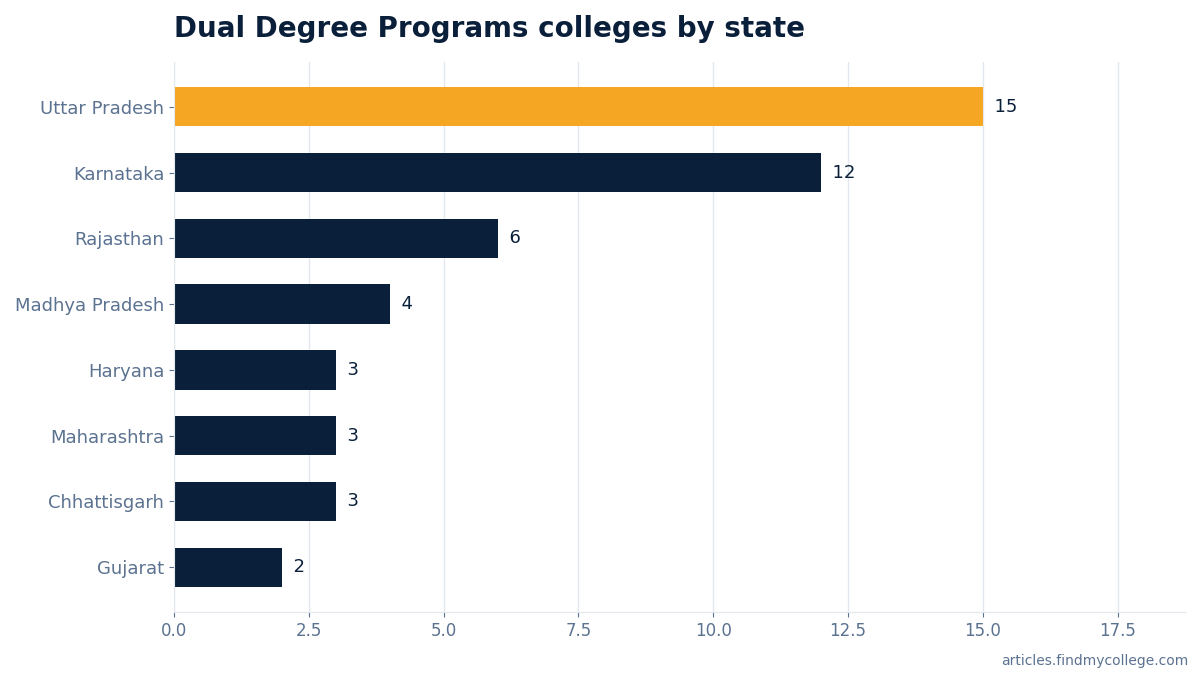
At least 54 colleges offer Dual Degree Programs in India, with Uttar Pradesh hosting 15 institutions and Karnataka 12. Across private colleges with fee data, the median total course fee is ₹3.00 lakh, with the middle half charging between ₹1.17 lakh and ₹6.75 lakh.
Restrictions, PhD Bar, and Non-Retrospective Constraints
While UGC guidelines provide flexibility for dual degree enrollment, strict regulatory boundaries exist to maintain academic rigor and prevent misuse.
The primary regulatory restrictions include:
- PhD Doctoral Prohibition: Combining a PhD programme with any other academic degree course is strictly prohibited under UGC rules across all learning modes.
- Non-Retrospective Policy: The UGC dual degree policy applies strictly from its official implementation date. Students who were registered for two degrees prior to the policy’s implementation date cannot claim retrospective validity or benefits.
Risk Factors: Invalid Degrees and Schedule Clashes
- Unapproved Dual Enrollment: Enrolling in two full-time physical degrees without formal university permission may lead to one or both qualifications being invalidated.
- Unaccredited Institutions: Pursuing a second degree from an unapproved or unaccredited institution can render the resulting certificate legally invalid.
- Schedule Clashes: Students are responsible for reviewing exam calendars and timetable schedules of both universities to prevent clashes, while universities hold administrative responsibility for addressing dual enrollment matters such as migration certificates and exam coordination.
Students are responsible for checking exam calendars and timetables of both institutions to prevent schedule conflicts. Verifying university approval and accreditation prevents degrees from being declared legally invalid.
Verification Checklist Before Applying for Two Degrees
Before completing formal admission paperwork at two institutions, candidates should complete a thorough verification process using the framework below:
| Step Number | Verification Area | Key Action to Complete |
|---|---|---|
| Step 1 | Institutional Approval | Confirm that both universities formally allow simultaneous enrollment. |
| Step 2 | Accreditation Check | Verify that both programmes and bodies are recognized and accredited. |
| Step 3 | Schedule Review | Ensure academic calendars, class timings, and exam schedules do not conflict. |
| Step 4 | Workload Assessment | Evaluate personal capacity to manage coursework, assignments, and exams. |
| Step 5 | Documentation & Rules | Check certificate issuance, migration paperwork, fee structures, and scholarship rules. |
How to Apply for Dual Degree Programs Admission in 2026: Step by Step
- Check Institutional Policy: Confirm that both target universities have formally adopted and implemented the UGC dual degree framework for simultaneous registration.
- Verify University Accreditation: Ensure both selected programmes are recognized and accredited by competent academic regulatory authorities.
- Cross-Check Class and Exam Schedules: Verify that lecture timings for physical modes do not overlap and that exam dates between institutions do not clash.
- Complete Administrative & Fee Formalities: Coordinate documentation like migration certificates and clear institutional fee and scholarship requirements for both courses.
FAQs
- Can I pursue two degrees at the same time under UGC guidelines? Yes, UGC allows students to pursue two degrees simultaneously in India as two physical degrees (with non-overlapping class timings), one physical degree plus one online/distance degree, or two online/distance degrees.
- Is it permitted to pursue a PhD along with another degree? No. Combining a PhD programme with any other academic degree course is strictly prohibited under UGC rules.
- What happens if I pursue two full-time physical degrees without approval? If a student enrolls in two full-time physical degrees without official university approval, one or both degrees may be declared invalid.
- Does the UGC dual degree guideline apply retrospectively to older enrollments? No. The policy applies strictly from its official implementation date. Students enrolled in two courses before that date cannot claim retrospective benefits under the guidelines.
Students must verify eligibility criteria and institutional accreditation before enrolling in dual degree programmes.