Electronics Engineer Salary 2026: Pay Scale and Jobs
- 15 Oct 2026Cabinet Secretariat Recruits 250 DFO Positions via GATE
Cabinet Secretariat opened recruitment for 250 Deputy Field Officer posts for GATE qualified candidates, open through 15 November 2026. - 5 Oct 2026DRDO RCI Hyderabad Announces 195 Apprentice Openings
DRDO Research Centre Imarat Hyderabad opened applications for 195 Apprentice posts, with application closing on 01 November 2026. - 3 Sep 2026GAIL Executive Trainee Positions via GATE 2027
GAIL announced 100 Executive Trainee vacancies through GATE 2027, with registrations open until 18 March 2027.
In India, an Electronics Engineer earns an average salary of ₹27,823 per year, with typical pay ranging between ₹17,092 (25th percentile) and ₹44,199 (75th percentile), while top earners in the 90th percentile make up to ₹1,73,600 per year.
Students pursuing this discipline can evaluate salary benchmarks across private and public sectors, examine top corporate recruiter offers, explore government job openings, analyze college fee structures across cities, and follow a clear step-by-step career path.
| Parameter | Details |
|---|---|
| Average Annual Salary | ₹27,823 / year |
| 25th Percentile Salary | ₹17,092 / year |
| 75th Percentile Salary | ₹44,199 / year |
| Top Earner (90th Percentile) Salary | ₹1,73,600 / year |
| India Telecom Consumer Base Target | 1.2 Billion consumers |
Electronics Engineering Salary in India
| Company Name | Reported Salary Range | Median Salary Offered |
|---|---|---|
| Valeo | ₹7 L – ₹14 L / year | ₹11 L / year |
| Samsung Electronics | ₹21K – ₹60K / month | ₹27K / month |
| First Student | ₹25K – ₹50K / month | ₹33K / month |
| Evision Technoserve | ₹24K – ₹27K / month | ₹25K / month |
| Elcome Integrated Systems | ₹20K – ₹27K / month | ₹24K / month |
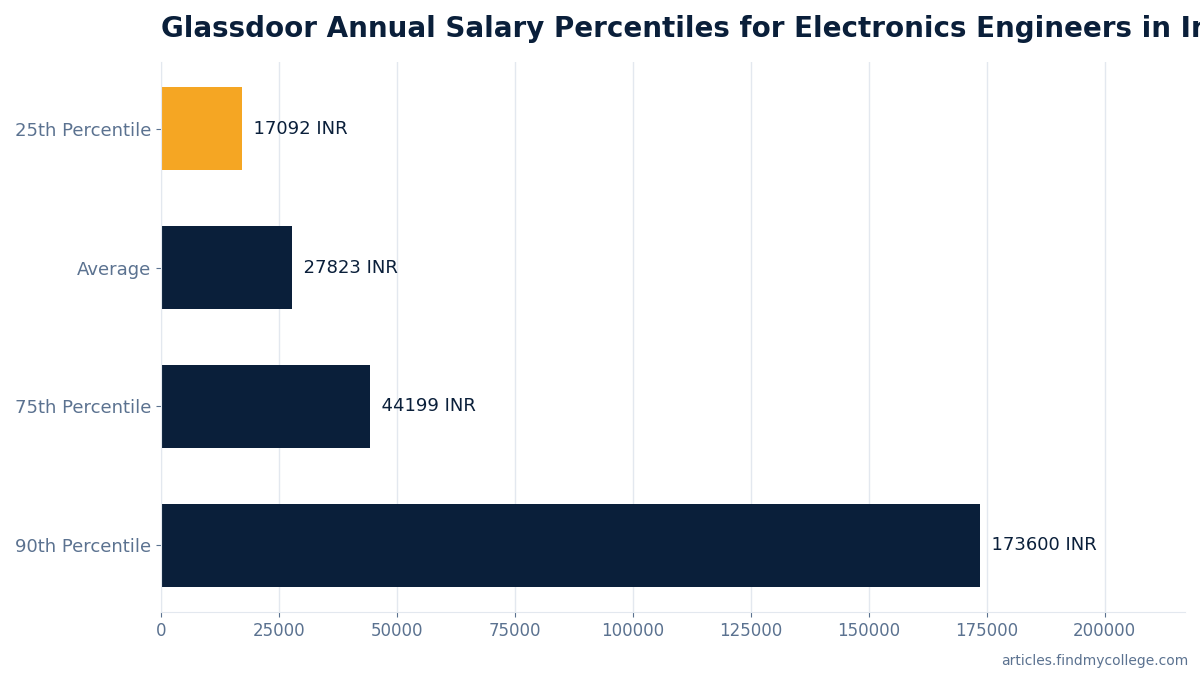
Electronics Engineers in India earn an average salary of ₹27,823 per year (equivalent to ₹13 per hour).
Salaries range from ₹17,092 per year at the 25th percentile to ₹44,199 at the 75th percentile, with top earners in the 90th percentile earning up to ₹1,73,600 per year.
Electronics Engineering Salary by Job Role
| Company Name | Reported Salary Range | Median Salary Offered |
|---|---|---|
| Valeo | ₹7 L – ₹14 L / year | ₹11 L / year |
| Samsung Electronics | ₹21K – ₹60K / month | ₹27K / month |
| First Student | ₹25K – ₹50K / month | ₹33K / month |
| Evision Technoserve | ₹24K – ₹27K / month | ₹25K / month |
| Elcome Integrated Systems | ₹20K – ₹27K / month | ₹24K / month |
Across specific job roles, Systems Engineers earn between ₹40,000 and ₹90,000 per month, while Electronics Design Engineers average ₹24,000 per month. Other specialized roles like Design Engineers report ₹15,000 to ₹35,000 per month and Electronics Technicians earn ₹18,000 per month.
Electronics Engineering Salary in Government vs Private Sector
| Recruiting Body | Post Title | Number of Openings | Application Deadline |
|---|---|---|---|
| Cabinet Secretariat | Deputy Field Officer (Through GATE) | 250 | 15-11-2026 |
| DRDO (RCI Hyderabad) | Apprentices | 195 | 01-11-2026 |
| GAIL | Executive Trainee (Through GATE 2027) | 100 | 18-03-2027 |
| Indian Army | 145th Technical Graduate Course (TGC) | 30 | 29-10-2026 |
| IIT BHU | SRF / Postdoctoral Fellow (Electronics) | 1 | 03-11-2026 |
Public sector recruitment for ECE engineers occurs through GATE and ISRO examinations across major organizations like ISRO, DRDO, BSNL, and GAIL. In comparison, private recruiters like Valeo offer annual packages between ₹7 L and ₹14 L per year.
Top Recruiters
Electronics engineering graduates find wide opportunities across both corporate technology leaders and core central government organizations. Primary private recruiters include Valeo, Samsung Electronics, First Student, Evision Technoserve, and Elcome Integrated Systems. Key government recruitment bodies include ISRO, DRDO, BSNL, Airport Authority of India, BEL, GAIL, and Cabinet Secretariat.
Strong hiring demand is supported by market expansion, as India stands as the second-largest telecommunications market globally with projections pointing to over 1.2 billion consumers.
How to Increase Electronics Engineering Salary
- Qualify in competitive exams: Public sector organizations and research institutions rely on GATE and ISRO Scientist/Engineer examinations for selection.
- Target major government recruiters: Key recruiters include ISRO, DRDO, BSNL, Airport Authority of India, and BEL.
- Apply for GATE-based openings: Opportunities include 250 Deputy Field Officer posts in the Cabinet Secretariat and 100 Executive Trainee roles in GAIL.
- Capitalize on telecom sector growth: India is the second-largest telecommunications market worldwide, with GSMA projecting over 1.2 billion consumers.
Clearing national exams like GATE or ISRO Scientist/Engineer tests grants access to top public sector roles and Executive Trainee positions. Expanding opportunities in India’s massive telecommunications sector also drive long-term career growth.
How to Start Your Electronics Engineering Journey: Step by Step
- Prepare for competitive examinations: Focus preparation on GATE and ISRO Scientist/Engineer examinations, which primary PSU and research selections rely upon.
- Apply for central government positions: Track central recruitment notifications, such as the Cabinet Secretariat’s 250 Deputy Field Officer positions selected through GATE scores.
- Pursue PSU trainee and apprentice roles: Apply for openings like GAIL’s 100 Executive Trainee roles through GATE 2027 and DRDO RCI Hyderabad’s 195 Apprentice positions.
- Explore defense graduate entry schemes: Look into technical recruitment pathways such as the Indian Army’s 30 posts under the 145th Technical Graduate Course (TGC).
- Evaluate EEE government avenues: Note that Electrical and Electronics Engineers can also target Power Grid, NTPC, Indian Railways, State Electricity Boards, and BEL.
| What to do | Where | Link |
|---|---|---|
| Compare colleges, fees and cutoffs | Electronics Engineering colleges in India | findmycollege.com |
Public sector selections for electronics engineers rely heavily on competitive examinations like GATE and ISRO tests. Prospective candidates can build career pathways across defense, space research, and public sector undertakings.
FAQs
What is ECE engineering salary?
Electronics Engineers earn an average salary of ₹27,823 per year in India. Reported salaries typically range from ₹17,092 (25th percentile) to ₹44,199 (75th percentile), with top earners in the 90th percentile earning up to ₹1,73,600 per year.
Can an ECE student get a government job?
Yes, ECE graduates can secure government jobs in major organizations like ISRO, DRDO, BSNL, Airport Authority of India, BEL, Cabinet Secretariat, and GAIL, primarily through GATE scores or specialized ISRO Scientist/Engineer examinations.
Which is better, ECE or EEe salary?
Both branches offer strong salary prospects. ECE focuses on telecommunications, defense, space research, and VLSI roles, while EEE targets power generation, transmission, and state electricity boards. Leading employers like Valeo offer ECE engineers annual packages up to ₹14 L.
What is the highest paying job in electronics?
Top private employers like Valeo offer salary packages between ₹7 L and ₹14 L per year, with a median of ₹11 L per year. Top earners in the 90th percentile across the sector reach up to ₹1,73,600 per year.
Electronic salary per month in india
Corporate employers offer varied monthly pay, including Samsung Electronics (₹21K – ₹60K / month) and First Student (₹25K – ₹50K / month).
Are electronic engineers in demand?
Yes, demand is high due to India being the second-largest telecommunications market globally, targeting over 1.2 billion consumers, alongside extensive public sector recruitment across DRDO, GAIL, Cabinet Secretariat, and the Indian Army.