Gnm Course Subject — 2026
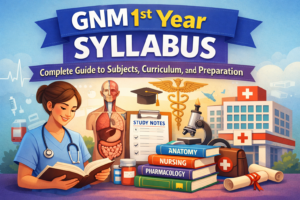
The General Nursing and Midwifery (GNM) program is a 3.5-year Diploma course, including a mandatory six-month internship, designed to train skilled nurses and midwives for India’s healthcare sector. While the Indian Nursing Council (INC) phased out new GNM admissions after the 2020-21 batch, many state nursing councils and private institutions continue to offer the program for the 2026 academic session, adapting their curriculum to meet regional demands. This section details the GNM course subjects, year-wise structure, and other facts for students considering this practical-focused healthcare Diploma.
| Parameter | Details |
|---|---|
| Course Full Form | General Nursing and Midwifery |
| Course Type | Diploma Program |
| Academic Duration | 3 Years |
| Compulsory Internship | 6 Months (Total course duration: 3.5 years) |
| Eligibility Criteria (General) | Class 12 pass with minimum 40-50% marks and English as a subject; Science stream (PCB) preferred. Registered ANM candidates also eligible. |
| Minimum Age | 17 years (as of December 31, 2026) |
| Maximum Age | 35 years (no age bar for Registered ANM/RLHV candidates) |
| Admission Mode | State-level entrance exams, college-specific entrance exams/interviews, or direct admission based on Class 12 marks. |
| Accreditation Bodies | Indian Nursing Council (INC) and respective State Nursing Councils. |
| First Year Subjects | Anatomy & Physiology, Microbiology, Nursing Foundations, Community Health Nursing. |
| Second Year Subjects | Medical-Surgical Nursing (including Pharmacology), Mental Health Nursing, Child Health Nursing. |
| Third Year Subjects | Midwifery & Gynaecological Nursing, Community Health Nursing-II. |
| Core Subjects (Overall) | Medical Surgical Nursing, Child Health Nursing, Mental Health Nursing, Midwifery, Gynaecological Nursing, Anatomy, Physiology, Pharmacology, Maternal and Child Health, Community Health Nursing, Microbiology, Pediatric Nursing, Obstetric Nursing, Psychology, Biology, Sociology, First Aid, Nutrition. |
| Key Practical Training | Clinical postings, hospital internships, simulation labs, practical record books, field and clinical diaries, First Aid, CPR, Basic life support. |
| Focus Areas/Specializations | Rehabilitation, Mental health care, Maternity care, Post-trauma care, Community health nursing. |
| Assessment & Passing Marks | 50% in theory and practical separately for each subject; 70-79% for First Division. |
| Required Attendance | Typically 80% in both theory and practical components to be eligible for exams. |
| Further Education Options | Post Basic B.SC. Nursing (2-year course), M.SC. Nursing. |
| Current Status (2026) | INC phased out new GNM admissions after 2020-21; however, many state councils and private institutions continue to offer the program. |
The GNM curriculum emphasizes strong clinical training and practical application, preparing students for immediate roles in diverse healthcare settings across India. For those interested in a broader academic foundation, exploring B.SC. Nursing programs can offer a degree-level alternative.
GNM Course Subject: Types, Categories & Key Components Explained
The GNM (General Nursing and Midwifery) course in 2026 spans 3 years of academic study plus a 6-month compulsory internship, totaling 3.5 years. Its syllabus, set by the Indian Nursing Council (INC), covers core subjects like Medical Surgical Nursing, Midwifery, and Community Health Nursing across three academic years.
| Type/Category | Details | Key Feature |
|---|---|---|
| First Year Subjects | Anatomy & Physiology, Microbiology, Nursing Foundations, Community Health Nursing-I, Nutrition, Psychology, Sociology, First Aid | Focus on foundational medical sciences and basic patient care principles. |
| Second Year Subjects | Medical-Surgical Nursing-I (including Pharmacology), Medical-Surgical Nursing-II, Mental Health Nursing, Child Health Nursing | Covers advanced patient care, disease management, and specialized nursing areas. |
| Third Year Subjects | Midwifery & Gynaecological Nursing, Community Health Nursing-II | Emphasizes maternal and child health, public health, and advanced community care practices. |
| Core Nursing Subjects | Medical Surgical Nursing, Child Health Nursing, Mental Health Nursing, Midwifery, Gynaecological Nursing, Obstetric Nursing, Pediatric Nursing | Provides full knowledge across major nursing specializations. |
| Foundational Sciences | Anatomy, Physiology, Microbiology, Pharmacology, Nutrition, Psychology, Sociology, Biology | Establishes the scientific basis for understanding the human body, health, and disease processes. |
| Practical & Clinical Training | Clinical rotations in hospitals, clinics, and long-term care facilities; simulation labs | Offers hands-on experience in patient care, basic life support, and first aid procedures. |
| Compulsory Internship | 6-month clinical posting after the 3rd academic year | Allows students to apply theoretical knowledge and develop practical skills in real-world healthcare settings. |
| Theory Assessment | Minimum 50% passing marks required in theory for each subject | Evaluates students’ theoretical understanding of nursing concepts and principles. |
| Practical Assessment | Minimum 50% passing marks required in practical for each subject; 2nd year practicals are 100 marks (internal/external split) | Assesses clinical skills, procedural competence, and practical application of knowledge. |
| Attendance Requirement | Minimum 80% attendance in both theory and practical sessions is mandatory for exam eligibility | Ensures consistent engagement and full learning throughout the course duration. |
| Required Textbooks | Approximately 4 major textbooks for the 2nd year and 3-4 books for the 3rd year | resources for in-depth study, reference, and syllabus coverage. |
| Specialized Focus Areas | Rehabilitation, Mental health care, Maternity care, Post-trauma care | Prepares GNM graduates for diverse healthcare challenges and specific patient needs. |
This structured curriculum ensures GNM graduates are well-prepared with both theoretical knowledge and practical skills for diverse healthcare roles in 2026.
GNM Course Subject: Key Statistics & Data Points for 2026
GNM (General Nursing and Midwifery) is a 3-year Diploma course, followed by a 6-month compulsory internship, making the total duration 3.5 years. While the Indian Nursing Council (INC) has phased out new admissions from 2020-21, many private institutions continue to offer the GNM course for the 2026 academic session.
| Parameter | Detail/Value (2026 Academic Session) | Notes/Source |
|---|---|---|
| Full Form | General Nursing and Midwifery | Diploma course in nursing and midwifery |
| Course Type | Diploma | Focuses on practical nursing skills and patient care |
| Total Duration | 3.5 years | Includes 3 years of academic study and 6 months of compulsory internship |
| Academic Duration | 3 years | Structured into year-wise subjects and practical components |
| Compulsory Internship | 6 months | Mandatory clinical experience in hospitals and healthcare settings |
| Minimum Age for Admission | 17 years | As of December 31, 2026 |
| Maximum Age for Admission | 35 years | No age bar for Registered ANM (RANM) or Registered Lady Health Visitor (RLHV) candidates |
| General Eligibility (Class 12) | Minimum 40-50% aggregate marks with English as a subject | Science stream (PCB) preferred; Arts/Commerce with English also eligible in some states |
| Vocational Eligibility | 10+2 with English and 40% marks in Vocational ANM or Health Care Science | From Indian Nursing Council (INC) recognized boards |
| Admission Mode | State-level entrance exams, college-specific entrance exams/interviews, or merit-based on 12th marks | Varies by state and institution |
| Accreditation & Recognition | Indian Nursing Council (INC) and respective State Nursing Councils | Ensures standardized curriculum and quality of education |
| Core Subjects (Year 1) | Anatomy & Physiology, Microbiology, Nursing Foundations, Community Health Nursing | Foundation subjects for nursing practice |
| Core Subjects (Year 2) | Medical-Surgical Nursing, Mental Health Nursing, Child Health Nursing | Specialized nursing areas covered in depth |
| Core Subjects (Year 3) | Midwifery & Gynaecological Nursing, Community Health Nursing-II | Advanced nursing and community health applications |
| Practical Training Components | Clinical postings, hospital internships, simulation labs, field diaries, procedure logs | for developing hands-on patient care skills |
| Passing Marks (Theory & Practical) | 50% separately in theory and practical subjects | Required for eligibility in subsequent years and final certification |
| Attendance Requirement | Usually 80% in theory and practicum | Mandatory for appearing in annual examinations |
| Further Education Options | Post Basic B.SC. Nursing (2 years), M.SC. Nursing | Pathways for career advancement and higher qualifications |
| Current Status (INC Directive) | Phased out for new batches from 2020-21, replaced by 4-year traditional BSc Nursing course | Many private colleges continue to offer GNM for 2026 admissions (Source: Indian Nursing Council, various private college websites) |
The GNM course structure for 2026 emphasizes a blend of theoretical knowledge and extensive practical training, preparing students for diverse roles in healthcare.
How GNM Course Subject Works: Process, Steps & Key Details
The GNM course is a 3-year Diploma program with a mandatory 6-month internship, totaling 3.5 years of study for aspiring nurses. This structure emphasizes both theoretical knowledge and extensive practical application in clinical settings. The Indian Nursing Council (INC) sets the full syllabus and standards for GNM programs across India.
- Course Duration and Structure: The GNM course spans 3 years of academic study, followed by a compulsory 6-month internship, making IT a 3.5-year Diploma program. This duration ensures students gain in-depth knowledge and hands-on experience in nursing and midwifery.
- INC Syllabus Framework: The Indian Nursing Council (INC) establishes the core curriculum and standards for GNM, which is structured year-wise with specific subjects and practical components. This ensures uniformity and quality across recognized institutions.
- Core Subject Integration: The curriculum integrates core subjects like Medical Surgical Nursing, Child Health Nursing, Mental Health Nursing, and Midwifery across the three academic years. These subjects are designed to build foundational and specialized nursing competencies.
- Practical Training Methodology: Students undergo extensive practical training through clinical rotations in hospitals, clinics, and long-term care facilities. This includes hands-on experience in first aid, CPR, basic life support, and assisting doctors in patient care.
- Assessment Pattern: GNM assessment includes both theory and practical evaluations, with students required to secure a minimum of 50% passing marks in each component separately. For the 2nd year, each practical subject carries 100 marks, split between internal and external evaluations.
- Compulsory Internship Details: The 6-month mandatory internship provides real-world clinical experience, allowing students to apply theoretical knowledge directly in patient care settings. This phase is for developing practical skills and professional judgment.
- Eligibility Criteria Impact: Admission typically requires Class 12 pass with 40-45% marks and English as a subject, with a minimum age of 17 years by December 31, 2026. This ensures a baseline academic preparedness for the rigorous nursing curriculum.
- Progression to Post Basic BSc Nursing: GNM graduates can pursue higher education options, such as the 2-year Post Basic B.SC. Nursing course, to upgrade their qualifications and explore advanced roles. This pathway builds upon the foundational subjects learned in GNM.
Understanding the detailed process and structure of the GNM course subjects is for students planning a career in nursing and midwifery.
People Also Read


GNM Course Subject: Benefits, Advantages & Why Students Choose IT
The GNM course, a 3-year Diploma, offers a practical-focused curriculum that prepares students for direct patient care roles in India. This program’s full subject matter, including Medical Surgical Nursing and Midwifery, gives graduates skills for immediate employment in the healthcare sector. Students choose GNM for its strong clinical training and clear career progression pathways.
- Strong Clinical Skill Development: The GNM curriculum emphasizes practical training through clinical rotations in hospitals, clinics, and simulation labs. Students gain hands-on experience in First Aid, CPR, and basic life support, for patient care.
- full Subject Coverage: Students explore core subjects like Anatomy, Physiology, Microbiology, and Medical-Surgical Nursing across the 3-year program. This broad knowledge base prepares them for diverse healthcare scenarios, from general wards to specialized units.
- Specialized Midwifery Training: The third year focuses heavily on Midwifery & Gynaecological Nursing, preparing students for maternal and child health roles. This specialization is vital for addressing women’s health needs and supporting new mothers in India.
- Community Health Expertise: The GNM course subject includes Community Health Nursing-I and II, focusing on public health initiatives and rural healthcare. Graduates are trained to manage health needs in various community settings, promoting preventive care.
- Foundation for Higher Education: GNM graduates can pursue Post Basic B.SC. Nursing, a 2-year course, to upgrade their qualifications to a degree level. This pathway allows for career progression into advanced nursing roles, administration, or teaching positions.
- Immediate Employment Opportunities: The practical nature of GNM subjects and the mandatory 6-month internship ensure graduates are job-ready upon completion. They find roles as staff nurses, community health workers, and home nurses across India’s healthcare facilities.
- Life-Saving Skills: The program integrates practical aspects like assisting doctors, caring for patients, and managing real healthcare needs in clinical settings. This direct application of theoretical subjects builds confidence and competence in critical situations.
The GNM course provides a strong foundation in nursing, making its graduates highly valuable in India’s growing healthcare industry.
GNM Course Subject vs Alternatives: Which Option is Best?
The GNM (General Nursing and Midwifery) course is a 3.5-year Diploma program, distinct from the 2-year ANM (Auxiliary Nursing & Midwifery) Diploma and the 4-year professional BSc Nursing degree. Each program prepares students for different levels of healthcare responsibility and requires varying academic commitments.
| Feature | GNM (General Nursing and Midwifery) | ANM (Auxiliary Nursing & Midwifery) | BSc Nursing (Bachelor of Science in Nursing) |
|---|---|---|---|
| Course Type | Diploma program | Diploma program | Undergraduate Degree program |
| Duration | 3 years academic + 6 months compulsory internship (total 3.5 years) | 2 years academic | 4 years professional course |
| Eligibility (Summary) | Class 12 pass (40-45% marks with English); Science stream preferred, but Arts/Commerce/Vocational ANM also eligible in some states. Age 17-35 years. | Class 12 pass from a recognized board. Age 17-35 years. | Class 12 pass with Physics, Chemistry, Biology (PCB) and English, typically with higher aggregate marks (e.g., 45-50%). |
| Primary Objective/Focus | Trains skilled nurses and midwives for patient care, clinical practice, and community health. | Focuses on basic healthcare, maternal and child health, and first aid at the community level. | Covers a broader range of nursing sciences, preparing for advanced roles, administration, and teaching. |
| Key Subject Areas | Anatomy, Physiology, Microbiology, Nursing Foundations, Medical-Surgical Nursing, Child Health Nursing, Mental Health Nursing, Midwifery & Gynaecological Nursing, Community Health Nursing. | Community Health Nursing, Health Promotion, Primary Healthcare, Maternal and Child Health, Basic Medical Care, First Aid. | Advanced Anatomy, Physiology, Pharmacology, Pathology, Medical-Surgical Nursing (in-depth), Pediatric Nursing, Psychiatric Nursing, Nursing Research, Administration, Education. |
| Practical Training Emphasis | Strong clinical training with 6 months compulsory hospital internship, clinical rotations, and simulation labs. | Significant practical exposure in community health settings, primary health centers, and basic clinics. | Extensive clinical rotations in various specialties, advanced lab work, and exposure to specialized hospital departments. |
| Career Progression | Can pursue Post Basic BSc Nursing (2 years) for a degree, then MSc Nursing. | Can pursue GNM or BSc Nursing for further career advancement. | Directly eligible for advanced roles, nursing administration, teaching, and MSc Nursing. |
| Degree vs. Diploma | Diploma (not a graduation degree) | Diploma (not a graduation degree) | Graduation Degree |
| Recognition | Indian Nursing Council (INC) and State Nursing Councils | Indian Nursing Council (INC) and State Nursing Councils | Indian Nursing Council (INC) and State Nursing Councils |
Choosing between GNM, ANM, and BSc Nursing depends on your academic background, career aspirations, and desired duration of study in the healthcare sector.
Common Misconceptions About GNM Course Subject: Myths vs Reality
The GNM course, a 3-year Diploma, is often misunderstood regarding its academic content and career progression, despite being offered in numerous colleges like Mangalayatan University and Brainware University. Clarifying these common misconceptions helps students make informed decisions about their nursing education, similar to how students evaluate subjects in BBA first year.
- Myth: GNM courses are completely phased out in India.
Reality: The Indian Nursing Council (INC) phased out new GNM admissions from the 2020-21 academic session, replacing IT with the 4-year BSc Nursing. However, many private colleges like Medisky Nursing Institute and Usha Martin University continue to offer the GNM program for the 2026-27 session, and existing batches complete their Diploma. - Myth: GNM subjects are very basic and lack academic depth.
Reality: GNM subjects are full, covering core areas like Medical Surgical Nursing, Child Health Nursing, Mental Health Nursing, and Midwifery. The curriculum includes in-depth study of Anatomy, Physiology, Microbiology, and Pharmacology, requiring significant academic effort over 3 years. - Myth: The GNM course is exclusively for female candidates.
Reality: Both male and female candidates are eligible for the GNM course, as well as for further studies like Post Basic B.SC. Nursing and M.SC. Nursing. Eligibility criteria for M.SC. Nursing explicitly state ‘Both Female and Male candidates’ can apply. - Myth: GNM is a bachelor’s degree program.
Reality: GNM is a Diploma course with a duration of 3 years of study plus a mandatory 6-month internship, totaling 3.5 years. IT is distinct from a Bachelor of Science in Nursing (BSc Nursing), which is a 4-year professional degree. - Myth: GNM primarily focuses on theoretical knowledge with minimal practical exposure.
Reality: The GNM curriculum heavily emphasizes practical training, including clinical rotations, hospital internships, and simulation labs. Students typically require 80% attendance in both theory and practical components to be eligible for exams, ensuring extensive hands-on experience. - Myth: GNM limits future career and educational advancement opportunities.
Reality: GNM graduates have clear pathways for further education, including the 2-year Post Basic B.SC. Nursing course and M.SC. Nursing. These advanced degrees enable roles in nursing administration, education, and specialized clinical practice. - Myth: The GNM syllabus is identical across all institutions nationwide.
Reality: While the Indian Nursing Council (INC) sets the overall standards, the specific GNM syllabus and curriculum can vary slightly across different colleges and states. For instance, some colleges might emphasize certain elective subjects or clinical postings more than others.
Understanding these distinctions between common beliefs and the actual structure of the GNM course helps students make well-informed decisions about their nursing career path.
What to Do Next: Actionable Steps for Students Interested in GNM Course Subject
Students considering the General Nursing and Midwifery (GNM) course for the 2026-27 academic session must verify course availability and specific admission criteria. While the Indian Nursing Council (INC) has phased out GNM as a primary Diploma, many private institutions continue to offer IT, with applications for 2026-27 already open at some universities. Here are specific steps for prospective GNM students:
- Verify Course Offering: Confirm that your target colleges offer the GNM course for the 2026-27 academic year. Many private institutions like Mangalayatan University (Aligarh) and Brainware University (Kolkata) are accepting applications for GNM programs, despite the INC’s broader shift towards BSc Nursing.
- Check Detailed Eligibility: Ensure you meet the GNM eligibility criteria, which typically requires a Class 12 pass with at least 40% marks and English as a subject. Science stream (Physics, Chemistry, Biology) with 40-45% aggregate is often preferred, and candidates must be between 17 and 35 years old as of December 31, 2026.
- Prepare for Entrance Exams: Identify the admission mode for your chosen colleges. Many GNM admissions are based on state-specific entrance exams or college-specific tests and interviews. Some colleges also offer direct admission based on Class 12 merit.
- Submit Applications by Deadlines: Be aware of application deadlines for the 2026-27 session. For instance, Mangalayatan University has an application deadline of March 10, 2026, for its GNM program, and Rajastan University also closes GNM applications by March 10, 2026.
- Understand Core Subjects: Familiarize yourself with the GNM course subjects, including Anatomy, Physiology, Microbiology, Medical-Surgical Nursing, Child Health Nursing, Mental Health Nursing, and Midwifery. This preparation helps in academic success during the 3-year Diploma.
- Plan for Career Progression: Consider the Post Basic B.SC. Nursing as a direct progression option after completing GNM. This 2-year course allows GNM graduates to upgrade their Diploma to a bachelor’s degree, career prospects in nursing.
Key Takeaways
- GNM course eligibility for 2026-27 generally requires a Class 12 pass with 40% marks and English, with an age limit of 17-35 years.
- Specific application deadlines, such as March 10, 2026, for some universities, are for prospective GNM students.
- Graduates can pursue Post Basic B.SC. Nursing, a 2-year program, to advance their qualifications after completing the GNM Diploma.
Check the official websites of INC-recognized private nursing colleges for their specific GNM admission criteria and application deadlines for the 2026-27 academic session.
Frequently Asked Questions (FAQs)
How to get admission in GNM course in Delhi?
GNM admission in Delhi requires passing 12th with 40% marks and English as a subject. Most colleges conduct state-level entrance exams like West Bengal GNM or their own tests. Some private institutions like Prakash Institute of Physiotherapy Rehabilitation and Allied Medical Sciences also accept direct admission based on merit.
What are the top entrance exams for GNM course in 2026?
Top entrance exams include West Bengal GNM, AIIMS NORCET for B.SC Nursing, and Indian Army MNS Exam. These exams test subjects like Physics, Chemistry, Biology, and General Knowledge. Application deadlines for 2026 sessions are typically in March-April.
What is the eligibility criteria for GNM course?
Students must pass 12th standard with minimum 40% marks and English as a subject. Science stream (Physics, Chemistry, Biology) is mandatory for most colleges. Age limit is usually 17-35 years as of 31 December 2026.
What is the average fee for GNM course in India?
GNM course fees range from ₹15,000 (government colleges) to ₹7.6 lakh (private institutions) for the full 3-year program. Private colleges like S.M.S. Medical College charge around ₹2.5-3 lakh annually. Government institutions have discontinued GNM courses as of 2025.
What are the career options after GNM course?
Graduates work as staff nurses, ICU nurses, or midwives in hospitals like AIIMS Delhi and Apollo Hospitals. Average starting salaries range ₹3-6 LPA. Top recruiters include government hospitals, private healthcare chains, and NGOs.
Can GNM graduates pursue B.SC Nursing?
Yes, GNM graduates can join lateral entry B.SC Nursing programs through AIIMS NORCET or state-level exams. Baba Farid University of Health Sciences offers 2-year bridge courses for GNM holders. Minimum 50% aggregate is required for lateral entry.
Which are the top colleges for GNM course in India?
Top colleges include John’s National Academy of Health Sciences (Kerala), S.M.S. Medical College (Jaipur), and GRD Institute of Management and Technology (Dehradun). These institutions report 85-95% placement rates in nursing roles across India.
Disclaimer: The information provided in this article is sourced from official websites, NIRF rankings, and publicly available data. Fees, placement figures, and other details may vary. Please verify with the official institution website for the most current information.