
How to Become a Philosopher: Education Pathway and Career Scope
- 5 Dec 2026SAT India December 2026 Exam Scheduled
The December attempt for the SAT India exam takes place on 05 December 2026. - 14 Oct 2026CPGET 2026 Phase III Seat Allotment Announced
CPGET 2026 Phase III seat allotment for post-graduate admissions was released on 14 October 2026. - 11 May 2026CUET UG 2026 Exam Window Details
CUET UG 2026 examination window is scheduled between 11 May 2026 and 31 May 2026.
Below is the complete overview of eligibility rules, entrance exams, top colleges, fee benchmarks, essential skills, salary expectations, and step-by-step admission procedures.
| Parameter | Details |
|---|---|
| UG Course Duration | 3 – 4 Years |
| PG Course Duration | 2 Years |
| PhD Course Duration | 3 – 5 Years |
| UG Eligibility Criteria | Class 12 in any stream (Arts, Science, Commerce) with minimum 50% aggregate |
| PG Eligibility Criteria | Bachelor’s degree (BA, BSc, BCom, BTech, etc.) with minimum 50% aggregate |
| Key Entrance Exams | CUET UG, CUET PG, UGC NET, CSIR NET, GATE, CPGET, SAT India |
| Government College Fee Range | INR 1,000 – INR 8.08 Lakh |
| Average Salary | INR 4.3 LPA |
Who is a Philosopher
A philosopher conducts a logical and systematic study of basic questions concerning human existence, knowledge, values, language, culture, and universe reality. Rather than relying solely on empirical testing, philosophers analyze concepts through rigorous critical reasoning, argument structure, and conceptual analysis.
In modern career contexts, a philosopher applies theoretical frameworks to real-world challenges. Beyond traditional academic research and teaching in universities, professional philosophers evaluate ethical implications in artificial intelligence, formulate public policy, consult on corporate strategy, and contribute to editorial analysis across media organizations.
Eligibility to Become a Philosopher
Candidates need Class 12 from any stream with at least 50% aggregate marks for undergraduate admission. Postgraduate programs require a Bachelor’s degree in any discipline with 50% aggregate, while PhD programs require a Master’s degree with 50% aggregate score.
Courses to Become a Philosopher
Students can enter the field of Philosophy through certificate, undergraduate, postgraduate, and doctoral qualification tracks. Undergraduate degrees build foundational knowledge in logical analysis, while postgraduate and doctoral qualifications enable academic specialization and research authority.
Core branches taught across degree levels include Metaphysics, Epistemology, Formal Logic, Ethics, Aesthetics, Political Philosophy, Philosophy of Language, and Philosophy of Religion.
| Course Level | Duration | Eligibility Criteria |
|---|---|---|
| Undergraduate (BA) / Certification | UG: 3 – 4 Years | Cert: 3 Months – 2 Years | Class 12 from any stream with min 50% aggregate score from a recognized board |
| Postgraduate (MA) / PG Diploma | PG: 2 Years | PG Diploma: 3 Months – 2 Years | Bachelor’s degree (BA, BSc, BCom, BTech, etc.) in any discipline with min 50% aggregate score |
| Doctorate (PhD) | 3 – 5 Years | Master’s degree (MA, MSc, MCom, etc.) in any discipline with min 50% aggregate from a UGC-approved university |
Top Colleges in India for Philosophy Degrees
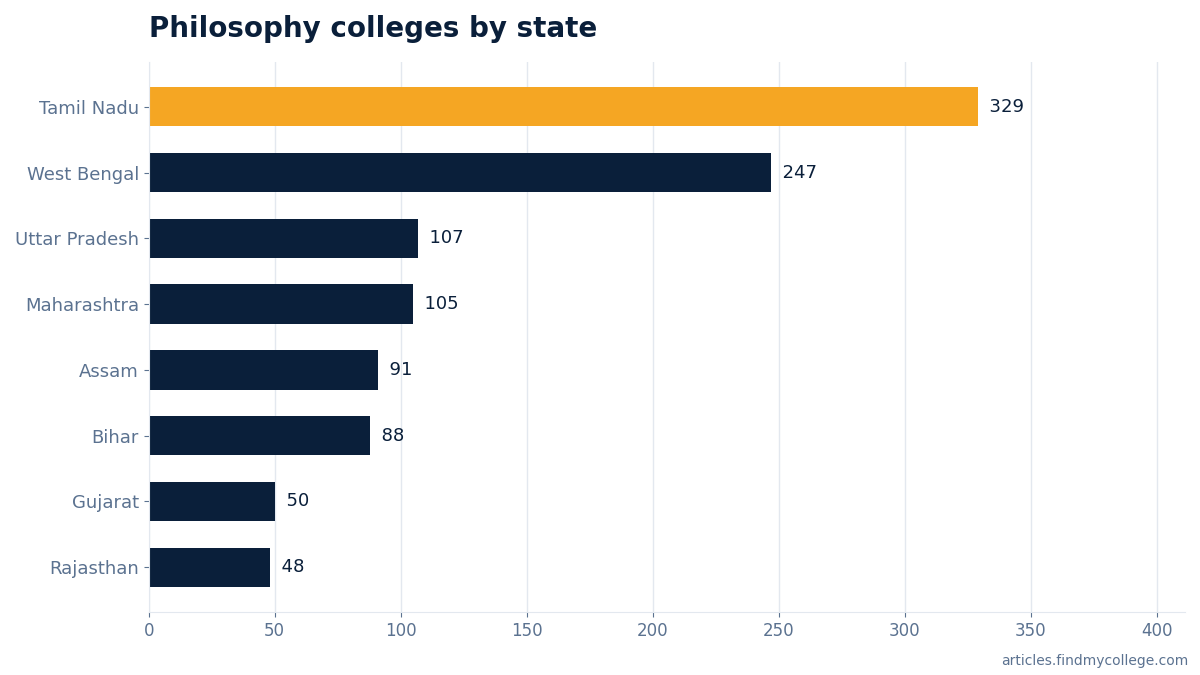
At least 1501 colleges offer Philosophy degrees across India, including 397 government institutions and 485 private colleges. State-wise distributions highlight strong representation in Tamil Nadu with 329 colleges, West Bengal with 247, Uttar Pradesh with 107, Maharashtra with 105, Assam with 91, and Bihar with 88 institutions. Across 95 reporting colleges, the median average placement package stands at 2.27 LPA.
| College Name | City | Ownership | Total Course Fee | NIRF Rank |
|---|---|---|---|---|
| Indian Institute of Technology Madras | Chennai | Government | ₹30,850 | 1 (Overall, 2025) |
| Miranda House | Delhi | Government | ₹32,060 | 2 (Overall, 2025) |
| Indian Institute of Technology Bombay | Mumbai | Government | ₹89,500 | 3 (Overall, 2024) |
| Hans Raj College | Delhi | Government | ₹86,615 | 3 (Overall, 2025) |
| Jamia Millia Islamia University | Delhi | Government | ₹41,610 | 4 (Overall, 2025) |
| Indian Institute of Technology Kanpur | Kanpur | Government | ₹52,200 | 5 (Overall, 2025) |
| City | Colleges | Fee Range | Well-known Options |
|---|---|---|---|
| Kolkata | 67 | ₹5,125 – ₹3.69 lakh | Jadavpur University, Amity University Kolkata |
| Chennai | 59 | ₹7,050 – ₹8.00 lakh | Indian Institute of Technology Madras, Saveetha Institute of Medical and Technical Sciences |
| Coimbatore | 49 | ₹6,000 – ₹1.03 lakh | Amrita Vishwa Vidyapeetham, P.S.G College of Technology |
| Delhi | 31 | ₹12,000 – ₹96,300 | Jamia Millia Islamia University, Delhi University |
| Patna | 26 | ₹5,574 – ₹4.00 lakh | Patliputra University, Patna University |
| Pune | 24 | ₹6,140 – ₹17.40 lakh | Dr. DY Patil Vidyapeeth, Fergusson College |
| Mumbai | 23 | ₹7,405 – ₹5.48 lakh | Indian Institute of Technology Bombay, Homi Bhabha National Institute |
| Hooghly | 18 | ₹5,200 – ₹1.07 lakh | Hooghly Women’s College, Hoogly Mohsin College Chinsurah |
Government vs Private Fees for Philosophy Courses
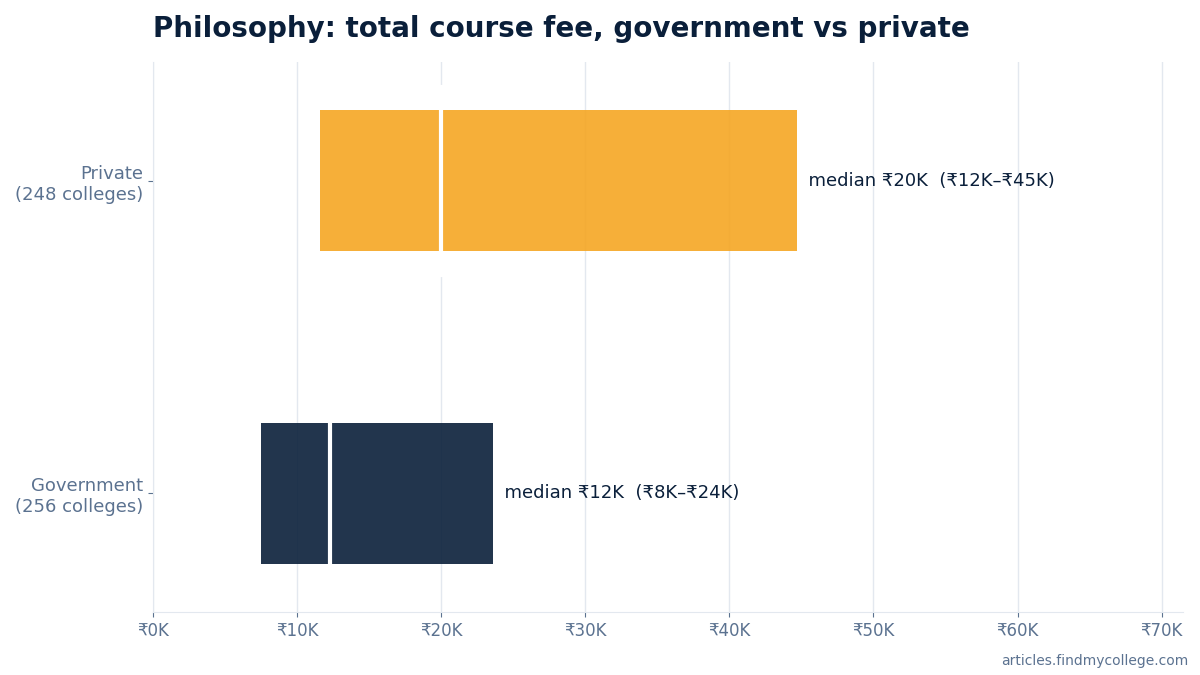
Philosophy course fee structures range from INR 1,000 to INR 8.08 Lakh in government colleges and INR 1,000 to INR 40.91 Lakh in private institutions. In government colleges, the median total course fee is ₹12,292, with the middle half of colleges charging between ₹7,500 and ₹23,616 based on data from 256 colleges. In private colleges, the median total course fee is ₹20,000, with the middle half ranging between ₹11,580 and ₹44,687 across 248 colleges.
| College Name | City | Ownership | Total Course Fee |
|---|---|---|---|
| Baosi Banikanta Kakati College | Barpeta | Government | ₹5,000 |
| Panihati Mahavidyalaya | Kolkata | Government | ₹5,125 |
| Netaji Mahavidyalaya | Hooghly | Government | ₹5,200 |
| Ram Lakhan Singh Yadav College Ranchi | Ranchi | Government | ₹5,215 |
| Abhayapuri College | Bongaigaon | Government | ₹5,220 |
| Government Degree College Baramulla | Baramulla | Government | ₹5,288 |
| Jogesh Chandra Chaudhuri College | Kolkata | Government | ₹5,400 |
| Karimganj College | Karimganj | Government | ₹5,430 |
| Dr. Gour Mohan Roy College | Bardhaman | Government | ₹5,435 |
| Chandrakona Vidyasagar Mahavidyalaya | Medinipur | Government | ₹5,490 |
Skills Required
Excelling as a professional philosopher requires mastering advanced cognitive and analytical capabilities:
- Logical & Systematic Analysis: Ability to break down complex claims regarding human existence, knowledge, values, and reality into structured premises.
- Ethical Evaluation: Competence in assessing moral dilemmas in technology, governance, and business management.
- Critical Reasoning: Capacity to identify fallacies, evaluate counterarguments, and build rigorous logical arguments.
- Written Communication: Proficiency in writing precise essays, policy briefs, research papers, and technical documentations.
How to Start a Career in Philosophy: Step by Step
- Check Eligibility Criteria: Verify that you have passed Class 12 with at least 50% aggregate marks for UG courses, or hold a Bachelor’s or Master’s degree with 50% aggregate score for PG or PhD courses.
- Register for Entrance Exams: Apply online for relevant exams if required, such as CUET UG 2026, CUET PG 2026, UGC NET 2026, CSIR NET 2026, CPGET 2026, or SAT India 2026.
- Submit University Application Forms: Fill out online application forms on individual college or university portals like Delhi University, Banaras Hindu University, Jawaharlal Nehru University, or IGNOU.
- Check Merit Lists: Review university merit lists prepared on the basis of entrance exam scores or qualifying exam marks.
- Participate in Counselling Sessions: Attend counselling sessions conducted by the respective universities or state boards.
- Complete Document Verification: Submit required documents like mark sheets, ID proofs, and entrance exam scores for verification.
- Pay Course Admission Fees: Pay the admission fees to confirm the seat, with course fee structures ranging from INR 1,000 to INR 8.08 Lakh in government colleges and up to INR 40.91 Lakh in private institutions.
| What to do | Where | Link |
|---|---|---|
| Compare colleges, fees and cutoffs | Philosophy colleges in India | findmycollege.com |
Candidates from any discipline, including B.Tech graduates, can pursue an MA in Philosophy. To work as a Post Graduate Teacher in schools, candidates complete an MA in Philosophy, followed by B.Ed and passing the TET exam.
FAQs
Do you need a degree to become a philosopher?
Can you pursue an MA in Philosophy after BTech?
Yes. Most universities accept students into MA Philosophy programs regardless of their undergraduate stream, allowing BTech, BSc, and BCom graduates to apply if they meet the 50% minimum aggregate eligibility.
What qualifications do you need to be a philosopher?
Academic qualifications depend on the degree level, requiring Class 12 with at least 50% aggregate for undergraduate courses up to a Master’s degree with 50% aggregate for PhD admission. School teaching roles require an MA in Philosophy, B.Ed, and clearing the TET exam.
Can you make money doing philosophy?
Yes.
What are the major branches of philosophy you can study?
Core branches of study include Metaphysics, Epistemology, Formal Logic, Ethics, Aesthetics, Political Philosophy, Philosophy of Language, and Philosophy of Religion.
Which top recruiters hire philosophy graduates?
Philosophy graduates are recruited by top global consulting firms, tech companies, media houses, and NGOs, including McKinsey & Company, Boston Consulting Group, Microsoft, OpenAI, Goldman Sachs, JPMorgan Chase & Co., and BBC Hindi.