IGNOU MA Economics Syllabus 2026: Detailed Subjects, Credits, and Course Structure
Get the complete IGNOU MA Economics Syllabus 2026, including semester-wise subjects, credits, specialisations, study materials, and official PDF download details.
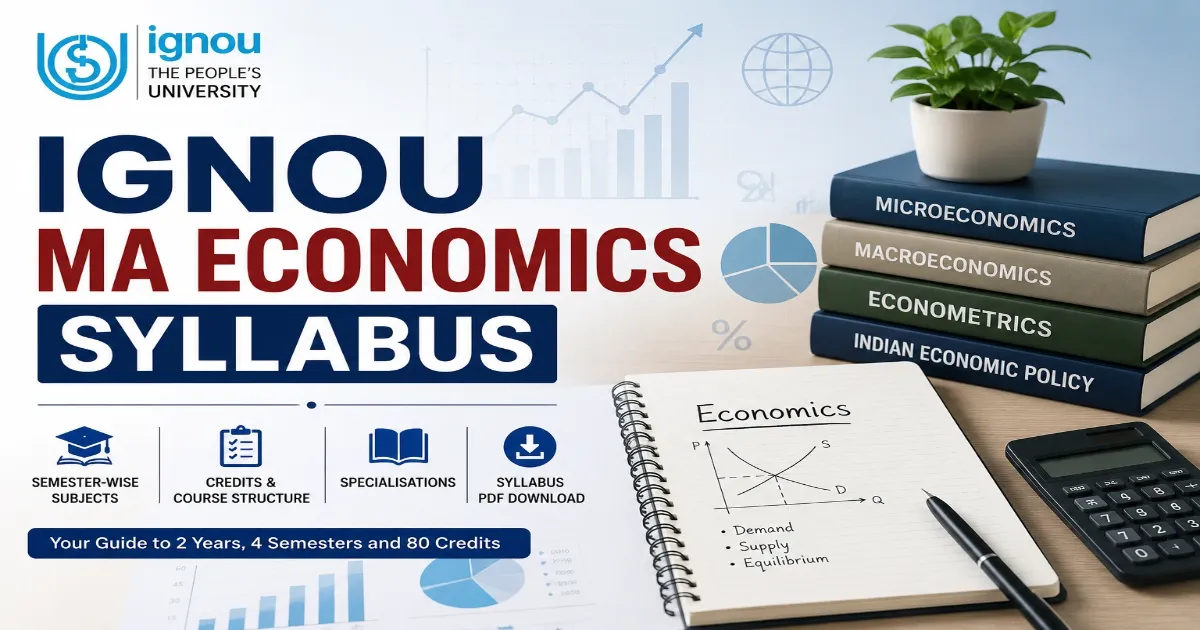
The IGNOU MA Economics syllabus for 2026 is meticulously structured to equip students with advanced knowledge in economic theory and its practical applications. The IGNOU MA Economics syllabus is divided into 2 years and 4 semesters. While the first three semesters focus on compulsory subjects, the fourth semester introduces multiple specialisations. These specializations include Data Analytics, Energy and Environmental Economics, Insurance and Finance, and Social Policy. The IGNOU MA Economics Syllabus comprises a total of 80 credits. This comprehensive postgraduate program features a blend of compulsory courses in microeconomics, macroeconomics, and econometrics, complemented by diverse elective choices. Here, you’ll find a detailed breakdown of subjects, credit distribution, alignment with UPSC Economics Optional, and how to access the official syllabus.
MA Economics IGNOU: Semester-wise Subject Breakdown and Credits 2026
The MA Economics program at IGNOU spans two years, comprising four semesters and a total of 80 credits. This section details the ma economics syllabus ignou, outlining the subject breakdown and credit structure for each semester, including specialization options.
Semester 1
Semester 1 of the MA Economics program covers foundational subjects like Microeconomic Analysis, Macroeconomic Analysis, and Quantitative Methods, totaling 20 credits for the semester.
| Course Code | Course Title | Credits |
| MEC-101 | Microeconomic Analysis | 6 |
| MEC-102 | Macroeconomic Analysis | 6 |
| MEC-203 | Quantitative Methods | 8 |
| Total | 20 |
Semester 2
The second semester focuses on Economics of Growth and Development, Research Methods, and Indian Economic Policy, also contributing 20 credits towards the degree.
| Course Code | Course Title | Credits |
| MEC-104 | Economics of Growth and Development | 8 |
| MEC-109 | Research Methods in Economics | 6 |
| MEC-205 | Indian Economic Policy | 6 |
| Total | 20 |
Semester 3
Semester 3, a compulsory semester, includes core subjects such as Public Economics, International Trade and Finance, and Money, Financial Institutions and Markets, accumulating 20 credits.
| Course Code | Course Title | Credits |
| MEC-106 | Public Economics | 6 |
| MEC-107 | International Trade and Finance/International Trade and Development | 6 |
| MEC-110 | Money, Financial Institutions and Markets | 8 |
| Total | 20 |
Semester 4
The fourth semester offers four specialization groups—Data Analytics, Energy and Environmental Economics, Insurance and Finance, and Social Policy—from which students must choose 20 credits to complete their MA Economics syllabus.
| Specialization Group | Subjects Mentioned in Group | Available Elective Course (Code) | Credits |
| A: Data Analytics | Introductory Econometric Methods, Advanced Econometric Methods, Data Science and Big Data, Artificial Intelligence and Machine Learning, Project Work I | MECE-101: Introductory Econometric Methods | 4 |
| MECE-102: Advanced Econometric Methods | 4 | ||
| MCS-226: Data Scie | |||
| MECP-201: Project Work-I | 6 | ||
| B: Energy and Environmental Economics | Introductory Econometric Methods, Advanced Econometric Methods, Economics of Environment and Social Sector, Project Work I | MECE-101: Introductory Econometric Methods | 4 |
| MECE-102: Advanced Econometric Methods | 4 | ||
| MECE-104: Economics of Environment and Social Sector | 6 | ||
| MECP-201: Project Work-I | 6 | ||
| C: Insurance and Finance | Introductory Econometric Methods, Advanced Econometric Methods, Actuarial Economics, Project Work I | MECE-101: Introductory Econometric Methods | 4 |
| MECE-102: Advanced Econometric Methods | 4 | ||
| MECE-103: Actuarial Economics: Theory and Practice | 6 | ||
| MECP-201: Project Work-I | 6 | ||
| D: Social Policy | Introductory Econometric Methods, Gandhi’s Economic Thoughts, Women in the Economy, Gender Issues in Work, Employment and Productivity, Project Work II | MECE-101: Introductory Econometric Methods | 4 |
| MECP-202: Project Work-II | 4 |
How to Download IGNOU MA Economics Syllabus and Programme Guide 2026
The IGNOU MA Economics syllabus, including programme structure, fee structure, and examination outline, can be easily downloaded. This section details the official method to access the ma economics syllabus ignou and programme guide directly from the university’s website.
-
- Official Website: ignou.ac.in
- Syllabus Content: Includes programme structure, fee structure, and examination outline.
- Download Method: Available from the official website; a direct link is also provided.
- Step 1: Visit the official website of IGNOU at ignou.ac.in.
- Step 2: Click on the “Programmes Offered” link on the homepage.
- Step 3: Click on the ”MA Economics” link among all other subjects.
- Step 4: Click on the “Syllabus” link.
- Step 5: View and download the MA Economics syllabus PDF file.
Compulsory IGNOU MA Economics Subjects
The Master of Arts (Economics) program at Indira Gandhi National Open University (IGNOU) spans two years and four semesters. This table outlines the nine compulsory courses, totaling 60 credits, that students must complete during the first three semesters of the MA Economics program at IGNOU. Each compulsory semester contributes 20 credits towards the overall program.
| Semester | Course Code | Course Title | Credits |
| First Semester | MEC-101 | Microeconomic Analysis | 6 |
| First Semester | MEC-102 | Macroeconomic Analysis | 6 |
| First Semester | MEC-203 | Quantitative Methods | 8 |
| Second Semester | MEC-104 | Economics of Growth and Development | 8 |
| Second Semester | MEC-109 | Research Methods in Economics | 6 |
| Second Semester | MEC-205 | Indian Economic Policy | 6 |
| Third Semester | MEC-106 | Public Economics | 6 |
| Third Semester | MEC-107 | International Trade and Development | 6 |
| Third Semester | MEC-110 | Money, Financial Institutions and Markets | 8 |
Specialisations in IGNOU MA Economics Syllabus
The fourth semester of the IGNOU MA Economics syllabus allows students to pursue a specialization by completing 20 credits from one of the following focus areas aligned with emerging academic and industry needs.
| Specialization Group | Focus Area |
| Group A | Data Analytics |
| Group B | Energy and Environmental Economics |
| Group C | Insurance and Finance |
| Group D | Social Policy |
IGNOU MA Economics Syllabus: NEP 2020 Framework and Multiple Entry-Exit
The IGNOU MA Economics syllabus has been thoroughly restructured to align with the NEP 2020 framework and UGC guidelines, offering a multiple entry-exit system. The MA Economics syllabus at IGNOU now offers multidisciplinary education, including a mix of core and elective courses, as per NEP guidelines 2020. This structure supports flexible learning pathways.
| Feature | Details |
| Programme Structure | Semester-based as per NEP 2020 and UGC guidelines |
| Policy Framework | Aligned with NEP 2020 and UGC regulations on multiple entry-exit, credit norms, and qualification framework |
| Total Duration | 4 Semesters |
| Credits per Semester | 20 Credits |
| Total Programme Credits | 80 Credits |
| Learning Approach | Multidisciplinary curriculum with a combination of core and elective courses |
| Compulsory Coursework | First, Second, and Third Semesters |
| Specialization/Elective Semester | Fourth Semester |
| Number of Specialization Groups | 4 |
| Group A | Data Analytics |
| Group B | Energy and Environmental Economics |
| Group C | Insurance and Finance |
| Group D | Social Policy |
| Credits Required for Specialization | Students must complete 20 credits from a single specialization group to earn that specialization |
| Option Without Specialization | Students may choose any combination of 20 credits from Groups A, B, C, and D without opting for a specific specialization |
| Flexibility Features | Multiple entry-exit options and flexible course selection pathways under NEP 2020 |
IGNOU MA Economics Study Materials (SLMs)
IGNOU provides comprehensive study material, known as IGNOU MEC Books, for its MA Economics program. These materials are designed for flexible, self-paced learning, covering the complete ma economics syllabus ignou in detail to help students prepare for exams and assignments effectively.
| Course Code | Course Name | Block | Chapter/Topic |
| MEC-001 | Micro Economic Analysis Study Material | Block-01 | Consumer Behavior |
| Block-02 | Producer Behavior | ||
| Block-03 | Price and Output Determination-I | ||
| Block-04 | Price and Output Determination-II | ||
| Block-05 | Welfare Economics | ||
| Block-06 | General Equilibrium | ||
| Block-07 | Economics of Uncertainly | ||
| Block-08 | Non-Cooperative Game Theory | ||
| MEC-02 | Macroeconomic Analysis Study Material | Block-01 | Traditional Approaches to Macroeconomics |
| Block-02 | Economic Growth | ||
| Block-03 | Rational Expectations | ||
| Block-04 | Inter-temporal Decision-Making | ||
| Block-05 | Economic Fluctuations | ||
| Block-06 | Unemployment | ||
| Block-07 | Open-Economy Macro-Modelling | ||
| MEC-03 | Quantitative Methods Study Material | Block-01 | Introduction to Differential Calculus |
| Block-02 | Extreme Values and Optimization | ||
| Block-03 | Integral Calculus and Economic Dynamics | ||
| Block-04 | Linear Algebra and Economics Application | ||
| Block-05 | Statistical Methods-I | ||
| Block-06 | Statistical Methods-II | ||
| MEC-004 | Economics of Growth and Development Study Material | Block-1 | Economic Growth Models-I |
| Block-2 | Economic Growth Models-II | ||
| Block-3 | Economic Growth Models-III | ||
| Block-4 | Social and Institutional Aspects of Development | ||
| Block-5 | Theories of Development | ||
| Block-6 | Development Strategies | ||
| MEC-05 | Indian Economic Policy Study Material | Block-01 | Framework of Indian Economy |
| Block-02 | Development Strategies in India |
Recommended Books for IGNOU MA Economics Course
While IGNOU provides comprehensive self-learning materials for all MA Economics subjects, students can strengthen their conceptual understanding and exam preparation through the following reference books:
| Recommended Book | Author(s) |
| Microeconomic Theory | A. Koutsoyiannis |
| Intermediate Microeconomics | Hal R. Varian |
| Macroeconomics | N. Gregory Mankiw |
| Advanced Macroeconomics | David Romer |
| Fundamental Methods of Mathematical Economics | Alpha C. Chiang & Kevin Wainwright |
| Basic Econometrics | Damodar N. Gujarati |
| Economic Development | Michael P. Todaro & Stephen C. Smith |
| Indian Economy | Ramesh Singh |
| Public Finance | Harvey S. Rosen & Ted Gayer |
| International Economics | Dominick Salvatore |
| Money, Banking and Financial Markets | Frederic S. Mishkin |
| Research Methodology: Methods and Techniques | C. R. Kothari |
Frequently Asked Questions
How many credits are required for the IGNOU MA Economics program?
The IGNOU MA Economics program requires a total of 80 credits, with four semesters of 20 credits each. This restructured program aligns with NEP 2020.
What are good reference books for an MA in economics from IGNOU?
For good reference books in MA Economics at IGNOU, consider international publications like Pearson or Tata McGraw Hill. Gregory Mankiw’s “Macroeconomics” is also a helpful reference.
What is ma economics syllabus ignou?
The MA Economics syllabus is restructured into four semesters, each 20 credits. Semesters 1-3 are compulsory, while Semester 4 offers specialization in four distinct areas.
How do I apply for ma economics syllabus ignou?
Apply for IGNOU MA Economics by March 31, 2026, for the January 2026 session. Visit @ignou.ac.in to complete the online application process.
Which specialisations are available in IGNOU MA Economics syllabus?
IGNOU MA Economics offers four specialisations in the fourth semester: Data Analytics, Energy and Environmental Economics, Insurance and Finance, and Social Policy. Students must complete 20 credits within a chosen specialization group.