IIT Council Proposes Adaptive JEE Advanced Exam Based on Students’ Ability
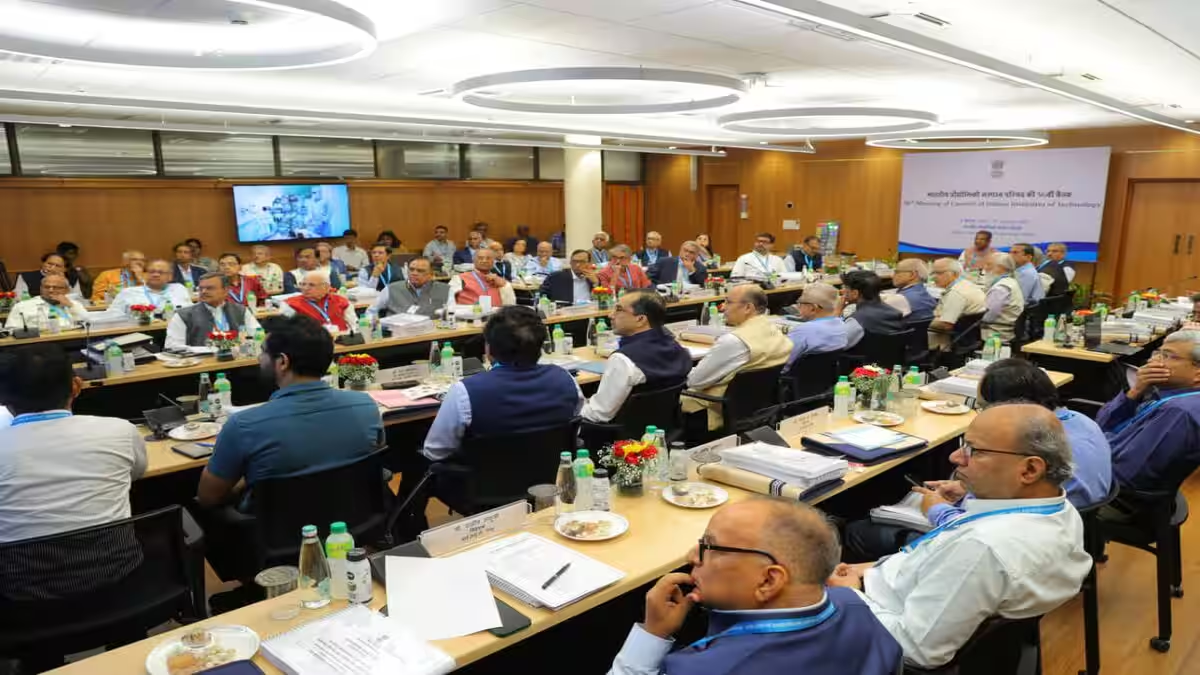
In a potential paradigm shift for one of India’s most competitive entrance examinations, the Council of the Indian Institutes of Technology (IIT Council) has recommended exploring a fundamentally new format for the Joint Entrance Examination (JEE) Advanced — an “adaptive” test tailored to individual student performance. The proposal, revealed in official minutes from the Council’s August 25, 2025 meeting and released publicly this week, aims to reduce stress, curb reliance on coaching, and better assess true analytical ability among applicants.
The JEE Advanced exam, long viewed as a crucible for entry into India’s prestigious IIT system, has drawn criticism for the intense pressure it places on students and their families, as well as for the dominant role of coaching institutes in shaping preparation strategies. Under the proposed model, the exam would dynamically adjust the difficulty and selection of questions in real time, based on how each candidate performs — a departure from the current one-size-fits-all, static question papers.
What Is Adaptive Testing and How Would It Work?
Adaptive testing — already used in some standardized assessments globally — involves an algorithm that selects each subsequent question based on a candidate’s previous responses. A test-taker who answers correctly would receive progressively harder questions, while incorrect answers would pivot the algorithm toward easier or medium-level items. Proponents within the IIT Council argue that this method can more accurately and efficiently gauge a student’s reasoning and problem-solving skills across varying levels of difficulty.
According to the meeting records, IIT Kanpur Director Prof. Manindra Agrawal flagged the need for such innovation, stressing that the current system disproportionately rewards coached rote learning rather than innate aptitude and critical thinking. In an adaptive format, he explained, “aptitude-based questions … can reduce the impact of coaching. Coaching can only train students to use intelligence better; it cannot change that intelligence.”
Pilot Phase and Roadmap
Rather than impose sweeping changes immediately, the Council has advocated for careful testing: an optional adaptive pilot exam to be offered before the next scheduled JEE Advanced, to gather data on student responses, operational challenges and outcomes. Based on analysis of this pilot, the Council envisions crafting a phased roadmap with clear timelines for a possible full transition.
In tandem with the pilot, the Council has also suggested that a free mock adaptive test be made available to students roughly two months prior to the main exam, which is usually held in May. This would allow candidates to familiarize themselves with the adaptive format without cost barriers.
To support implementation, the Council recommended that a specialized panel — led by the JEE Apex Board (JAB) and officials from IIT Kanpur — conduct in-depth evaluations of logistical requirements, security implications, and the potential impact on reducing coaching dependency. The Council also emphasized the need for developing advanced tools capable of generating questions at multiple difficulty tiers.
Addressing the Coaching Culture
A central motivation behind the push for adaptive testing is the perceived overemphasis on coaching institutes in the conventional JEE Advanced system. Critics argue that expensive and extensive coaching coaching regimens have become almost essential to crack the exam under its current format, placing undue financial and emotional strain on students and their families.
Proponents of the new approach argue that an adaptive system — by continuously tailoring question difficulty in real time — would prioritize reasoning ability and conceptual depth over repetitive practice and memorization techniques often taught in coaching centers. The Council believes this could level the playing field for students from diverse socioeconomic backgrounds.
Supporting Mental Health and Student Well-Being
Beyond exam format reforms, the IIT Council also touched on mental health support, another key priority arising from concerns about student stress. The minutes of the Council meeting recommend creating sanctioned posts for mental health professionals — including counsellors, psychologists and psychiatrists — at all IIT campuses, to provide structured and sustained support for the large student population.
This move reflects growing awareness across educational institutions about the toll that high-stakes examinations and academic pressures can take on young adults. The Council has tasked IIT Gandhinagar with devising a comprehensive staffing proposal outlining job structures, career progression and quality assessment mechanisms for mental health cadres.
Concerns and Future Deliberations
While the adaptive testing proposal has been widely discussed within academic circles, its ultimate adoption is not yet guaranteed. Experts emphasize that real-time adaptive systems require robust technology infrastructure, extensive validation of question banks across multiple difficulty levels, and careful calibration to ensure fairness and reliability. There are also concerns about how adaptive testing might impact students differently based on their test-taking strategies and psychological responses to changing difficulty patterns.
Moreover, any fundamental change to one of India’s flagship competitive exams is likely to be scrutinized by students, parents, educators and policymakers alike. Many aspirants and coaching experts may seek clarity on scoring mechanisms, practice resources, and transition plans should adaptive testing be introduced in future cycles.
Looking Ahead: Evolution Rather Than Revolution
The IIT Council’s recommendation represents a significant shift in philosophy: moving away from standardized, static testing to a more individualized, performance-based assessment strategy. Whether this vision materializes into a concrete reality for JEE Advanced 2026 or subsequent years remains to be seen, but the dialogue itself reflects evolving perspectives on how best to identify and nurture engineering talent in India.
As deliberations continue, stakeholders across the education spectrum will be watching closely — mindful that the future of adaptive testing could redefine not just an exam, but the very fabric of competitive assessment in the country.