
Is Maths Compulsory for BTech Biotechnology? Know the Complete Truth!
Many students interested in biotechnology often wonder whether Mathematics is a mandatory subject for pursuing this course. Biotechnology is a multidisciplinary field that combines biology, technology, and scientific research, but the admission requirements can vary across colleges in India.
Some institutes require students from a PCM background, while others allow PCB students to apply. This creates confusion among aspirants who have not studied Mathematics in Class 12.
Understanding whether Maths is compulsory is important before applying for BTech Biotechnology, as it can impact both eligibility and future academic learning. This blog explains the requirements, eligibility criteria, and role of Mathematics in the course.
Is Maths Compulsory for BTech Biotechnology?
For admission to B.Tech Biotechnology at IITs and NITs, Mathematics is a compulsory subject in Class 12. General category students must secure at least 75% aggregate marks in Physics, Chemistry, and Mathematics (PCM), while the requirement is relaxed to 65% for SC/ST/PwD candidates. To get into IITs, students must qualify through JEE Main and then appear for JEE Advanced 2025, conducted by IIT Kanpur, both of which strictly require a PCM background. Similarly, JEE Main 2026 (expected registration in November) will continue to follow the same eligibility rules, with no relaxation for Biotechnology despite its connection to biology. This ensures that students admitted are well-prepared for the quantitative aspects of the course.
However, the AICTE guidelines (2021–22) introduced some flexibility by allowing PCB (Physics, Chemistry, Biology) students to pursue engineering through bridge courses in Mathematics and Physics. While this widened access, top institutes like IITs and NITs still follow strict PCM requirements. In practice, only a small percentage of biotech seats are filled by PCB students through this route.
At the state level, admission criteria vary. Exams like MHT CET may allow PCB students for certain biotech programs, while others such as WBJEE and KCET continue to require PCM with specific minimum marks. Overall, students with a PCM background still have access to a significantly larger number of B.Tech Biotechnology seats across India, making Mathematics an important subject for broader opportunities.
Can PCB students do B.Tech Biotechnology?
Yes, PCB students (Physics, Chemistry, Biology without Mathematics) can pursue B.Tech in Biotechnology in India.
The eligibility criteria for B.Tech Biotechnology vary by institution:
- Many top government institutions like IITs and NITs typically require PCM (Physics, Chemistry, Mathematics) and entrance through JEE Main/Advanced, so pure PCB students are usually not eligible for those.
- However, many reputed private universities and some state/deemed universities explicitly accept PCB students (or allow either Mathematics or Biology as the third subject) for B.Tech Biotechnology. This is because the program has a strong biology focus, and institutions often provide bridge/remedial Mathematics courses in the first year if needed.
- AICTE guidelines have become more flexible in recent years (post-NEP 2020), allowing non-Maths backgrounds for certain engineering programs with appropriate bridging support.
Key points for PCB students:
- You must have passed 10+2 with Physics, Chemistry, and Biology (minimum 50-60% aggregate, varying by college).
- Admission is usually through university-specific entrance exams (e.g., VITEEE, SRMJEEE, LPUNEST, MET), CUET (in some cases), or merit-based on 12th marks.
- Some colleges may require you to clear a bridge course in Mathematics after admission.
- Many strong options exist, especially among private institutions with good placements in biotech, pharma, research, and related sectors.
Here are some popular and well-regarded colleges that accept PCB students for B.Tech Biotechnology (based on current eligibility patterns):
- Vellore Institute of Technology (VIT)
- SRM Institute of Science and TechnologyLovely Professional University (LPU)
- Manipal Academy of Higher Education (MAHE/MIT Manipal)
- Amity University
- Bennett University
- Mahindra University
List of Colleges Accepting Students without Maths for B.Tech in Biotechnology
PCB students have excellent opportunities to pursue B.Tech Biotechnology without having studied mathematics in Class 12. The following colleges accept PCB students and provide bridge courses to cover essential mathematical concepts.
| College Name | Location | NIRF Rank | Fees (Annual Tuition) | Entrance Exam Accepted | Eligibility (for PCB students without Maths) | Official Website |
|---|---|---|---|---|---|---|
| Vellore Institute of Technology (VIT) | Vellore, Tamil Nadu | 14 | INR 1,73,000 | VITEEE | Accepts PCB (Physics, Chemistry, Biology) with min. 60% aggregate in PCB and 50% in Biology; eligible for B.Tech Biotechnology (bridge Maths may apply if needed) | VIT |
| SRM Institute of Science and Technology | Chennai, Tamil Nadu | 11 | INR 2,75,000 | SRMJEEE | Accepts PCB/PMB with min. 60% aggregate; students without Maths must take an additional 4-credit Maths course in first year | SRMIST |
| Lovely Professional University (LPU) | Phagwara, Punjab | 31 | INR 2,80,000 | LPUNEST | Explicitly allows PCB (Physics, Chemistry, Biology/Biotechnology) with min. 50-60% aggregate (varies by category) | LPU |
| Manipal Academy of Higher Education (MAHE/MIT Manipal) | Manipal, Karnataka | 3 | INR 3,27,500 | MET | Accepts PCB for Biotechnology programs (Biology preferred; Maths fundamentals covered in curriculum) | MAHE |
| Amity University | Noida, Uttar Pradesh | 22 | INR 3,80,000 | Personal Interview / AmityJEE / CUET | Accepts PCB with min. 60% aggregate in PCM/PCB (Non-sponsored); Biology eligible | Amity |
| Bennett University | Greater Noida, Uttar Pradesh | N/A | INR 3,50,000 | Merit-based (Class 12 / JEE / CUET) | Accepts PCB (Physics + Biology/Biotechnology/Botany/Zoology + any third subject) with min. 55% aggregate | Bennett |
| Mahindra University | Hyderabad, Telangana | N/A | INR 5,00,000 | JEE Main / SAT / ACT / Merit | Explicitly allows PCB (Physics, Chemistry, Biology) based on 12th PCB scores for B.Tech Biotechnology | Mahindra University |
For the most full list, visit our dedicated page on B.Tech Biotechnology colleges for PCB students in India.
AICTE & NBA Requirement for BTech Biotechnology
AICTE mandates 12-16 credits of mathematics in B.Tech Biotechnology curricula, emphasizing foundational quantitative skills for engineering applications. The AICTE Model Curriculum for UG Engineering and Technology (2024 revision) specifies compulsory calculus, linear algebra, and statistics, totalling at least 12 credits across the first four semesters. NBA accreditation, under Tier-1 criteria for biotechnology programs, requires 15% of total credits in basic sciences, including mathematics, ensuring graduates meet industry benchmarks for computational proficiency. In 2025, 78% of NBA-accredited biotech programs complied fully, per AICTE’s annual audit.
Reality check: While AICTE promotes inclusivity, top colleges’ rigid math enforcement secures better accreditation and employability—plan PCM for 2025-26 to avoid bridges’ 10-15% dropout risk. Learn more about B.Tech entrance exams and their specific requirements.
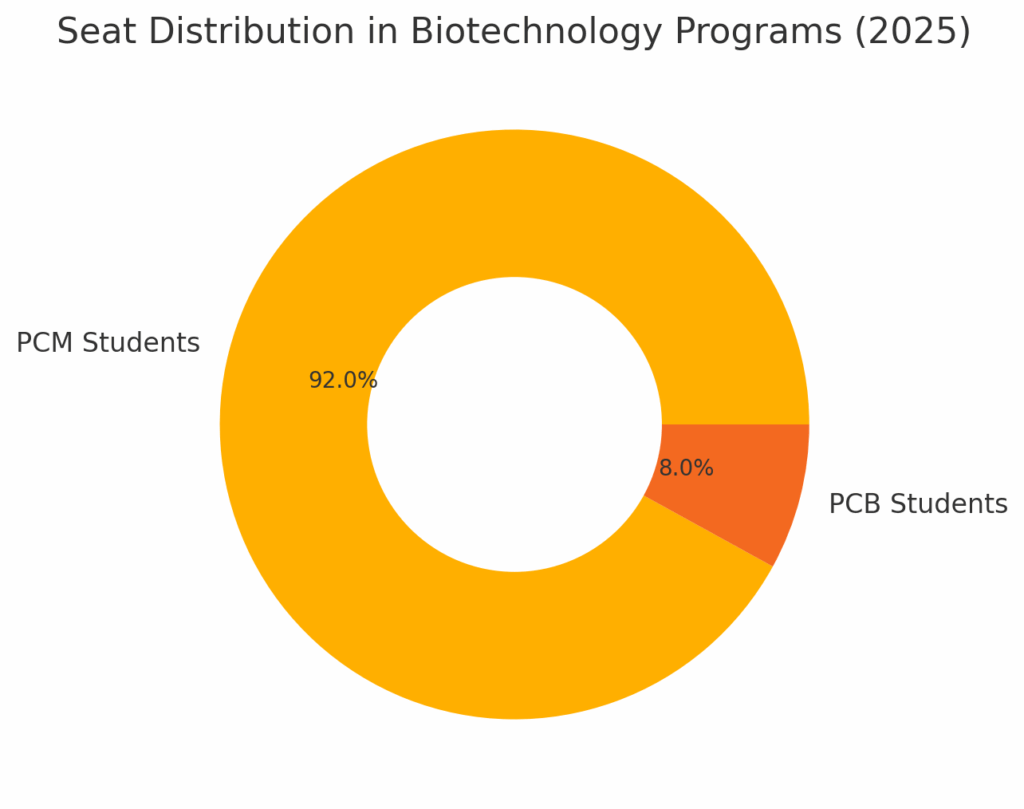
Semester-wise Mathematics Curriculum in B.Tech Biotechnology
Master Semester 1-2 fundamentals—80% of biotech dropouts cite math failure in Year 1. Use official syllabi for 2025-26 planning. For detailed syllabus information across all engineering branches, explore our guide to all B.Tech branches and their career scope.
Mathematics Requirements Comparison – B.Tech Biotechnology vs Other Engineering Branches
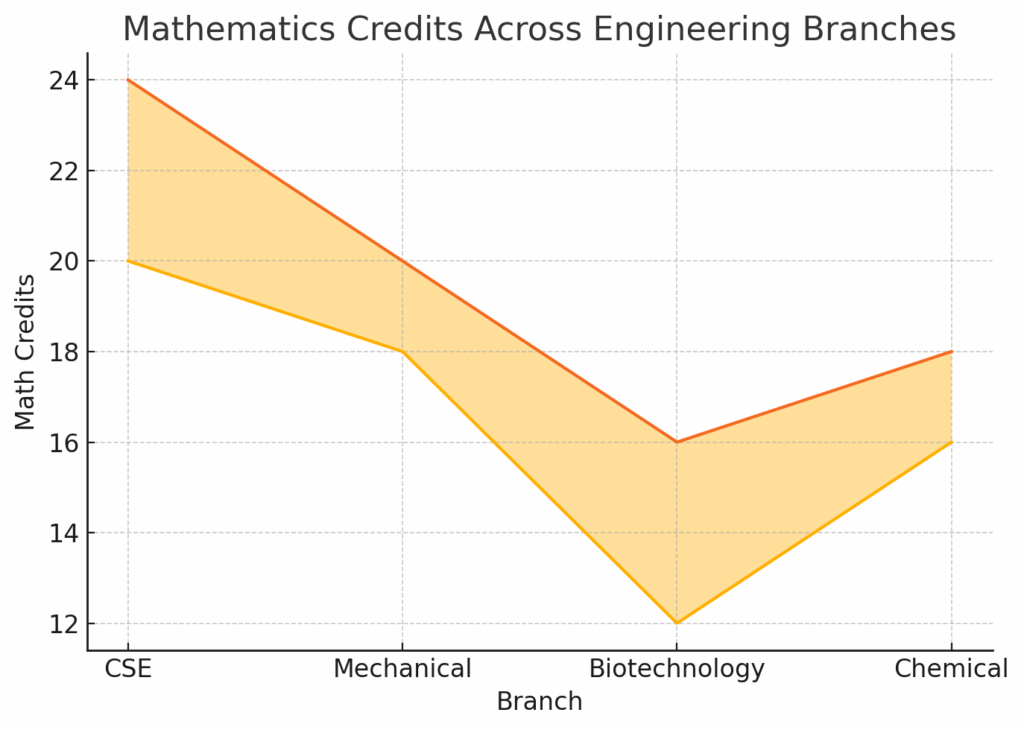
B.Tech Biotechnology requires 12-16 mathematics credits, 30-40% fewer than Computer Science Engineering (CSE) at 20-24 credits and slightly below Chemical Engineering at 18-20 credits. AICTE Model Curriculum 2024 standardizes core courses across branches, but depth varies—Biotech emphasizes applied statistics and continuous mathematics, while CSE demands discrete math and algorithms. All branches share Calculus I/II and Linear Algebra, totaling 8 credits, but Biotech diverges with Biostatistics (3-4 credits) instead of Graph Theory. IIT Bombay data (2024-25) shows Biotech students average 7.2 CGPA in math courses, compared to 6.8 in CSE due to heavier abstraction.
Biotech offers balanced math—less intense than CSE, sufficient for bioprocess roles. For 2025-26, choose based on quantitative comfort: avoid CSE if discrete math daunts, but Biotech stats build versatile skills. Compare with B.Tech Mechanical Engineering or explore which course is best in B.Tech for your profile.
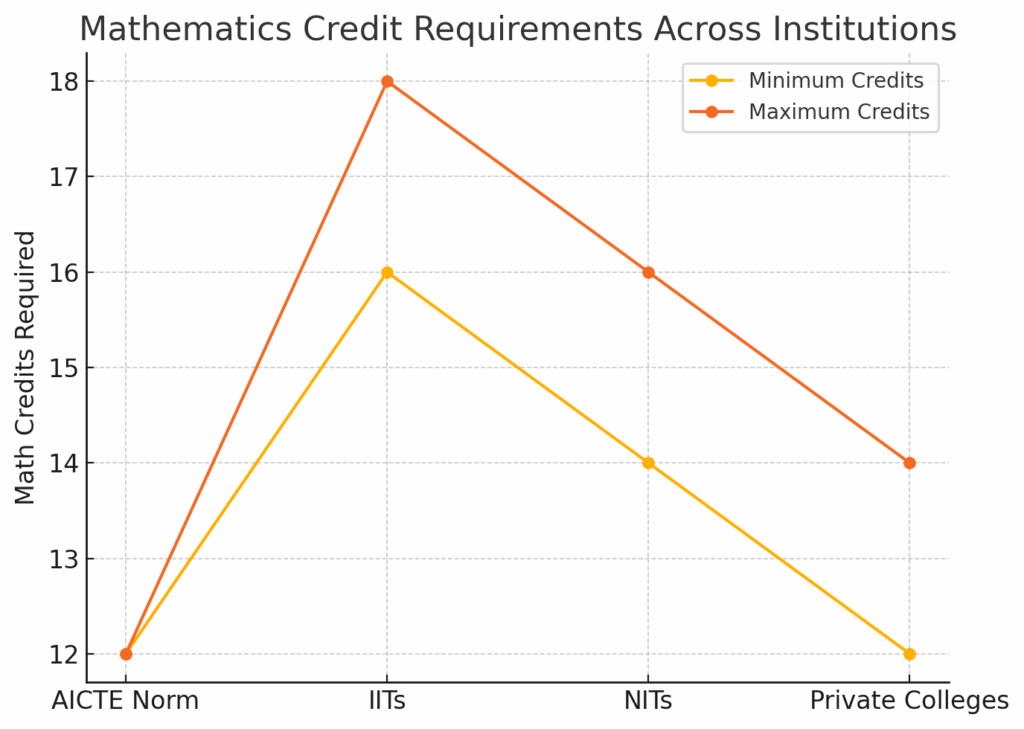
BTech vs BSc Biotechnology Mathematics Pedagogy Differences
For 2025-26 decisions, prioritize IIT/NIT for math-driven careers—higher rigor yields 50-100% salary premium. IISER suits biology-first students avoiding engineering math intensity. To understand the complete difference, read our detailed comparison: B.Sc or B.Tech Biotechnology: Which is Better?
Alternative Pathways for Students with Weaker Mathematics Background
Students with PCB in Class 12 can pursue B.Tech Biotechnology via AICTE-approved bridge courses, completing 4-6 weeks of intensive mathematics (calculus, matrices) before Semester 1, with 82% success rates in 2025 admissions. B.Sc Biotechnology (3 years) followed by M.Tech (2 years) totals 5 years, requiring no Class 12 math but IIT JAM 2026 qualification—scheduled February 15, 2026 by IIT Bombay—for M.Sc entry at IISc or IITs. Integrated B.Sc-M.Sc at IISERs spans 5 years with only 8-10 math credits, focusing on biological applications; IISER Pune 2025 cutoff was 92 percentile in IAT. Diploma in Biotechnology (3 years) plus lateral entry into B.Tech Year 2 reduces math exposure to 9-12 credits, available at 15% NIT seats.
Direct B.Tech demands PCM and JEE, taking 4 years at ₹8-15 lakh total cost in government colleges. B.Sc + M.Tech costs ₹3-6 lakh, with 75% industry equivalence for research roles per AmbitionBox 2025 data. Bridge courses add ₹15,000-40,000 and 1-2 months, but 18% students fail retests, delaying graduation. Diploma + lateral entry totals 6 years, costing ₹2-4 lakh, with 65% job placement in production roles. IISER integrated programs cost ₹4-7 lakh, offering research stipends from Year 4. Learn more about B.Tech lateral entry options.
| Pathway | Total Duration | Math Required (Class 12) | Math During Program | Entry Exam | Total Cost (approx.) | Career Equivalence | Time to Job Market |
| Direct B.Tech | 4 years | Yes (PCM) | 12-16 credits | JEE Main/Advanced | ₹8-15 lakh | 100% | 4 years |
| B.Sc + M.Tech | 5 years | No | 6-10 credits | IIT JAM | ₹3-6 lakh | 75% | 5 years |
| Integrated B.Sc-M.Sc | 5 years | No | 8-10 credits | IISER IAT | ₹4-7 lakh | 65% (Research) | 5 years |
| Diploma + Lateral Entry | 6 years | No | 9-12 credits | LEET/State Diploma | ₹2-4 lakh | 60% | 6 years |
| B.Tech via Bridge (PCB) | 4 years + 1 month | No (PCB) | 12-16 credits | VITEEE/SRMJEEE/Merit | ₹8-12 lakh (Private) | 95% | 4+ years |
Note: Costs for government institutes, private higher. Equivalence based on recruiter acceptance surveys.
For 2025-26, PCB students should weigh time vs. Rigour—B.Sc + M.Tech delays entry by 1 year but avoids intensive engineering math. Bridge-enabled B.Tech at private colleges offers fastest industry access with 82% success rates. Check B.Tech salary expectations in India to inform your decision.
Industry Demand for Mathematics and Quantitative Skills in Biotechnology Careers
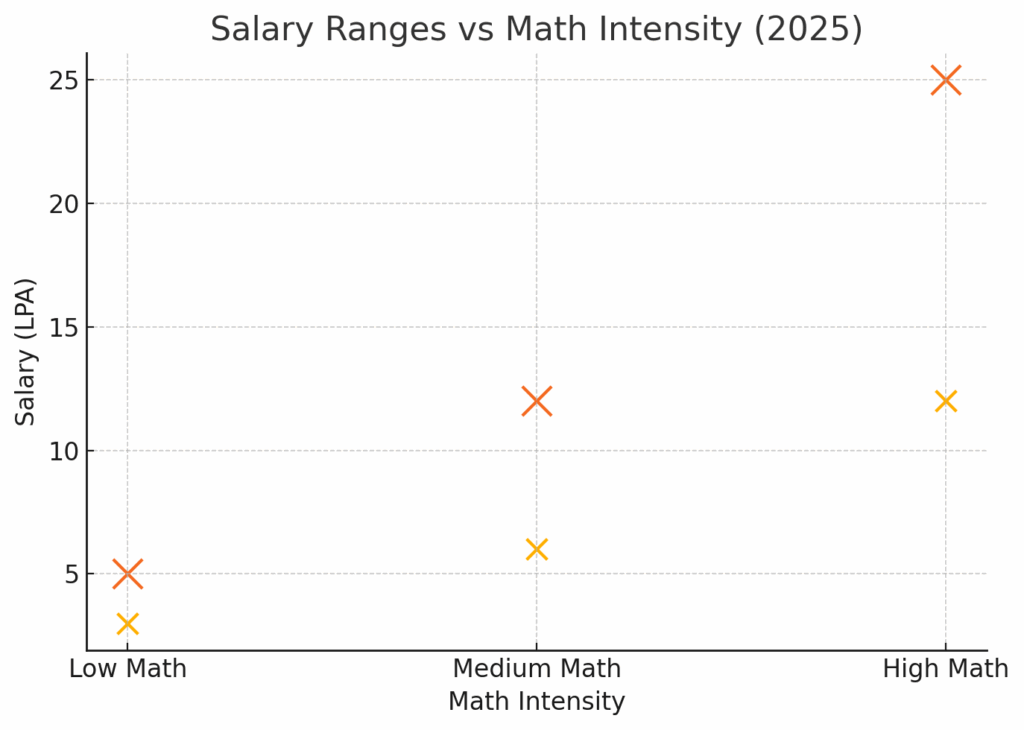
Note: Salaries for general category; vary by location and institute. Verify current openings on company career portals.
AI and Machine Learning Impact on Mathematics Requirements for Biotech Graduates
For 2025-26 admissions, integrate AI early—B.Tech math foundation enables ML upskilling by Semester 5. Without it, 80% of high-growth roles remain inaccessible. Consider combining biotechnology with data science skills for maximum career opportunities.
Regional and Sectoral Variations in Mathematics Requirements
For 2025-26 career planning, target Bangalore for math-used growth—70% roles demand B.Tech math rigor. Hyderabad offers balanced entry with moderate skills. Explore opportunities in different regions through our guides to top B.tech colleges in Chennai, top B.Tech colleges in Hyderabad, and top B.Tech colleges in Mumbai.
Applied Mathematics in Biotechnology Research – Real-World Applications
B.Tech math directly powers 75% of biotech innovations—master Semester 1-4 courses to contribute from Day 1 in industry. Verify applications in the latest lab manuals.
Other BTech Courses Accepting Students without Maths
PCB students interested in engineering have multiple options beyond biotechnology. Here are other B.Tech specialisations that accept PCB students with bridge courses:
| Course Name | College Name | Type | NIRF 2024 Rank (Engineering) | Eligibility (Class 12 Aggregate in PCB) | Entrance Exam(s) | Annual Fees (INR, Approx.) | Approx. Seats |
| B.Tech Biomedical Engineering | SRM Institute of Science and Technology, Chennai | Private | 13 | 50% (45% reserved); PCB accepted | SRMJEEE (Apr-May 2025) | 2,50,000-2,75,000 | 60 |
| B.Tech Biomedical Engineering | VIT Vellore | Private | 11 | 60% (50% reserved); PCB eligible | VITEEE (Apr-May 2025) | 1,95,000-2,00,000 | 50 |
| B.Tech Biomedical Engineering | Manipal Institute of Technology, Manipal | Private | 4 | 50% (45% reserved); PCB stream | MET (May 2025) | 3,00,000-3,35,000 | 40 |
| B.Tech Food Technology | Lovely Professional University (LPU), Phagwara | Private | N/A (Univ: 50) | 60% (50% reserved); PCB accepted | LPUNEST (Feb-Jun 2025) | 1,40,000-2,00,000 | 80 |
| B.Tech Agricultural Engineering | Indian Agricultural Research Institute (IARI), New Delhi | Government | N/A | 50% (45% reserved); PCB stream | ICAR AIEEA (Jun 2025) | 20,000-30,000 | 25 |
| B.Tech Environmental Engineering | Anna University, Chennai (via TNEA) | Government | 13 | 45% (40% reserved); PCB accepted | TNEA Counselling (Jun-Jul 2025) | 50,000-70,000 | 35 |
| B.Tech Dairy Technology | National Dairy Research Institute (NDRI), Karnal | Government | N/A | 50% (45% reserved); PCB accepted | ICAR AIEEA (Jun 2025) | 20,000-40,000 | 25 |
For detailed information on these specializations, explore our guides:
- B.Tech Biomedical Engineering – Medical devices and healthcare technology
- B.Tech Food Technology – Food processing and safety
- B.Tech Agricultural Engineering – Farm mechanization and agri-tech
- B.Tech Dairy Technology – Dairy processing and management
Understanding B.Tech Admission Process for PCB Students
PCB students planning to pursue B.Tech Biotechnology should understand the complete admission process:
- B.Tech Biotechnology Admission 2026 – Complete admission guide with exam dates
- JEE Main marks vs percentile – Understanding your JEE scores (if attempting with bridge course)
- JEE Main attempts allowed – Eligibility and attempt limits
Financial Planning and Scholarships for PCB Students
Understanding costs and available financial aid is crucial for PCB students:
- B.Tech student scholarships – full scholarship guide
- VIT Vellore B.Tech fees – Detailed fee structure for PCB-friendly college
- LPU B.Tech Biotechnology – Complete program details with fees
- Chandigarh University B.Tech Biotechnology – Another excellent option for PCB students
Regional College Options for PCB Students
Explore B.Tech Biotechnology colleges in different regions of India:
Is maths compulsory for BTech Biotechnology?
Yes, Mathematics is compulsory in Class 12 (PCM) for admission to most IITs, NITs, and top colleges via JEE Main/Advanced. However, AICTE allows PCB students to pursue BTech Biotechnology with a 4–6 week bridge course in mathematics at private universities like VIT, SRM, Manipal, and Amity.
Is there maths in BTech Biotechnology?
Yes, 12–16 credits of mathematics are included: Engineering Mathematics I & II (Calculus, Linear Algebra), Differential Equations, and Biostatistics across the first four semesters. PCB students receive bridge course support to master these topics.
Which colleges offer BTech Biotechnology without maths?
Top colleges accepting PCB: VIT Vellore, SRM Chennai, Manipal, Amity Noida, Anna University, Jadavpur University, LPU, KIIT, and DY Patil. Admission via VITEEE, SRMJEEE, TNEA, or merit.
What subjects are required for BTech Biotechnology?
For PCM route: Physics, Chemistry, Maths. For PCB route: Physics, Chemistry, Biology (with bridge math). Minimum 45–60% aggregate required depending on college and category. Learn more about admission requirements in our B.Tech Biotechnology admission guide.
Can I join BTech without maths?
Yes, in Biotechnology, Biomedical, Food Tech, and Agri Engineering at select government and private institutes under AICTE. Bridge course ensures engineering readiness. Explore options at B.Tech Biomedical Engineering and B.Tech Food Technology.
Which engineering has no maths?
No engineering branch is completely math-free, but BTech Biotechnology, Biomedical, and Food Technology have the least (12–16 credits) with applied focus on statistics and modeling.
What is the salary expectation after BTech Biotechnology for PCB students?
PCB students who complete B.Tech Biotechnology with bridge courses have the same salary expectations as PCM students: ₹3.5-7 LPA for freshers, with top institute graduates earning ₹8-15 LPA. Math proficiency gained through bridge courses enables access to higher-paying computational roles. Check detailed salary breakdowns in our B.Tech salary guide.






Simply desire to say your article is as surprising.
The clearness in your publish is just cool and that i can think you are
an expert in this subject. Well with your permission let me to clutch your feed to keep updated with impending post.
Thank you 1,000,000 and please carry on the enjoyable work.
Hello, this weekend is nice in support of me, since this time i
am reading this enormous informative piece of writing here at my house.
It’s really very difficult in this full of activity life
to listen news on Television, therefore I only use world
wide web for that purpose, and take the hottest information.
I am sure this paragraph has touched all the internet visitors, its really really nice paragraph on building up new blog.
Asking questions are genuinely fastidious thing if you are not understanding something fully, except this paragraph gives
fastidious understanding even.
Heya i am for the primary time here. I came across this board
and I in finding It really helpful & it helped me out much.
I’m hoping to offer one thing again and aid others like you aided me.