LLB Entrance Exams 2026: Eligibility, Registration, Important Dates , Syllabus, Exam Pattern & Cutoff
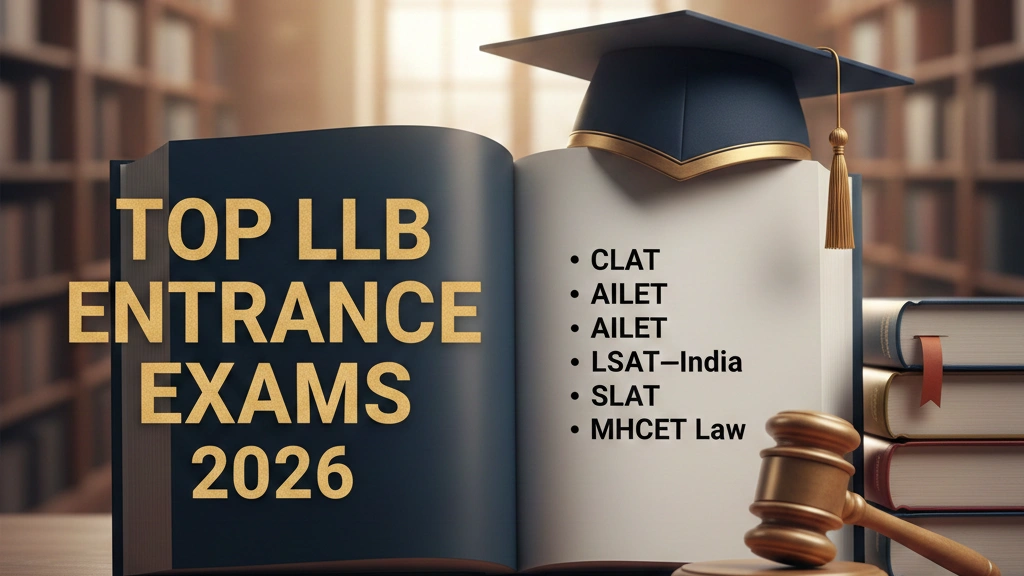
The dream of becoming a lawyer continues to inspire thousands of students across India every year. In 2026, the path to top law schools remains highly competitive, with major entrance exams such as CLAT, AILET, DU LLB (through CUET PG), LSAT India, SLAT, and various state-level tests serving as key gateways to prestigious National Law Universities, Delhi University’s Faculty of Law, and other leading institutions.
Many 2026 cycles have already begun or concluded key stages, including CLAT 2026 registration (closed in December 2025) and AILET 2026 (closed mid-December 2025). Fresh aspirants are now focusing on upcoming results, counselling rounds, and the next application windows. Knowing exact registration dates, exam schedules, eligibility rules, result timelines, detailed syllabi, and exam patterns is crucial for smart preparation and strong performance.
This full guide to LLB Entrance Exams 2026 covers everything you need to plan effectively and secure admission to a top law school.
Also Read: LLB Course Guide: Admissions, Top Colleges & Career Scope
LLB Entrance Exam Dates 2026
The LLB Entrance Exam Dates 2026 section is crucial for aspirants, as most major exams for admission to the 2026-2027 academic year (5-year integrated LLB and 3-year LLB programs) were held in late 2025 or are scheduled in early 2026. As of 2026, registration for several key exams has closed, with results, counselling, or upcoming cycles in focus.
| Exam | Conducting Body | Registration Start Date | Registration Last Date | Exam Date(s) | Key Notes |
| CLAT 2026 | Consortium of NLUs | August 1, 2025 | November 7, 2025 (extended) | December 7, 2025 | Closed; results awaited in January 2026 |
| AILET 2026 | NLU Delhi | August 7, 2025 | December 14, 2025 (extended/varied) | December 14, 2025 | Closed; admit card released late Nov 2025 |
| SLAT 2026 | Symbiosis International University | August 1, 2025 | November 30, 2025 | December 20 & 28, 2025 | Closed; results declared January 15, 2026 |
| LSAT India 2026 | LSAC (for participating colleges) | Varies (multiple windows) | Varies by test window | Multiple dates (Jan-May 2026) | Ongoing windows; flexible scheduling |
| MH CET Law 2026 (5-year LLB) | CET Cell Maharashtra | Expected early 2026 | Expected March/April 2026 | May 8, 2026 | Upcoming; check cetcell.mahacet.org |
| MH CET Law 2026 (3-year LLB) | CET Cell Maharashtra | Expected early 2026 | Expected March/April 2026 | April 1-2, 2026 | Upcoming; separate from 5-year |
| DU LLB (via CUET PG 2026) | NTA (for 3-year LLB) | Expected Dec 2025/Jan 2026 | Expected Feb/March 2026 | March/April 2026 (tentative) | CUET PG 2026 correction ongoing; exam pending |
CLAT 2026
The CLAT 2026 (Common Law Admission Test) is the premier national-level entrance exam for admission to undergraduate (5-year integrated LLB) and postgraduate (LLM) programs at 25 National Law Universities (NLUs) across India, plus several other participating institutions. Conducted by the Consortium of National Law Universities, the exam took place on December 7, 2025, with results declared on December 16, 2025.
Currently, the admissions counselling process is ongoing, with multiple rounds of seat allotment in progress (e.g., Round 2 cut-offs released recently, showing competitive shifts in top NLUs like NLSIU Bengaluru and NALSAR Hyderabad). Candidates should regularly check the official portal for further allotment lists, fee payment deadlines, and spot rounds.
CLAT Exam Dates 2026
The CLAT 2026 cycle for the 2026-2027 academic year followed this key timeline (all dates confirmed by the Consortium of NLUs):
| Event | Date | Status/Notes |
| Notification Release | July 20, 2025 | Official announcement |
| Registration Start | August 1, 2025 | Online portal opened |
| Registration Last Date | November 7, 2025 (extended) | Original October 31; extended once |
| Admit Card Release | November 22, 2025 | Download from consortiumofnlus.ac.in |
| CLAT 2026 Exam Date | December 7, 2025 (2:00 PM – 4:00 PM) | Offline, pen-and-paper mode |
| Provisional Answer Key | December 10, 2025 | Objections window: Dec 10-12 |
| Final Answer Key & Result | December 16, 2025 | Scorecards available; counselling started |
| Counselling Rounds | December 17, 2025 onwards | Ongoing in January 2026 (multiple rounds) |
Note: The exam evaluated candidates out of 119 marks for UG (one question withdrawn). Monitor consortiumofnlus.ac.in for the latest counselling updates.
People Also Read




CLAT Eligibility
CLAT 2026 eligibility criteria for the Undergraduate (UG) program (5-year integrated LLB) are as follows (no upper age limit applies):
| Category | Educational Qualification | Minimum Marks Requirement | Additional Notes |
| General / OBC / EWS / PWD | Passed 10+2 or equivalent examination | 45% aggregate or equivalent grade | Candidates appearing in March/April 2026 also eligible (provisional admission) |
| SC / ST | Passed 10+2 or equivalent examination | 40% aggregate or equivalent grade | Relaxation as per norms |
| Appearing Candidates | Appearing for qualifying exam in 2026 | Provisional eligibility | Must submit proof by September 30, 2026 |
There is no upper age limit for CLAT UG. For PG (LLM), separate criteria apply (LLB with 50%/45% for General/SC-ST). Always verify on the official website for any updates.
CLAT Exam Pattern
The CLAT 2026 UG exam was a 2-hour offline test with 120 multiple-choice questions (1 mark each), negative marking of 0.25 for wrong answers, and focus on comprehension and reasoning.
| Section | Number of Questions (Approximate) | Marks | Key Features |
| English Language | 22-26 | 22-26 | Passage-based (450 words); comprehension, grammar, vocabulary |
| Current Affairs, including GK | 28-32 | 28-32 | Static GK + recent events (national/international) |
| Legal Reasoning | 28-32 | 28-32 | Principle-based passages; legal aptitude |
| Logical Reasoning | 22-26 | 22-26 | Critical reasoning, arguments, inferences |
| Quantitative Techniques | 10-14 | 10-14 | Class 10-level maths; data interpretation |
| Total | 120 | 120 | 120 minutes; no sectional time limits |
Note: One question was withdrawn post-exam, so final scoring was out of 119 marks. The pattern emphasizes reading speed and analytical skills over rote learning.
CLAT Syllabus
The CLAT 2026 UG syllabus assesses aptitude for law through passage-based questions (no direct legal knowledge required beyond principles provided).
| Section | Key Topics / Focus Areas | Preparation Tips |
| English Language | Reading comprehension, vocabulary (synonyms/antonyms), grammar, sentence correction, idioms | Read editorials, practice RC from newspapers |
| Current Affairs, including GK | National/international events, awards, sports, economy, science/tech, history, polity (last 1-2 years) | Follow daily news, monthly magazines |
| Legal Reasoning | Legal principles, propositions, facts; contracts, torts, constitution, criminal law basics | Understand principles; practice application |
| Logical Reasoning | Arguments, assumptions, inferences, analogies, puzzles, syllogisms, critical reasoning | Solve puzzles, strengthen analytical skills |
| Quantitative Techniques | Ratios, percentages, averages, profit/loss, time-speed-distance, basic algebra, data interpretation (graphs/tables) | Class 10 NCERT maths; quick calculation practice |
The syllabus promotes comprehension, reasoning, and awareness rather than prior legal study. Official details are available on consortiumofnlus.ac.in. Aspirants preparing for future cycles (e.g., CLAT 2027) should align with this structure for effective preparation.
DU LLB 2026
The DU LLB entrance for the 3-year LLB program at the Faculty of Law, University of Delhi (including Campus Law Centre, Law Centre-I, and Law Centre-II) is now conducted through CUET PG 2026 (Common University Entrance Test – Postgraduate) by the National Testing Agency (NTA). This computer-based test serves as the sole gateway for admission to approximately 2,889 seats (subject to final allocation).
Currently, the application correction window is ongoing (until January 30, 2026), with the exam scheduled in March 2026. After the exam, candidates must register on the University of Delhi’s CSAS (PG) portal for counselling and seat allotment based on CUET PG scores. This shift to CUET PG emphasises standardised, skill-based assessment for graduate aspirants from any discipline.
DU LLB Exam Dates 2026
Admission to DU LLB 2026 is through CUET PG 2026 (paper code: COQP11 for LLB/General Test). Key tentative and confirmed dates (based on NTA notifications; always verify on exams.nta.nic.in/cuet-pg):
| Event | Date(s) | Status/Notes |
| Notification & Application Start | December 14, 2025 | Online portal opened |
| Registration Last Date | January 23, 2026 (extended) | Final extended deadline (11:50 PM) |
| Application Fee Payment Deadline | January 25, 2026 (tentative) | Via net banking/UPI/credit/debit card |
| Application Correction Window | January 28 – 30, 2026 | Ongoing as of January 30, 2026 |
| Advance City Intimation Slip | February 2026 (tentative) | To be notified |
| Admit Card Release | February/March 2026 (tentative) | 4-7 days before exam; download from NTA site |
| CUET PG 2026 Exam Date (including LLB) | March 13 – April 1, 2026 (tentative window) | CBT mode; exact shift/date on admit card |
| Provisional Answer Key & Challenges | April 2026 (tentative) | Objection window post-exam |
| Final Answer Key & Result Declaration | May 2026 (tentative) | NTA scores (percentile/normalized) released |
| DU CSAS (PG) Registration & Counselling | May/June 2026 onwards (tentative) | Seat allotment rounds based on CUET scores |
Note: The exam is conducted in multiple shifts; normalization applies via equi-percentile method. Check exams.nta.nic.in/cuet-pg and admission.uod.ac.in for real-time updates.
DU LLB Eligibility
Eligibility for DU LLB 2026 (via CUET PG) follows NTA and University of Delhi norms. There is no upper age limit.
| Category | Educational Qualification | Minimum Marks Requirement | Additional Notes |
| General / EWS / OBC-NCL | Bachelor’s degree (3-year or 4-year) in any discipline from a recognized university | 50% aggregate or equivalent grade | Appearing candidates in final year eligible (provisional admission subject to proof) |
| SC / ST / PwBD | Bachelor’s degree (3-year or 4-year) in any discipline from a recognized university | 45% aggregate or equivalent grade | Relaxation as per government norms |
| Appearing Candidates | Pursuing final year/semester of qualifying degree in 2026 | Provisional eligibility | Must submit passing certificate/marksheet by specified deadline (usually September/October 2026) |
Candidates must appear in CUET PG 2026 (COQP11 paper) and meet program-specific criteria. Foreign nationals follow separate FSR guidelines.
DU LLB Exam Pattern
CUET PG 2026 for DU LLB (COQP11 – General/LLB paper) is a single-subject test focused on aptitude for law studies. It is a computer-based test (CBT) with no sectional time limits.
| Parameter | Details | Key Features |
| Mode | Computer-Based Test (CBT) | Online, objective-type |
| Duration | 90 minutes (revised from previous 105 min) | Reduced time; high speed & accuracy needed |
| Total Questions | 75 Multiple Choice Questions (MCQs) | Each question 4 marks |
| Total Marks | 300 | +4 for correct; -1 for incorrect (negative marking) |
| Medium | English (primarily); some bilingual options | Focus on comprehension & reasoning |
| Sections / Structure | Single paper: Language/Verbal Ability + GK + Logical Reasoning + Computer Basics (general aptitude) | Passage-based & direct questions; skill-oriented |
Note: The pattern emphasizes analytical skills over rote memorization. Normalization is applied for multi-shift fairness. No prior legal knowledge is required beyond basic principles.
DU LLB Syllabus
The CUET PG 2026 syllabus for LLB (COQP11) is general aptitude-based, covering areas relevant to law studies. Detailed syllabus is available on exams.nta.nic.in/cuet-pg/syllabus.
| Section | Key Topics / Focus Areas | Preparation Tips |
| Language / Verbal Ability | Reading comprehension, vocabulary (synonyms/antonyms), grammar, sentence structure, idioms & phrases, para jumbles | Read newspapers/editorials; practice RC & grammar exercises |
| General Knowledge | Current affairs (national/international), Indian polity & constitution, history, economy, geography, science & technology, awards, sports, legal & trade awareness | Daily news apps, monthly GK magazines; focus on last 1-2 years |
| Logical Reasoning | Arguments, assumptions, inferences, analogies, syllogisms, critical reasoning, puzzles, blood relations, coding-decoding | Solve reasoning puzzles; strengthen analytical & deductive skills |
| Computer Basics | Fundamentals of computers, MS Office, internet, hardware/software basics, operating systems | Basic computer awareness; quick revision of terms & applications |
MHT CET 2026
The MHT CET 2026 (often referred to as MH CET Law 2026) is the state-level entrance exam conducted by the State Common Entrance Test Cell, Maharashtra, for admission to 3-year LLB and 5-year integrated LLB programs in government, aided, and private law colleges across Maharashtra (including institutions like Government Law College Mumbai, ILS Law College Pune, and others). As of January 30, 2026, registrations are ongoing with recent extensions: the process for 5-year LLB started on January 9, 2026, and has been extended to February 14, 2026, while 3-year LLB extends to February 13, 2026. The exam is held separately for each program in online (computer-based) mode. This test assesses aptitude, reasoning, and awareness for law studies, with scores used for centralized counselling (CAP rounds). Candidates should apply via cetcell.mahacet.org and monitor for admit cards, results, and counselling updates.
MHT CET Exam Dates 2026
MH CET Law 2026 follows separate schedules for 3-year and 5-year LLB programs (based on official CET Cell notifications and extensions as of late January 2026).
| Event | 5-Year LLB Dates | 3-Year LLB Dates | Status/Notes |
| Notification Release | November 21, 2025 | November 21, 2025 | Tentative schedule published |
| Online Registration Start | January 9, 2026 | January 8, 2026 | Portal opened |
| Registration Last Date (Extended) | February 14, 2026 | February 13, 2026 | Recent extension announced |
| Application Correction Window | Expected February/March 2026 | Expected February/March 2026 | Tentative; check official site |
| Admit Card Release | April 2026 (one week before exam) | March 2026 (one week before exam) | Download from cetcell.mahacet.org |
| MH CET Law 2026 Exam Date | May 8, 2026 | April 1 – 2, 2026 | Online CBT; single day for 5-year |
| Provisional Answer Key & Objections | 10-12 days after exam | 10-25 days after exam | Objection window via portal |
| Final Answer Key & Result Declaration | May/June 2026 (tentative) | April/May 2026 (tentative) | Scores for counselling |
| Counselling (CAP Rounds) | June/July 2026 onwards (tentative) | May/June 2026 onwards (tentative) | Centralized allotment based on merit |
Note: Dates are subject to minor changes; always verify on cetcell.mahacet.org. The exam is conducted in multiple shifts if needed, with normalization applied.
MHT CET Exam Eligibility
Eligibility for MH CET Law 2026 varies slightly for 3-year and 5-year LLB (no upper age limit for either). Relaxations apply for Maharashtra state reserved categories.
| Category | Program | Educational Qualification | Minimum Marks Requirement | Additional Notes |
| General / EWS | 5-Year LLB | Passed 10+2 or equivalent from recognized board | 45% aggregate | Appearing candidates eligible (provisional) |
| SC / ST (Maharashtra) | 5-Year LLB | Passed 10+2 or equivalent from recognized board | 40% aggregate | State domicile benefits |
| OBC / VJNT / SBC (Maharashtra) | 5-Year LLB | Passed 10+2 or equivalent from recognized board | 42% aggregate | Relaxation per norms |
| General / EWS | 3-Year LLB | Bachelor’s degree in any discipline | 45% aggregate | Final year appearing eligible |
| SC / ST (Maharashtra) | 3-Year LLB | Bachelor’s degree in any discipline | 40% aggregate | Relaxation per norms |
| OBC / VJNT / SBC (Maharashtra) | 3-Year LLB | Bachelor’s degree in any discipline | 42% aggregate | Relaxation per norms |
Candidates must be Indian nationals (or as per rules for NRI/PIO). Verify exact criteria in the official information brochure on cetcell.mahacet.org.
MHT CET Exam Pattern
MH CET Law 2026 is an online computer-based test (CBT) with objective questions. The pattern differs slightly between 3-year and 5-year programs, emphasizing speed and accuracy (no sectional time limits).
| Parameter | 5-Year LLB Details | 3-Year LLB Details | Key Features |
| Mode | Online CBT | Online CBT | Objective MCQs |
| Duration | 120 minutes | 120 minutes | Fixed time |
| Total Questions | 150 Multiple Choice Questions | 150 Multiple Choice Questions | Each question 1 mark |
| Total Marks | 150 | 150 | No negative marking |
| Medium | English / Marathi | English / Marathi | Choice at registration |
| Sections & Weightage | English (30-40), GK & Current Affairs (30-40), Logical & Analytical Reasoning (40), Legal Reasoning (30-40), Mathematics (10-20) | English (50), GK & Current Affairs (30-40), Logical Reasoning (40), Legal Aptitude (30-40) | Passage-based & direct; no maths for 3-year |
Note: Questions test comprehension and application; no prior legal study required beyond basic principles. No negative marking makes accuracy key.
MHT CET Syllabus
The MH CET Law 2026 syllabus focuses on aptitude for legal education (official details on cetcell.mahacet.org). It covers comprehension, awareness, and reasoning.
| Section | Key Topics / Focus Areas (Both Programs) | Preparation Tips |
| English Language | Reading comprehension, vocabulary, grammar, synonyms/antonyms, idioms, para jumbles, sentence correction | Read newspapers, practice RC & grammar |
| General Knowledge & Current Affairs | National/international events, polity, constitution, history, economy, geography, science, awards, sports (last 1-2 years) | Daily news, GK magazines, monthly capsules |
| Logical & Analytical Reasoning | Arguments, inferences, assumptions, syllogisms, analogies, puzzles, coding-decoding, series, blood relations | Solve reasoning sets; build analytical skills |
| Legal Reasoning / Aptitude | Legal principles, propositions, facts; contracts, torts, constitution basics, criminal law awareness | Apply given principles; practice scenarios |
| Mathematics (5-Year only) | Basic arithmetic: percentages, ratios, averages, profit/loss, time-speed-distance, algebra, geometry (Class 10 level) | NCERT Class 10 maths; quick calculation practice |
SET SLAT 2026
The SET SLAT 2026 (Symbiosis Law Admission Test), conducted by Symbiosis International (Deemed University), serves as the entrance exam for 5-year integrated law programs—BA LLB (Hons), BBA LLB (Hons), and BCom LLB (Hons)—at four prestigious Symbiosis Law Schools: SLS Pune, SLS Noida, SLS Hyderabad, and SLS Nagpur. As of January 30, 2026, the SLAT 2026 exam has already been conducted on December 20 and 28, 2025 (in two slots, with candidates allowed to attempt both and have the best score considered).
Results were declared on January 15, 2026. Aspirants should now focus on the ongoing admission process, including PI (Personal Interaction) rounds, merit lists, and seat allotment via the official portal (slat-test.org or set-test.org). This computer-based test (CBT) emphasizes aptitude, reasoning, and awareness for legal studies.
SET SLAT Exam Dates 2026
The SLAT 2026 cycle for 2026-2027 admissions followed this timeline (all dates confirmed by Symbiosis International; exam completed, focus on post-exam processes):
| Event | Date(s) | Status/Notes |
| Registration Start | August 1, 2025 | Online registration opened |
| Registration Last Date | November 30, 2025 | Closed; no further extensions |
| Admit Card Release (Test 1) | December 11, 2025 | For December 20 slot |
| Admit Card Release (Test 2) | December 18, 2025 | For December 28 slot |
| SLAT 2026 Exam Date (Test 1) | December 20, 2025 (Saturday) | CBT mode; timings on admit card |
| SLAT 2026 Exam Date (Test 2) | December 28, 2025 (Sunday) | CBT mode; best score considered if both attempted |
| Result Declaration | January 15, 2026 | Scores available; results live post-3:00 PM |
| PI / WAT (if applicable) & Counselling | January/February 2026 onwards | Merit lists, PI rounds, seat allotment ongoing |
Note: No negative marking; candidates could appear in one or both tests. Verify latest counselling updates on slat-test.org or respective law school portals.
SET SLAT Eligibility
Eligibility for SLAT 2026 (5-year integrated LLB programs) has no upper age limit and follows these criteria (relaxations for reserved categories as per norms):
| Category | Educational Qualification | Minimum Marks Requirement | Additional Notes |
| General / OBC / EWS | Passed 10+2 or equivalent from recognized board | 45% aggregate | Appearing candidates in 2026 eligible (provisional admission) |
| SC / ST | Passed 10+2 or equivalent from recognized board | 40% aggregate | Relaxation as per university norms |
| Appearing Candidates | Appearing for 10+2 in 2026 | Provisional eligibility | Must submit passing proof by specified deadline (usually post-results) |
Candidates must be Indian nationals (or as per NRI/PIO rules). Final eligibility confirmed during admission; check official brochure on slat-test.org.
SET SLAT Exam Pattern
SLAT 2026 was a 60-minute computer-based test (CBT) with 60 multiple-choice questions (1 mark each), no negative marking, and equal weightage across sections.
| Section | Number of Questions | Marks | Key Features |
| Logical Reasoning | 12 | 12 | Analytical puzzles, arguments, sequences |
| Legal Reasoning | 12 | 12 | Principle-based application, legal aptitude |
| Analytical Reasoning | 12 | 12 | Data interpretation, basic maths/logic |
| Reading Comprehension | 12 | 12 | Passage-based understanding, inference |
| General Knowledge | 12 | 12 | Current affairs, static GK |
| Total | 60 | 60 | 60 minutes; no sectional limits; CBT mode |
Note: Focus on speed and accuracy; no prior legal knowledge required beyond principles in questions. WAT discontinued for 2026.
SET SLAT Syllabus
The SLAT 2026 syllabus tests aptitude for law through balanced sections (official details on slat-test.org/structure.php).
| Section | Key Topics / Focus Areas | Preparation Tips |
| Logical Reasoning | Patterns, sequences, analogies, syllogisms, assumptions, inferences, critical thinking | Practice puzzles, reasoning sets daily |
| Legal Reasoning | Legal principles/propositions, fact application, contracts/torts basics, constitutional awareness | Apply given rules; practice scenario questions |
| Analytical Reasoning | Data interpretation, basic calculations (percentages, ratios), logical deductions, puzzles | Solve DI sets; quick math & logic practice |
| Reading Comprehension | Passage understanding, main idea, inferences, vocabulary in context, tone/author intent | Read editorials, practice RC from newspapers |
| General Knowledge | Current affairs (national/international, last 1-2 years), polity, economy, history, awards, sports, science | Follow daily news, monthly GK compilations |
CUSAT CAT 2026
The CUSAT CAT 2026 (Cochin University of Science and Technology Common Admission Test) is the university-level entrance exam conducted by Cochin University of Science and Technology (CUSAT) for admission to various undergraduate and postgraduate programs, including 5-year integrated LLB programs (BBA LLB (Hons), BCom LLB (Hons), BSc LLB (Hons)) and 3-year LLB at the School of Legal Studies, CUSAT, Kochi.
Currently, registrations are open (started January 27, 2026) and ongoing until March 5, 2026, via the official portal admissions.cusat.ac.in. The exam is a computer-based test (CBT) scheduled for May 9-11, 2026. It assesses aptitude, reasoning, legal awareness, and general knowledge for law aspirants, with scores used for centralized counselling and seat allotment (approximately 40-60 seats per integrated program, plus supernumerary). Candidates should refer to the official prospectus for exact seat matrix, fees, and updates.
CUSAT CAT Exam Dates 2026
CUSAT CAT 2026 follows this timeline for UG/PG admissions, including law programs (based on official announcements from admissions.cusat.ac.in and prospectus):
| Event | Date(s) | Status/Notes |
| Registration Start | January 27, 2026 | Online portal opened at admissions.cusat.ac.in |
| Registration Last Date | March 5, 2026 | For UG/PG programs (including LLB); no extensions announced yet |
| Application Correction Window | March 2026 (tentative) | Post-registration; check portal |
| Admit Card Release | April 2026 (tentative) | Download from official site |
| Mock Test Availability | April 2026 (tentative) | Practice CBT interface |
| CUSAT CAT 2026 Exam Date | May 9, 10, and 11, 2026 | Online CBT; specific date/shift on admit card |
| Provisional Answer Key & Objections | May 2026 (post-exam, tentative) | Objection window via portal |
| Final Answer Key & Result Declaration | June 2026 (tentative) | Scores for counselling |
| Counselling & Seat Allotment | June/July 2026 onwards (tentative) | Merit-based rounds; document verification |
Note: Law programs (integrated/3-year LLB) are part of the UG/PG schedule. Dates are tentative for post-exam stages; always verify on admissions.cusat.ac.in for real-time updates.
CUSAT CAT Eligibility
Eligibility for CUSAT CAT 2026 law programs (5-year integrated LLB and 3-year LLB) has no upper age limit and includes relaxations for reserved categories (SC/ST/OBC as per Kerala norms).
| Category | Program | Educational Qualification | Minimum Marks Requirement | Additional Notes |
| General / OBC / EWS | 5-Year Integrated LLB | Passed 10+2 or equivalent from recognized board | 50% aggregate (relaxed for reserved) | Appearing candidates eligible (provisional) |
| SC / ST | 5-Year Integrated LLB | Passed 10+2 or equivalent from recognized board | 45% aggregate (or as per norms) | Relaxation per university/Kerala rules |
| General / OBC / EWS | 3-Year LLB | Bachelor’s degree in any discipline from recognized university | 50% aggregate | Final year appearing eligible |
| SC / ST | 3-Year LLB | Bachelor’s degree in any discipline from recognized university | 45% aggregate | Relaxation per norms |
Candidates must be Indian nationals (or as per NRI/PIO rules). Verify exact criteria, including any entrance-specific requirements, in the official 2026 prospectus on admissions.cusat.ac.in.
CUSAT CAT Exam Pattern
CUSAT CAT 2026 for law programs is a computer-based test (CBT) with objective questions. The pattern for LLB (integrated/3-year) emphasizes aptitude and reasoning (no negative marking in most cases; confirm in prospectus).
| Parameter | Details (for Law Programs) | Key Features |
| Mode | Online CBT | Computer-based, objective MCQs |
| Duration | 120-180 minutes (varies by program; typically 2-3 hours) | Fixed time |
| Total Questions | 150-200 (approximate; law-specific around 150) | Each question carries marks (usually 3-4) |
| Total Marks | 450-600 (varies) | No negative marking (as per recent patterns) |
| Medium | English | Primary language |
| Sections & Weightage | English & Comprehension, GK & Current Affairs, Legal Aptitude/Reasoning, Logical Reasoning, Basic Maths (for integrated) | Balanced; passage-based & direct questions |
Note: Exact structure for law may include 50-60 questions each on GK/Current Affairs, Legal Reasoning, and Logical Reasoning. Focus on speed and accuracy; no sectional limits.
CUSAT CAT Syllabus
The CUSAT CAT 2026 syllabus for law programs is aptitude-oriented, based on 10+2/graduation level (official details in prospectus; no deep legal subjects tested beyond principles).
| Section | Key Topics / Focus Areas | Preparation Tips |
| English Language & Comprehension | Reading passages, vocabulary, grammar, synonyms/antonyms, idioms, sentence correction, para jumbles | Read newspapers/editorials; practice RC |
| General Knowledge & Current Affairs | National/international events, Indian polity/constitution, history, economy, geography, science/tech, awards, sports (last 1-2 years) | Daily news, GK magazines, monthly updates |
| Legal Aptitude / Reasoning | Legal principles, propositions, facts application; contracts, torts, constitution basics, criminal law awareness, legal maxims | Apply given principles; practice scenarios |
| Logical Reasoning | Arguments, inferences, assumptions, syllogisms, analogies, puzzles, coding-decoding, series, blood relations | Solve reasoning sets; analytical practice |
| Basic Mathematics (Integrated LLB) | Class 10-12 level: percentages, ratios, averages, profit/loss, time-speed-distance, basic algebra/geometry | NCERT maths; quick calculations |
TS LAWCET 2026
The TS LAWCET 2026 (Telangana State Law Common Entrance Test), also known as TG LAWCET 2026, is the state-level entrance exam conducted by Osmania University on behalf of the Telangana Council of Higher Education (TGCHE) for admission to 3-year LLB and 5-year integrated LLB programs in law colleges across Telangana (including Osmania University-affiliated institutions, Kakatiya University, and private colleges). As of January 30, 2026, the exam schedule has been announced, with registrations set to begin on February 10, 2026. The computer-based test (CBT) is scheduled for May 18, 2026, in multiple shifts (3-year LLB in morning/afternoon sessions, 5-year LLB in evening). Scores are used for centralized counselling and allotment (thousands of seats available). Aspirants should apply via the official portal lawcet.tgche.ac.in and check for the detailed notification (issued February 8, 2026) for fees, zones, and updates.
TS LAWCET Exam Dates 2026
TG LAWCET 2026 follows this official schedule (confirmed by TGCHE/Osmania University; separate shifts for programs):
| Event | Date(s) | Status/Notes |
| Notification Release | February 8, 2026 | Official detailed notification issued |
| Online Registration Start | February 10, 2026 | Portal opens at lawcet.tgche.ac.in |
| Last Date for Registration (without late fee) | April 1, 2026 | Regular window closes |
| Last Date for Registration (with late fees, various slabs) | May 13, 2026 | Extended with incremental late fees |
| Admit Card Release | Early May 2026 (tentative) | 7-10 days before exam; download from portal |
| TS LAWCET 2026 Exam Date | May 18, 2026 (Monday) | CBT mode: 3-Year LLB (09:30 AM-11:00 AM & 12:30 PM-02:00 PM); 5-Year LLB (04:00 PM-05:30 PM) |
| Provisional Answer Key & Objections | Late May 2026 (tentative) | Objection window post-exam |
| Final Answer Key & Result Declaration | June 2026 (tentative) | Ranks/scores for counselling |
| Counselling & Seat Allotment | June/July 2026 onwards (tentative) | Centralized web-based rounds |
Note: Exam conducted in multiple shifts; normalization may apply. Verify real-time updates on lawcet.tgche.ac.in.
TS LAWCET Eligibility
Eligibility for TS LAWCET 2026 (no upper age limit; relaxations for reserved categories per Telangana norms):
| Category | Program | Educational Qualification | Minimum Marks Requirement | Additional Notes |
| General / BC / EWS | 5-Year Integrated LLB | Passed 10+2 or equivalent from recognized board | 45% aggregate | Appearing candidates eligible (provisional) |
| SC / ST | 5-Year Integrated LLB | Passed 10+2 or equivalent from recognized board | 40% aggregate | Relaxation per norms |
| General / BC / EWS | 3-Year LLB | Bachelor’s degree in any discipline from recognized university | 45% aggregate | Final year appearing eligible |
| SC / ST | 3-Year LLB | Bachelor’s degree in any discipline from recognized university | 40% aggregate | Relaxation per norms |
Candidates must be Indian nationals; state domicile benefits for local seats. Verify exact criteria in the official notification/prospectus on lawcet.tgche.ac.in.
TS LAWCET Exam Pattern
TS LAWCET 2026 is an online CBT with objective questions (no negative marking; separate papers for 3-year and 5-year programs).
| Parameter | Details (Both Programs) | Key Features |
| Mode | Online Computer-Based Test (CBT) | Objective MCQs |
| Duration | 90 minutes | Fixed time per shift |
| Total Questions | 120 Multiple Choice Questions | Each question 1 mark |
| Total Marks | 120 | No negative marking |
| Medium | English, Telugu, Urdu | Choice at registration |
| Sections & Weightage | Part A: General Knowledge & Mental Ability (30 Qs); Part B: Current Affairs (30 Qs); Part C: Aptitude for Study of Law (60 Qs) | Balanced; 5-year at intermediate level, 3-year at degree level |
Note: Emphasis on comprehension, reasoning, and legal aptitude. Questions are passage-based or direct.
TS LAWCET Syllabus
The TS LAWCET 2026 syllabus is aptitude-focused (official details in notification; no deep legal subjects beyond principles).
| Section | Key Topics / Focus Areas | Preparation Tips |
| General Knowledge & Mental Ability | Static GK (history, polity, geography, economy, science), mental ability (series, analogies, puzzles, coding-decoding, blood relations) | GK books, reasoning practice sets |
| Current Affairs | National/international events, polity, economy, sports, awards, science/tech (last 1-2 years) | Daily newspapers, monthly current affairs |
| Aptitude for Study of Law | Legal reasoning: principles, propositions, facts application; elementary knowledge of constitution, contracts, torts, criminal law basics; reading comprehension of legal passages | Practice legal aptitude questions; apply principles to scenarios |
AP LAWCET 2026
The AP LAWCET 2026 (Andhra Pradesh Law Common Entrance Test), conducted by the Andhra Pradesh State Council of Higher Education (APSCHE) through Acharya Nagarjuna University (or designated authority), is the state-level entrance exam for admission to 3-year LLB and 5-year integrated LLB programs in government, aided, and private law colleges across Andhra Pradesh.
Currently, the official notification is expected soon, with registrations tentatively starting in March 2026 on the portal cets.apsche.ap.gov.in/LAWCET. The computer-based test (CBT) is scheduled for May 4, 2026 (same date for both 3-year and 5-year programs, in multiple shifts if required). Scores help centralized web-based counselling (multiple rounds) for seat allotment (thousands of seats available). Candidates should monitor the official website for the exact notification, application fees, late fee slabs, and updates.
AP LAWCET Exam Dates 2026
AP LAWCET 2026 follows this tentative schedule (based on APSCHE announcements and reliable sources; exam date confirmed as May 4, 2026; other dates provisional until official notification):
| Event | Date(s) (Tentative) | Status/Notes |
| Notification Release | Fourth week of March 2026 | Detailed brochure expected |
| Online Registration Start | Fourth week of March 2026 | Portal opens at cets.apsche.ap.gov.in/LAWCET |
| Last Date for Registration (without late fee) | First week of May 2026 | Regular window closes |
| Last Date with Late Fee (various slabs, e.g., Rs. 500–10,000) | Up to fourth week of May 2026 | Incremental late fees apply |
| Application Correction Window | First week of June 2026 (tentative) | Short window post-registration |
| Admit Card Release | Late April / Early May 2026 (tentative) | Download from official portal |
| AP LAWCET 2026 Exam Date | May 4, 2026 | Online CBT; same day for 3-year & 5-year LLB |
| Provisional Answer Key & Objections | May 2026 (post-exam, tentative) | Objection facility via portal |
| Final Answer Key & Result Declaration | June 2026 (tentative) | Ranks/scores released |
| Counselling & Seat Allotment | June/July 2026 onwards (tentative) | Web options, rounds, document verification |
Note: Dates subject to confirmation in official notification; exam in online mode with possible normalization. Check cets.apsche.ap.gov.in regularly.
AP LAWCET Eligibility
Eligibility for AP LAWCET 2026 (no upper age limit; relaxations for reserved categories per Andhra Pradesh norms):
| Category | Program | Educational Qualification | Minimum Marks Requirement | Additional Notes |
| General / BC / EWS | 5-Year Integrated LLB | Passed 10+2 or equivalent from recognized board | 45% aggregate | Appearing candidates eligible (provisional) |
| SC / ST | 5-Year Integrated LLB | Passed 10+2 or equivalent from recognized board | 40% aggregate | Relaxation per norms |
| General / BC / EWS | 3-Year LLB | Bachelor’s degree in any discipline from recognized university | 45% aggregate | Final year appearing eligible |
| SC / ST | 3-Year LLB | Bachelor’s degree in any discipline from recognized university | 40% aggregate | Relaxation per norms |
Candidates must be Indian nationals; local/non-local status affects seat categories. Verify in official notification on cets.apsche.ap.gov.in.
AP LAWCET Exam Pattern
AP LAWCET 2026 is an online CBT with objective questions (no negative marking; separate consideration for program levels but same structure).
| Parameter | Details (Both Programs) | Key Features |
| Mode | Online Computer-Based Test (CBT) | Objective MCQs |
| Duration | 90 minutes | Fixed time |
| Total Questions | 120 Multiple Choice Questions | Each question 1 mark |
| Total Marks | 120 | No negative marking |
| Medium | English, Telugu | Choice at registration |
| Sections & Weightage | Part A: General Knowledge & Mental Ability (30 Qs); Part B: Current Affairs (30 Qs); Part C: Aptitude for Study of Law (60 Qs) | Balanced; 5-year at intermediate level, 3-year at degree level |
Note: Heavy emphasis on legal aptitude (50% weightage); questions test comprehension and application.
AP LAWCET Syllabus
The AP LAWCET 2026 syllabus is aptitude-based (official details in notification; focuses on reasoning and awareness, no advanced legal subjects).
| Section | Key Topics / Focus Areas | Preparation Tips |
| General Knowledge & Mental Ability | Static GK (Indian history, polity, geography, economy, science, culture), mental ability (series, analogies, puzzles, coding-decoding, blood relations, syllogisms, direction sense) | GK books, reasoning practice; solve mocks |
| Current Affairs | National/international events, polity, economy, sports, awards, science/tech (last 1-2 years) | Daily newspapers, monthly current affairs magazines |
| Aptitude for Study of Law | Legal reasoning: principles/propositions, fact application; elementary knowledge of Indian Constitution, contracts, torts, criminal law basics, legal maxims; reading comprehension of legal passages | Practice legal aptitude sets; apply principles to scenarios |
PU LLB 2026
The PU LLB 2026 refers to the Panjab University LLB entrance exams conducted by Panjab University, Chandigarh, for admission to its law programs: 5-year integrated courses (BA LLB (Hons.) and BCom LLB (Hons.)) at the University Institute of Legal Studies (UILS) and 3-year LLB at the Department of Laws and affiliated colleges.
Currently, the 5-year program entrance (PU-BA/BCom LLB (Hons.) 5-Year Integrated Course) is scheduled for April 26, 2026 (postponed from earlier dates), while the 3-year LLB exam is set for June 28, 2026. Applications are handled through admissions.puchd.ac.in or pglaw.puchd.ac.in, with separate portals for each. These offline/pen-and-paper tests assess aptitude, reasoning, and awareness, with scores used for merit-based counselling and seat allotment (around 480 seats for 5-year and varying for 3-year programs). Monitor official sites for application openings, admit cards, and updates.
PU LLB Exam Dates 2026
PU LLB 2026 has distinct timelines for 5-year and 3-year programs (based on official announcements; 5-year postponed to April 26, 2026).
| Event | 5-Year Integrated (BA/BCom LLB (Hons.)) | 3-Year LLB | Status/Notes |
| Notification Release | December 2025/January 2026 | March/April 2026 (tentative) | Issued for 5-year; await for 3-year |
| Online Registration Start | January/February 2026 (tentative) | April/May 2026 (tentative) | Via admissions.puchd.ac.in or pglaw.puchd.ac.in |
| Registration Last Date | March/April 2026 (tentative) | June 13, 2026 (tentative) | Check official portal for exact deadlines |
| Admit Card Release | April 2026 (tentative) | June 2026 (tentative) | Download from official site |
| PU LLB Entrance Exam Date | April 26, 2026 (Saturday) | June 28, 2026 (Sunday) | Offline mode; confirm on pglaw.puchd.ac.in |
| Provisional Answer Key & Objections | Late April 2026 (tentative) | Late June 2026 (tentative) | Objection window post-exam |
| Final Answer Key & Result Declaration | May 2026 (tentative) | July 2026 (tentative) | Scores for counselling |
| Counselling & Seat Allotment | May/June 2026 onwards | July/August 2026 onwards | Merit-based rounds |
Note: Dates for 3-year are tentative; 5-year confirmed as postponed. Verify on pglaw.puchd.ac.in or admissions.puchd.ac.in.
PU LLB Eligibility
Eligibility for PU LLB 2026 (no upper age limit; relaxations for reserved categories per university norms):
| Category | Program | Educational Qualification | Minimum Marks Requirement | Additional Notes |
| General / OBC / EWS | 5-Year Integrated (BA/BCom LLB) | Passed 10+2 or equivalent from recognized board | 50% aggregate | Appearing candidates eligible (provisional) |
| SC / ST / PwD | 5-Year Integrated (BA/BCom LLB) | Passed 10+2 or equivalent from recognized board | 45% aggregate | Relaxation per norms |
| General / OBC / EWS | 3-Year LLB | Bachelor’s degree in any discipline | 45% aggregate | Final year appearing eligible |
| SC / ST / PwD | 3-Year LLB | Bachelor’s degree in any discipline | 40% aggregate | Relaxation per norms |
Candidates must be Indian nationals; verify exact details in official prospectus on pglaw.puchd.ac.in.
PU LLB Exam Pattern
PU LLB 2026 is an offline pen-and-paper test with objective MCQs (similar structure for both programs; no negative marking in some sources, but confirm).
| Parameter | Details (Both Programs) | Key Features |
| Mode | Offline (Pen-and-Paper) | Objective MCQs |
| Duration | 90 minutes | Fixed time |
| Total Questions | 100 Multiple Choice Questions | Each question 1 mark |
| Total Marks | 100 | Negative marking: 0.25 for wrong (as per some sources) |
| Medium | English, Hindi, Punjabi | Choice during application |
| Sections & Weightage | General Knowledge & Current Affairs (25-30), Legal Aptitude (25-30), Mental Ability/Reasoning (20-25), English/Verbal Ability (20-25) | Balanced; no sectional limits |
Note: Pattern emphasizes aptitude over rote learning; 5-year at 10+2 level, 3-year at graduation level.
PU LLB Syllabus
The PU LLB 2026 syllabus tests general aptitude and legal readiness (official details on pglaw.puchd.ac.in; focus on comprehension and reasoning).
| Section | Key Topics / Focus Areas | Preparation Tips |
| General Knowledge & Current Affairs | Static GK (history, polity, geography, economy, science), current events (national/international, awards, sports; last 1-2 years) | Read newspapers, GK magazines |
| Legal Aptitude / Reasoning | Legal principles, propositions, facts application; elementary constitution, contracts, torts, criminal law basics; legal maxims | Practice legal reasoning questions |
| Mental Ability / Logical Reasoning | Analogies, series, puzzles, syllogisms, coding-decoding, assumptions, inferences | Solve reasoning sets; analytical practice |
| English / Verbal Ability | Reading comprehension, vocabulary (synonyms/antonyms), grammar, sentence correction, idioms, para jumbles | Read editorials; practice RC & grammar |
Rajasthan University Law Entrance Test 2026
The Rajasthan University Law Entrance Test 2026 (commonly referred to as RULET for 5-year integrated LLB and ULET for 3-year LLB) is conducted by the University of Rajasthan (UNIRAJ), Jaipur, for admission to law programs at its constituent colleges: University Five Year Law College (UFYLC) for BA LLB/BCom LLB (Hons.) and University Law College/University Law College Centre-II for 3-year LLB.
Currently, notifications for both are expected soon (RULET typically in spring for integrated programs, ULET in May/June for 3-year). These pen-and-paper/offline tests assess aptitude, reasoning, legal awareness, and general knowledge. Scores determine merit-based counselling and seat allotment (limited seats: approx. 120-300 for integrated, 300-600 for 3-year across colleges). Candidates should monitor uniraj.ac.in or specific portals like ulet.univraj.org/rulet.univraj.org for official notifications, applications, and updates.
Rajasthan University Law Entrance Exam Dates 2026
Dates vary by program (RULET for 5-year integrated; ULET for 3-year LLB). Tentative timelines based on recent patterns and announcements (confirm on uniraj.ac.in upon notification release).
| Event | RULET (5-Year Integrated LLB) Dates (Tentative) | ULET (3-Year LLB) Dates (Tentative) | Status/Notes |
| Notification Release | March/April 2026 | Second week of May 2026 | Official brochure expected |
| Online Registration Start | April/May 2026 | Second week of May 2026 | Via uniraj.ac.in or dedicated portal |
| Registration Last Date | May/June 2026 | Second week of June 2026 | Without late fee; extensions possible |
| Application Correction Window | June 2026 (tentative) | Third week of June 2026 | Short window post-closure |
| Admit Card Release | May/June 2026 (tentative) | First week of July 2026 | Download from official site |
| Entrance Exam Date | June 2026 | Second week of July 2026 | Offline pen-and-paper mode |
| Provisional Answer Key & Objections | Post-exam (tentative) | Post-exam (tentative) | Objection facility |
| Final Answer Key & Result Declaration | July 2026 (tentative) | Late July/August 2026 | Merit lists for counselling |
| Counselling & Seat Allotment | July/August 2026 onwards | August 2026 onwards | Merit-based rounds, document verification |
Note: RULET often in June; ULET in July. Exact dates released with notification; check uniraj.ac.in for updates.
Rajasthan University Law Entrance Eligibility
Eligibility differs by program (no upper age limit; relaxations for SC/ST/OBC/EWS/PwD per Rajasthan norms).
| Category | Program | Educational Qualification | Minimum Marks Requirement | Additional Notes |
| General / OBC / EWS | 5-Year Integrated (BA/BCom LLB) | Passed 10+2 or equivalent from recognized board | 45%-50% aggregate (varies by source) | Appearing candidates eligible (provisional) |
| SC / ST | 5-Year Integrated (BA/BCom LLB) | Passed 10+2 or equivalent from recognized board | 40%-45% aggregate | Relaxation per norms |
| General / OBC / EWS | 3-Year LLB | Bachelor’s degree in any discipline from recognized university | 45% aggregate | Final year appearing eligible |
| SC / ST | 3-Year LLB | Bachelor’s degree in any discipline from recognized university | 40% aggregate | Relaxation per norms |
Candidates must be Indian nationals; state domicile may influence seats. Verify in official notification/prospectus.
Rajasthan University Law Entrance Exam Pattern
Both RULET and ULET are offline pen-and-paper tests with objective MCQs (no negative marking in most patterns; confirm in notification).
| Parameter | RULET (5-Year) Details | ULET (3-Year) Details | Key Features |
| Mode | Offline (Pen-and-Paper) | Offline (Pen-and-Paper) | Objective MCQs |
| Duration | 90-120 minutes (typically 2 hours) | 90 minutes (1.5 hours) | Fixed time |
| Total Questions | 150-200 (varies; often 150) | 150 | 1 mark each |
| Total Marks | 150-200 | 150 | No negative marking (common) |
| Medium | English/Hindi | English/Hindi | Bilingual options |
| Sections & Weightage | English, Legal Reasoning, GK/Current Affairs, Logical Reasoning/Quantitative Aptitude | GK & Social Science, Indian Constitution, General English | Balanced; 10+2 level for RULET, graduation level for ULET |
Note: Emphasis on comprehension and application; no sectional limits.
Rajasthan University Law Entrance Syllabus
Syllabus is aptitude-based (Class 12 level for RULET; graduation level for ULET; official details in notification/prospectus).
| Section | Key Topics / Focus Areas | Preparation Tips |
| English Language | Reading comprehension, grammar (tenses, idioms, phrasal verbs, articles, voice, speech), vocabulary (synonyms/antonyms), sentence correction | Read newspapers; practice grammar & RC |
| General Knowledge & Current Affairs | Static GK (Indian history, polity, geography, economy, science), current events (national/international, awards, sports; last 1-2 years) | Daily news, GK magazines |
| Legal Reasoning / Aptitude | Legal principles, Latin maxims, legal words, Indian Constitution basics, constitutional development, basic law study | Practice principle-application questions |
| Logical Reasoning / Quantitative Aptitude | Analogies, series, puzzles, syllogisms, coding-decoding, assumptions, inferences, basic maths (percentages, ratios, averages) | Solve reasoning sets; quick math practice |
LLB Admission Process
- Step 1: Appear in the Entrance Exam Take the relevant exam (CLAT, AILET, CUET PG, state LAWCETs, SLAT, etc.) on the scheduled date.
- Step 2: Check Result & Scorecard Download your result, rank/scorecard and answer key (if released) from the official website (usually 2–6 weeks after the exam).
- Step 3: Counselling Registration Register on the official counselling portal of the conducting body / university / consortium (e.g. Consortiumofnlus.ac.in for CLAT, admission.uod.ac.in for DU LLB, lawcet.tgche.ac.in for TS LAWCET, etc.).
- Step 4: Choice Filling & Locking Fill and lock preferred colleges + courses in order of preference (usually multiple rounds of choice modification allowed).
- Step 5: Merit List / Seat Allotment Authorities release round-wise allotment lists based on rank, category, choices filled, and seat availability.
- Step 6: Pay Seat Acceptance Fee Pay the counselling / seat confirmation fee online within the given deadline to freeze the allotted seat (amount varies; refundable/adjustable in many cases).
- Step 7: Document Verification & Admission Upload/submit required documents (10+2/graduation marksheets, category certificate, photo ID, etc.) online or at the allotted college.
- Step 8: Pay College Tuition Fee Pay the remaining admission / tuition fee to confirm final admission.
- Step 9: Subsequent Rounds (if required) Participate in further rounds / spot / mop-up rounds if you did not get a seat earlier or wish to upgrade.
Important tips
- Keep checking official websites regularly – dates are revised frequently.
- Do not miss any deadline (fee payment, document upload, choice locking).
- Keep scanned copies of all documents ready in advance.
- Category certificates must be valid and issued by competent authority.
FAQs
1. Which LLB entrance exam should I choose if I want to study at a National Law University (NLU)?
Aim for CLAT 2026, as it is the primary entrance for admission to 24 out of 25 NLUs in India (excluding NLU Delhi). A high CLAT rank is essential for top NLUs like NLSIU Bengaluru, NALSAR Hyderabad, and NLU Jodhpur.
2. Can final-year graduation students apply for 3-year LLB programs like DU LLB or MH CET Law (3-year)?
Yes, candidates appearing in their final year/semester of graduation in 2026 are eligible for provisional admission. They must submit the passing marksheet and degree certificate by the specified deadline (usually September/October 2026) after clearing the entrance.
3. Is there negative marking in most LLB entrance exams for 2026?
It varies. CLAT, DU LLB (via CUET PG), and PU LLB have negative marking (-0.25 or -1 per wrong answer). However, MH CET Law, TS LAWCET, AP LAWCET, SLAT, and RULET/ULET generally have no negative marking, so attempt all questions confidently.
4. What happens if I miss the counselling registration deadline after clearing the entrance exam?
Missing the counselling registration or fee payment deadline usually means forfeiture of your seat. You may get another chance in subsequent/mop-up/spot rounds if seats remain vacant, but priority goes to registered candidates. Always track official portals closely.
5. Are there any reservations or quotas in national and state-level LLB admissions?
Yes, most exams follow government reservation policies: SC/ST (15-7.5%), OBC (27% in central institutions), EWS (10%), PwD (5%), and state-specific quotas (e.g., women, defence, local/non-local in TS/AP/MH). Category certificates must be valid and uploaded during counselling.
6. How can I prepare effectively for multiple LLB entrances like CLAT, AILET, SLAT, and state LAWCETs together?
Focus on common sections: English, GK/Current Affairs, Logical Reasoning, and Legal Reasoning. Practice passage-based questions daily, read newspapers, solve previous years’ papers of major exams, and take mocks. Prioritize CLAT/AILET preparation, as their difficulty benefits state-level exams too.