
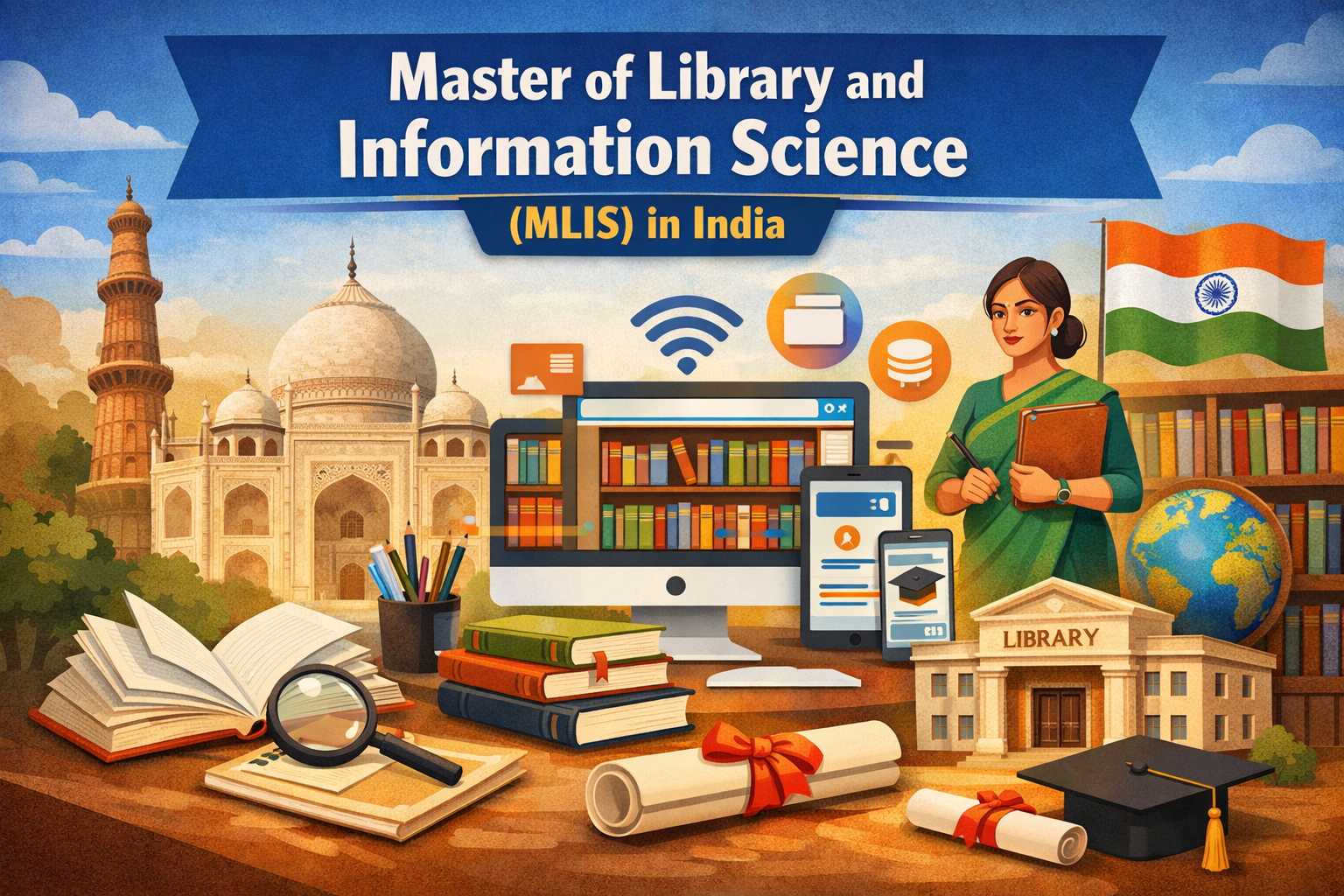
Master of Library and Information Science (MLIS) in India: Courses, Colleges, Fees, and Career Opportunities
The Master of Library and Information Science (MLIS) in India is a postgraduate program designed to provide advanced knowledge in library management, information systems, digital archiving, and research services.
🔔 Master of Library and Information Science (MLIS) in India Admission Alerts 2026
- IGNOU MLIS Application Deadline: The last date to fill the form for IGNOU MLIS Admission 2026 was March 15, 2026.
- IGNOU MLIS Application Fee: The registration charge for IGNOU MLIS Admission 2026 was INR 300/-.
- IGNOU MLIS Program Duration: The Master of Library and Information Science (MLIS) program at IGNOU has a duration of 2 to 4 years.
- IGNOU MLIS Exam Start Date: Exams for the IGNOU MLIS program are scheduled to start on June 1, 2026.
- IGNOU MLIS Program Type: The IGNOU MLIS is an ODL (Open Distance Learning) program.
The course focuses on organizing, managing, and retrieving information efficiently in libraries, academic institutions, corporate sectors, and digital platforms. With the growing demand for digital libraries and knowledge management professionals, MLIS graduates play a vital role in modern information services across universities, public libraries, research organizations, publishing houses, and government institutions nationwide.
This blog gives detailed information about MLIS courses, top colleges, fee structure, eligibility, and career opportunities in India.
Master of Library and Information Science (MLIS) Course Highlights
| Feature | Details |
|---|---|
| Degree Full Form | Master of Library and Information Science |
| Degree Type | Postgraduate (PG) |
| Typical Duration | 1 to 4 years (IGNOU: 1-year PG level, 2-4 years program duration) |
| Eligibility (India) | Bachelor’s degree in Library and Information Science (BLIS) or equivalent |
| Admission Process | Merit-based (no entrance exam for IGNOU MLIS 2026) |
| Mode of Study | Open Distance Learning (ODL) at IGNOU |
| Application Fee (IGNOU 2026) | ₹300 |
| IGNOU 2026 Admissions | Open for January 2026 session, application deadline March 15, 2026 |
| Core Subjects | Library Management, Information Processing, Research Methodology |
| Career Options | Librarian, Information Scientist, Knowledge Manager |
Why Choose Master of Library and Information Science (MLIS)?
Pursuing a Master of Library and Information Science (MLIS) opens up a world of opportunities for those interested in managing, organizing, and disseminating information. Here are the key reasons to choose this program:
-
High Demand for Information Professionals: With the surge in digital content and knowledge resources, there is a growing need for skilled professionals to manage libraries, archives, and information systems effectively.
-
Diverse Career Opportunities: MLIS graduates can work in academic libraries, public libraries, corporate organizations, research institutions, and government departments, providing flexibility in career paths.
-
Digital Skills Development: The course equips students with expertise in digital libraries, information retrieval, database management, and content organization, blending traditional library science with modern technology.
-
Stable and Respected Profession: Librarianship and information management are well-regarded fields offering stable career prospects, especially in academic and government sectors.
-
Access to Government Jobs: Graduates can pursue positions such as Librarian, Assistant Librarian, Documentation Officer, and Information Officer in both central and state government organizations.
-
Academic and Research Growth: MLIS serves as a foundation for advanced studies like MPhil or PhD and teaching opportunities in library and information science.
-
Contributing to Society: Information professionals play a vital role in supporting education, research, and public access to knowledge, making a meaningful societal impact.
-
Good Work-Life Balance: Many roles in libraries and information centers offer structured working hours, providing a balanced professional life.
-
Attractive Salary Packages: With experience and specialization, MLIS professionals can secure competitive salaries in academia, corporate sectors, and specialized information centers.
-
Integration of Traditional and Modern Learning: The program combines classical principles of library science with modern technological tools, preparing students for a dynamic and evolving profession.
Master of Library and Information Science (MLIS) Eligibility Criteria
Master of Library and Information Science (MLIS) eligibility criteria in India differ between government and private colleges. A bachelor’s degree in any discipline is generally required, with some institutions specifying a minimum percentage or CGPA.
| Parameter | Government Colleges | Private Colleges |
|---|---|---|
| Minimum Qualification | Bachelor’s degree in any discipline | Bachelor’s degree in any discipline, with a preference for Library Science background |
| Minimum Percentage/CGPA | 50% or 5.5 CGPA | 55% or 6.0 CGPA |
| Specific Subjects | Library Science, Information Science, or related fields | Library Science, Information Science, Computer Science, or related fields |
| Age Limit | No upper age limit | No upper age limit, but some colleges may have restrictions |
| Entrance Exam | CUET PG, DUET | CUET PG, DUET, or college-specific entrance exams |
| College Name | IGNOU (Indira Gandhi National Open University) | St. John’s University |
| City | New Delhi | New York |
| NIRF Ranking (if available) | 45 | Not applicable in India |
| Accreditation | NAAC A++ | American Library Association (ALA) accredited |
Master of Library and Information Science (MLIS) Admission Process
The Master of Library and Information Science (MLIS) admission process in India involves several steps. Candidates must hold a bachelor’s degree in any academic discipline to be eligible. While admission requirements and curriculum may vary, most institutions follow a similar process. Colleges to consider include the University of Delhi, Jawaharlal Nehru University, and Banaras Hindu University.
- Candidates must meet the minimum GPA requirement, typically 3.0 on the last 60 hours of a bachelor’s degree or a 3.0 cumulative undergraduate GPA.
- Submit the application form with required documents, including transcripts, resume, and statement of purpose.
- Some colleges require entrance exams like CUET PG, while others use merit-based selection.
- Candidates may need to attend an interview or counseling session.
- Colleges may consider work experience, research experience, and extracurricular activities.
- Application fees range from ₹500 to ₹2,000, depending on the college.
- Apply through online or offline modes, as per the college’s process.
- Some colleges offer scholarships or financial aid, ranging from ₹5,000 to ₹20,000 per annum.
Master of Library and Information Science (MLIS) Syllabus
The Master of Library and Information Science (MLIS) is a two-year postgraduate program that equips students with the skills and knowledge to manage, organize, and disseminate information effectively. The syllabus is designed to balance traditional library science principles with modern digital technologies, preparing students for careers in academic, public, corporate, and digital libraries.
Semester 1
-
Fundamentals of Library and Information Science
-
Library Classification and Cataloguing
-
Library Management Principles
-
Information Sources and Services
-
Introduction to Documentation and Archives
Semester 2
-
Information Retrieval and Indexing
-
Research Methods in Library and Information Science
-
Digital Libraries and Information Technology
-
E-Resources Management and Online Databases
-
Preservation and Conservation of Library Materials
Semester 3
-
Knowledge and Information Management
-
Library Automation and Database Management Systems
-
Elective / Specialization Subjects (choose based on interest, e.g., Archival Studies, School Library Management, Corporate Information Management)
-
Library Legislation and Ethics
-
Seminar / Case Studies
Semester 4
-
Project Work / Dissertation
-
Emerging Trends in Library and Information Science
-
Library Administration and Policy
-
Professional Practices and Communication Skills
-
Internship / Practical Training (in academic, public, or digital libraries)
| Semester | Subjects / Topics Covered |
|---|---|
| Semester 1 | • Fundamentals of Library and Information Science
• Library Classification and Cataloguing • Library Management Principles • Information Sources and Services • Introduction to Documentation and Archives |
| Semester 2 | • Information Retrieval and Indexing
• Research Methods in Library and Information Science • Digital Libraries and Information Technology • E-Resources Management and Online Databases • Preservation and Conservation of Library Materials |
| Semester 3 | • Knowledge and Information Management
• Library Automation and Database Management Systems • Elective / Specialization Subjects (e.g., Archival Studies, School Library Management, Corporate Information Management) • Library Legislation and Ethics • Seminar / Case Studies |
| Semester 4 | • Project Work / Dissertation
• Emerging Trends in Library and Information Science • Library Administration and Policy • Professional Practices and Communication Skills • Internship / Practical Training |
Core Subjects in Master of Library and Information Science (MLIS)
The core subjects are designed to give students a strong foundation in library science while integrating modern technology and digital tools. These subjects form the backbone of the MLIS curriculum:
-
Library Classification and Cataloguing – Learning systems like Dewey Decimal and Library of Congress Classification.
-
Information Retrieval and Indexing – Techniques to search and organize both print and digital content efficiently.
-
Digital Libraries – Managing electronic resources, e-books, and digital repositories.
-
Knowledge and Information Management – Organizing institutional knowledge for easy access and use.
-
Library Management and Administration – Leadership, budgeting, and operational management skills.
-
Research Methods in Library Science – Academic research, surveys, and data analysis for library science projects.
-
Information Technology in Libraries – Database management, online search tools, and library automation software.
| Semester | Subjects / Topics Covered |
|---|---|
| Semester 1 | Fundamentals of Library & Information Science, Library Management, Classification and Cataloguing |
| Semester 2 | Information Retrieval, Indexing, Research Methods, Digital Libraries |
| Semester 3 | Knowledge Management, Information Technology in Libraries, Elective / Specialization subjects |
| Semester 4 | Project Work / Dissertation, Emerging Trends in LIS, Library Administration & Policy |
| Core Subjects | Library Classification & Cataloguing, Information Retrieval & Indexing, Digital Libraries, Knowledge & Information Management, Library Management, Research Methods, IT in Libraries |
Skills Required for Master of Library and Information Science (MLIS) Students
To excel in MLIS and build a successful career in library and information management, students need a mix of technical, analytical, and interpersonal skills:
-
Information Organization and Management: Ability to classify, catalog, and manage both physical and digital information efficiently.
-
Digital Literacy and IT Skills: Familiarity with library automation software, digital databases, e-resources, and online library systems.
-
Research and Analytical Skills: Capacity to conduct academic research, analyze data, and evaluate sources critically.
-
Communication Skills: Strong written and verbal communication skills for guiding users, preparing reports, and collaborating with colleagues.
-
Attention to Detail: Accuracy in cataloging, indexing, and maintaining library records is essential for effective information retrieval.
-
Problem-Solving and Decision-Making: Ability to manage challenges like organizing large volumes of data, digital preservation, and resolving user queries.
-
Interpersonal and Customer Service Skills: Engaging with library users, guiding students, researchers, and corporate employees in finding relevant information.
-
Adaptability to Emerging Technologies: Keeping up with trends in digital libraries, AI in information retrieval, and data management systems.
-
Time Management and Organizational Skills: Prioritizing tasks, managing multiple projects, and maintaining systematic records efficiently.
Career Scope After Master of Library and Information Science (MLIS)
Completing an MLIS opens up diverse career opportunities across academic, public, corporate, and digital information sectors. Graduates can explore roles that combine traditional librarianship with modern information management skills:
-
Academic Librarian: Manage university and college libraries, guide students and researchers, and maintain educational resources.
-
Public Librarian: Work in community libraries, ensuring accessibility of information and promoting reading and learning programs.
-
Corporate Information Manager
Organize and maintain company databases, knowledge repositories, and research materials for efficient decision-making. -
Archivist / Documentation Officer: Preserve, organize, and manage historical documents, rare manuscripts, and archival records.
-
Digital Librarian / E-Resource Manager: Handle digital content, manage online databases, and maintain digital libraries.
-
Information Analyst / Knowledge Manager: Analyze, interpret, and manage information to support business or research objectives.
-
Government Jobs: Roles like Librarian, Assistant Librarian, Information Officer, Documentation Officer in government departments, research organizations, and public libraries.
-
Higher Studies and Academia: Pursue PhD or MPhil in Library and Information Science or related fields and become a lecturer or researcher.
-
Freelancing / Consultancy: Offer library setup, digital resource management, or knowledge management consultancy for institutions and companies.
-
Salary and Growth: Entry-level MLIS professionals earn around ₹3–5 LPA, while experienced librarians, digital information managers, and knowledge specialists can earn ₹6–12 LPA or more, depending on sector and expertise.
Salary After Master of Library and Information Science (MLIS)
The Master of Library and Information Science (MLIS) degree opens up a range of career opportunities in academic, corporate, public, and digital sectors. Salaries vary depending on the type of organization, role, experience, and location.
1. Entry-Level Salary
-
Fresh MLIS graduates typically start in positions such as Assistant Librarian, Library Assistant, or Documentation Officer.
-
Average salary range: ₹3–5 LPA in India.
-
Entry-level roles in government libraries or public institutions may offer slightly lower salaries but provide job stability and benefits.
2. Mid-Level Salary
-
After 3–5 years of experience, professionals can take roles like Librarian, Digital Librarian, Knowledge Manager, or Information Analyst.
-
Average salary range: ₹5–8 LPA.
-
Corporate organizations, digital libraries, and research institutions often pay more compared to public libraries.
3. Senior-Level Salary
-
Senior positions include Head Librarian, Library Director, Chief Knowledge Officer, or Senior Archivist.
-
Average salary range: ₹8–12 LPA or higher, especially in corporate, research, or international organizations.
-
Experienced professionals with specialization in digital libraries, knowledge management, or archival studies can command higher salaries.
4. Factors Affecting Salary
-
Type of Organization: Corporate and private sector jobs generally pay more than government and academic institutions.
-
Location: Salaries are higher in metro cities like Delhi, Mumbai, Bengaluru, and Hyderabad due to higher living costs and demand.
-
Experience and Skills: Specialized skills in digital libraries, database management, knowledge management, or AI-based information retrieval boost earning potential.
-
Further Qualifications: Pursuing PhD or certifications in library automation, archival studies, or information management can lead to higher-paying roles.
5. Career Growth and Benefits
-
MLIS offers a stable and respected career, especially in government and academic institutions.
-
With experience, professionals can move into managerial roles, consultancy, or research and teaching positions, increasing both salary and job satisfaction.
-
Benefits may include job security, pensions (for government jobs), health insurance, and opportunities for professional development.
| Career Level | Job Roles | Average Salary (₹ LPA) |
|---|---|---|
| Entry-Level | Assistant Librarian, Library Assistant, Documentation Officer | 3–5 |
| Mid-Level | Librarian, Digital Librarian, Knowledge Manager, Information Analyst | 5–8 |
| Senior-Level | Head Librarian, Library Director, Chief Knowledge Officer, Senior Archivist | 8–12+ |
Higher Studies After Master of Library and Information Science (MLIS)
After completing an MLIS, students have multiple options to enhance their academic profile, specialize in niche areas, and open doors to higher-level career opportunities. Higher studies allow for advanced knowledge, research skills, and teaching opportunities in the field of library and information science.
1. PhD in Library and Information Science
-
Students can pursue a Doctor of Philosophy (PhD) in Library and Information Science or related fields.
-
Focus areas may include digital libraries, knowledge management, archival studies, information retrieval, or library automation.
-
PhD holders are eligible for teaching positions at universities, senior research roles, and policy-making positions in government or educational institutions.
2. MPhil in Library Science
-
Some universities offer MPhil programs for students interested in academic research and specialization.
-
MPhil research can lead to publications and prepare students for PhD programs.
3. Specialized Certifications and Diplomas
-
Short-term courses and certifications in digital librarianship, knowledge management, archival studies, or information technology can enhance expertise and job prospects.
-
These certifications are especially useful for professionals looking to enter corporate libraries, digital libraries, or data management roles.
4. Postgraduate Diplomas in Niche Areas
-
Students can pursue diplomas in records management, archival management, e-resource management, and library automation.
-
These programs help students gain hands-on skills that are highly valued in specialized libraries and corporate sectors.
5. Teaching and Research Opportunities
-
Graduates with higher studies can become lecturers or professors in universities and colleges.
-
Research opportunities are available in academic libraries, research centers, and digital knowledge repositories.
Benefits of Higher Studies:
-
Deepen subject expertise
-
Access to academic and research roles
-
Higher salary and senior positions
-
Opportunities to influence library policies and knowledge management practices
Government Jobs After Master of Library and Information Science (MLIS)
An MLIS degree opens doors to stable and well-paying government positions across academic, public, and national institutions. Government roles provide career security, structured growth, and recognition in the field of library and information management.
1. Librarian Positions
-
Central and State Government Universities: Assistant Librarian, Librarian, Senior Librarian roles in universities, colleges, and research institutes.
-
Responsibilities include managing library operations, guiding students and faculty, and maintaining educational resources.
2. Documentation Officer / Information Officer
-
Roles in government departments, research organizations, and public institutions.
-
Tasks include documenting government publications, organizing archives, managing information systems, and supporting research activities.
3. Archivist
-
Positions in national archives, museums, or heritage centers.
-
Responsibilities include preserving historical documents, cataloguing rare manuscripts, and maintaining digital records.
4. Library and Information Scientist
-
Jobs in public libraries, research centers, and government knowledge hubs.
-
Manage digital and physical information resources, organize data, and support information dissemination to citizens and researchers.
5. Government Exams and Recruitment
-
MLIS graduates can apply for exams conducted by UPSC, SSC, State Public Service Commissions, and other government bodies for librarian and information officer posts.
-
Many central and state universities recruit MLIS graduates directly through entrance exams or merit-based selection.
Benefits of Government Jobs
-
Stable career with job security and pension benefits
-
Structured promotions and growth opportunities
-
Opportunities to work on national-level projects and policies
-
Respectable positions in academia and public service
Popular Government Organizations for MLIS Graduates:
-
National Library of India
-
State Public Libraries
-
University Libraries (Delhi University, Banaras Hindu University, JNU, etc.)
-
Indian Council of Historical Research (ICHR)
-
National Archives of India
Top Government Colleges for Master of Library and Information Science in India
The Master of Library and Information Science (MLIS) program focuses on information management, curation, and dissemination.
| College Name | City | Annual Fees | Admission Mode | NIRF Ranking |
|---|---|---|---|---|
| IGNOU (Indira Gandhi National Open University) | New Delhi | INR 32,400 | Merit-based | – |
| University of Delhi | New Delhi | INR 44,400 | Entrance exam (DUET) | 11 |
| Aligarh Muslim University | Aligarh | INR 30,600 | Entrance exam | 18 |
| Banaras Hindu University | Varanasi | INR 36,400 | Entrance exam | 19 |
| Andhra University | Visakhapatnam | INR 38,400 | Entrance exam (AU CET) | – |
| Punjab University | Chandigarh | INR 42,400 | Entrance exam (PU CET) | 28 |
| Anna University | Chennai | INR 46,400 | Entrance exam (TANCET) | 20 |
| Jamia Millia Islamia | New Delhi | INR 33,400 | Entrance exam | 22 |
Top Private Colleges for Master of Library and Information Science in India
The following table lists top private colleges in India offering Master of Library and Information Science (MLIS) programs.
| College Name | City | Annual Fees (INR) | Admission Mode | Ranking |
|---|---|---|---|---|
| Indian Institute of Technology (IIT) Delhi | New Delhi | Rs 1,85,000 | NIRF Rank #2 | |
| National Institute of Technology (NIT) Trichy | Tiruchirappalli | Rs 1,50,000 | NIRF Rank #9 | |
| Mohanlal Sukhadia University | Udaipur | Rs 30,600 | NAAC A+ accredited | |
| St. Xavier’s College | Mumbai | Rs 50,000 | NAAC A+ accredited | |
| Loyola College | Chennai | Rs 40,000 | NAAC A+ accredited | |
| Christ University | Bengaluru | Rs 60,000 | NAAC A+ accredited | |
| University of Petroleum and Energy Studies (UPES) | Dehradun | Rs 1,20,000 | NAAC A accredited | |
| Amity University | Noida | Rs 1,00,000 | NAAC A+ accredited | |
| Jamia Millia Islamia | New Delhi | Rs 20,000 | NAAC A accredited | |
| Aligarh Muslim University | Aligarh | Rs 15,000 | NAAC A accredited |
These colleges are approved by the University Grants Commission (UGC) and the All India Council for Technical Education (AICTE). They offer specializations including library management, information technology, and archival science. Annual fees vary, and some offer scholarships. Admission is typically based on merit or entrance exams like CUET or DUET.
FAQs
Q: What are the top colleges for Master of Library and Information Science (MLIS) in India with good placement rates?
Several institutions offer excellent Master of Library and Information Science (MLIS) programs. Top choices include the University of Delhi, Banaras Hindu University, and the University of Calcutta. These universities often boast placement rates exceeding 75% for their Master of Library and Information Science (MLIS) graduates, placing them in roles within academic libraries, research institutions, and corporate information centers across India.
Q: What is the eligibility criteria for Master of Library and Information Science (MLIS) in India for 2026 admissions?
To be eligible for Master of Library and Information Science (MLIS) in India for 2026, candidates typically need a Bachelor’s degree in Library and Information Science (BLIS) or an equivalent qualification from a recognized university. Most institutions require a minimum aggregate score of 50-55% in the undergraduate degree. Some universities might also consider candidates with a Bachelor’s degree in any discipline along with a postgraduate diploma in Library Science.
Q: What is the average salary after Master of Library and Information Science (MLIS) in India in 2026?
The average salary after Master of Library and Information Science (MLIS) in India in 2026 can range from ₹3.5 LPA to ₹7.0 LPA, depending on the role and sector. Entry-level positions like Junior Librarian or Information Assistant might start around ₹3.0 LPA, while experienced professionals in specialized roles such as Digital Archivist or Knowledge Manager can command salaries upwards of ₹8.0 LPA, especially in corporate or research environments.
Q: What are the typical fees for Master of Library and Information Science (MLIS) in India for the academic year 2026-2027?
The typical fees for Master of Library and Information Science (MLIS) in India for the 2026-2027 academic year vary significantly. Government universities generally charge between ₹15,000 to ₹50,000 per year for the Master of Library and Information Science (MLIS) program. Private institutions, however, can have fees ranging from ₹60,000 to ₹2,00,000 annually, depending on their infrastructure and reputation.
Q: What are the career opportunities and job roles after Master of Library and Information Science (MLIS) in India?
After completing Master of Library and Information Science (MLIS) in India, graduates can explore diverse career opportunities. Common job roles include Librarian, Information Officer, Archivist, Documentation Officer, and Digital Curator. Emerging roles like Data Curator, Research Analyst, and Knowledge Manager are also gaining traction, particularly in IT firms, research organizations, and e-learning platforms, offering a wide scope for growth.
Q: Can I pursue Master of Library and Information Science (MLIS) in India and then work abroad, specifically in the UK or USA?
Yes, pursuing Master of Library and Information Science (MLIS) in India can open doors to working abroad, particularly in countries like the UK or USA. Many Indian Master of Library and Information Science (MLIS) degrees are recognized internationally. However, you might need to meet specific country-wise professional accreditation requirements or gain a few years of relevant experience (e.g., 2-3 years) to enhance your chances for visa and job applications in these regions.





Hello Findmycollege Com,
This is Angie Parsons from Spiegelglass Construction Company. We’re reviewing potential partners for an upcoming Q2 2026 project and wanted to check your availability and interest in receiving more details.
Scope information will be shared once we confirm your interest..
Sincerely,
Angie Parsons
Project Manager
Spiegelglass Construction Company.