Master’s Degree in Interior Design: Courses, Eligibility and Scope
Students can explore at least 84 colleges offering postgraduate interior design degrees across India. Below is a complete breakdown of course options, eligibility criteria, entrance examinations, detailed semester syllabi, total fee structures, top institutions, and career opportunities offering salary packages up to 14 LPA.
| Parameter | Details |
|---|---|
| Course Duration | 2 Years (4 Semesters) |
| Degree Types | M.Des, MID (Master’s in Interior Design), M.Sc, MVoc, MA, M.Arch |
| Minimum Eligibility | Graduation in any discipline or relevant 4-year design/architecture/engineering degree with 50% minimum aggregate marks |
| Entrance Exams | CEPT PG Test, SMEAT, UID DAT, Pearl Academy Written Exam, ADEPT, UPESDAT, LPUNEST, CUET / UCEED |
| Highest Salary Package | 14 LPA |
What is M.Des in Interior Design
A Master of Design (M.Des) or Master’s in Interior Design (MID) is a 2-year postgraduate program spread across 4 semesters. The curriculum is designed to advance a student’s expertise in spatial planning, environmental design, building systems, design research, and project management.
Institutions across India cater to different academic backgrounds. For instance, Pearl Academy offers a 2-year M.Des in Interior Design open to graduates from any stream across its campuses in Bengaluru, Delhi-West, Jaipur, and Mumbai. Similarly, CEPT University offers a specialized 2-year Master’s in Interior Design (MID) program, while AAFT provides direct mentorship under Padma Shree Awardee Sunita Kohli. Vogue Institute of Art & Design in Bangalore offers an M.Des in Interior Design Management (IDM) recognized by the University of Mysore.
Types and Specialisations of Master’s Degrees in Interior Design
| Degree Title | Primary Focus | Key Institutions |
|---|---|---|
| M.Des in Interior & Experience Design | Postgraduate design training integrating spatial and experiential design principles | Unitedworld Institute of Design (UID), Ahmedabad |
| M.Des in Interior Design Management (IDM) | Project management, store operations, estimation, costing, and CRM | Vogue Institute of Art & Design, Bangalore |
| M.Des in Interior and Spatial Design | Spatial planning, ergonomics, adaptive reuse, furniture systems, and circular design | Galgotias University, Greater Noida |
Master’s degree options in interior design range from general M.Des and MID programs to specialized management and spatial design tracks. Institutes offer these two-year degree formats across multiple campuses in India for graduates seeking advanced design education.
M.Des in Interior Design Eligibility
Eligibility criteria for master’s programs in interior design vary by institute. While many private universities welcome graduates from any academic discipline, specialized design universities require prior degrees in design, architecture, or civil engineering.
- Technical Stream Eligibility: CEPT University requires a 4-year or longer Bachelor’s degree in interior design, interior architecture, industrial design, furniture design, urban design, or product design with 50% aggregate marks (45% for reserved categories).
- Engineering & Architecture Eligibility: Manipal Academy of Higher Education (MAHE) requires candidates to hold a B.Des (Interior Design), B.Arch, B.E. Civil, or B.Tech Civil degree with minimum 50% marks.
M.Des in Interior Design Admission Process
Admission to postgraduate interior design degrees in India is based on institutional entrance examinations, creative portfolio evaluations, and personal interviews.
Prominent entrance examinations include the CEPT PG Test (for CEPT University), SMEAT (for Srishti Manipal Institute), UID DAT (for Unitedworld Institute of Design), Pearl Academy Online Written Exam, ADEPT (for Anant National University), and UPESDAT (for UPES Dehradun). In addition, Galgotias University offers admission based on merit while giving preference to candidates with UCEED or CUET scores.
M.Des in Interior Design Syllabus and Subjects
The M.Des in Interior Design curriculum combines spatial design theory, technical building systems, software applications, practical studio projects, and project management modules across 4 semesters.
| Category | Core Subjects / Modules |
|---|---|
| Design Fundamentals & Planning | Spatial Planning & Ergonomics, History & Theory of Interiors, Fundamentals of Interior Design, 2D & 3D Graphics |
| Building Systems & Engineering | Construction Materials I & II, Construction Detailing, Interior Services I (Lighting), Interior Services II (Plumbing & Sanitation) |
| Digital Technologies | CAD in Interiors, 3D Visualization & Renderings, BIM Workflows, Parametric Modelling, AR/VR Visualisation |
| Specialized Practice | Adaptive Reuse, Sustainability & Circular Design, Furniture Design, Interior Landscaping, Store Operation Management |
| Management & Practice | Project Management, Estimation & Costing, Research Methodology, Professional Practice, Customer Relationship Management |
Digital Tools, Software, and Design Technologies Mastered in M.Des
Modern interior design practice requires advanced mastery over industry-standard design technologies and visualization suites. Students enrolled in an M.Des in Interior Design receive comprehensive practical training in digital software throughout their course.
Core design tools mastered during the program include AutoCAD for 2D drafting and technical layouts, Google SketchUp and 3ds Max for 3D spatial modelling, Revit for Building Information Modelling (BIM) workflows, Lumion for real-time rendering, Photoshop and Adobe Creative Suite for presentation boards, as well as immersive AR/VR spatial visualization tools.
M.Des in Interior Design Fees
- CEPT University, Ahmedabad: ₹2,67,500 per semester (total program fee of ₹10,70,000 for 2025-2026).
- Pearl Academy: ₹82,000 one-time fee + ₹2,84,600 per semester.
- Srishti Manipal Institute, Bangalore: ₹6,65,000 for Year 1 (includes ₹50,000 refundable caution deposit) and ₹6,15,000 for Year 2.
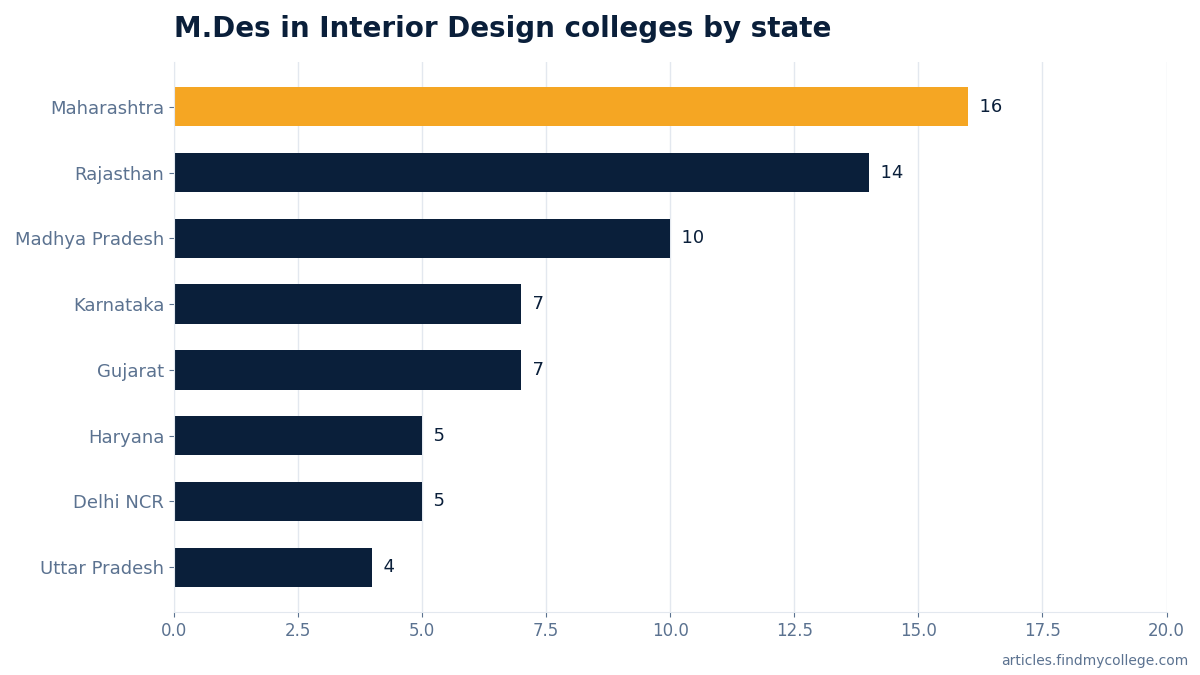
Geographically, Maharashtra leads with 16 colleges, followed by Rajasthan with 14, Madhya Pradesh with 10, Karnataka with 7, Gujarat with 7, and Haryana with 5 colleges offering postgraduate interior design programs.
Top M.Des in Interior Design Colleges
| College Name | Program Name | Entrance Exam | Total Fee / Semester Fee |
|---|---|---|---|
| CEPT University, Ahmedabad | Master’s in Interior Design (MID) | CEPT PG Test | ₹2,67,500 per semester (₹10,70,000 total) |
| Pearl Academy (Delhi, Mumbai, Jaipur, Bengaluru) | M.Des in Interior Design | Pearl Academy Online Written Exam | ₹82,000 one-time + ₹2,84,600 per semester |
| Srishti Manipal Institute, Bangalore | Master of Design (M.Des) | SMEAT | ₹6,65,000 (1st Year) / ₹6,15,000 (2nd Year) |
Admission to these leading postgraduate programs is evaluated through specialized entrance tests such as the CEPT PG Test, SMEAT, or UID DAT.
| College | City | Ownership | Total course fee | NIRF rank |
|---|---|---|---|---|
| Manipal University Manipal | Manipal | — | ₹1.75 lakh | 3 (Overall, 2025) |
| Kalinga Institute of Industrial Technology | Bhubaneswar | — | ₹5.63 lakh | 17 (Overall, 2025) |
| Manipal University Jaipur | Jaipur | — | ₹2.62 lakh | 58 (Overall, 2025) |
| Chitkara University | Patiala | Private | ₹3.60 lakh | 78 (Overall, 2025) |
| Sharda University | Noida | — | ₹6.49 lakh | 87 (Overall, 2025) |
| Guru Gobind Singh Indraprastha University | Delhi | — | ₹5.19 lakh | 93 (Overall, 2025) |
| Parul University | Vadodara | — | ₹3.00 lakh | 151 (Overall, 2023) |
| College | City | Ownership | Total course fee |
|---|---|---|---|
| Chitkara University | Patiala | Private | ₹3.60 lakh |
| Karnavati University | Gandhi Nagar | Private | ₹11.00 lakh |
| Dev Bhoomi Uttarakhand University | Dehradun | Private | ₹2.75 lakh |
| Mahatma Jyoti Rao Phoole University | Jaipur | Private (aided) | ₹1.08 lakh |
| Pearl Academy West Campus | Delhi | Private | ₹12.20 lakh |
| Pacific University | Udaipur | Private | ₹1.59 lakh |
| Cindrebay School of Design Bangalore | Bangalore | Private | ₹3.20 lakh |
| Vogue Institute of Art and Design | Bangalore | Private | ₹6.00 lakh |
| Neewara Academy of Design | Jaipur | Private | ₹6.00 lakh |
| City | Colleges | Fee range | Well-known options |
|---|---|---|---|
| Jaipur | 10 | ₹1.08 lakh – ₹12.20 lakh | Manipal University Jaipur, JECRC University |
| Indore | 5 | ₹1.29 lakh – ₹1.91 lakh | SAGE University Indore, Shri Vaishnav Vidyapeeth Vishwavidyalaya |
| Bangalore | 5 | ₹3.20 lakh – ₹12.20 lakh | Cindrebay School of Design Bangalore, Vogue Institute of Art and Design |
| Navi Mumbai | 5 | ₹1.30 lakh – ₹2.23 lakh | Chhatrapati Shivaji Maharaj University, School of Design and Arts, Chhatrapati Shivaji Maharaj University |
| Delhi | 5 | ₹3.19 lakh – ₹12.40 lakh | Guru Gobind Singh Indraprastha University, Pearl Academy West Campus |
| Gurgaon | 4 | ₹1.91 lakh – ₹5.77 lakh | Gurugram University, Ansal University |
| Pune | 4 | ₹3.25 lakh – ₹4.10 lakh | Pimpri Chinchwad University, International School of Design Baner |
| Mumbai | 3 | ₹2.60 lakh – ₹12.20 lakh | Pearl Academy Mumbai, Pannache International School of Design |
How to Choose the Right Master’s Degree in Interior Design College
- Academic Curriculum & Specialisations: Check whether the coursework covers relevant areas like interior architecture, retail design, spatial experience, or project management (such as the University of Mysore-recognized M.Des in Interior Design Management at Vogue Institute).
- Industry Mentorship & Faculty: Prioritize institutes offering direct access to renowned industry leaders, such as AAFT’s direct mentorship under Padma Shree Awardee Sunita Kohli.
- Software & Digital Tools: Look for programs offering hands-on training in core design tools such as AutoCAD, 3ds Max, Revit, Lumion, and AR/VR applications.
When selecting a college for an M.Des in Interior Design, prospective students should evaluate curriculum specialisations, faculty mentorship, practical software training, and total course fees.
M.Des in Interior Design Career Scope and Salary
Graduates holding an M.Des in Interior Design can enter diverse creative and management roles across architectural firms, interior design consultancies, real estate developers, retail brands, and entertainment industries. Leading recruiters actively hiring master’s graduates include Livspace, Bluestone, Mango, Fabindia, AVA Design Studio, Ravish Vohra Homes, and Pantaloons. Top institutes like AAFT report highest salary packages reaching 14 LPA.
| Job Role | Key Responsibilities |
|---|---|
| Interior Architect / Spatial Designer | Shape human-centered, aesthetic, and functional indoor environments for residential and commercial spaces. |
| Workplace & Facility Strategist | Optimize corporate office layouts, environmental comfort, and spatial usability based on organizational needs. |
| Adaptive-Reuse Specialist | Redesign and repurpose existing building structures while preserving historical or cultural value. |
| Sustainability & Circular Design Advisor | Integrate green building codes, eco-friendly materials, and energy-efficient systems into spatial plans. |
| 3D Visualization / Render Artist | Create high-fidelity 3D renderings, architectural walkthroughs, and VR/AR visualizations for stakeholders. |
| Set Designer (Film / Theatre / TV) | Design immersive, thematic sets and environments for entertainment productions and live events. |
| Interior Design Project Manager | Supervise site execution, manage budgets and timelines, coordinate with contractors, and ensure code compliance. |
How to Apply for M.Des in Interior Design Admission in 2026: Step by Step
- Check Eligibility Criteria: Verify that you hold a recognized Bachelor’s degree (any discipline for Pearl/Galgotias/Anant; or 4-year B.Des/B.Arch/BE Civil for CEPT/MAHE) with at least 50% aggregate marks.
- Register for Entrance Exam: Apply and register online for institutional entrance tests such as CEPT PG Test, UID DAT, SMEAT, Pearl Academy Written Exam, UPESDAT, ADEPT, or CUET/UCEED.
- Prepare and Submit Creative Portfolio: Compile a creative portfolio displaying spatial drafting, sketching, 3D visualisations, or prior design projects as required during the application process.
- Attend Personal Interview & Portfolio Review: Appear for personal interviews and design aptitude presentations conducted by admissions panels at institutes like UPES, Anant National University, or AAFT.
- Verify Merit Rank and Acceptance Letter: Check institutional merit lists or counselling results after clearing written exams and interview rounds.
- Submit Documents and Pay Course Fees: Submit required academic mark sheets, degree certificates, caution deposits, and semester fees to confirm seat allotment.
| What to do | Where | Link |
|---|---|---|
| Compare colleges, fees and cutoffs | M.Des in Interior Design colleges in India | findmycollege.com |
FAQs
Which degree is best for interior design at the postgraduate level?
Degrees such as M.Des (Master of Design) in Interior Design, MID (Master’s in Interior Design), and M.Des in Interior & Spatial Design are among the best options for advanced design training, software literacy, and professional project management.
What are the eligibility criteria for a master’s degree in interior design in India?
Most institutes require a Bachelor’s degree in any discipline with a minimum of 50% aggregate marks. Programs like CEPT MID require a 4-year or longer Bachelor’s degree in interior design, interior architecture, industrial design, furniture design, urban design, or product design.
What subjects are taught in a Master’s degree in interior design?
Subjects include spatial planning, history of interiors, construction detailing, lighting and plumbing services, furniture design, sustainability, 3D visualization, CAD, BIM, AR/VR modelling, and project management.
What are the fees for a Master’s degree in interior design in India?
What job roles can you pursue after completing a Master’s in Interior Design?
Graduates can work as Interior Architects, Workplace Strategists, Adaptive-Reuse Specialists, Set Designers, 3D Visualization Artists, Sustainable Design Advisors, or Interior Design Project Managers.
What software and tools are taught during M.Des in Interior Design?
Students learn tools such as AutoCAD, 3ds Max, Revit, Lumion, Google SketchUp, Photoshop, AR/VR spatial applications, and Adobe Creative Suite.