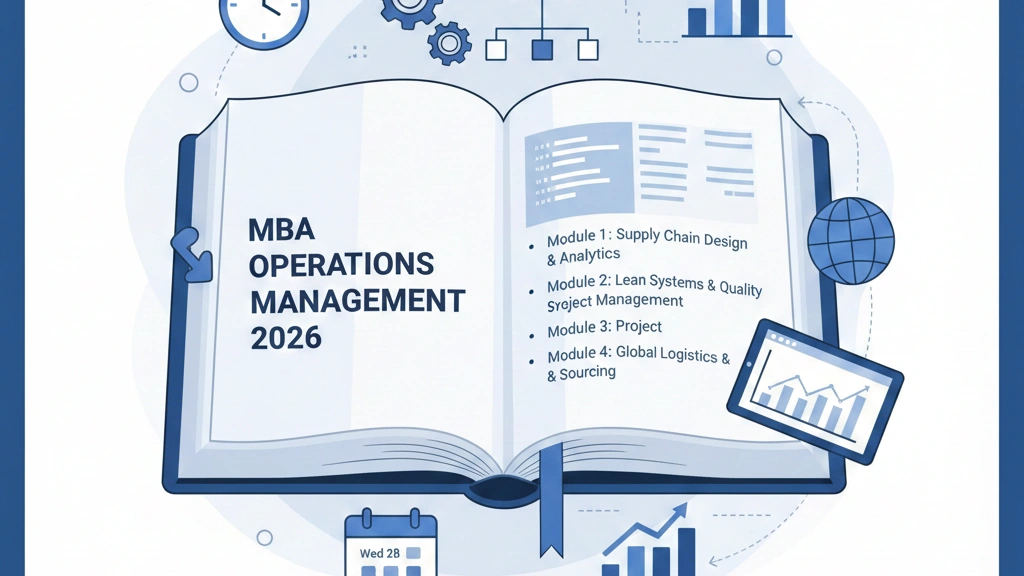
MBA Operations Management Syllabus 2026: Subjects, Semester-Wise Syllabus, PDF, Books
In today’s fast-paced and highly competitive business landscape, operations management stands as the backbone of organizational success. It focuses on designing, overseeing, and optimizing processes to deliver products and services efficiently, cost-effectively, and with superior quality. Pursuing an MBA in Operations Management equips aspiring professionals with the strategic tools to manage supply chains, streamline production, implement lean methodologies, harness data analytics, and drive sustainable growth across industries like manufacturing, e-commerce, logistics, and services.
The MBA Operations Management syllabus for 2026 blends core business fundamentals in the initial semesters, such as managerial economics, financial accounting, marketing management, and organisational behaviour, with specialised subjects in later terms, including supply chain management, project management, total quality management, operations research, inventory control, and emerging areas like digital operations and global logistics. This structured approach ensures graduates can tackle real-world challenges, from process optimisation to strategic decision-making in dynamic environments.
This full blog breaks down the semester-wise syllabus, key subjects, recommended books, and downloadable PDF resources (where available from top institutions like IIMs and leading universities). Whether you’re preparing for entrance exams like CAT/XAT or planning your specialisation, this guide offers valuable insights to help you excel in one of the most in-demand MBA streams of 2026.
MBA Operations Management: Course Overview
The MBA in Operations Management is a specialized postgraduate program that prepares professionals to excel in planning, controlling, and improving business processes across manufacturing, services, logistics, supply chains, and digital operations. In an era of globalization, e-commerce boom, and Industry 4.0 technologies, this specialization is highly sought after for its focus on efficiency, cost reduction, quality assurance, and strategic decision-making using tools like data analytics, Six Sigma, and ERP systems.
| Aspect | Details |
| Course Types | Primarily full-time 2-year MBA/PGDM (with Operations specialization or focus); also available as Executive MBA, Online/Distance MBA, or integrated programs in select institutes. |
| Entrance Exams | CAT (for IIMs and most top B-schools), XAT (XLRI, SPJIMR, etc.), SNAP (Symbiosis), CMAT, MAT, GMAT (for select/private/global-oriented programs), and institute-specific tests. |
| Duration | 2 years (4 semesters); some executive formats are 1–1.5 years. |
| Fees | Vary widely: ₹15–28 lakhs for top IIMs and premier private colleges (e.g., IIM Mumbai ~₹21 lakhs); ₹5–15 lakhs for mid-tier institutes; lower for government/university-affiliated programs (₹1–5 lakhs in some cases). |
| Top MBA Colleges | IIM Bangalore, IIM Calcutta, IIM Mumbai (strong in Operations & Supply Chain), XLRI Jamshedpur, SPJIMR Mumbai, IIM Lucknow, MDI Gurgaon, Symbiosis Institute of Operations Management (SIOM) Nashik, SCMHRD Pune, NIT Trichy/IIT Delhi equivalents. |
| Eligibility | Bachelor’s degree in any discipline with minimum 50% aggregate (45% for reserved categories); final-year students can apply; many top institutes prefer 1–3 years of work experience, especially for specialised Operations programs. |
Read More: Best MBA Specialisations in India 2026
MBA Operations Management Syllabus 2026 Semester-wise Subject Breakdown
The MBA Operations Management syllabus for 2026 offers a strong framework that integrates foundational management concepts with specialised knowledge in operations and supply chain. Spanning two years across four semesters, the program begins with core subjects in management, economics, and accounting to build a strong base, transitioning to advanced topics like logistics, procurement, and global supply chains in later semesters.
It emphasises practical skills through project work, research methodologies, and electives, enabling students to address real-world challenges in efficiency, quality, and innovation.
MBA Operations Management Syllabus Year 1
| Semester | MBA Operations Management Subjects | Key Objectives | Main Topics |
| I | Management Concepts | Understand core management principles and applications | – Management nature, functions, levels, skills, responsibilities
– Planning, MBO, decision making – Organizing, delegation, structure trends – Communication, innovation, creativity – Comparative styles, diversity, benchmarking |
| I | Managerial Economics | Apply economic concepts to business decisions | – Demand analysis, elasticity, forecasting – Production/cost functions, risk/uncertainty
– Market structures, pricing, discrimination – National income, business cycles, policies – Liberalization, globalization, FDI |
| I | Accounting for Managers | Prepare, analyze financial statements; use costing tools | – Financial accounting basics, final accounts – Depreciation, ratio analysis – Funds/cash flow statements
– Marginal costing, break-even, CVP applications – Cost sheet, standard costing, variances (material/labor) |
| I | Business Environment | Analyze domestic/global business factors | – Business dynamics, ethics, governance – Economic systems, resources, environment
– Infrastructure, productivity issues – Global trends, MNCs – Foreign capital, FDI trends |
| I | Research Methodology | Conduct research and analyze data | – Research types, design, hypotheses
– Data collection, sampling, errors – Probability, hypothesis tests, distributions – Correlation/regression, ANOVA, factor analysis – Report writing, SPSS intro |
| I | Organisational Behaviour | Manage human behavior for organizational success | – OB concepts, perception, personality, motivation
– Stress, attitudes, values – Groups, leadership, power/politics – Structure, culture, change – Trends: vision, gender, competencies |
| I | Business Law | Understand key commercial laws | – Contract Act: offer, acceptance, remedies
– Partnership/Sales of Goods Acts – Negotiable Instruments, Insurance – Companies Act: formation, directors, meetings – Factory/Industrial Disputes/Minimum Wages Acts |
| II | Financial Management | Manage finance sources, decisions, and capital | – Goals, cost of capital
– Capital budgeting (NPV, IRR, payback) – use, capital structure theories – Dividend policies/models – Working capital management |
| II | Marketing Management | Apply marketing concepts and mix | – Concepts, environment, segmentation – Product decisions, life cycle
– Pricing strategies – Channels, retailing – Promotion, advertising, sales |
| II | Human Resources Management | Manage people effectively | – HR functions, planning, recruitment
– Training, appraisal, career development – Compensation, motivation, QWL – Unions, bargaining, participation |
| II | Operations Research | Use quantitative techniques for decisions | – Linear programming, simplex
– Transportation/assignment, inventory models – CPM/PERT, crashing – Game theory, queuing |
| II | Strategic Management | Formulate and implement strategies | – Concepts, environment/SWOT analysis – Strategy choice, generic strategies
– Functional strategies – Implementation, evaluation/control |
| II | Business Ethics | Apply ethics and governance principles | – Ethics concepts, dilemmas, programs
– Workplace values, CSR – Corporate governance, trends – Indian ethos, Gandhian principles |
| II | Operations Management | Improve productivity and processes | – Process planning, layout, capacity
– Inventory, forecasting – Aggregate planning, MRP – Work study, quality control – Maintenance, reliability |
People Also Read

MBA Operations Management Syllabus Year 2
| Semester | MBA Operations Management Subjects | Key Objectives | Main Topics |
| III | Production and Operations Management | Manage production processes and quality | – Transformation process, product design – Process types, location/layout
– Aggregate planning, PPC – Quality tools, TQM, Six Sigma – Work study, maintenance/TPM |
| III | Logistics Management | Handle logistics and transportation | – Integrated logistics, warehousing
– Inventory, material handling, packaging – Transportation modes, economics – Containerization, reverse logistics – Outsourcing (3PL/4PL), IT applications |
| III | Supply Chain Management | Design and coordinate supply chains | – Drivers, strategies, network design
– Forecasting, inventory planning – Transportation, sourcing – Coordination, bullwhip effect, VMI – Collaboration, performance metrics |
| III | Materials and Stores Management | Control materials and inventory | – Stock policies, ABC analysis
– Forecasting, levels, JIT/Kanban – Storage/layout, handling – Security, disposal, environmental issues – Performance measurement |
| III | Information System in Supply Chain | Use IT for supply chain efficiency | – IT role, ERP, data mining
– Infrastructure, DSS – E-business, integration – Master planning, design |
| III | Elective – I | Specialized topic (varies by university) | – Common: Lean Operations, Analytics, etc. (details depend on institution) |
| III | Elective – II | Specialized topic (varies by university) | – Common: Sustainable Supply Chain, etc. |
| IV | Project Management in Supply Chain | Manage supply chain projects | – Life cycle, selection, organization – Planning, budgeting, scheduling (PERT/CPM)
– Resource allocation, control – Auditing, termination |
| IV | Innovations and R&D Management | build innovation and R&D | – Innovation types/models, strategy
– R&D classification, performance – Financial evaluation, resource allocation – Organization, commercialization |
| IV | Procurement and Quality Management | Manage procurement and quality | – Quality control, vendor evaluation
– Assurance, Six Sigma – Outsourcing benefits/risks – E-procurement |
| IV | Customer Relationship Management | Build and manage customer relations | – CRM concepts, loyalty, SLAs
– Marketing/service applications – Automation, analytics – Implementation, ethics |
| IV | Global Supply Chain Management | Handle international supply chains | – Global forces, risks/strategies
– Issues: import/export, alliances – Performance, green indicators – Wastivity reduction |
| IV | Project Work | Apply concepts in real-world project | – Independent research/project in operations/supply chain |
| IV | Elective – III | Specialized topic (varies by university) | – Common: Blockchain/AI in Supply Chain, etc. |
| IV | Elective – IV | Specialized topic (varies by university) | – Common: Risk Management, E-commerce Logistics, etc. |
MBA in Operations Syllabus PDF
Below is the MBA in Operations Management syllabus in a downloadable PDF format for your reference.
MBA Operations and Management Syllabus
MBA Operations Management Subjects
The MBA in Operations Management specialization focuses on equipping students with the skills to design, oversee, and optimise business processes for maximum efficiency, cost-effectiveness, and quality. It blends core management principles with specialized topics like supply chain coordination, production planning, quality assurance, and data-driven decision-making. This program prepares graduates to handle complex operational challenges in manufacturing, services, logistics, and global supply networks.
| Subject | Brief Description |
| Operations Management | Fundamentals of planning, organizing, and controlling production/service processes. |
| Supply Chain Management | End-to-end management of sourcing, logistics, inventory, and distribution networks. |
| Project Management | Tools and techniques for initiating, executing, and closing projects efficiently. |
| Operations Research | Quantitative methods, optimization, and modeling for decision-making. |
| Total Quality Management (TQM) | Principles of quality control, continuous improvement, and standards like Six Sigma. |
| Inventory Management | Strategies for stock control, demand forecasting, and reducing holding costs. |
| Logistics & Transportation | Management of material flow, warehousing, and global transportation systems. |
| Enterprise Resource Planning (ERP) | Integration of business processes using systems like SAP for operational collaboration. |
Read More: MBA Salary: Complete Guide in 2026
MBA Operations Management Books and Study Materials
The MBA Operations Management books are of utmost importance due to the course’s technical nature. Below is the list of the best and most popular MBA Operations Management subject books:
| Sl. No. | Subject/Area | Book Title (with Author) | Publisher/Edition Notes |
| 1 | Management Concepts & Organisational Behaviour | Principles of Management (Koontz, Weihrich, et al.) | Tata McGraw-Hill (latest editions) |
| 2 | Managerial Economics | Managerial Economics (Geetika, Ghosh & Choudhury) | Tata McGraw-Hill |
| 3 | Accounting for Managers | Accounting for Managers (Jelsy Joseph Kuppapally) or Financial Accounting for Management (Ambrish Gupta) | PHI Learning / Pearson |
| 4 | Business Environment & Ethics | Business Environment (Namita Gopal) or Business Ethics (various) | Tata McGraw-Hill |
| 5 | Research Methodology | Research Methodology: Methods and Techniques (C.R. Kothari) | New Age International / Wiley |
| 6 | Business Law | Legal Aspects of Business (Daniel Albuquerque) or Company Law (Kappor & Dhamija) | Oxford / Taxmann |
| 7 | Financial Management | Financial Management (Prasanna Chandra) or Basic Financial Management (Khan & Jain) | Tata McGraw-Hill |
| 8 | Marketing & HR Management | Marketing Management (Philip Kotler) / Human Resource Management (Aswathappa) | Pearson / Tata McGraw-Hill |
| 9 | Operations Research | Operations Research (R. Panneerselvam) or Quantitative Techniques in Management (N.D. Vohra) | Prentice Hall / Tata McGraw-Hill |
| 10 | Strategic Management | Strategic Management and Business Policy (Azhar Kazmi) or Concepts in Strategic Management (Fred R. David) | Pearson |
| 11 | Operations Management | Production and Operations Management (R. Panneerselvam) or Operations Management (William J. Stevenson / Heizer & Render) | Prentice Hall / Pearson |
| 12 | Logistics Management | Logistics Management (Ailawadi & Singh) or Logistics & Supply Chain Management (Sultan Chand) | Prentice Hall / Sultan Chand |
| 13 | Supply Chain Management | Supply Chain Management: Strategy, Planning, and Operation (Sunil Chopra & Peter Meindl) | Pearson (latest edition) |
| 14 | Materials & Stores Management | Materials Management (various) or Purchasing & Supply Management (Dobler & Burt) | Various Indian publishers |
| 15 | Information Systems in SCM | Supply Chain Management (with IT focus) or ERP-related texts | Various |
| 16 | Project Management | Project Management: A Managerial Approach (Jack R. Meredith & Samuel J. Mantel) | Wiley |
| 17 | Procurement & Quality Management | Procurement & Supply Management or Quality Management texts (e.g., Six Sigma references) | Various |
| 18 | Customer Relationship Management | Customer Relationship Management (Alok Kumar Rai or Kaushik Mukherjee) | Prentice Hall |
| 19 | Global Supply Chain Management | Global Logistics & Supply Chain Management (various) or Chopra & Meindl (advanced chapters) | Pearson |
FAQs
1. What is MBA in Operations and Supply Chain Management?
This 2-year postgraduate program focuses on optimizing business processes, production, logistics, procurement, and global supply chains. It combines core management subjects (like finance, marketing, HR) in the first year with specialized topics (logistics, SCM, project management) in the second year to build efficiency-driven leaders.
2. What are the key subjects in the first year?
The first year covers foundational courses: Management Concepts, Managerial Economics, Accounting for Managers, Business Environment, Research Methodology, Organisational Behaviour, Business Law (Semester I), followed by Financial Management, Marketing Management, HRM, Operations Research, Strategic Management, Business Ethics, and Operations Management (Semester II).
3. What specialized subjects are taught in the second year?
The second year emphasises operations expertise: Production & Operations Management, Logistics Management, Supply Chain Management, Materials & Stores Management, Information Systems in SCM (Semester III), plus Project Management, Innovations & R&D, Procurement & Quality, CRM, Global SCM, Project Work, and electives (Semester IV).
4. What is the career scope after this MBA?
Graduates pursue roles like Supply Chain Manager, Logistics Manager, Operations Analyst, Procurement Specialist, Project Manager, or Consultant in manufacturing, e-commerce, retail, logistics firms, and consulting. High demand exists in India due to growth in e-commerce, manufacturing, and global trade.
5. What is the average salary after completing this program?
Freshers can expect ₹6–12 LPA, while experienced professionals earn ₹12–25+ LPA (depending on company, location, and role). Top recruiters include Amazon, Flipkart, Deloitte, Accenture, Tata, Reliance, and global firms, with higher packages in supply chain and operations roles.
6. Is this MBA suitable for freshers or only for experienced candidates?
It suits both fresh graduates (with strong entrance scores) and working professionals. Freshers gain broad exposure, while those with experience (especially in manufacturing/logistics) advance faster to managerial roles. Many programs offer internships/project work for practical exposure.
7. What entrance exams are required for admission in India?
Common exams include CAT (for IIMs/top institutes), MAT, XAT, CMAT, or state-level tests. Some universities accept direct admissions or their own tests. Check specific college requirements, as top programs prioritize high percentiles in national exams like CAT.