
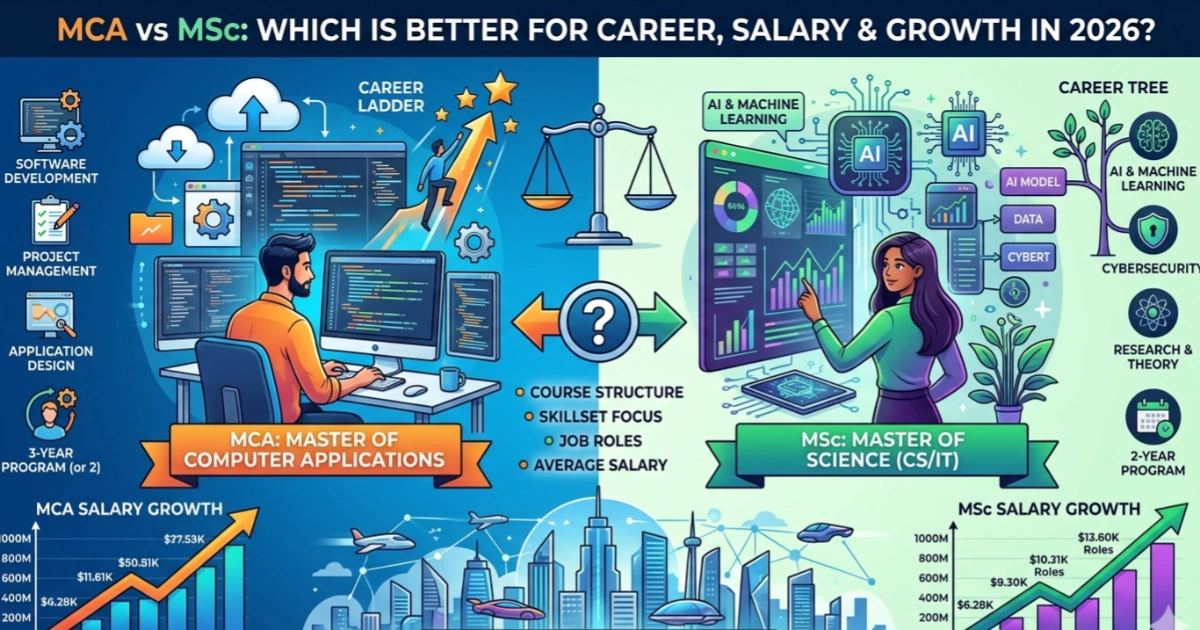
Deciding between MCA vs MSc: which career option has better scope often depends on your specific career aspirations and learning style. While both postgraduate degrees offer robust pathways into the tech industry, their emphasis on practical application versus theoretical depth shapes distinct professional trajectories. This article will unpack the nuances of each, comparing their career growth, salary potential, and industry relevance to help you make an informed choice for 2026.
MSc After BCA: Detailed Overview
For BCA graduates considering postgraduate studies, understanding the distinctions between MCA and MSc IT/CS is crucial. This section details the focus, career prospects, and salary potential of both degrees, helping to clarify mca vs msc: which career option has better scope in today’s evolving IT landscape.
- Eligibility: BCA graduates are eligible for both MCA and MSc IT/CS, with MCA a natural progression.
- MCA Focus: Emphasizes advanced application development, industry readiness, practical exposure, and coding labs.
- MSc IT/CS Focus: Leans toward information systems, academic research, theoretical learning, and IT frameworks.
- MCA Career: Offers a broader career scope in IT companies, including Software Developer and Data Scientist.
- MSc IT/CS Career: More suited for research and teaching roles, such as Network Administrator or Research Associate.
- Salary Potential: MCA graduates often earn more due to its professional, industry-focused curriculum.
These distinctions highlight that while both degrees are valid after BCA, MCA is geared towards immediate industry readiness and broader IT roles, often leading to faster salary growth. This makes it a strong contender when considering mca vs msc: which career option has better scope for direct tech employment. MSc IT/CS, however, provides a strong foundation for research, academia, and specialized IT infrastructure roles.
| Aspect | MCA | MSc IT/CS |
| Course Duration | 2 or 3 years | 2 years |
| Entry-Level Salary (India) | ₹4-8 LPA | ₹5-9 LPA |
| Mid-Career Salary (India) | ₹10-18 LPA | ₹12-22 LPA |
| Global Salary Prospects | ₹35-60 LPA | ₹35-60 LPA |
| Cost | Generally more expensive | Generally less expensive |
The salary data indicate that while M.Sc CS can offer a slightly higher entry-level range, MCA generally ensures faster salary growth and stronger alignment with the broader IT job market, favouring its long-term salary trajectory.
MCA After BCA: Detailed Overview
For BCA graduates eyeing a stronger foothold in the IT industry, MCA (Master of Computer Applications) is widely regarded as the most natural and rewarding postgraduate progression. This section details the course structure, career prospects, salary potential, and key advantages of pursuing MCA after BCA, helping clarify why it remains one of the most sought-after combinations in the Indian IT landscape in 2026.
- Eligibility: BCA graduates are directly eligible for MCA admission; many universities offer lateral entry, reducing the programme to 2 years instead of 3
- Course Focus: Emphasises advanced software development, system design, database management, cloud computing, cybersecurity, and hands-on coding labs
- Industry Alignment: Curriculum is designed in close alignment with industry standards, making graduates job-ready from day one
- Career Roles: Software Developer, Full Stack Developer, System Analyst, Data Scientist, Cloud Engineer, IT Consultant, and Project Manager
- Top Recruiters: TCS, Infosys, Wipro, HCL, Accenture, Cognizant, and mid-size product-based startups
- Higher Education Path: MCA graduates can also pursue MBA (IT/Systems), Ph.D in Computer Science, or specialised certifications in AWS, Azure, and Google Cloud
MCA after BCA offers a seamless academic and professional transition — BCA builds the foundational programming and IT knowledge, while MCA deepens it with industry-level application and specialisation. This combination is particularly valued by top IT recruiters who see the BCA + MCA pathway as equivalent to a strong technical degree in Computer Science.
| Aspect | MCA After BCA |
| Programme Duration | 2 Years (Lateral Entry) / 3 Years (Regular) |
| Top Entrance Exams | NIMCET, MAH MCA CET, TANCET, University-level exams |
| Entry-Level Salary (India) | ₹4–8 LPA |
| Mid-Career Salary (India) | ₹10–18 LPA |
| Global Salary Prospects | ₹35–60 LPA |
| Top Specialisations | AI/ML, Cybersecurity, Cloud Computing, Data Science |
| Employment Rate | High — strong industry demand for MCA graduates |
| Best For | Students targeting software development and IT industry roles |
The BCA + MCA combination remains one of the most efficient and cost-effective routes into the core IT industry in India. With lateral entry reducing both time and cost, and the degree’s strong employer recognition, MCA after BCA consistently delivers faster career growth and higher salary trajectories compared to most alternative postgraduate paths in computer science.
MCA After BSc: Detailed Overview
For BSc graduates looking to transition into the IT industry or deepen their technical expertise, MCA (Master of Computer Applications) offers a well-structured and industry-recognized postgraduate pathway. Whether you hold a BSc in Computer Science, IT, Mathematics, or even Physics, MCA bridges the gap between a science foundation and a professional career in software and technology. This section covers eligibility, course structure, career prospects, and salary potential to help BSc graduates evaluate MCA as their next academic step in 2026.
- Eligibility: BSc graduates with Mathematics as a subject at 10+2 or graduation level are eligible; BSc (CS/IT) graduates have a direct advantage due to prior programming exposure
- Course Focus: Advanced software engineering, object-oriented programming, database systems, operating systems, networking, AI/ML fundamentals, and project-based learning
- Industry Alignment: Designed to make graduates job-ready with practical labs, internships, and industry projects integrated into the curriculum
- Career Roles: Software Developer, Web Developer, Database Administrator, Systems Analyst, Network Engineer, Data Analyst, IT Consultant, and DevOps Engineer
- Top Recruiters: TCS, Infosys, Wipro, HCL Technologies, Accenture, Capgemini, Tech Mahindra, and emerging product-based startups
- Higher Education Path: After MCA, graduates can pursue MBA (IT/Systems), Ph.D in Computer Science, or professional certifications in AWS, Azure, Data Science, and Cybersecurity
MCA after BSc is especially beneficial for students from BSc (Mathematics) or BSc (Physics) backgrounds who did not pursue Computer Science at graduation but wish to enter the IT sector. The programme systematically builds programming competency and applied IT skills, making the transition smooth and professionally rewarding. For BSc (CS/IT) graduates, MCA adds an advanced specialization layer that significantly upgrades their employability and salary bracket.
| Aspect | MCA After BSc |
| Programme Duration | 2 Years (if BSc CS/IT) / 3 Years (General BSc) |
| Top Entrance Exams | NIMCET, MAH MCA CET, TANCET, OJEE, University-level exams |
| Eligibility Condition | BSc with Maths at 10+2 or degree level (varies by university) |
| Entry-Level Salary (India) | ₹4–7 LPA |
| Mid-Career Salary (India) | ₹10–18 LPA |
| Global Salary Prospects | ₹30–55 LPA |
| Top Specialisations | Data Science, AI/ML, Cloud Computing, Cybersecurity, Full Stack Development |
| Employment Rate | High — particularly in service-based and mid-size IT firms |
| Best For | BSc graduates targeting core IT roles and software development careers |
BSc Stream-Wise MCA Suitability
| BSc Background | MCA Suitability | Key Advantage |
| BSc Computer Science | Excellent | Strong programming base; fast-tracked learning |
| BSc IT | Excellent | Direct relevance; network and web skills transferable |
| BSc Mathematics | Very Good | Strong analytical base; ideal for data/AI roles |
| BSc Physics | Good | Problem-solving skills; suits systems and hardware roles |
| BSc Statistics | Good | Strong data analysis foundation for Data Science track |
| BSc Electronics | Moderate | Suits embedded systems and IoT specialisations |
MCA after BSc consistently delivers one of the highest career ROIs among postgraduate science options, particularly for students from non-CS science backgrounds who want to pivot into the technology sector. The degree’s broad industry acceptance, combined with India’s growing IT talent demand, makes this a reliable and future-proof academic investment in 2026.
MCA vs MSc: Top Jobs, Salary and Industry Placement
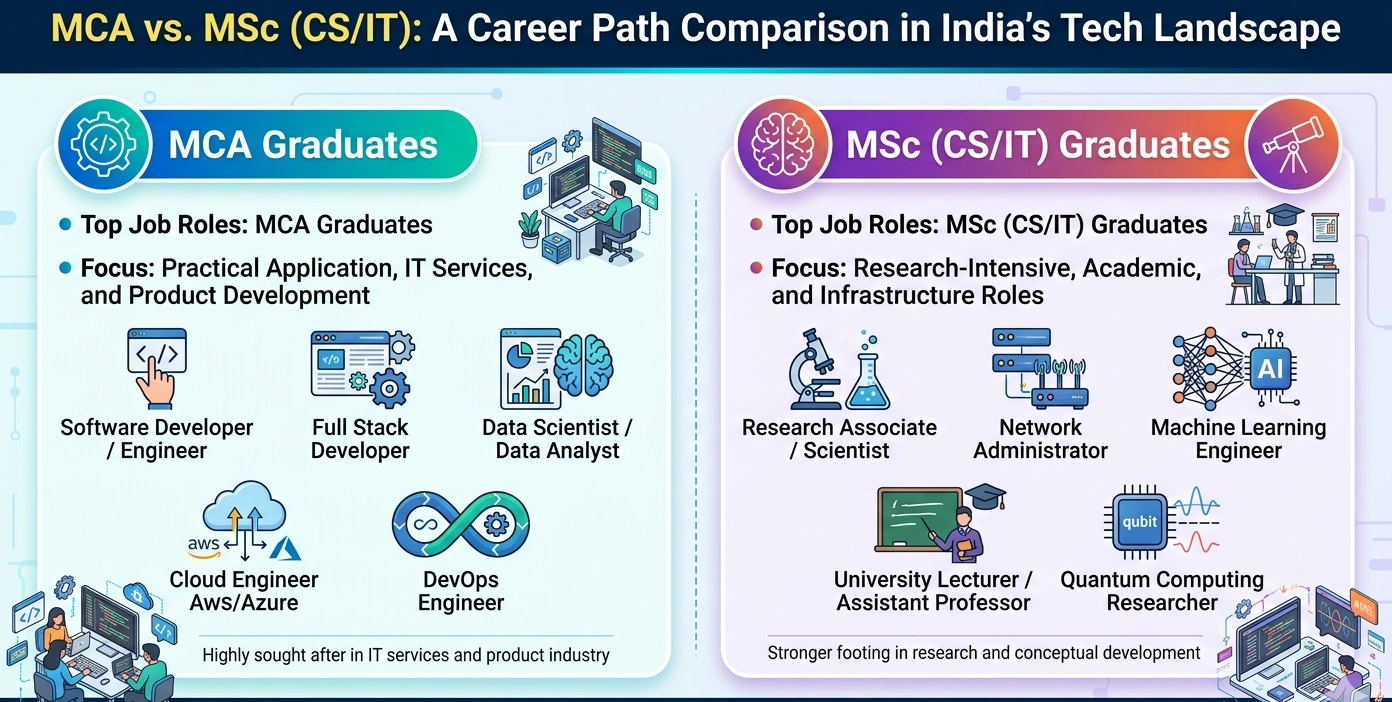
When evaluating MCA vs MSc, career outcomes are often the deciding factor for most graduates. Both degrees open strong professional pathways, but they diverge significantly in terms of job roles, industry demand, and salary trajectories. MCA leans heavily toward hands-on IT industry roles, while MSc (CS/IT) caters more to research, academia, and specialized technical functions. Here is a comprehensive breakdown of where each degree takes you in 2026.
Top Job Roles: MCA Graduates
MCA graduates are highly sought after in India’s IT services and product industry, with roles that directly match software development and systems management demand:
- Software Developer / Engineer — Core coding, application development, and product building
- Full Stack Developer — Frontend and backend web/app development
- Data Scientist / Data Analyst — Data modelling, visualization, and business insights
- Cloud Engineer — AWS, Azure, and GCP-based infrastructure management
- Cybersecurity Analyst — Network security, ethical hacking, and threat management
- Systems Analyst — Business-IT alignment, system design, and architecture
- DevOps Engineer — CI/CD pipeline management, automation, and deployment
- IT Project Manager — Leading cross-functional technical teams and delivery cycles
- Database Administrator (DBA) — SQL/NoSQL database design and management
- Mobile App Developer — Android/iOS application development
Top Job Roles: MSc (CS/IT) Graduates
MSc graduates tend to find stronger footing in research-intensive, academic, and infrastructure-focused roles:
- Research Associate / Scientist — Academic and industrial R&D in computer science
- Network Administrator — Managing enterprise networks, servers, and IT infrastructure
- Machine Learning Engineer — Algorithm design and model development for AI systems
- University Lecturer / Assistant Professor — Teaching and academic research roles
- IT Systems Manager — Overseeing organisational IT systems and digital assets
- Embedded Systems Engineer — Hardware-software integration and IoT development
- Information Security Specialist — Data governance, compliance, and security audits
- Business Intelligence Analyst — Reporting, dashboards, and strategic data analysis
- Quantum Computing Researcher — Emerging role in next-gen computing research
- Technical Writer / Consultant — Documentation and IT advisory roles
Salary Comparison 2026
| Career Stage | MCA (India) | MSc CS/IT (India) | MCA (Global) | MSc CS/IT (Global) |
| Entry-Level (0–2 yrs) | ₹4–8 LPA | ₹5–9 LPA | ₹30–45 LPA | ₹32–48 LPA |
| Mid-Career (3–7 yrs) | ₹10–18 LPA | ₹12–22 LPA | ₹45–70 LPA | ₹50–75 LPA |
| Senior Level (8+ yrs) | ₹20–35 LPA | ₹22–40 LPA | ₹80–1.2 Cr | ₹85–1.3 Cr |
| Highest Paying Role | Data Scientist | ML Engineer | Cloud Architect | AI Research Scientist |
Industry-Wise Placement Comparison
| Industry Sector | MCA Placement Demand | MSc CS/IT Placement Demand |
| IT Services (TCS, Infosys, Wipro) | Very High | Moderate |
| Product Companies (Google, Microsoft) | Moderate | High |
| Banking & Fintech | High | Moderate |
| Research & Academia | Low | Very High |
| Defence & Government (DRDO, ISRO) | Moderate | High |
| Startups & E-Commerce | Very High | Moderate |
| Healthcare IT | High | Moderate |
| Telecom & Networking | Moderate | High |
Top Recruiting Companies 2026
| Degree | Top Recruiters |
| MCA | TCS, Infosys, Wipro, HCL, Accenture, Cognizant, Capgemini, IBM, Tech Mahindra, Zoho |
| MSc CS/IT | Google, Microsoft, IBM Research, DRDO, ISRO, Wipro, Deloitte, Oracle, Intel, CDAC |
Practical vs Theoretical: MCA and MSc Industry Relevance 2026
Choosing between MCA and MSc IT involves understanding their distinct industry relevance and career paths. MCA is primarily practical and job-focused, emphasizing software development, while MSc IT concentrates on theoretical knowledge and research. This section clarifies core differences, helping determine which career option has better scope for individual aspirations in the evolving tech landscape.
| Parameters | MCA | MSC IT |
| Focus | More focus on Application development, software engineering, and professional IT skills | Gives focus on Information technology concepts, systems, and analytics |
| Curriculum | Programming in C, DBMS, Web & Mobile Apps, Software Engineering, Cloud | IT Infrastructure, Data Analytics, Networking, Cyber Security |
| Career path | Software Developer, Full-Stack Developer, System Analyst, App Developer | IT Analyst, Data Analyst, Network Administrator, IT Consultant |
| Industry demand | Industry demand is very high in IT & software companies | High industry demand, especially in IT services & data analytics |
| Suitability | Best for students aiming for software development roles | Best for students inclined towards IT systems & analysis |
Online MCA vs Online MSc: Career Scope and Opportunities 2026
For 2026, MCA is generally more practical and job-focused, offering direct industry opportunities, while MSc IT leans towards theory and research. This section explores the career scope and opportunities for both, helping to determine which career option has better scope.
| Factor | MCA (Master of Computer Applications) | MSc (Master of Science) |
| Duration | 2-3 years | 2 years |
| Eligibility | BCA, BSc (CS/IT), BTech, or any graduation with Mathematics | BSc in relevant discipline |
| Focus Area | Application Development, Programming, Software Engineering | Research, Theoretical Concepts, Data Science |
| Job Roles | Software Developer, IT Analyst, Web Developer, System Manager | Researcher, Data Analyst, Lecturer, Scientist |
| Salary Range | ₹4 – ₹12 LPA | ₹3.5 – ₹10 LPA |
| Industry Demand | High in IT, Software, and Corporate Sectors | High in Research, Data Science, and Academics |
| Further Studies | PhD, Certifications, Specializations | PhD, Research Fellowship |
This quick comparison highlights key differences in duration, focus, and typical career paths, showing MCA’s industry-oriented nature versus MSc’s research focus.
- General Focus: MCA is practical and job-focused; MSc IT is theory and research-focused.
- Skill Emphasis: MCA focuses on software development; MSc IT on theoretical knowledge.
- Job Readiness: MCA offers direct industry jobs; MSc IT may need higher study.
- Broader Scope: MCA provides wider IT career scope; MSc IT suits research/teaching.
- Faster Salary Growth: MCA generally ensures faster salary growth due to its industry curriculum.
- BCA Preference: MCA is a stronger choice for BCA graduates due to professional depth.
Understanding these foundational differences is crucial when evaluating mca vs msc: which career option has better scope, especially considering specific job roles and earning potentials.
| Job Role | Average Salary (INR) |
| Software Developer | ₹6 – ₹12 LPA |
| IT Consultant | ₹5 – ₹10 LPA |
| Database Administrator | ₹6 – ₹12 LPA |
| Cybersecurity Analyst | ₹7 – ₹14 LPA |
| AI/ML Engineer | ₹8 – ₹15 LPA |
These roles demonstrate MCA’s strong alignment with industry demand for software development and IT specializations.
| Job Role | Average Salary (INR) |
| Data Scientist | ₹6 – ₹15 LPA |
| Research Scientist | ₹5 – ₹12 LPA |
| System Analyst | ₹6 – ₹10 LPA |
| University Lecturer | ₹5 – ₹9 LPA |
| Quantum Computing Expert | ₹8 – ₹20 LPA |
MSc graduates are well-positioned for roles in data science, research, and academia, reflecting its theoretical emphasis.
| Role | Online MCA Graduate | Online MSc IT Graduate |
| Entry-Level Developer/Analyst | ₹4,00,000 – ₹7,00,000 | ₹3,50,000 – ₹6,50,000 |
| Mid-Level Software Engineer | ₹8,00,000 – ₹12,00,000 | ₹7,00,000 – ₹10,00,000 |
| Project Manager/IT Consultant | ₹12,00,000 – ₹18,00,000 | ₹10,00,000 – ₹16,00,000 |
| Technical Architect/Cybersecurity Specialist | ₹18,00,000+ | ₹16,00,000+ |
Online MCA graduates generally show higher earning potential across entry, mid, and project management levels compared to online MSc IT graduates.
| Factor | MCA (Master of Computer Applications) | M.Sc Computer Science |
| Job Roles | Software Developer, Web Developer, System Analyst, Application Support Engineer, Cloud Associate | Data Scientist, AI/ML Engineer, Research Analyst, Cybersecurity Researcher, Ph.D Scholar |
| Entry-Level Salary | ₹4-8 LPA | ₹5-9 LPA |
| Mid-Career Salary | ₹10-18 LPA | ₹12-22 LPA |
This comparison further highlights the distinct career paths and salary expectations for MCA versus M.Sc Computer Science roles.
- Career Growth: MCA growth depends on skill/experience; MSc IT on research/higher education.
- Industry Priorities (2026): Companies prioritize application skills, DevOps, and AI-assisted coding workflows.
- Earning Potential: Salary depends more on specialization and skill set than degree title.
- Key Expertise: AI, cloud computing, and data science significantly increase earning potential for both degrees.
- Global Prospects: Both degrees can fetch ₹35-60 LPA globally based on role and specialization.
- MSc IT Value: MSc IT remains valuable for those passionate about IT infrastructure or academic roles.
MSc Graduates in 2026: Detailed Overview
MSc graduates in 2026 can achieve global starting salaries of ₹35-60 LPA (equivalent) in Canada, Germany, and the US. This section examines salary expectations for MCA and M.Sc Computer Science/IT graduates in India, helping determine which career option has better scope by comparing average earnings and job profiles.
| Job Profiles After MCA | Average Salary (INR) | Job Profiles After MSc IT | Average Salary (INR) |
| Software Developer / Engineer | 4–12 LPA | IT Analyst | 4–8 LPA |
| Full-Stack Developer | 5–12 LPA | Data Analyst | 5–10 LPA |
| Web / Mobile App Developer | 3–8 LPA | Network Administrator | 3–7 LPA |
| System Analyst | 5–9 LPA | IT Consultant | 6–10 LPA |
| Database Administrator | 6–10 LPA | Cyber Security Analyst | 5–12 LPA |
Frequently Asked Questions
Which has a better scope after BCA: MCA or MSc IT?
MCA generally offers a wider career scope and higher salaries for BCA graduates, with professional postgraduate enrolments steadily increasing in the last five years.
Which course has a better industry demand: MCA or MSc in IT?
Both MCA and MSc in IT have good industry demand as the technology field grows fast. MCA offers quick job market entry, while MSc IT is suitable for research.
Which program is better for software development?
MCA is generally considered more industry-focused for direct software development roles, emphasizing practical application and project work. MSc programs can also lead to software careers, often with a stronger theoretical foundation.
What is mca vs msc: which career option has better scope?
MCA is often seen as the stronger choice for BCA graduates, offering wider career scope and higher salaries. Professional postgraduate enrolments like MCA have steadily increased in the last five years.
What are the eligibility requirements for mca vs msc: which career option has better scope?
BCA graduates are eligible for both MCA and MSc IT. MCA generally offers wider career scope, higher salaries, and professional depth in software development, while MSc IT suits IT infrastructure and research roles.
How do I apply for mca vs msc: which career option has better scope?
MCA offers strong scope for industry readiness and application development, with professional postgraduate enrolments increasing over the last five years. MSc IT suits academic research.







