
MS Courses List: Surgical Specializations and Degree Branches
Master of Science (MS and M.Sc) courses in India are predominantly 2-year full-time post-graduate programs spanning engineering, biotechnology, healthcare, and agricultural sciences. Related post-graduate medical and surgical degrees such as MDS and MD range from 2 to 3 years in duration.
At least 602 colleges offer MS (Master of Surgery) degrees in India, with median course fees ranging from ₹1.50 lakh in government institutions to ₹24.14 lakh in private institutions. Below is a detailed guide covering eligible degree branches, surgical specializations, program fees, career placement trends, and selection steps.
| Parameter | Details |
|---|---|
| MS / M.Sc Program Duration | 2 Years (Full Time) |
| MDS Course Duration | 2 to 3 Years (Full Time) |
| MD Course Duration | 2 to 3 Years (Full Time) |
| Engineering MS Branches | Mechanical, Aerospace, Electrical, ECE, EEE, Mechatronics, Automation & Robotics, Automobile |
| Healthcare & Allied MS Branches | Medical Surgical Nursing, Child Health Nursing, Community Health Nursing, Hospital Administration, Medical Lab Technology |
| Agricultural MS Branches | Agriculture, Horticulture, Agricultural Economics, Agricultural Entomology, Agricultural Statistics |
Fees
At least 602 colleges offer MS (Master of Surgery) programs in India, including 186 government and 199 private institutions. Program fee structures vary considerably based on institutional ownership and facilities.
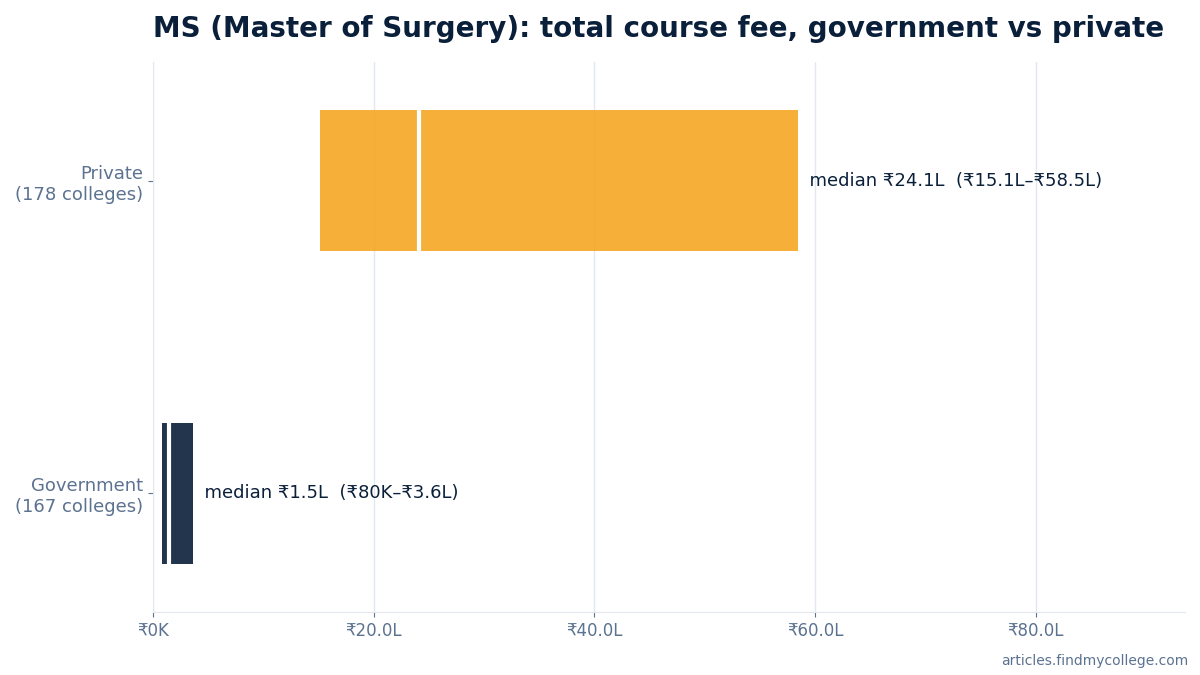
Among government colleges, the median total course fee is ₹1.50 lakh, with the middle half of reporting institutions charging between ₹79,500 and ₹3.63 lakh (calculated across 167 government colleges with fee data). Private colleges reflect a median total course fee of ₹24.14 lakh, with the middle half ranging from ₹15.14 lakh to ₹58.46 lakh (across 178 private colleges with fee data).
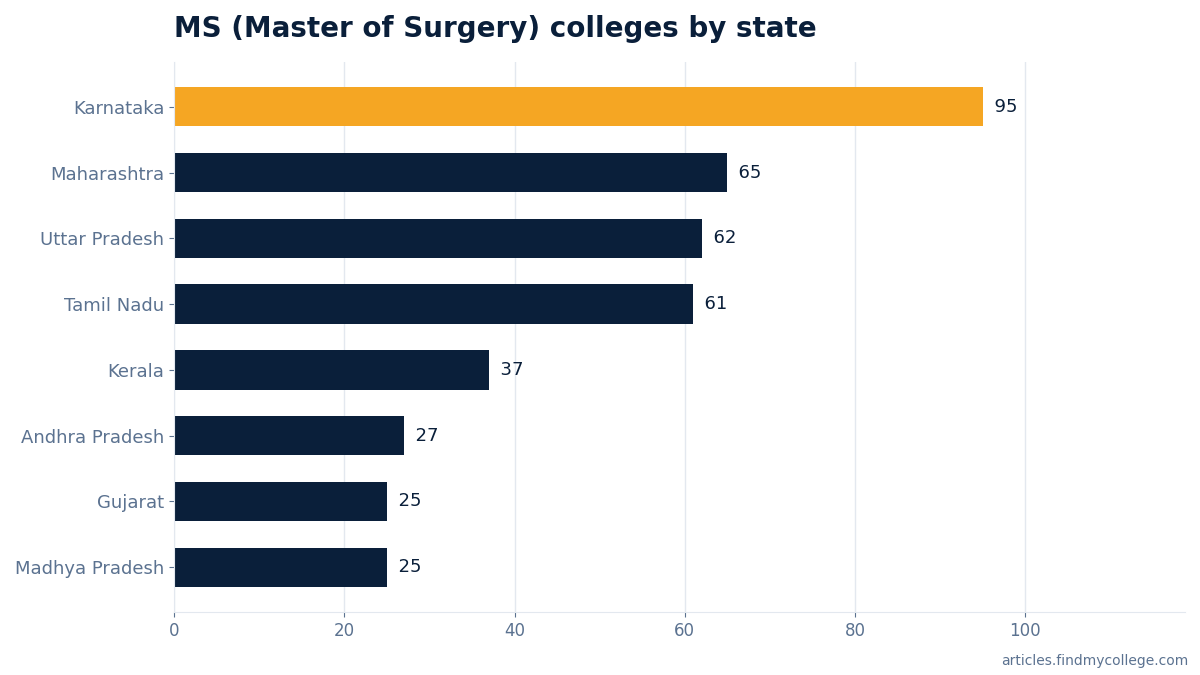
Institutional availability is distributed across several key states: Karnataka has 95 colleges, Maharashtra has 65, Uttar Pradesh has 62, Tamil Nadu has 61, Kerala has 37, and Andhra Pradesh has 27 colleges.
| College | City | Ownership | Total course fee | NIRF rank |
|---|---|---|---|---|
| All India Institute of Medical Sciences New Delhi | Delhi | Government | — | 1 (Medical, 2025) |
| Post Graduate Institute of Medical Education & Research | Chandigarh | Government | ₹9,210 | 2 (Medical, 2025) |
| Christian Medical College Vellore | Vellore | Private | — | 3 (Medical, 2025) |
| Manipal University Manipal | Manipal | — | ₹69.30 lakh | 3 (Overall, 2025) |
| Jawaharlal Institute of Post Graduate Medical Education and Research | Pondicherry | Government | ₹1.03 lakh | 4 (Medical, 2025) |
| Sanjay Gandhi Postgraduate Institute of Medical Sciences | Lucknow | Government | — | 5 (Medical, 2025) |
| Banaras Hindu University | Varanasi | Government | ₹42,828 | 6 (Medical, 2025) |
| Kasturba Medical College Manipal | Manipal | Private | ₹81.22 lakh | 10 (Medical, 2025) |
| College | City | Ownership | Total course fee |
|---|---|---|---|
| Post Graduate Institute of Medical Education & Research | Chandigarh | Government | ₹9,210 |
| Sardar Patel Medical College | Bikaner | Government | ₹11,235 |
| Regional Institute of Medical Sciences | Imphal | Government | ₹13,830 |
| Nalanda Medical College | Patna | Government | ₹15,000 |
| Nilratan Sircar Medical College & Hospital | Kolkata | Government | ₹18,000 |
| Government Medical College Kota | Kota | Government | ₹26,250 |
| Jawaharlal Nehru Medical College Ajmer | Ajmer | Government | ₹27,225 |
| Bankura Sammilani Medical College | Bankura | Government | ₹30,000 |
| RNT Medical College | Udaipur | Government | ₹35,873 |
| North Bengal Medical College | Darjeeling | Government | ₹36,000 |
| City | Colleges | Fee range | Well-known options |
|---|---|---|---|
| Bangalore | 23 | ₹1.98 lakh – ₹96.00 lakh | Sanjay Gandhi Institute of Trauma and Orthopaedic, Rajiv Gandhi University of Health Sciences |
| Chennai | 21 | ₹70,800 – ₹1.17 crore | Madras Medical College, Saveetha Institute of Medical and Technical Sciences |
| Pune | 12 | ₹4.31 lakh – ₹90.00 lakh | Armed Forces Medical College, Dr. DY Patil Vidyapeeth |
| Kolkata | 11 | ₹18,000 – ₹22.50 lakh | West Bengal University of Health Sciences, Calcutta National Medical College |
| Mangalore | 11 | ₹21.42 lakh – ₹1.05 crore | Nitte University, Yenepoya University Mangalore |
| Delhi | 10 | ₹39,000 – ₹48.25 lakh | All India Institute of Medical Sciences New Delhi, Maulana Azad Medical College |
| Pondicherry | 9 | ₹1.03 lakh – ₹1.17 crore | Jawaharlal Institute of Post Graduate Medical Education and Research, Mahatma Gandhi Medical College and Research Institute |
| Lucknow | 9 | ₹1.21 lakh – ₹1.17 crore | King George’s Medical University, Sanjay Gandhi Postgraduate Institute of Medical Sciences |
Career Options and Salary
Post-graduate options across engineering, healthcare, and surgical branches lead to distinct career pathways in industry, research, clinical practice, and hospital administration. Across 21 reporting colleges, the median average placement package is 5.6 LPA.
Placement packages and fee structures vary across private institutions. Mahatma Gandhi Medical College and Hospital in Jaipur records an average package of 16.1 LPA alongside a total course fee of ₹93.47 lakh. JJM Medical College in Davanagere reports an average package of 4.8 LPA with a fee of ₹21.42 lakh.
St. John’s Medical College in Bangalore offers an average package of 4.3 LPA with a course fee of ₹35.10 lakh. Yenepoya Medical College in Mangalore reports an average package of 3.43 LPA with a fee of ₹1.05 crore. Father Muller Medical College in Mangalore records 3 LPA with a fee of ₹23.49 lakh, and Jawaharlal Nehru Medical College in Belagavi records 2.88 LPA with a fee of ₹76.05 lakh.
| College | City | Ownership | Total course fee | Average package |
|---|---|---|---|---|
| Mahatma Gandhi Medical College and Hospital | Jaipur | Private | ₹93.47 lakh | 16.1 LPA |
| JJM Medical College | Davanagere | Private | ₹21.42 lakh | 4.8 LPA |
| St. John’s Medical College | Bangalore | Private | ₹35.10 lakh | 4.3 LPA |
| Yenepoya Medical College | Mangalore | Private | ₹1.05 crore | 3.43 LPA |
| Father Muller Medical College | Mangalore | Private | ₹23.49 lakh | 3 LPA |
| Jawaharlal Nehru Medical College | Belagavi | Private | ₹76.05 lakh | 2.88 LPA |
How to Choose
Selecting the right post-graduate specialization requires aligning personal career goals with core discipline elements:
- Engineering & Machinery: Candidates interested in machine design, operations, and production across biotechnology and aerospace can opt for Mechanical Engineering. Those aiming to work on aircraft components, maintenance, spacecraft, missiles, and weapon systems should consider Aeronautical or Aerospace Engineering.
- Automation & Electronics: Applicants focusing on artificial intelligence, intelligent automated systems, or integrated electronic technology can select Automation and Robotics, Mechatronics Engineering, ECE, or EEE.
- Built Environment & Design: Architecture combines science, art, and technology to focus on structural planning and space utilization.
- Healthcare & Surgical Branches: Practitioners seeking clinical, surgical, or administrative tracks can choose specialized programs such as Medical Surgical Nursing, Hospital Administration, or surgical dental degrees like MDS in Oral & Maxillofacial Surgery.
How to Apply for MS Admission: Step by Step
- Step 1: Choose Your Specialization Stream: Select a discipline in engineering (Mechanical, Aerospace, Electrical, ECE, EEE, Automation & Robotics, Automobile, Mechatronics, Architecture) or healthcare and science fields.
- Step 2: Check Program Options: Explore 2-year full-time MS/M.Sc options like Biotechnology, Electronics & Communication, Medical Lab Technology, Hospital Administration, or Nursing specializations.
- Step 3: Consider Agricultural & Surgical Fields: Evaluate 2-year M.Sc options in Agriculture, Horticulture, Agricultural Economics, Entomology, and Statistics, or clinical/surgical degrees (MDS/MD) lasting 2 to 3 years.
- Step 4: Confirm Course Duration: Verify program structures, noting that standard MS and M.Sc degrees run for 2 years full-time, whereas MDS and MD specializations span 2 to 3 years.
- Step 5: Assess College Types and Costs: Compare options across 602 MS (Master of Surgery) colleges, noting median fees of ₹1.50 lakh in 186 government colleges versus ₹24.14 lakh in 199 private colleges.
| What to do | Where | Link |
|---|---|---|
| Compare colleges, fees and cutoffs | MS (Master of Surgery) colleges in India | findmycollege.com |
Master of Science programs in India generally require 2 years of full-time study across engineering, healthcare, and agricultural streams. Candidates evaluating Master of Surgery (MS) options can choose among 186 government and 199 private colleges nationwide.
FAQs
What MS courses are available in India?
MS and M.Sc courses in India cover specializations such as Biotechnology, Electronics and Communication, Medical Surgical Nursing, Medical Lab Technology, Hospital Administration, as well as engineering branches like Mechanical, Aerospace, Electrical, ECE, EEE, and Automation & Robotics.
What is the duration of MS courses?
Master of Science (MS / M.Sc) degrees in India generally have a duration of 2 years full-time. Surgical and clinical medical post-graduate degrees like MDS and MD range from 2 to 3 years.
Which engineering disciplines offer MS degrees in India?
Engineering branches offering MS degrees include Mechanical Engineering, Aerospace Engineering, Aeronautical Engineering, Electrical Engineering, ECE, EEE, Automation and Robotics, Automobile Engineering, Mechatronics, and Architecture.
What allied medical surgical specializations are offered at the post-graduate level?
Surgical and healthcare post-graduate specializations include Master of Science [M.Sc] in Medical Surgical Nursing (2 years) and Master of Dental Surgery [MDS] in Oral & Maxillofacial Surgery (2 years).
What is MS after graduation?
MS after graduation is a post-graduate master’s degree program (Master of Science or Master of Surgery) pursuing advanced specialized study in engineering, technology, science, or healthcare branches.