Online UG Degrees in India After 12th 2026: BCA, BBA, BSc, BA, BCom & More — Complete Guide
Online UG degrees after 12th in India include BA, BSc, BCom, BCA and others. Find out top colleges offering these degrees with fees, application process and more.
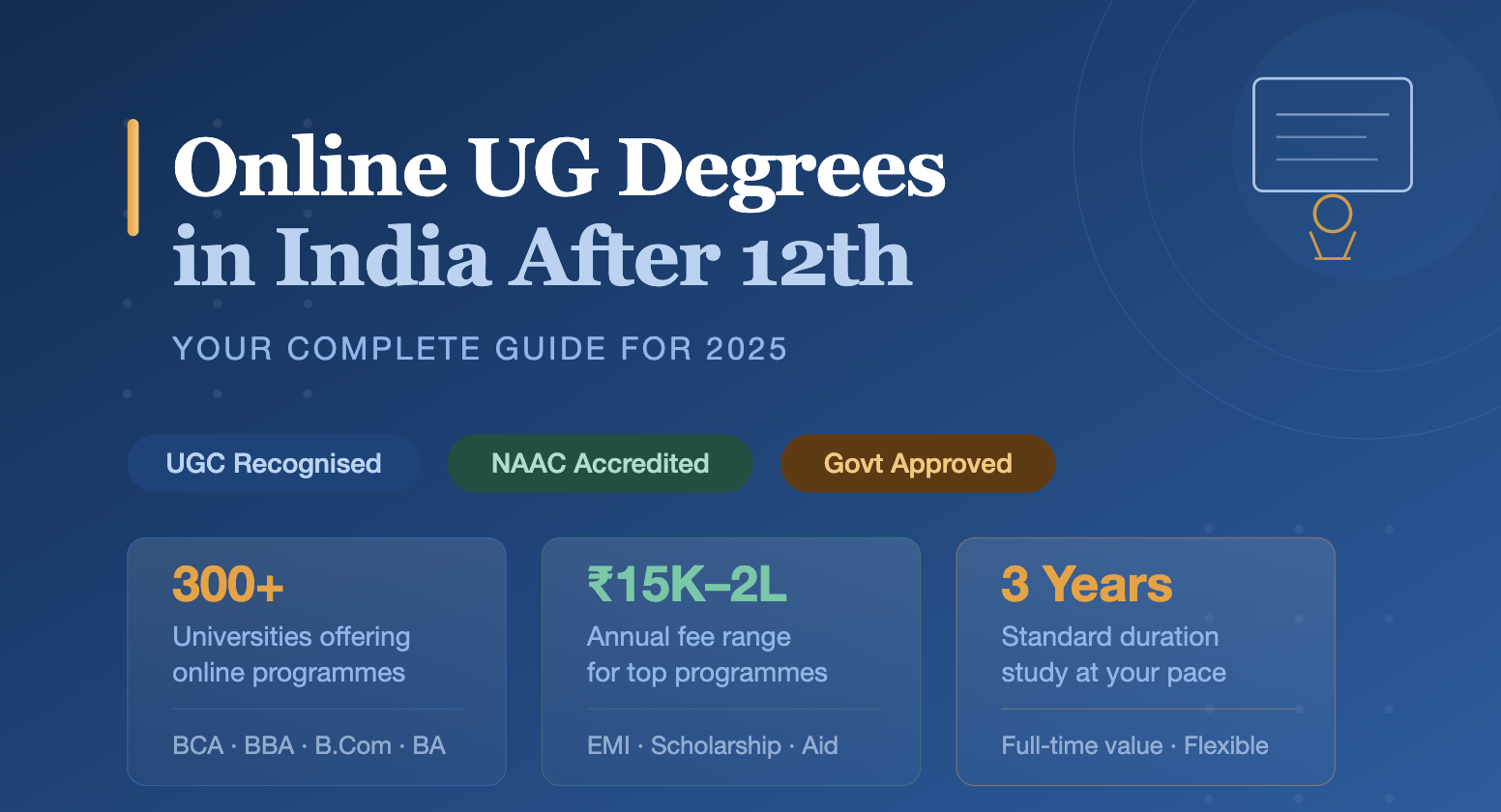
Online UG Degrees in India are becoming increasingly popular due to their flexibility and affordability. Students pursue prestigious degrees like BSc, BCom, BA and BCA in online modes. Institutes like IGNOU, Manipal University, Amity University, LPU, Chandigarh University and many more provide a range of online UG courses. Online UG degrees in India typically range from 3-4 years, depending on the course. These can offer lucrative job opportunities, with salaries ranging from Rs. 3-6 LPA, and opening doors to higher education. Read this detailed guide to online UG courses in India. Find popular courses, top colleges, course-wise overviews and more.
Can You Do a Degree Online After 12th?
Yes. The UGC (Open and Distance Learning Programmes and Online Programmes) Regulations, 2020 — notification number F.No. 1-1/2020(DEB-I), dated 4 September 2020 — establishes that any student who has passed Class 12 from a recognised board is eligible to enrol in an ODL or online UG programme at a UGC-DEB approved institution. There is no upper age limit. The regulations explicitly state equivalence with conventional mode degrees.
At most online universities, admission to UG programmes is merit-based on Class 12 marks. No entrance exam is required by IGNOU, Manipal University Jaipur (Online), LPU Online, Amity Online, or Chandigarh University Online for their online UG admissions. Stream eligibility, however, varies by degree — some programmes accept all three streams (Science, Commerce, Arts) while others have subject-level requirements.
Popular Online UG Degrees
| Degree | Stream Requirement | Math Mandatory in 12th? | Key Caveats |
| BCA | Any stream (Arts/Commerce/Science) | IGNOU: Yes (or bridge course BCS-012). Manipal Online: No. LPU Online: No. CU Online: No. Amity Online: No. | IGNOU requires Mathematics as a distinct 12th subject; others don’t. Always verify before applying. |
| BBA | Any stream | No | Open to all streams uniformly across all major online providers. |
| BSc (IT/CS/Data Science) | Any stream at most online providers | No — for IT/CS specialisations. Yes — for Physics/Chemistry/Bio-based BSc. | Lab-heavy BSc streams (PCB) are not practically offered online. |
| BA | Any stream | No | Broadest eligibility; no stream restriction. |
| BCom | Any stream | No | Traditionally a Commerce stream degree, but all major online providers accept any stream. |
Popular Colleges Offering Online UG Degrees
Online UG degrees are offered by IGNOU, Amity University, Manipal University and many more in India. Here are some popular options to explore:
| College / University | Online UG Degrees Offered |
| Indira Gandhi National Open University (IGNOU) | BA, BCom, BCA, BBA, BSc (selected), BSWT |
| Amity University (Amity Online) | BA, BBA, BCom, BCA, BA (Journalism), BA (Economics) |
| Manipal University Jaipur (Online Manipal) | BA, BBA, BCom, BCA |
| Lovely Professional University (LPU Online) | BA, BBA, BCom, BCA |
| Chandigarh University (CU Online) | BA, BBA, BCom, BCA |
| NMIMS Global Access School for Continuing Education | BBA, BCom, BA (in select streams) |
| Jain University (Online Jain University) | BBA, BCom, BCA |
| Symbiosis Centre for Distance Learning | BA, BCom, Diploma & skill-based UG-level programs |
| Dr. D. Y. Patil Vidyapeeth (Online) | BA, BBA, BCom (selected programs) |
| Sikkim Manipal University (Distance/Online) | BA, BBA, BCom, BCA |
Admission Process for Online UG Degrees
Online undergraduate degree admissions are streamlined, entirely digital, and primarily based on your high school merit:
Step 1: Check Eligibility & Accreditation
Verify that you meet the minimum high school marks requirement (usually 45%–50%) and confirm the university holds valid regulatory approvals (like UGC-DEB or regional accreditation).
Step 2: Online Registration
Visit the university’s official portal, create an applicant account with your basic contact details, and pay a nominal registration fee.
Step 3: Complete the Application Form
Fill out your academic history, choose your specific UG program (e.g., BBA, BCA, BCom), and select any desired specializations.
Step 4: Upload Required Documents
Upload clean, scanned copies of your 10th and 12th-grade marksheets, a government-issued ID, and recent passport-size photographs.
Step 5: Document Verification
Wait 2 to 3 days for the university admission cell to verify your academic credentials; entrance exams are rarely required.
Step 6: Fee Payment
Receive your admission offer letter and secure your seat by paying the first semester or annual tuition fee through the online portal.
Step 7: LMS Onboarding
Receive your official enrollment number and login credentials for the Learning Management System (LMS) to begin your online classes.
What Online UG Degrees Actually Cost?
The table below compares per-year and 3-year total fees across four study modes, using standard non-honours programmes as the reference. Government college fees reflect median ranges for aided institutions; private college fees reflect typical mid-tier private universities.
| Mode | Per-Year Fee Range | 3-Year Total (Approx.) |
| Online UG (mid-tier, e.g., LPU, Manipal Online) | ₹30,000 – ₹75,000 | ₹90,000 – ₹2,25,000 |
| Regular Private College | ₹50,000 – ₹2,00,000 | ₹1,50,000 – ₹6,00,000 |
| Regular Government College | ₹10,000 – ₹60,000 | ₹30,000 – ₹1,80,000 |
| Distance / IGNOU | ₹3,000 – ₹12,000 | ₹9,000 – ₹36,000 |
Note on hidden costs: Online learners who are working professionals save on hostel (₹5,000–₹25,000/year at government institutions; more at private ones), daily commute (₹3,000–₹8,000/month in metro cities), and loss-of-income costs. For a working professional earning ₹20,000–₹25,000/month, three years of full-time campus study means an income forgone of ₹7.2–₹9.0 lakhs — a cost that does not appear in any fee comparison table but is the most significant financial variable for most applicants.
Online BCA — Bachelor of Computer Applications
Online BCA (Bachelor of Computer Applications) is a 3-year undergraduate program divided into 6 semesters, with a maximum completion window of up to 6 years in most universities. It is open to Class 12 pass students from any recognised board, usually requiring 45–50% aggregate, while Mathematics eligibility depends on the university.
Graduates can pursue careers as Software Developers, Web Developers, System Administrators, Data Analysts, QA Engineers, Network Administrators, or Database Administrators, and may also progress to MCA or MBA (Tech), with salaries ranging from Rs. 3.5 – 6 LPA.
Top Institutions with Fees (2025)
| University | Total Programme Fee | Per Semester | NAAC/NIRF |
| IGNOU | ₹23,700 | ₹3,950 | —- |
| LPU Online | ₹1,11,360 (post 20% grant) | ₹20,400 | A++, NIRF #27 |
| Manipal University Jaipur Online | ₹1,35,000 | ₹22,500 | A+, NIRF #64 |
| Chandigarh University Online | ₹1,41,600 (post-discount) | ₹23,600 | A++, NIRF #20 |
| Amity Online | ₹1,32,000–₹1,98,000 | ₹25,000–₹37,500 | A++, NIRF #32 |
Online BBA — Bachelor of Business Administration
Online BBA (Bachelor of Business Administration) is a 3-year undergraduate program (6 semesters) open to Class 12 pass students with a minimum of 45–50% aggregate with no Mathematics requirement. It prepares students for careers such as Marketing Executive, Sales Executive, HR Executive, Operations Executive, Business Analyst, Accounts Executive, and Entrepreneurship, and is also the most common pathway to MBA programs. Freshers usually earn around ₹2.5–4.5 LPA, while specialisations like Finance or Information Systems can reach ₹3.5–5 LPA in early roles.
The degree is highly relevant for MBA progression, and many universities even offer integrated BBA+MBA programs (such as Amity Online and LPU Online), enabling a structured 5-year management pathway at comparatively lower combined costs.
Top Institutions with Fees (2025)
| University | Total Programme Fee | Per Semester | NAAC/NIRF |
| IGNOU | ₹31,200 | ₹5,200 | A++, Not NIRF-ranked |
| LPU Online | ₹1,11,360 (post 20% grant) | ₹20,400 | A++, NIRF #27 |
| Manipal University Jaipur Online | ₹1,35,000 | ₹22,500 | A+, NIRF #64 |
| Chandigarh University Online | ~₹1,58,400 (post-discount) | ~₹26,400 | A++, NIRF #20 |
| Amity Online | ₹1,45,200 | ₹27,500 | A++, NIRF #32 |
Online BSc — Bachelor of Science
BSc IT and BSc Data Science are two of the most popular online UG BSc degrees. Most conventional BSc specialisations, such as Physics, Chemistry, Biology etc. are not available in online mode due to heavy reliability on lab work. Bsc IT and BSc Data Science, on the other hand, require only software and computing tools like Python, SQL, Excel, Power BI, network simulation software — which are deliverable entirely online.
Online BSc Degrees go on for 30-4 years, offering roles like software tester, web developer, data analyst and more with salaries from Rs. 4-7.5 LPA.
Top Institutions — Online BSc IT / Data Science (2025)
| University | Programme | Total Fee | NAAC/NIRF |
| IIT Madras | BSc in Programming and Data Science | ₹1,00,000–₹2,27,000 | IIT (autonomous) |
| Amity Online | BCA in Data Analytics (near-equivalent) | ₹1,95,000–₹2,20,000 | A++, NIRF #32 |
| Chandigarh University Online | BSc in Data Science (PG) / BCA IT (UG) | ₹1,41,600 (BCA IT) | A++, NIRF #20 |
| Manav Rachna Online | BCA in Data Science & Big Data Analytics | ₹1,56,000 | A+, NAAC |
| IGNOU | BSc General | ₹17,700 | A++ |
Online BA – Bachelor of Arts
The 3 year Online BA UG degree is open for students with valid 12th scores from any stream. Applicants can opt for subjects like History, Political Science, Economics, Sociology, Psychology, English, Hindi, Sanskrit, Urdu, Public Administration, Geography, Philosophy, Anthropology, Journalism and Mass Communication.
Who Benefits From This Course
UPSC aspirants: The most common use case. A student self-studying for UPSC CSE, IAS, IPS, or state PSC exams needs a recognised undergraduate degree as a minimum eligibility criterion. IGNOU BA — at ₹13,200 total for 3 years — is the cheapest nationally accredited degree available in India.
Working professionals in media and communications: Amity Online’s BA in Journalism and Mass Communication (₹1,49,600 total) provides a nationally recognised credential for professionals already working in media, PR, or content roles who need the degree for promotions, regulatory requirements, or senior positions.
Top Institutions With Fee Range
| University | Programme | Total Fee | Per Semester |
| IGNOU | BA General (ODL) | ₹13,200 | ₹2,200 |
| IGNOU | BA Hons (English/History/Pol.Sci.) | ₹14,700 | |
| LPU Online | BA General | ₹89,760 | ₹16,400 |
| Amity Online | BA General | ₹87,120 | ₹16,500 |
| Amity Online | BA (Journalism & Mass Communication) | ₹1,49,600 | ₹28,000 (avg) |
Online BCom — Bachelor of Commerce
Online BCom (Bachelor of Commerce) is a 3-year undergraduate program (6 semesters) open to Class 12 pass students from any recognised board, with most online providers accepting all streams. It is especially suited for CA/CMA/CS aspirants (as it aligns well with ICAI articleship requirements, with IGNOU being a popular low-cost option), as well as working professionals in accounting, banking, and finance who need a formal degree for career progression.
Graduates can pursue roles such as Accountant, Accounts Executive, Tax Consultant, Financial Analyst, Banking Executive, Insurance Advisor, Auditor and others, with salaries ranging from INR 3-6 LPA.
Top Institutions with Fees (2025)
| University | Total Fee | Per Year | NAAC/NIRF |
| IGNOU BCom (ODL) | ₹8,100 | ₹2,700 | A++ |
| IGNOU BCom (Online) | ₹10,500 | ₹3,500 | A++ |
| Jain University Online | ₹90,000–₹3,36,000 | ₹30,000–₹1,12,000 | A++, NIRF #65 |
| Amity Online BCom | ₹87,120–₹2,20,000 | ₹29,040–₹73,333 | A++, NIRF #32 |
| Amity Online BCom (ACCA) | ₹2,20,000 | ₹73,333 | A++, NIRF #32 |
| GLA University Online | ₹71,000 | ₹23,667 | A+, NIRF #98 |
| Amrita Online BCom | ₹1,20,000–₹2,85,000 | ₹40,000–₹95,000 | A++, NIRF #7 |
Pursuing Two UG Degrees Simultaneously
UGC Notification F.No.6-1/2022(CPP-II) permits a student enrolled in any regular, distance, or online programme to simultaneously pursue a second degree. Both degrees may be in online or ODL mode; at least one may be in a different subject area. Here are practical steps to follow to pursue two UG degrees in India:
Step 1 — Confirm regular college policy. If you are in a regular campus programme, check whether your institution has formally adopted the dual degree policy.
Step 2 — Check academic calendar conflicts. End-term exam windows at both institutions must not overlap. Online universities typically offer December–January and May–June examination windows. Confirm dates before finalising the combination.
Step 3 — Assess live session requirements. Most online universities offer recorded lectures as the primary content delivery. Some (Amity Online, Symbiosis SCOL) require live synchronous sessions.
Step 4 — Manage credit load. UGC guidelines suggest a maximum of 20–24 credits per semester for a full-time student. A dual online degree typically adds 18–22 credits per semester for the second programme. Working professionals and students already in a campus programme should assess this against their available weekly hours before committing.
Step 5 — Budget the second degree. In most cases, the second degree is billed entirely separately. Common second-degree additions and their costs:
| Second Degree Added | Approx. Additional Cost | Best Combined With |
| IGNOU BA (ODL) | ₹13,200 (3 years) | Any campus UG programme |
| IGNOU BCom (ODL) | ₹8,100 (3 years) | Campus BBA or BCA |
| LPU Online BBA | ₹1,11,360 | Campus BCom or BA |
| LPU Online BCA | ₹1,11,360 | Campus BBA or BCom |
| Amity Online BA | ₹87,120 | Any technical degree |
Does Online Degree Hold Any Value in India?
Yes, online degrees in India are fully valid if pursued from a UGC-DEB approved university, and are legally equivalent to regular degrees for jobs, higher studies, and government exams.
- Legal validity: Over 113 universities in India are approved to offer online degrees, and these programs are officially recognised under UGC regulations, making them equivalent to campus degrees for all purposes.
- Employer acceptance: Recent industry surveys suggest around 78% of Indian employers accept UGC-approved online degrees for hiring and promotions, especially when backed by skills and experience.
- Higher education (PG scope): Online UG degrees are accepted for MBA, MCA, MCom, MA, etc., with most universities treating online and regular graduates equally in eligibility criteria.
- Government job eligibility: Valid for UPSC, SSC, banking, railways, and other competitive exams if the degree is from a recognised institution.
- Job market reality: Companies prioritise skills, projects, internships, and certifications over study mode, especially in IT, finance, marketing, and business roles.
- Perception gap: Top-tier campus placement pipelines may still favour regular college students, but this gap reduces significantly in startups and mid-sized companies.
Red Flags to Avoid While Pursuing Online UG Degree
- University not on UGC-DEB approved list. Verify every institution at ugc.ac.in before paying any fee. As of 2026, UGC has declared 32 fake universities operating across 12 states — 12 in Delhi alone. A degree from any of these is invalid for all government and private employment.
- No NAAC accreditation or NIRF rank. UGC requires a minimum NAAC score of 3.26 to offer online programmes. Any institution offering online degrees without displaying a valid NAAC certificate and UGC-DEB approval letter is operating outside the regulatory framework.
- Programme not listed on DEB portal. Even if a university is UGC-approved, each specific programme must be listed on the DEB portal for that academic year. A university may be approved for MBA online but not BCA online. Verify the specific programme, not just the institution name.
- CGPA conversion manipulation. Some institutions advertise inflated CGPA-to-percentage conversion formulae that produce unrealistically high percentage equivalents on mark sheets. This causes problems during job applications when employers or HR systems apply the standard formula.
- “Guaranteed placement” claims for online UG degrees. No accredited university offers or is permitted to offer guaranteed placement for an undergraduate degree. Any institution making this claim is either misleading students or conflating placement assistance (interview prep, resume workshops) with placement outcomes. Placement data for online UG degrees is almost entirely undisclosed by universities.
- No proctored exam requirement. A legitimate online degree programme in India requires proctored end-term examinations — either at designated exam centres or via live remote proctoring. If an institution offers a degree where all assessments are self-submitted assignments with no proctored examination, the degree will not be treated as credible by most employers.
Frequently Asked Questions
Which online UG degree has the best job prospects in India?
Online BCA has the strongest direct job market among online UG degrees, with fresher salary ranging from Rs. 3.5-5 LPA (software developer, web developer, system administrator, QA analyst, and data analyst roles). Online BCom follows next with banking (IBPS PO/Clerk), accounts, and taxation roles offering INR 3-5 LPA.
Is an online BCA valid for IT jobs?
Yes, if UGC-DEB approved. Online degrees are equivalent to regular ones under UGC rules. Hiring depends more on skills, coding tests, and projects than mode of degree.
Can I do an online degree while studying at a regular college?
Yes. UGC allows dual degrees (one regular + one online/ODL). No exam clashes and manageable workload required. IGNOU is preferred by most students due to its flexible, low-cost structure.
What is the cheapest online UG degree in India?
IGNOU BCom (ODL) at ₹8,100 total for 3 years is the cheapest accredited undergraduate degree in India across any mode. This works out to ₹2,700 per year, or approximately ₹450 per month over 18 months of active enrolment. IGNOU BA General (ODL) is ₹13,200 total (₹2,200 per semester), and IGNOU BCA (ODL) is ₹23,700 total.
Do online UG degrees have entrance exams?
No entrance exam is required for most online UG degrees. Admission is based on Class 12 marks and document verification, with only minor aptitude checks in some universities.