Salary for Early Childhood Educators in India 2026: Pay Trends
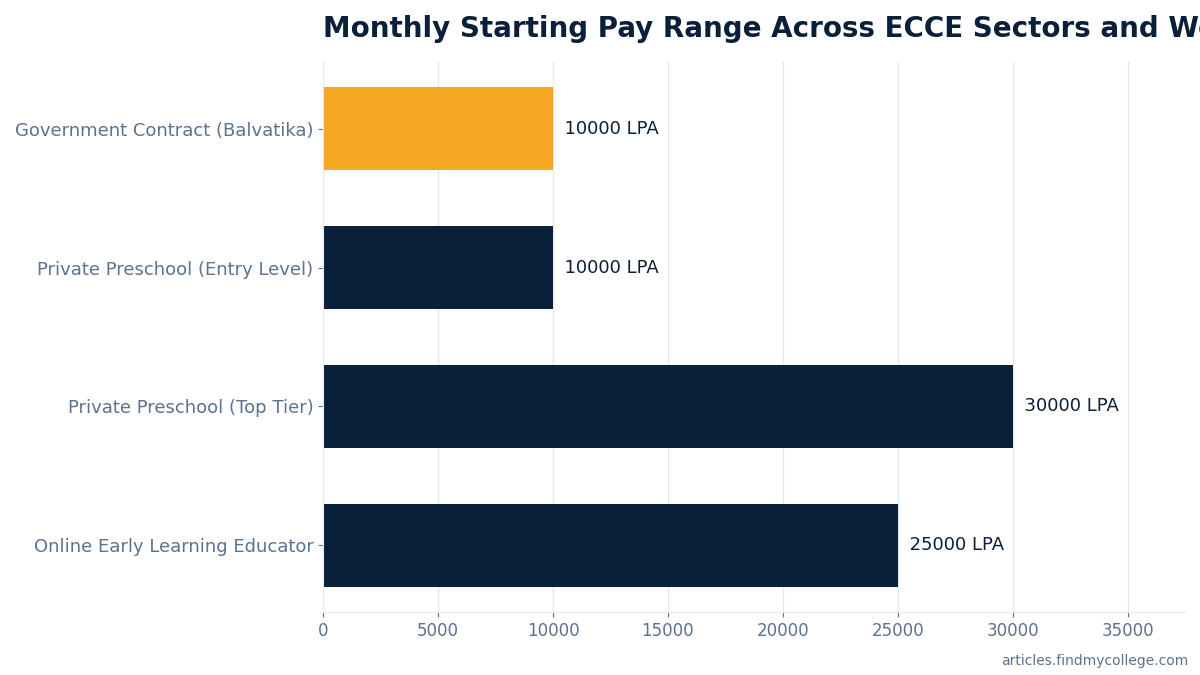
In 2026, Early Childhood Care and Education (ECCE) educators in India earn an average salary of ₹15,000 to ₹25,000 per month, with an overall typical range of ₹14,000 to ₹40,000 per month. Entry-level freshers start at ₹10,000 to ₹20,000 per month, while experienced educators in leadership roles earn ₹40,000 to ₹80,000+ per month, reaching up to ₹5–10 LPA in specialized roles.
Candidates can evaluate salary structures across experience levels, government and private sectors, tech-enabled teaching formats, regional variations, and top academic options for professional certification.
| Parameter | Details |
|---|---|
| Average Monthly Salary | ₹15,000 – ₹25,000 per month |
| Overall Monthly Pay Range | ₹14,000 – ₹40,000 per month |
| Fresher Starting Salary | ₹10,000 – ₹20,000 per month (up to ₹30,000 in top private preschools) |
| Government Sector Pay (Anganwadi / Balvatika) | ₹10,000 – ₹12,000 per month (contract roles) |
| Private & International School Pay | ₹20,000 – ₹80,000+ per month |
| Leadership & Senior Role Pay | ₹40,000 – ₹80,000+ per month |
Early Childhood Education Salary in India
Early Childhood Care and Education has seen increased structured investment across educational setups. The implementation of NEP 2020 prioritizes foundational learning for children aged 3 to 8 years, significantly expanding teacher recruitment in public initiatives such as Balvatika classrooms as well as private pre-primary institutions.
The average monthly pay scale for ECCE educators ranges from ₹15,000 to ₹25,000 per month. Overall pay spans between ₹14,000 and ₹40,000 per month across mid-tier private preschools, international institutions, and public contract programs.
Early Childhood Education Salary by Experience
| Experience Level | Monthly Salary Range (₹) | Key Skills & Role Focus |
|---|---|---|
| Fresher / Entry-Level (0–2 Years) | ₹10,000 – ₹20,000 (up to ₹30,000 in top private schools) | Classroom management, communication |
| Mid-Level Teachers (2–5 Years) | ₹18,000 – ₹35,000 | Lesson planning, parent handling, activity-based teaching |
| Experienced Teachers (5–10+ Years) | ₹25,000 – ₹50,000 | Child psychology, experiential teaching methods |
| Leadership & Administrative Roles | ₹40,000 – ₹80,000+ | Center leadership, non-classroom roles |
Entry-level ECCE freshers earn ₹10,000 to ₹20,000 per month, reaching up to ₹30,000 in top private schools. Mid-level teachers earn ₹18,000 to ₹35,000, while experienced educators make ₹25,000 to ₹50,000 and leadership roles command ₹40,000 to ₹80,000+ per month.
Early Childhood Education Salary by Job Role
Compensation varies significantly based on whether an educator serves in classroom instruction, digital delivery, or center administration. Leadership and administrative positions command the upper tier of early childhood pay scales.
Entry-level classroom teachers earn between ₹10,000 and ₹20,000 per month, while mid-level teachers handling curriculum implementation earn ₹18,000 to ₹35,000 per month. Specialized educators working in online and tech-enabled platforms earn ₹25,000 to ₹60,000+ per month.
Early Childhood Education Salary in Government vs Private Sector
The sector of employment plays a defining role in initial earnings and long-term financial growth. Government contractual positions offer consistent foundational roles, while private and tech-driven platforms provide higher upper-salary caps.
| Sector / School Type | Monthly Pay Range (₹) | Key Features & Earning Dynamics |
|---|---|---|
| Government Sector (Anganwadi / Balvatika) | ₹10,000 – ₹12,000 | Contractual recruitment, public sector foundational initiatives |
| Private & International Schools | ₹20,000 – ₹80,000+ | Higher growth potential based on curriculum, skills, and experience |
| Online & Tech-Enabled Early Learning | ₹25,000 – ₹60,000+ | Integrates AI aids, digital storytelling, and interactive tools |
Early Childhood Educator Salary Variations Across Indian Cities
Geographic location influences compensation scales due to variations in cost of living, parent fee structures, and the concentration of premium pre-primary school networks.
| Location Tier / City | Monthly Pay Range (₹) | Location Pay Insights |
|---|---|---|
| Metro Cities | ₹20,000 – ₹50,000+ | Driven by high urban demand and premium private preschool chains |
| Mumbai (Specific Range) | ₹18,000 – ₹50,000 | Varies significantly based on school reputation and experience |
| Tier-2 Cities | ₹15,000 – ₹35,000 | Moderate pay with expanding pre-primary school infrastructure |
| Rural Areas | ₹10,000 – ₹25,000 | Primarily government programs and basic local setups |
How to Increase Early Childhood Education Salary
Educators can boost their earning potential by acquiring recognized qualifications, expanding core pedagogical capabilities, and leveraging modern educational technologies.
Completing specialized credentials such as Nursery Teacher Training (NTT), Montessori training, or a Diploma in Early Childhood Care and Education (ECCE) establishes strong foundational eligibility. Upskilling in English communication fluency, lesson planning creativity, classroom management, and child psychology enables movement into top private institutions. Furthermore, integrating technology—such as AI learning aids, digital storytelling, and interactive content tools—opens access to online learning platforms paying ₹25,000 to ₹60,000+ per month.
Early Childhood Education Colleges and Course Fees in India
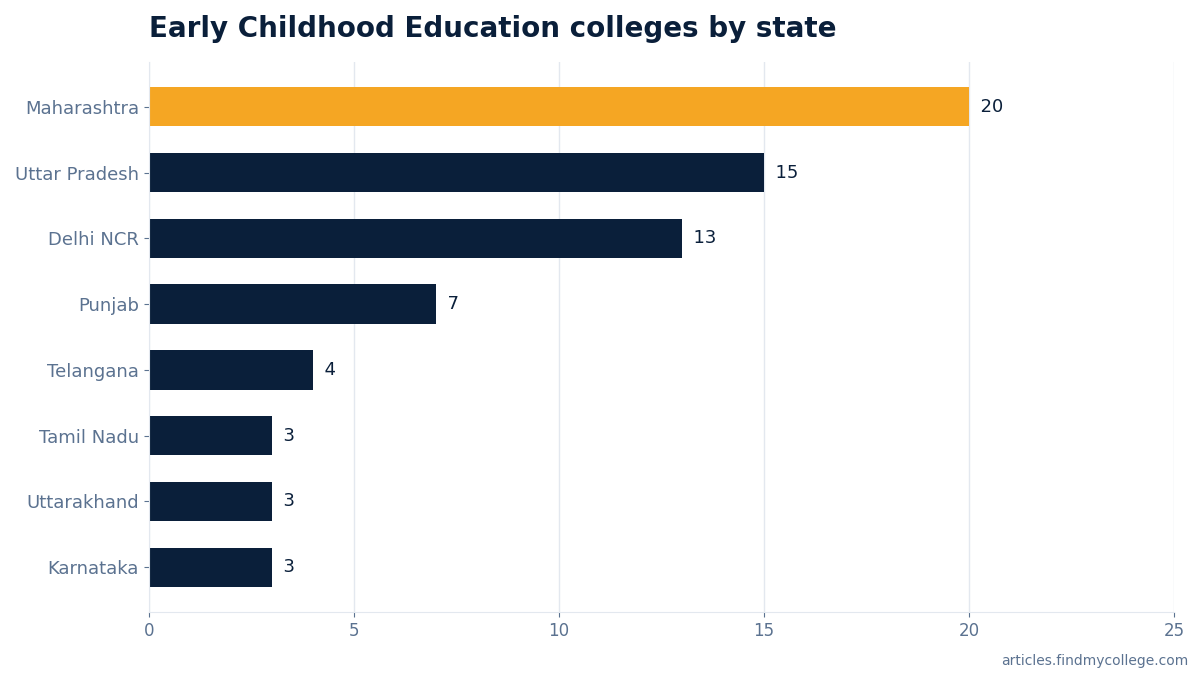
At least 87 colleges offer Early Childhood Education courses, including 8 government colleges and 24 private colleges. Private colleges maintain a median total course fee of ₹30,000, with the middle half ranging between ₹26,120 and ₹40,000 among institutions reporting fee figures. State-level presence includes Maharashtra with 20 colleges, Uttar Pradesh with 15 colleges, Delhi NCR with 13 colleges, Punjab with 7 colleges, Telangana with 4 colleges, and Tamil Nadu with 3 colleges.
| College | City | Ownership | Total course fee | NIRF rank |
|---|---|---|---|---|
| Punjab Agricultural University | Ludhiana | — | ₹65,510 | 3 (Overall, 2025) |
| Delhi University | Delhi | Government | — | 5 (Overall, 2025) |
| Guru Nanak Dev University | Amritsar | — | ₹37,235 | 48 (Overall, 2023) |
| Tata Institute of Social Sciences Mumbai | Mumbai | — | ₹80,000 | 72 (Overall, 2025) |
| Institute of Home Economics | Delhi | University | — | 75 (Overall, 2022) |
| Maulana Azad National Urdu University | Hyderabad | University | — | 151 (Overall, 2023) |
| College | City | Ownership | Total course fee |
|---|---|---|---|
| Mahatma Jyoti Rao Phoole University | Jaipur | Private (aided) | ₹30,000 |
| Kanya Mahavidyalaya | Jalandhar | Private (aided) | ₹34,260 |
| Maniben Nanavati Women’s College | Mumbai | Private (aided) | ₹28,900 |
| Pradeep Memorial Comprehensive College of Education | Delhi | Private | ₹60,000 |
| AMS College of Teacher Education | Hyderabad | Private (aided) | ₹26,120 |
| Dr. BMN College of Home Science | Mumbai | Private (aided) | ₹23,000 |
| Gannabathula Tulasamma Pedatata College of Education for Women | Godavari | Private | ₹40,000 |
| City | Colleges | Fee range | Well-known options |
|---|---|---|---|
| Delhi | 13 | ₹10,800 – ₹70,000 | Delhi University, Indira Gandhi National Open University |
| Mumbai | 13 | ₹15,500 – ₹80,000 | Tata Institute of Social Sciences Mumbai, Shreemati Nathibai Damodar Thackersey Women’s University Mumbai |
| Pune | 4 | ₹2.30 lakh – ₹2.30 lakh | Dr. P. A. Inamdar University, St. Mira’s College for Girls |
| Lucknow | 4 | — | Integral University, Babasaheb Bhimrao Ambedkar University |
| Hyderabad | 4 | ₹26,120 – ₹26,120 | Dr. B.R. Ambedkar Open University, Maulana Azad National Urdu University |
| Ludhiana | 3 | ₹65,510 – ₹65,510 | PCTE Group of Institutes, Punjab Agricultural University |
| Dehradun | 3 | ₹1.05 lakh – ₹1.39 lakh | Shri Guru Ram Rai University, Maya Group of Colleges |
| Allahabad | 2 | — | Uttar Pradesh Rajarshi Tandon Open University, Ruchi’s Institute of Creative Arts |
| College | City | Ownership | Total course fee |
|---|---|---|---|
| Indira Gandhi National Open University | Delhi | Government | ₹10,800 |
| Kavikulguru Kalidas Sanskrit University | Nagpur | University | — |
| Hansraj Jivandas College of Education | Mumbai | Private (aided) | — |
How to Start Your Early Childhood Education Journey: Step by Step
- Check Eligibility and Pursue Certification: Obtain early childhood education qualifications such as Nursery Teacher Training (NTT), Montessori training, or a Diploma in Early Childhood Care and Education (ECCE).
- Develop Core High-Impact Classroom Skills: Build strong English fluency, classroom management skills, child psychology awareness, and lesson planning capabilities.
- Apply to Entry-Level ECCE Positions: Apply for entry-level roles in private preschools (₹10,000–₹20,000/month) or government contractual initiatives such as Balvatika classrooms (₹10,000–₹12,000/month).
- Integrate Educational Technology Skills: Learn digital storytelling, interactive content creation tools, and AI learning aids to qualify for online programs earning ₹25,000–₹60,000+ per month.
| What to do | Where | Link |
|---|---|---|
| Compare colleges, fees and cutoffs | Early Childhood Education colleges in India | findmycollege.com |
FAQs
What is the average salary for early childhood educators in India per month?
The average salary for ECCE teachers in India ranges from ₹15,000 to ₹25,000 per month. Overall pay typically ranges between ₹14,000 and ₹40,000 per month based on school type and experience.
What is the highest salary for early childhood educators in India?
Experienced educators in administrative or center leadership roles earn ₹40,000 to ₹80,000+ per month, while specialized non-classroom roles can command annual salary packages reaching ₹5.00 to ₹10.00 LPA.
What is the salary for government early childhood care and education jobs?
Government contract roles in programs like Anganwadi or Balvatika pay around ₹10,000 to ₹12,000 per month.
What does early childhood education involve?
Early childhood education involves foundational learning for children aged 3 to 8 years, focusing on classroom management, child psychology, digital storytelling, interactive content creation, and experiential teaching methods.
Which skills raise an ECCE teacher’s salary in 2026?
English communication fluency, lesson planning creativity, tech integration (digital storytelling, AI aids), understanding child psychology, and professional certifications like NTT or Montessori significantly boost earning potential.