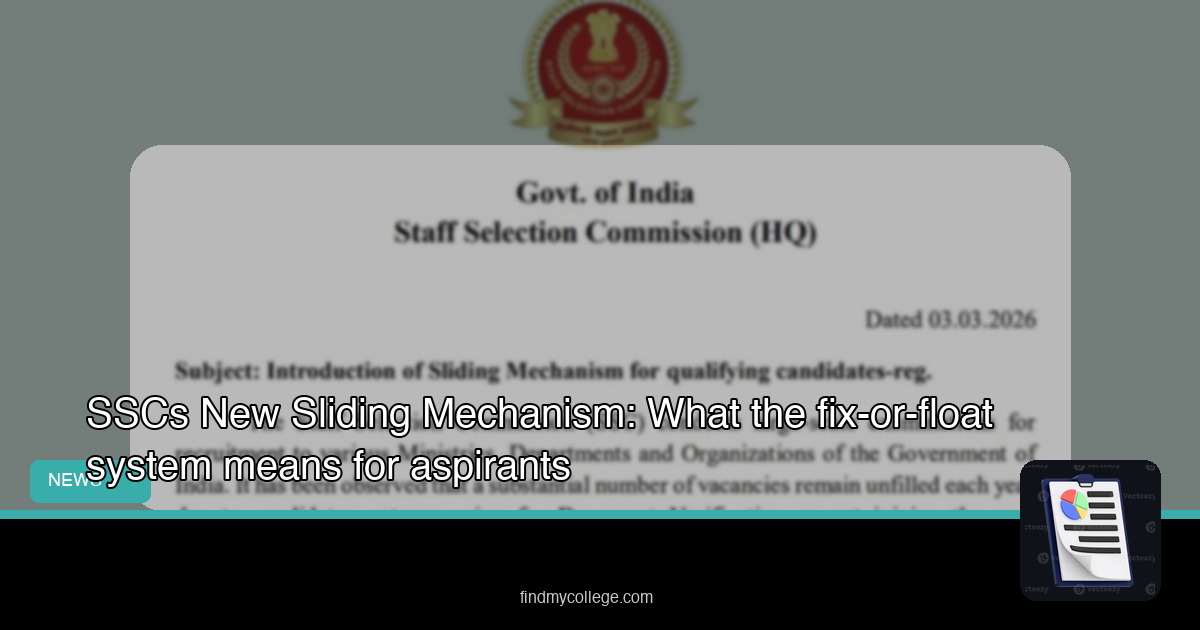
SSC’s New ‘Sliding Mechanism’: What the fix-or-float system means for aspirants
For lakhs of government job aspirants eyeing Staff Selection Commission (SSC) examinations in 2026, a important change is on the horizon. The SSC has officially introduced a new ‘Sliding Mechanism’ featuring a ‘Fix or Float’ option, directly impacting how successful candidates will be allocated posts and potentially offering a second chance at their dream role. This system, ed in early March 2026, aims to drastically reduce the persistent problem of unfilled vacancies, ensuring more eligible candidates secure positions within the same recruitment cycle.
This move is being hailed as a candidate-friendly initiative, designed to optimize the filling of maximum vacancies across major examinations like the Combined Graduate Level (CGL) and Combined Higher Secondary Level (CHSL). Aspirants will now face a critical decision during their Mandatory Identity Verification (IV) stage: either ‘fix’ their tentatively allotted post or ‘float’ for an upgrade in a subsequent reallocation round.
Understanding SSC’s New ‘Sliding Mechanism’ for 2026 Exams
The Staff Selection Commission, responsible for recruiting tens of lakh candidates annually for various Group B and Group C central government positions, has implemented the ‘Sliding Mechanism’ for all its 2026 recruitment cycles. This system fundamentally alters the post-selection allocation process, introducing a dynamic element previously absent. At its core, the mechanism is a two-stage allocation process designed to be more efficient and equitable.
Under this new framework, successful candidates will first receive a ‘First Round of Tentative Allocation’ (FRTA). This initial allotment will be based strictly on their merit and the department preferences they submitted during the application process. Following the FRTA, candidates are mandated to appear for an Identity Verification (IV) at their respective SSC Regional Director (RD) Office. IT is at this IV stage that the ‘Fix or Float’ decision comes into play, a choice that could significantly influence their career trajectory.
The SSC has confirmed that a detailed Standard Operating Procedure (SoP) for the ‘Sliding Mechanism’ will be released soon on its official website, SSC.gov.in. This SoP is expected to provide full guidelines on the implementation, timelines, and specific scenarios related to the new system, which aspirants must monitor closely.
Why the ‘Fix or Float’ System Became Necessary
The introduction of the ‘Sliding Mechanism’ is a direct response to a long-standing challenge faced by the Staff Selection Commission: many vacancies remaining unfilled each year. Despite millions of applicants and thousands of notified positions across various ministries and departments, a portion of these posts ultimately goes vacant. This persistent issue stems from two primary reasons:
- Non-Appearance for Document Verification (DV): Many selected candidates fail to appear for the mandatory identity and document verification process.
- Non-Joining After Selection: A considerable number of candidates, even after successful selection and verification, choose not to join the allotted department. This often happens if they secure a better opportunity elsewhere or decide against a government job.
The SSC conducts multi-stage examinations, making IT impractical to maintain traditional waiting lists. , any post that remains vacant due to non-joining or non-verification had to be reported again in the subsequent recruitment cycle, leading to delays and inefficient use of resources. This wastage of vacancies burdened the commission deprived other eligible candidates of an opportunity. The ‘Sliding Mechanism’ is specifically designed to mitigate this problem by allowing for a single reallocation round within the same examination cycle, thereby maximizing the utilization of reported vacancies and benefiting more eligible aspirants.
How the Sliding Mechanism Works: A Step-by-Step Breakdown
Understanding the mechanics of the new system is important for every SSC aspirant. Here’s a detailed look at the process:
- First Round of Tentative Allocation (FRTA): Based on your merit and the preferences you submitted during the application, the SSC will provisionally allot you a post and department. This is the initial offer.
- Mandatory Identity Verification (IV) at RD Office: All candidates who receive an FRTA must physically appear at their designated SSC Regional Director (RD) Office for Identity Verification. This step is for confirming your allocation.
- The ‘Fix or Float’ Choice: At the IV stage, candidates will be presented with two options regarding their FRTA-allotted post:
- Fix: Choosing ‘Fix’ means you accept the post and department allotted in the FRTA. By selecting this, you confirm your acceptance and will not be considered for any further upgrades or reallocations in the ‘Sliding Round’. This is a final decision for that particular post.
- Float: Choosing ‘Float’ means you accept the FRTA-allotted post opt to be considered for a potentially better post in the subsequent ‘Sliding Round’. This indicates your willingness to upgrade if a higher-preference or higher-merit post becomes available due to other candidates fixing their posts or not joining.
- The ‘Sliding Round’ (for ‘Float’ Candidates): After all candidates have made their ‘Fix or Float’ choices, the SSC will conduct a single ‘Sliding Round’. In this round, only candidates who chose ‘Float’ will be considered. The system will re-evaluate their merit against the newly available vacancies (posts released by ‘Fixed’ candidates or those who didn’t appear for IV) and their original preferences.
- If a ‘Float’ candidate is upgraded to a better post, their original FRTA post is released and can be offered to another eligible ‘Float’ candidate.
- If a ‘Float’ candidate does not receive an upgrade in the ‘Sliding Round’, they will retain their original FRTA-allotted post.
- Final Allocation: The process concludes with the final allocation of posts after the ‘Sliding Round’. The aim is to fill as many vacancies as possible within this single cycle.
Old System vs. New: A Comparative Look at Post Allocation
The ‘Sliding Mechanism’ marks a significant departure from the previous post-allocation methodology. Here’s a comparative overview:
| Feature | Old System (Pre-2026) | New ‘Sliding Mechanism’ (2026 Onwards) |
|---|---|---|
| Vacancy Filling Efficiency | Substantial number of vacancies remained unfilled annually due to non-joining/non-DV. Vacancies re-reported in next cycle. | Aims to optimize filling of maximum vacancies within the same recruitment cycle, reducing wastage. |
| Waiting List Provision | Not feasible to maintain traditional waiting lists for multi-stage exams. | Introduces a ‘Sliding Round’ as a single reallocation mechanism, effectively acting as a dynamic upgrade opportunity. |
| Candidate Opportunity | No second chance for candidates to upgrade or fill released posts within the same cycle. | ‘Float’ option allows candidates to seek an upgrade to a better post based on merit and availability. |
| Post Allocation Process | Tentative allocation based on merit and preferences, followed by Document Verification (DV) and joining. | First Round of Tentative Allocation (FRTA), followed by Mandatory Identity Verification (IV) with ‘Fix or Float’ choice, leading to a potential ‘Sliding Round’. |
| Decision Point for Candidates | Decision to join or not after final selection, with no immediate alternative if a better post becomes available. | Critical ‘Fix or Float’ decision at the Mandatory Identity Verification (IV) stage, requiring strategic thinking. |
What the ‘Fix or Float’ Choice Means for Your SSC Aspirations
This new system is a double-edged sword, offering both d opportunities and requiring more strategic decision-making from aspirants. For those who have performed exceptionally well and are confident in securing their top preferences, the ‘Fix’ option might be straightforward. However, for a vast majority, especially those on the cusp of higher-preference posts, the ‘Float’ option presents a valuable opportunity.
The primary benefit is the increased chance of securing a preferred post. In the past, if a candidate with higher merit declined a post, IT would simply go vacant until the next recruitment cycle. Now, that post becomes available for a ‘Float’ candidate in the ‘Sliding Round’. This means the system is designed to be more merit-based and responsive, ensuring that vacancies are filled by the most deserving candidates within the same cycle.
However, the ‘Float’ option also introduces a layer of complexity. Aspirants must carefully weigh their current FRTA allocation against the potential for an upgrade. While choosing ‘Float’ doesn’t risk losing your initially allotted post (you retain IT if no upgrade occurs), IT does require patience and a clear understanding of your preferences and merit standing. The decision at the IV stage will be important, and candidates are advised to research thoroughly and consider all possibilities.
Navigating the New System: Key Actions for Aspirants
With the ‘Sliding Mechanism’ now in effect for SSC Recruitment 2026, aspirants must adapt their approach. Here’s a checklist of steps:
- Understand the SoP: As soon as the detailed Standard Operating Procedure (SoP) is released by the SSC on SSC.gov.in, download and study IT thoroughly. This will contain the definitive rules and timelines.
- Re-evaluate Preferences: Before the FRTA and subsequent IV, critically review your submitted post and department preferences. Understand which roles are most desirable to you and where you stand in terms of merit.
- Prepare for Mandatory IV: Ensure all your identity and document verification papers are in order. Missing this step means forfeiting your FRTA.
- Strategic ‘Fix or Float’ Decision: During the IV, make an informed decision. If you are content with your FRTA post and do not wish for any changes, choose ‘Fix’. If you believe there’s a reasonable chance for an upgrade to a higher-preference post based on your merit and potential vacancy movement, choose ‘Float’.
- Stay Updated: Continuously check the official SSC website for any announcements, especially regarding the release of the SoP and the schedule for the ‘Sliding Round’.
This new system represents a significant step towards greater efficiency and candidate benefit in government recruitment. By understanding its and making informed choices, aspirants can maximize their chances of securing a coveted central government post in 2026.
Quick Summary
- SSC introduced a new ‘Sliding Mechanism’ with ‘Fix or Float’ options for all 2026 recruitment exams.
- The system aims to reduce unfilled vacancies by allowing a single reallocation round within the same exam cycle.
- Candidates receive a First Round of Tentative Allocation (FRTA) based on merit and preferences.
- During Mandatory Identity Verification (IV), candidates must choose to ‘Fix’ their FRTA post or ‘Float’ for a potential upgrade in a ‘Sliding Round’.
- A detailed Standard Operating Procedure (SoP) for the mechanism is expected to be released soon on SSC.gov.in.
TAGS: SSC, Sliding Mechanism, Fix or Float, Recruitment 2026, Government Jobs, Vacancy Filling, CGL, CHSL, Student Impact, Post Allocation, Identity Verification
Latest Education News
- AMU, University of Houston sign MoU to improve academic research, faculty development
- CBSE Class 12th Mathematics Exam Tips 2026: High weightage topics & important formulae
- NEET UG 2026 रजिस्ट्रेशन की डेडलाइन नजदीक, जान लें जरूरी नियम तभी दे सकेंगे परीक्षा
- India Post Gramin Dak Sevak Results 2026: When will merit list be issued at indiapostgdsonline.gov.in?
- Over 1.45 crore students enrolled in 1.04 lakh primary schools in Maharashtra

📰 More Education News
- Today News Headlines for School Assembly, March 6, 2026: US attack leaves Iran’s drone carrier burning, India beats England in ICC Men’s T20 World Cup 2026Mar 6, 2026 • Shreoshree Chakrabarty
- CBSE cancels Class 10th exams in the Middle East till March 11; Class 12th March 7 paper postponedMar 6, 2026 • Aarushi Mehra
- CM SHRI Schools Admission Test 2026: दिल्ली में सीएम श्री एडमिशन टेस्ट के लिए आवेदन जारी, इस डेट तक भर सकते हैं फॉर्म – cm shri schools admission test 2026 applications open for cm shri admission test in delhi opportunity to fill thMar 6, 2026 • Simran
- AMU, University of Houston sign MoU to improve academic research, faculty developmentMar 6, 2026 • Prabhu Raul