Salary for Telecommunications Engineer in India 2026
Students exploring telecommunication careers can analyze compensation structures across specialized roles, compare government versus private sector opportunities, review top recruiting colleges and key technical skills, and follow a clear step-by-step career path.
| Parameter | Details |
|---|---|
| Role Type | Technical / Engineering (Design, Installation & Maintenance) |
| Specialised Job Roles | Network Engineer, RF Engineer, VoIP Engineer, Telecom Systems Engineer, Telecom Systems Architect |
| Minimum Qualification | Bachelor’s degree in Telecommunications or Electronics Engineering |
| Work Sectors | Telecom Companies, IT Firms, Government Sectors |
| Workplace Environment | Desk/Office-bound remote monitoring with site travel for installation and repair |
| Core Technical Skills | Cloud Computing, Network Engineering, Calculus, Mechanical & Communication Skills |
Telecommunication Engineering Salary in India
| College | City | Total Course Fee | Average Placement Package |
|---|---|---|---|
| Pimpri Chinchwad College of Engineering | Pune | ₹4.83 lakh | 5.54 LPA |
| Progressive Education Society’s Modern College of Engineering | Pune | ₹3.82 lakh | 4.79 LPA |
| DKTE Society’s Textile and Engineering Institute | Kolhapur | ₹3.63 lakh | 4.48 LPA |
| Bhilai Institute of Technology Raipur | Raipur | ₹2.34 lakh | 4.16 LPA |
| Yeshwantrao Chavan College of Engineering | Nagpur | ₹2.78 lakh | 4.14 LPA |
| MIT Academy of Engineering | Pune | ₹3.51 lakh | 4.07 LPA |
| Sir M Visvesvaraya Institute of Technology | Bangalore | ₹4.50 lakh | 4.02 LPA |
| Maharashtra Institute of Technology | Aurangabad | ₹3.97 lakh | 3.61 LPA |
Across 20 engineering colleges, the median average placement package is 4.15 LPA. Average packages among private options reach 7.21 LPA at Shri Govindram Seksaria Institute of Technology and Science in Indore.
Telecommunication Engineering Salary in Government vs Private Sector
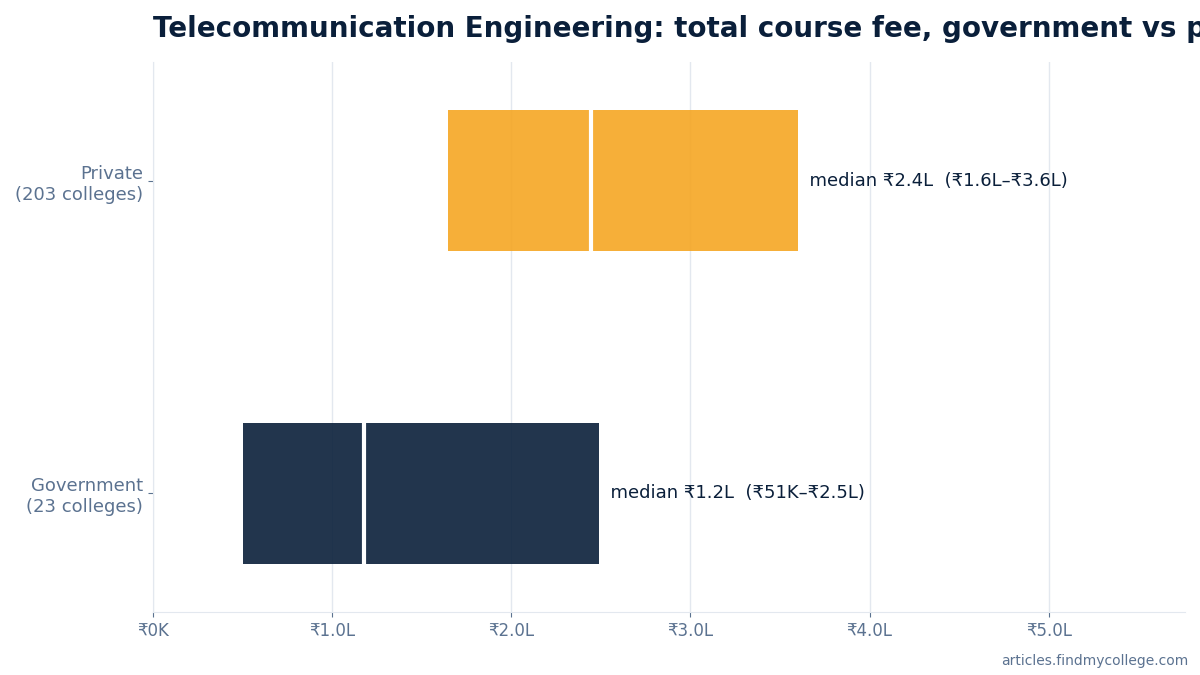
Employment opportunities exist across telecom companies, IT firms, and government sectors. Educational investment varies significantly between government and private institutions. At least 23 government colleges offer Telecommunication Engineering with a median total course fee of ₹1.18 lakh, where the middle half of fees falls between ₹50,586 and ₹2.49 lakh.
Private sector education comprises at least 232 colleges, with 203 reporting fee data. Private colleges feature a median total course fee of ₹2.45 lakh, with the middle half ranging from ₹1.65 lakh to ₹3.60 lakh. Affordable government institutions enable candidates to enter public sector roles with minimal educational debt.
| College | City | Ownership | Total Course Fee |
|---|---|---|---|
| Jadavpur University | Kolkata | Government | ₹9,960 |
| Visvesvaraya Technological University | Belgaum | Government | ₹17,420 |
| Tripura Institute of Technology | Agartala | Government | ₹38,420 |
| Indian Institute of Technology Kharagpur | Kharagpur | Government | ₹43,800 |
| Assam Engineering College | Guwahati | Government | ₹45,000 |
| Government College of Engineering Chandrapur | Chandrapur | Government | ₹50,586 |
| Government Engineering College Raipur | Raipur | Government | ₹62,085 |
| Government College of Engineering and Research | Pune | Government | ₹72,434 |
| Government College of Engineering Yavatmal | Yavatmal | Government | ₹73,362 |
| Parala Maharaja Engineering College | Berhampur | Government | ₹92,200 |
How to Increase Telecommunication Engineering Salary
Enhancing technical expertise and mastering specialized software tools directly impacts compensation growth for telecommunications engineers. Building expertise in cloud computing and network engineering supports modern WAN/LAN and cloud-based communication systems.
| Skill Category | Specific Skill Area | Role & Workplace Impact |
|---|---|---|
| Technical Knowledge | Cloud Computing & Network Engineering | Supports cloud-based communication systems, WAN/LAN, and network infrastructure management. |
| Analytical Skills | Calculus & Mathematical Skills | Enables situational analysis, precise troubleshooting, and complex equipment design. |
| Operational Skills | Eye for Detail & Organisational Skills | Facilitates tracking of technical components and managing complex technical documentation and maintenance. |
Strong analytical skills rooted in calculus and mathematics enable precise troubleshooting and situational analysis.
Workplace Environment and Travel Expectations
Telecommunications engineers operate primarily in office-bound settings using computers for remote network monitoring and troubleshooting. Desk-bound operational monitoring forms the core of daily routines, ensuring constant network uptime.
On-site travel to installation locations is frequently required to conduct physical equipment repairs and infrastructure maintenance. Engineers must also prepare for extended working hours due to project pressure, tight deadlines, or emergency network disruptions.
How to Start Your Telecommunication Engineering Journey: Step by Step
- Meet educational qualifications: Obtain a bachelor’s degree in telecommunications or electronics engineering.
- Develop essential technical and practical skills: Build proficiency in calculus, network engineering, cloud computing, mechanical handling, and technical communication.
- Acquire detailed operational capabilities: Master organizational skills and attention to detail to track technical components, document complex systems, and handle maintenance.
- Gain practical network experience: Build hands-on familiarity with configuring, installing, and remote monitoring of communication systems, as well as conducting site repairs.
- Target roles across key sectors: Pursue specialized roles such as Network Engineer, RF Engineer, VoIP Engineer, Telecom Systems Engineer, or Telecom Systems Architect across telecom companies, IT firms, and government sectors.
| What to do | Where | Link |
|---|---|---|
| Compare colleges, fees and cutoffs | Telecommunication Engineering colleges in India | findmycollege.com |
Telecommunications engineers work across telecom companies, IT firms, and government sectors to design and manage communication networks. Developing strong analytical, mechanical, and technical skills prepares professionals to configure, optimize, and troubleshoot complex systems.
FAQs
What are the responsibilities of a telecommunication engineer?
A Telecommunications Engineer designs, installs, and maintains communication systems like LANs, WANs, satellite networks, and fibre optics, ensuring reliable transmission of voice, data, and video while troubleshooting network issues.
What is the workplace environment like for a telecom engineer?
Telecom engineers work primarily in desk-bound office environments monitoring networks remotely using computers, but frequently travel to installation sites for equipment repairs and may work extended emergency hours.
What qualifications are required to become a telecommunications engineer?
Candidates typically require a Bachelor’s degree in Telecommunications or Electronics engineering, along with key skills in calculus, network engineering, cloud computing, mechanical handling, and technical communication.
What job roles can a telecommunications engineer specialize in?
Telecom engineers can specialize as Network Engineers, RF Engineers, VoIP Engineers, Telecom Systems Engineers, or Telecom Systems Architects, working across telecom companies, IT firms, and government sectors.