Textile Design Diploma: Course Details, Eligibility and Career
Diploma in Textile Design is a 1 to 2-year program focusing on yarn creation, fabric design, dyeing, printing, and textile artwork. The course fee ranges from INR 1 Lakh to INR 12 Lakhs, with starting salaries ranging between INR 2 Lakhs and INR 8 Lakhs per annum.
Students exploring this specialization will find complete details below regarding eligibility requirements, entrance tests, semester subjects, institutional fees, top colleges, and career pathways. The textile design sector has registered a growth rate of 27%, creating technical opportunities across design studios and manufacturing firms.
| Parameter | Details |
|---|---|
| Duration | 1 to 2 years |
| Eligibility | 50% to 55% aggregate marks in 10+2 / H.S.C examination |
| Admission Process | Merit-based, Personal Interview, or Entrance Exam (BHU UET, SOFT CET, MET) |
| Average Course Fees | INR 1 Lakh to INR 12 Lakhs |
| Average Starting Salary | INR 2 Lakhs to INR 8 Lakhs per annum |
What is Diploma in Textile Design
Diploma in Textile Design is a 1 to 2-year professional program that equips students with technical expertise in designing yarns, threads, and fabrics. The curriculum focuses on both structural fabric creation and surface decoration techniques, including dyeing, printing, and textile artwork. With the textile design industry registering a growth rate of 27%, the course prepares students for creative and commercial roles in the textile and fashion sectors.
Students gain hands-on training in yarn production, pattern creation, color development, and traditional textile crafts. The program bridges creative aesthetics with industrial production methods, enabling graduates to work in textile manufacturing units, fashion studios, and design firms.
Diploma in Textile Design Eligibility
- SOFT CET: Conducted by the School of Fashion Technology for candidates with a 50-60% aggregate in 10+2.
- BHU UET: Requires candidates to be under 23 years of age with at least 50% marks in qualifying vocational or stream subjects.
- General Eligibility: Candidates require a minimum of 50% to 55% aggregate in 10+2 H.S.C exams from a recognized board.
Admissions are conducted on the basis of merit or institutional entrance exams. Candidates must fulfill the qualifying marks requirements specified by their chosen university.
Diploma in Textile Design Admission Process
- Application Submission: Candidates can apply online via official institute websites or offline by visiting college offices.
- Selection Basis: Admissions are offered based on merit, personal interviews, or entrance examination performance.
- BHU UET: A computer-based test for candidates under 23 years of age who scored at least 50% marks in qualifying subjects.
- SOFT CET: Conducted by the School of Fashion Technology for candidates with 50% to 60% aggregate in 10+2.
- MET: Conducted by Manipal Academy of Higher Education for candidate selection.
Candidates can apply through online or offline modes for merit-based or entrance-based admission. Selection may involve entrance exams such as BHU UET, SOFT CET, or MET alongside personal interviews.
Diploma in Textile Design Syllabus and Subjects
| Semester / Module Subjects |
|---|
| Introduction to Textiles & Basics of Designing |
| Computer Applications I & II |
| Sketching, Freehand Drawing, and Painting |
| Structural Fabric Design I, II & III |
| Dyeing and Printing I & II |
| Indian Traditional Textiles & Textile Art and Craft |
| Fashion Design and Illustration |
| Computer-Aided Textile Design |
| Basic Textile Knitting & Colour Creation |
| Professional Management and Entrepreneurship & Environmental Studies |
The course focuses on hands-on technical expertise in fabrics, threads, yarns, dyeing, and printing over a 1 to 2-year duration. Students learn skills such as color matching, structural fabric design, and computer-aided textile design.
Diploma in Textile Design Fees
At least 74 colleges offer a Diploma in Textile Design in India, comprising 2 government and 10 private institutes. Private colleges charge a median total course fee of ₹80,000, with the middle half of institutes charging between ₹37,655 and ₹1.01 lakh.
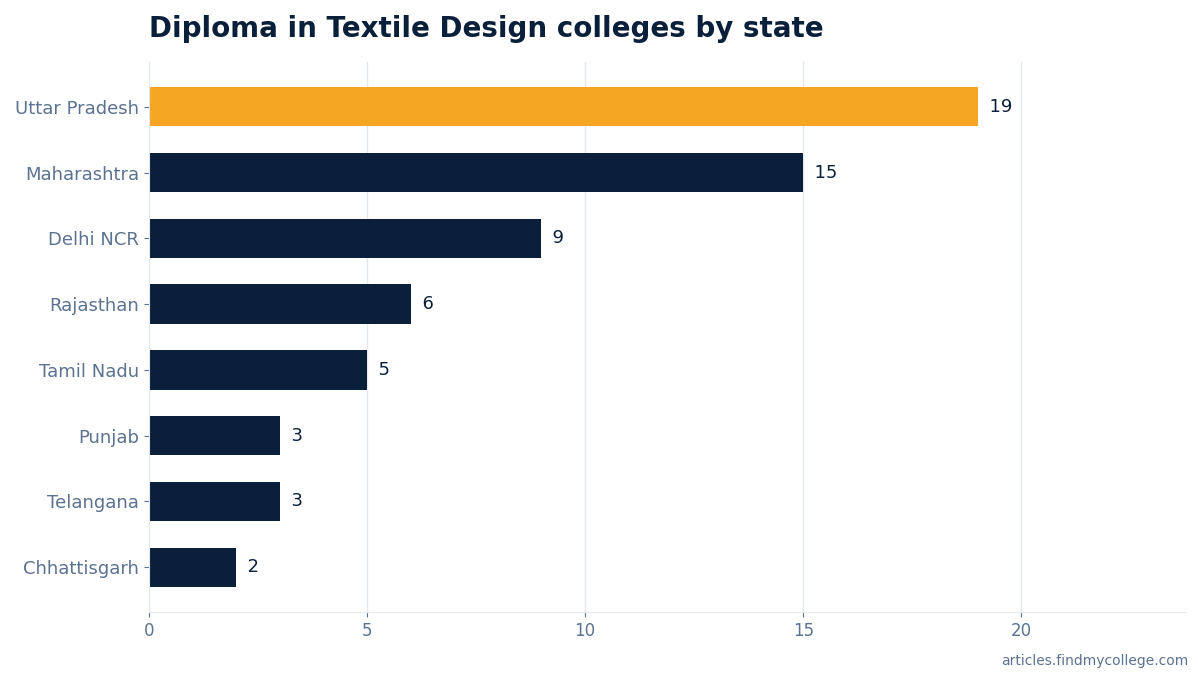
States with prominent course offerings include Uttar Pradesh with 19 colleges, Maharashtra with 15 colleges, Delhi NCR with 9 colleges, Rajasthan with 6 colleges, Tamil Nadu with 5 colleges, and Punjab with 3 colleges.
| College Name | Location | Average Fees |
|---|---|---|
| Chhatrapati Shivaji Maharaj University (CSMU) | Navi Mumbai | INR 1,30,000 – INR 2,00,000 |
| Mahatma Jyoti Rao Phoole University (MJRP) | Jaipur | INR 80,000 – INR 1,30,000 |
| Pacific University (PU) | Udaipur | INR 80,000 |
| Kamla Poddar Institute (KPI) | Jaipur | INR 50,000 |
| Axis Colleges | Kanpur | INR 40,000 |
| College | City | Ownership | Total course fee |
|---|---|---|---|
| Pacific University | Udaipur | Private | ₹40,000 |
| Kanya Mahavidyalaya | Jalandhar | Private (aided) | ₹30,620 |
| Neewara Academy of Design | Jaipur | Private | ₹1.00 lakh |
| AXIS Institute of Fashion Technology | Kanpur | Private | ₹80,000 |
| Axis Institute of Higher Education | Kanpur | Private | ₹80,000 |
| International Institute of Fine Arts | Modinagar | Private | ₹1.04 lakh |
| City | Colleges | Fee range | Well-known options |
|---|---|---|---|
| Delhi | 9 | ₹43,660 – ₹2.52 lakh | International Institute of Fashion Technology New Delhi, Indian School of Business Management and Administration New Delhi |
| Mumbai | 8 | ₹54,000 – ₹1.25 lakh | Shreemati Nathibai Damodar Thackersey Women’s University Mumbai, Le Mark School of Art Andheri |
| Udaipur | 3 | ₹40,000 – ₹1.00 lakh | Pacific University, Sai Tirupati University |
| Pune | 3 | ₹2.21 lakh – ₹3.17 lakh | International School of Design Pune, International School of Design Baner |
| Allahabad | 3 | — | Uttar Pradesh Rajarshi Tandon Open University, Ruchi’s Institute of Creative Arts |
| Jaipur | 3 | ₹65,000 – ₹1.00 lakh | Neewara Academy of Design, Heights Institute of Fashion & Technology |
| Hyderabad | 3 | ₹2.90 lakh – ₹2.90 lakh | Indian School of Business Management and Administration Hyderabad, International School of Design Hyderabad |
| Ghaziabad | 2 | — | Wisdom School of Management Ghaziabad, Wisdom College for Creativity & Design |
Diploma in Textile Design vs BDes in Textile Design
Choosing between a Diploma in Textile Design and a Bachelor of Design (BDes) in Textile Design depends on career objectives, time commitment, and depth of study.
| Parameter | Diploma in Textile Design | BDes in Textile Design |
|---|---|---|
| Course Level | Graduate / Diploma | Graduate Degree |
| Duration | 1 to 2 years | 4 years |
| Focus / Objective | Hands-on technical expertise in fabrics, threads, yarns, dyeing, and printing | Innovative concept development and comprehensive standard development across fabric stages |
Recommended Textbooks and Reference Materials for Textile Design
| Book Title | Author(s) |
|---|---|
| Fabric Structure and Design | N. Gokarneshan |
| Waste Management in Fashion and Textile Design | Rajkishore Nayak, Asis Patnaik |
| Elements of Fashion and Apparel Design | G. J. Sumathi |
| Fabric Art | Sukla Das |
Key reference books for textile design students include works by N. Gokarneshan, Rajkishore Nayak, Asis Patnaik, G. J. Sumathi, and Sukla Das. These recommended texts cover fabric structure, fashion and apparel design, waste management, and fabric art.
Diploma in Textile Design Career Scope and Salary
Graduates holding a Diploma in Textile Design can work in corporate design houses, independent design studios, garment export houses, dyeing & printing factories, fashion houses, textile laboratories, and merchandising firms.
Starting salaries for fresh graduates typically range between INR 2 Lakhs and INR 8 Lakhs per annum depending on portfolio quality, technical skills, and job role. Prominent career profiles include:
- Textile Designer: Develops fabric patterns, structural designs, and print motifs for garments and home furnishings.
- Embroidery Designer: Creates ornamental needlework patterns and decorative embroidery motifs for textiles.
- Fabric Resource Manager: Sources quality raw fabrics, threads, and textile materials for fashion production.
- Dyeing & Printing Consultant: Advises production units on color matching, chemical dyeing processes, and printing techniques.
- Fabric Analyzer: Inspects fabric weave, yarn strength, texture quality, and color fastness.
How to Apply for Diploma in Textile Design Admission: Step by Step
- Check Eligibility Criteria: Ensure completion of 10+2 / H.S.C from a recognized board with a minimum of 50% to 55% aggregate marks.
- Register for Entrance Examination (if applicable): Apply for institute or university-level entrance exams such as BHU UET, SOFT CET (School of Fashion Technology), or MET (Manipal Academy of Higher Education).
- Submit Application Form: Fill out the online or offline application form available on the official website or admission office of the respective college.
- Attend Personal Interview / Entrance Test: Appear for the written entrance test or personal interview round scheduled by the university or college.
| What to do | Where | Link |
|---|---|---|
| Compare colleges, fees and cutoffs | Diploma in Textile Design colleges in India | findmycollege.com |
FAQs
What is a diploma in textile design?
Diploma in Textile Design is a 1 to 2-year program where students learn techniques for designing yarns, threads, and fabrics, covering aspects like structural fabric design, color matching, dyeing, printing, and computer-aided textile design.
How much does a Textile Designer earn in India?
Starting salaries for textile designers typically range between INR 2 Lakhs and INR 8 Lakhs per annum depending on skills, job role, and employer.
Is there any 1 year diploma course in textile design?
Yes, depending on the university or institute, Diploma in Textile Design is offered as a 1-year or 2-year course.
What does a Textile Designer do?
A Textile Designer analyzes fabrics, matches colors and tones, understands yarn structures, and creates fabric patterns using traditional arts, structural designs, dyeing, printing, and computer-aided design software.