Top Online BSc Degrees in India 2026: Programs, Fees, & Admissions
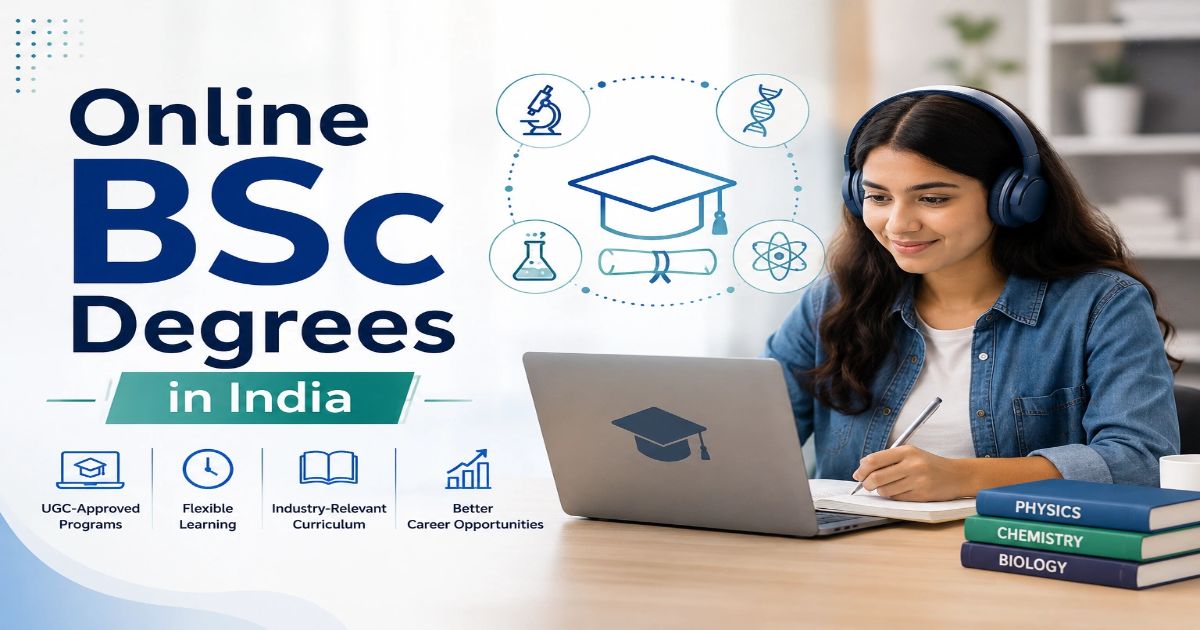
Colleges like SRIHER Chennai, SSODL Pune and IGNOU offer UGC-approved online BSc degrees in India. Key specialisations include Data Science, Computer Science, Information Technology (IT) and Electronic Systems.
Earning a BSc degree online in India offers unparalleled flexibility and accessibility for students aiming to advance their scientific education without geographical constraints. UGC-approved online BSc programs are rapidly gaining traction, offering a valid and valuable alternative to traditional on-campus learning. Top colleges offering online BSc degrees in India include Sri Ramachandra Institute of Higher Education and Research (SRIHER) Chennai, Symbiosis School for Online and Digital Learning (SSODL) Pune, IGNOU (ODL Alternative) and IIT Madras. This guide explores the top programs, fees, eligibility, and application processes for your online BSc journey in 2026.
UGC Approved Online BSc Degrees in India 2026: Key Programs
A UGC-approved online BSc degree typically lasts 3 years and 6 semesters. Students with 10+2 qualification in PCM/B background can apply for these courses. Unlike Online MBA, BBA, BCA, or M.Com, very few UGC-entitled universities currently offer fully online B.Sc. degrees in India.
| University | Online B.Sc. Program(s) | Duration | Eligibility | Approx. Total Fees | Key Highlights |
| Sri Ramachandra Institute of Higher Education and Research (SRIHER), Chennai | B.Sc. in Medical Laboratory Technology, Allied Health Sciences (online offerings vary by intake) | 3 Years (6 Semesters) | 10+2 with Science (PCB/PCM) | ₹60,000–₹2,00,000 | UGC-entitled online programs, NAAC A++, strong healthcare focus. |
| Symbiosis School for Online and Digital Learning (SSODL), Pune | B.Sc. (Economics / Social Sciences)* | 3 Years (6 Semesters) | 10+2 or equivalent | ₹3.1–3.7 Lakh | UGC-entitled online program with industry-oriented curriculum and flexible learning. *Subject offerings may vary by admission cycle. |
| IGNOU (ODL Alternative) | B.Sc. (General & Science combinations) | 3–6 Years | 10+2 with Science | ₹18,000–₹30,000 | Not a fully online degree; offered through Open & Distance Learning (ODL) with blended learning support. |
| IIT Madras | BS in Data Science and Applications | 4 Years | Class 12 or equivalent; Qualifier Exam or eligible direct admission | ₹2.2–2.5 lakh | Official IIT undergraduate degree |
Online BSc Degree Curriculum
The online BSc syllabus highlights a blend of core subjects, skill-based courses, electives, and essential soft skills training, preparing students comprehensively for future roles.
| Core Subjects | Skill-Based Courses | Electives and Labs | Soft Skills Training |
| Mathematics or Statistics | Data Analysis | Optional modules based on interest (For instance, Bioinformatics, GIS Mapping, and Robotics) | Communication skills |
| Physics | Programming Languages (Python, C++) | Virtual Lab sessions for practical learning | Analytical thinking |
| Chemistry | Environmental Studies | Capstone projects or research-based assignments | Presentation and project management |
| Computer Applications | Scientific Communication | – | – |
| Biology/Zoology/Botany (for Life Science streams) | Research Methodology | – | – |
Popular Online BSc Specializations
Online BSc/BS programmes in India are available across technology, science, and interdisciplinary fields, with Data Science and Computer Science among the most sought-after specializations.
| Online BSc Specialization | Key Focus Areas |
| Data Science | Statistics, Python programming, machine learning, data visualization, and analytics. |
| Computer Science | Programming, software development, databases, operating systems, and computer networks. |
| Information Technology (IT) | Networking, cybersecurity, cloud computing, web technologies, and IT infrastructure. |
| Electronic Systems | Embedded systems, digital electronics, IoT, communication systems, and hardware design. |
| Management and Data Science | Business analytics, data-driven decision-making, management principles, and analytics tools. |
| Aeronautics and Space Technology | Aerospace engineering fundamentals, aircraft systems, propulsion, and space technology. |
| Mathematics | Calculus, algebra, probability, statistics, mathematical modelling, and numerical methods. |
| Environmental Science | Ecology, biodiversity, sustainability, climate change, environmental policies, and conservation. |
Eligibility Criteria for Online BSc Courses in India
Candidates seeking admission to online BSc/BS programmes in India must satisfy the eligibility requirements prescribed by the respective university.
- Educational Qualification: Pass Class 12 (10+2) or an equivalent examination from a recognized board.
- Subject Requirement: Most programmes require a Science background (PCM/PCB), though some, such as IIT Madras BS programmes, accept students from any stream.
- Minimum Marks: Candidates generally need 45%–60% aggregate marks in Class 12, depending on the university.
- Age Limit: Most universities do not specify an upper age limit for admission.
- Entrance Process: Admission is usually merit-based, while IIT Madras requires candidates to qualify through its admission process or meet direct admission criteria.
- Working Professionals: Many online programmes allow working professionals and students pursuing another degree to apply
How to Apply for Online BSc Admission in India 2026
Applying for an online BSc degree in India for 2026 typically involves the following steps:
| Category | Detail |
| Application Step 1 | Visit the Institution’s official website and check eligibility for the BSc course. |
| Application Step 2 | Click “Apply Now” or “Online Application Form” to begin the application process. |
| Application Step 3 | Finish registration and create an account, typically using a unique username and passcode. |
| Application Step 4 | Log in by entering the correct credentials. |
| Application Step 5 | Provide all the right information in the form, filling out all fields with accurate academic and personal details. Choose the desired BSc course. |
| Application Step 6 | Upload scanned copies of the necessary documents in the proper format. |
| Application Step 7 | Pay the required registration/course fee using online payment gateways. |
| Application Step 8 | Before final submission, check the form carefully and then submit the online application form. |
| Application Step 9 | Register for and appear in the entrance exam, if applicable. |
| Application Step 10 | Participate in the counselling process, if applicable, based on exam scores or merit list. |
| Application Step 11 | Pay the admission fee after receiving the admission offer. |
| Application Step 12 | Complete any remaining admission formalities, which may include document verification. |
| Required Document | Transfer/Migration Certificate (if applicable). |
| Required Document | Character Certificate. |
| Required Document | Recent Passport-size Photographs. |
| Special Process | Credit Transfer: Eligible for direct 3rd-year admission if 2nd year BSc passed and discontinued. |
| Special Process | Breaking Study: Students who dropped out can enroll directly for 3rd year BSc Degree Courses. |
| Special Process | Lateral Entry: For diploma holders seeking BSc admission in a similar field. |
Online BSc vs Distance BSc vs Regular: Key Differences 2026
| Online BSc Specialization | Key Focus Areas |
| Data Science | Statistics, Python programming, machine learning, data visualization, and analytics. |
| Computer Science | Programming, software development, databases, operating systems, and computer networks. |
| Information Technology (IT) | Networking, cybersecurity, cloud computing, web technologies, and IT infrastructure. |
| Electronic Systems | Embedded systems, digital electronics, IoT, communication systems, and hardware design. |
| Management and Data Science | Business analytics, data-driven decision-making, management principles, and analytics tools. |
| Aeronautics and Space Technology | Aerospace engineering fundamentals, aircraft systems, propulsion, and space technology. |
| Mathematics | Calculus, algebra, probability, statistics, mathematical modelling, and numerical methods. |
| Environmental Science | Ecology, biodiversity, sustainability, climate change, environmental policies, and conservation. |
Frequently Asked Questions
What exactly is an online BSc degree in India and how does it work?
An online BSc degree is a bachelor’s programme delivered primarily through digital learning platforms. Students attend virtual classes, access recorded lectures, complete online assessments, and may appear for offline examinations, depending on university regulations.
Which are the top UGC-approved online BSc courses in India?
Some recognized options include online BSc programmes offered by SRIHER and selected programmes at Symbiosis School for Online and Digital Learning. IIT Madras also offers online BS degrees, while IGNOU provides BSc through the ODL mode.
What career opportunities are available after completing an online BSc degree in India?
Graduates can pursue careers as data analysts, software developers, laboratory technologists, research assistants, environmental consultants, IT professionals, or continue with higher studies such as MSc, MBA, or other professional certification programmes.
What is the application process for enrolling in an online BSc program in India?
Applicants need to register on the university’s official website, complete the application form, upload required documents, pay the application fee, and qualify for any entrance process or merit-based admission, if applicable.
How does an online BSc degree compare to a regular offline BSc in India?
Both programmes award a recognized bachelor’s degree when offered by approved institutions. An online BSc provides greater flexibility for working professionals and remote learners, while a regular BSc offers more campus-based interaction and laboratory exposure.
When do admissions typically open for online BSc programs in Indian universities?
Most universities begin online BSc admissions between January and July, depending on their academic calendar. Some institutions also offer multiple admission cycles each year, while IIT Madras conducts admissions in scheduled batches.