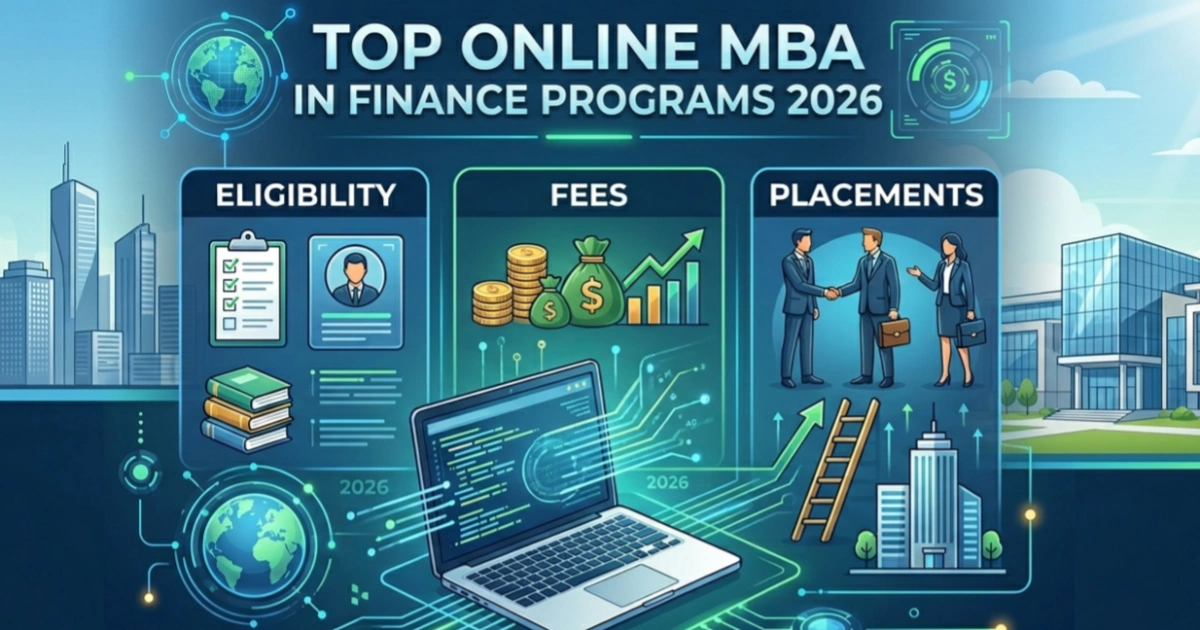
Top Online MBA in Finance Programs 2026: Eligibility, Fees, and Placements
An online MBA in finance offers a flexible yet rigorous path to advance your career in the dynamic financial sector, equipping you with essential skills for leadership roles. With the 2026 intake approaching, understanding program specifics is crucial for prospective students. This article details eligibility, fees, top universities like Chitkara University, DY Patil, and LPU, syllabus, and career outcomes to help you make an informed decision.
Top Online MBA in Finance Colleges with Fees 2026
The demand for online MBA programs in Finance has surged in 2026, primarily driven by working professionals seeking to upgrade their financial acumen without pausing their careers. When evaluating the best online MBA colleges in India, prospective students often weigh university reputation against affordability and placement support.
Public institutions and open universities typically offer the most budget-friendly options, with total fees starting as low as ₹50,000. However, top-tier private universities—which usually range from ₹1.5 Lakhs to ₹3 Lakhs—remain highly popular due to their robust Learning Management Systems (LMS), industry-aligned curriculums, and dedicated placement assistance.
| University/Institution | Total Program Fee (Approx.) | Payment Options & Flexibility | Key Highlights |
|---|---|---|---|
| NMIMS Global Access (NGASCE) | ₹1,96,000 | One-time payment: ₹1,96,000 Yearly: ₹1,05,000 Semester-wise: ₹55,000 |
Highly reputed for management; offers a strong alumni network and dedicated career support. |
| Amity University Online | ₹2,38,000 | One-time payment: ₹2,38,000 Yearly: ₹2,43,000 Semester-wise: ₹2,53,000 |
UGC-approved; offers robust placement assistance and additional scholarships for alumni and defense personnel. |
| Manipal University (MAHE Online) | ₹1,75,000 | Semester-wise and annual payment options available. | NAAC A++ rated; known for excellent academic structure and strong placement records. |
| Lovely Professional University (LPU Online) | ₹1,50,000 – ₹1,80,000 | Semester-wise installments available. | Highly affordable with excellent digital infrastructure and weekend live masterclasses. |
| Indira Gandhi National Open University (IGNOU) | ₹66,700 | Standard distance education fee structure. | Government-recognized; highly affordable but relies more on self-study with minimal placement support. |
| Welingkar Institute of Management (WeSchool) | ₹1,26,000 | Flexible installment plans. | Strong focus on insurance and banking; highly respected in the corporate sector. |
Online MBA fees in India: the range across 90 universities
Online MBA in Finance Eligibility Criteria & Admission Process 2026
The admission procedure for the Online MBA in Finance for the July 2026 session commences on April 15, 2026, with the last date to apply being May 31, 2026. This section details the eligibility criteria and admission process for various universities offering an online MBA in Finance, helping prospective students navigate their applications.
| University Name | Eligibility Criteria |
| Online Manipal University Jaipur | Bachelor’s Degree with a minimum of 50% aggregate marks (45% for reserved categories) |
| Online Sikkim Manipal University | Bachelor’s Degree with a minimum of 50% marks (45% for reserved categories). |
| Online DY Patil University | 50% minimum marks in Bachelor’s Degree (45% for reserved categories) |
| Online Chandigarh University | CA/ICWA graduates are also eligible. Bachelor’s Degree with 50% marks from a recognized university. |
| Online Amrita Vishwa Vidyapeetham University | Bachelor’s degree with a minimum of 50% marks, along with 10+2 (Class XII) from a recognized board. |
| Online Sharda University | 50% marks (or 45% for reserved categories) in Bachelor’s Degree |
This table highlights that a Bachelor’s Degree with at least 50% marks is a common eligibility requirement across most universities for an online MBA in Finance, with specific variations like eligibility for CA/ICWA graduates at Chandigarh University.
Beyond university-specific criteria, general eligibility and admission processes apply across many institutions:
- General Academic Eligibility: Bachelor’s Degree (min 50% aggregate; 45% for reserved categories).
- Amity University Specific: Applicants below 40% marks may pass an online entrance test.
- Work Experience: Not mandatory, but some institutes prefer 1-2 years of experience.
- Accepted Entrance Exams: CAT, XAT, MAT, NMAT by GMAC, CMAT, GMAT are common.
- Admission Basis: Merit list and first-come, first-served; some require entrance exams.
- Selection Criteria: Entrance exam scores, academic record, interviews, and work experience.
Prospective students should note the following key admission dates for various online MBA in Finance programs:
| Event | Start Date | Last Date |
| NMIMS Online MBA Finance Admission | 15 April 2026 | 31 May 2026 |
| Amity Online MBA Finance Admission | 15 April 2026 | 31 May 2026 |
| Symbiosis Online MBA Finance Admission | 15 April 2026 | 31 May 2026 |
| Manipal Online MBA Finance Admission | 15 April 2026 | 31 May 2026 |
| UPES Online MBA Finance Admission | 15 April 2026 | 31 May 2026 |
| Vignan Online MBA Finance Admission | 15 April 2026 | 31 May 2026 |
| DPY Pune Online MBA Finance Admission | 15 April 2026 | 31 May 2026 |
| DY Patil Navi Mumbai Online MBA Finance Admission | 15 April 2026 | 31 May 2026 |
| LPU Online MBA Finance Admission | 15 April 2026 | 31 May 2026 |
| Amrita AHEAD Online | 15 April 2026 | 31 May 2026 |
| Jain Online | 15 April 2026 | 31 May 2026 |
| BITS Pilani Online | 15 April 2026 | 31 May 2026 |
The admission window for many online MBA in Finance programs for the July 2026 session opens on April 15, 2026, with applications closing on May 31, 2026, across various institutions.
For DPU-COL, the admission process involves specific steps and document requirements:
- Step 01 Learner’s Authentication: Basic details, DEB Unique ID, mobile/email verification, e-Aadhaar upload.
- Step 02 Admission Form Submission: Fill personal, educational, employment details; upload photo/signature; pay semester fee.
- Step 03 Admission Confirmation: Document review, fee receipt generation, confirmation email, login credentials via SMS.
- Required Identity Proof: e-Aadhaar or Passport.
- Required Additional Documents: Passport-size photograph, student signature, marriage/gazette for name change.
- Document Format Guidelines: JPEG/JPG/PNG for all documents; specific dimensions/size for photo/signature.
Online MBA in Finance Fees Structure 2026: University-wise Breakdown
The average total fee for an online MBA in finance in India for 2026 ranges from INR 60,000 to 3,15,000. This section provides a detailed university-wise breakdown of the fee structure for various online MBA in Finance programs, offering insights into the costs involved.
| University | Total Fees |
| BITS Pilani Online MBA in Finance | INR 2,80,400 |
| Manav Rachna Online MBA in Finance | INR 1,27,839 |
| Jain Online MBA in Finance | INR 1,96,000 |
| Manipal University Jaipur Online MBA in Finance | INR 1,75,000 |
| DY Patil Online MBA in Finance | INR 1,89,400 |
| LPU Online MBA in Finance | INR 1,61,600 |
| Sharda Online MBA in Finance | INR 1,00,000 |
This table illustrates the varying total fees for different universities offering an online MBA in finance in 2026, with Sharda Online MBA in Finance being the most affordable among those listed.
- Average total fee for Online MBA in Finance in India (2026): INR 60,000 to 3,15,000
- Online MBA in Finance course fees per semester (2026): INR 19,000 – INR 65,000
- Total Online MBA in Finance course fee range (2026): INR 1,00,000 to INR 2,80,000
- IGNOU Distance MBF (Banking and Finance) program total fee (2026): ₹ 62,000
- IGNOU Distance MBF (Banking and Finance) program fee per semester (2026): ₹ 15,500
- IGNOU Online MBA (MBAOL) program total fee (2026): ₹ 62,000
Chitkara University vs DY Patil vs LPU: Top Online MBA Finance Programs 2026
When choosing an Online MBA with a specialisation in Finance in 2026, working professionals look for a balance of UGC-DEB accreditation, affordable fee structures, industry-relevant curriculum, and strong placement support. Among the top contenders this year, Chitkara University, Dr D.Y. Patil Vidyapeeth (DPUCOL), and Lovely Professional University (LPU Online) have emerged as front-runners.
| Aspect | DY Patil University (DPUCOL) | Lovely Professional University (LPU Online) | Chitkara University |
| Accreditation & Reputation | NAAC A++, UGC, AICTE, and AIU approvals. | NAAC A++ and high NIRF rankings; degree holds weight of regular MBA. | Highly regarded in North India for direct corporate tie-ups and cohort-based learning. |
| Finance Curriculum Focus | Corporate finance, investment banking, capital markets, risk management, and asset pricing. | Modern financial technologies, banking, and financial services (BFSI). | Highly analytical approach blending traditional financial management with data-driven decision-making. |
| Estimated Fee Structure | ₹1,30,000 to ₹1,89,400; offers a ₹10,000 scholarship for upfront payment. | Budget-friendly pricing, generally well under the ₹2,00,000 mark. | Positioned in the mid-tier premium segment, ranging from ₹2,50,000 to ₹3,30,000. |
| Learning Methodology | AI-powered curriculum featuring multimedia presentations, virtual simulations, and discussion forums. | Flexible LMS with recorded lectures, live weekend masterclasses, and online proctored exams. | Focuses on guided projects, role-aligned electives, and direct industry engagement. |
| Ideal Candidate Profile | Professionals wanting a specialized, AI-integrated curriculum with high accreditation and fee incentives. | Learners prioritizing flexibility, strong national rankings, and a massive alumni network. | Students seeking heavy corporate integration and practical financial analytics despite a higher budget. |
Online MBA in Finance Syllabus PDF
Online MBA in Finance Syllabus 2026: Core Subjects & Specializations
The curriculum for an Online MBA in Finance is meticulously designed to bridge the gap between core management principles and advanced financial strategies. Typically spanning across four semesters (two years), the syllabus progresses from foundational business concepts in the first year to highly specialized financial and analytical subjects in the second year.
| Semester | Focus Area | Subjects Covered |
| Semester 1 | Core Management | Management Concepts & Organisational Behaviour, Managerial Economics, Accounting for Managers, Business Environment and Law, Research Methodology |
| Semester 2 | Core Management | Financial Management, Marketing Management, Human Resources Management, Operations Research and Management, Strategic Management |
| Semester 3 | Finance Specialization | Strategic Financial Management, Banking and Indian Financial System, Merchant Banking and Financial Services, Project Management, Management Accounting |
| Semester 4 | Advanced Finance | Investment and Portfolio Management, Global Financial Management, International Trade and Finance, Security Market Operations, Financial Derivatives, Project Work |
Detailed Coverage of Key Finance Subjects
Financial Management & Accounting
In the first year, students build their financial fundamentals through basic and corporate financial management. The curriculum covers capital budgeting (NPV, IRR, Payback Period), operating and financial leverage, dividend policies, and working capital management. Management Accounting in the third semester expands on this by teaching budgetary control, marginal costing, break-even analysis, and advanced concepts like Activity-Based Costing (ABC) and DuPont Analysis.
Strategic & Global Finance
The third and fourth semesters shift focus toward high-level corporate strategies and international markets. Strategic Financial Management dives into corporate restructuring, including mergers, acquisitions, leveraged buyouts (LBOs), and venture capital. Global Financial Management equips students with knowledge of the international monetary system, balance of payments, foreign direct investment (FDI), and techniques for managing currency risk and transaction exposure.
Investment, Banking, and Markets
Students learn how to navigate the complex world of capital markets and banking institutions. The Banking and Indian Financial System course explores central banking, monetary policy, and mutual funds. Merchant Banking covers the mechanics of Initial Public Offers (IPOs), underwriting, and credit rating processes, while Security Market Operations details the legal environment of SEBI, stock exchanges, and capital market instruments.
Portfolio Management & Derivatives
The final semester includes highly technical subjects designed for aspiring financial analysts and portfolio managers. Investment and Portfolio Management covers fundamental and technical analysis, the Dow Theory, and asset pricing models like CAPM and the Arbitrage Pricing Model (APT). Finally, Financial Derivatives trains students on options pricing (Black-Scholes and Binomial models), futures contracts, swaps, and hedging strategies in the Indian stock market.
Career Prospects & Average Salaries After Online MBA in Finance 2026
Pursuing an online MBA in finance opens doors to significant career growth and competitive salaries in India. By 2026, freshers can expect a salary range of ₹6–18 LPA, with experienced professionals like CFOs potentially earning over ₹1 crore annually. The BFSI sector is projected to add 250,000 new jobs by 2030.
| Career Path | Starting Salary (LPA) | Top Recruiters |
| Investment Banking | ₹10–18 LPA | Goldman Sachs, JP Morgan, Morgan Stanley |
| Financial Analyst | ₹6–10 LPA | Deloitte, EY, KPMG, PwC |
| Corporate Finance Manager | ₹7–12 LPA | TCS, Infosys, Reliance Industries |
| Risk Manager | ₹6–11 LPA | HDFC Bank, ICICI Bank, Axis Bank |
| FinTech Product Manager | ₹8–15 LPA | Razorpay, Paytm, PhonePe, Cred |
| Portfolio / Asset Manager | ₹8–15 LPA | SBI Mutual Fund, ICICI Prudential AMC |
| Equity Research Analyst | ₹6–12 LPA | Motilal Oswal, Edelweiss, Kotak |
| Wealth Management Advisor | ₹7–14 LPA | HDFC Securities, IIFL Wealth |
| Treasury Manager | ₹8–15 LPA | Multinational corporations, large NBFCs |
| Financial Consultant | ₹8–16 LPA | Big 4, boutique advisory firms |
| Quant / ML Finance Analyst | ₹12–25 LPA | Hedge funds, FinTech firms |
| Government (RBI / SEBI / NABARD) | ₹12–20 LPA | RBI, SEBI, NABARD, PSU Banks |
This snapshot illustrates the diverse career paths available after an online MBA in finance, showcasing competitive starting salaries and prominent recruiters across various financial sectors. It emphasizes the breadth of opportunities for graduates in roles from investment banking to government.
How to Apply for Online MBA in Finance Programs in India 2026
Applying for an online MBA in finance in India for the 2026 session begins on April 15, 2026, with a final application deadline of May 31, 2026, for the July session. This section details the general eligibility, application process, and specific requirements for pursuing an online MBA in finance.
- Admission Procedure Commencement Date: 15 April 2026
- Last Date to Apply for July 2026 Session: 31 May 2026
- General Eligibility Criteria: Bachelor’s Degree with 50% marks (45% for reserved category).
- Eligibility Exception (Amity University): Below 40% marks may be admitted via online entrance test.
- Entrance Examination Requirement: Some universities require CAT, XAT, MAT, NMAT, CMAT scores.
- Work Experience Requirement: Some universities ask for 1-2 years of experience in finance.
These initial requirements highlight key dates and academic qualifications, including potential entrance exams and work experience, crucial for prospective students.
| Aspect | Details |
| Interview Requirement | Some universities, like NMIMS, ask for an interview test. |
| General Admission Basis | Merit list and first-come, first-served basis. |
| General Application Steps | Visit official portal, fill forms, complete online application, submit documents, pay fees. |
| Optional Information Step | Fill ‘Enquiry Now’ form for course, admission, fees, and university comparison. |
| DPU-COL Admission Process | Learner authentication, form submission (personal, educational, employment, photo, signature, fee), and confirmation. |
| DPU-COL Required Documents | e-Aadhaar or Passport, passport-size photo, student signature, marriage certificate (if applicable), Gazette notification (if applicable). |
| DPU-COL Document Formats | Photo/Signature: JPEG/JPG/PNG, 320px X 240px, under 600 KB. Educational Records: JPEG/JPG/PNG, Max 1 MB. |
This table outlines additional steps, including interview requirements, general application procedures, and specific details for DPU-COL admissions, covering document submission and format guidelines.
Frequently Asked Questions
What exactly is an online MBA in finance and its core focus?
An online MBA in finance is a two-year postgraduate program building advanced skills in markets, investing, financial analysis, and business deals like mergers and acquisitions.
What are the typical eligibility requirements for an online MBA in finance program?
For programs like BITS Pilani WILP’s online MBA in Finance, candidates must be working professionals in full-time employment or owners of a registered business at the time of application.
What career opportunities can I expect after completing an online MBA in finance?
An online MBA in finance leads to lucrative roles such as Financial Analyst, Investment Banker, and Financial Advisor across private, government, and public sectors.
How does an online MBA in finance compare to a traditional on-campus program?
Online MBAs in finance offer flexibility and affordability, chosen by over 30% of aspirants. Traditional programs provide on-campus networking and face-to-face interaction, with both offering excellent career opportunities.
What is the application process for enrolling in an online MBA in finance?
Apply by March 26, 2026, via the official university site, submitting forms with a non-refundable fee of INR 1500-2500. Admission is merit-based for graduates with 50% marks.
What is the typical duration and class schedule for an online finance MBA?
An online finance MBA generally takes 18 to 24 months, or 1 year for experienced professionals. It combines live classes, pre-recorded videos, interactive assignments, and self-paced study, with exams typically on weekends.