Top Research Institutes in India 2026: Rankings, Fees & Admission
- 17 Aug 2026Government Science College Application Window Starts
Application window for UG (B.Sc/BCA) and PG (M.Sc) programs runs from 17 Aug to 23 Aug 2026.
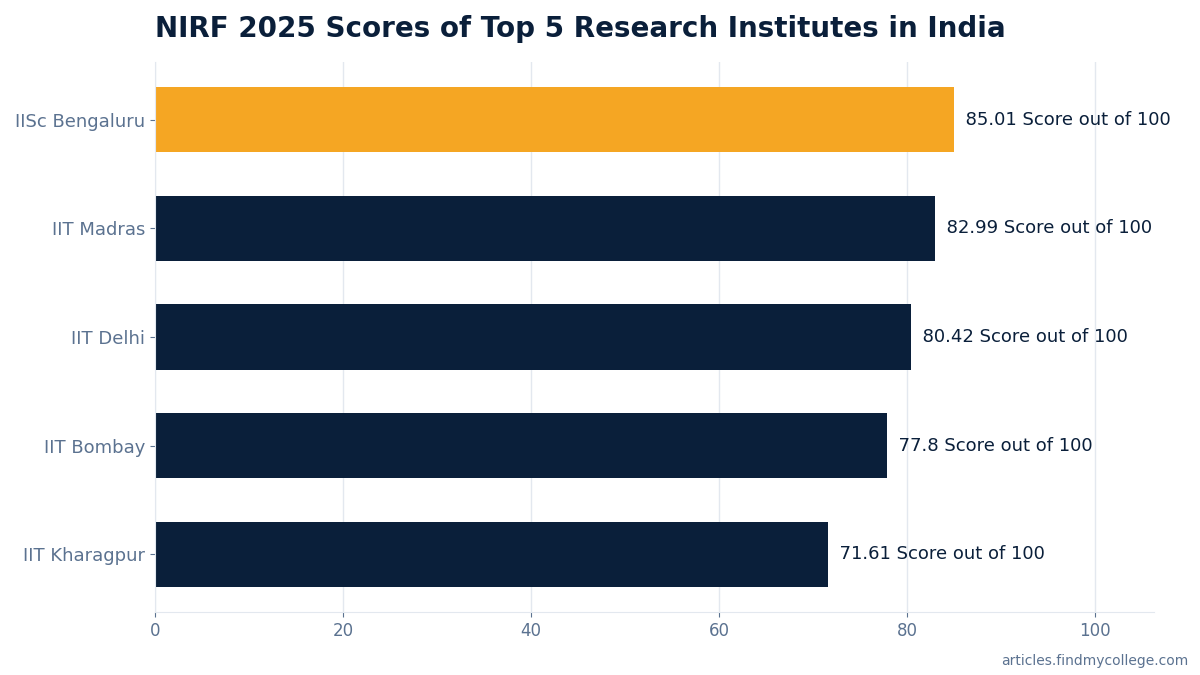
Indian Institute of Science (IISc) Bengaluru ranks #1 among research institutes in India in NIRF 2025 with a score of 85.01, followed by IIT Madras (#2, score 82.99) and IIT Delhi (#3, score 80.42). These premier institutions lead the country in scientific research output, citations, and patent filings.
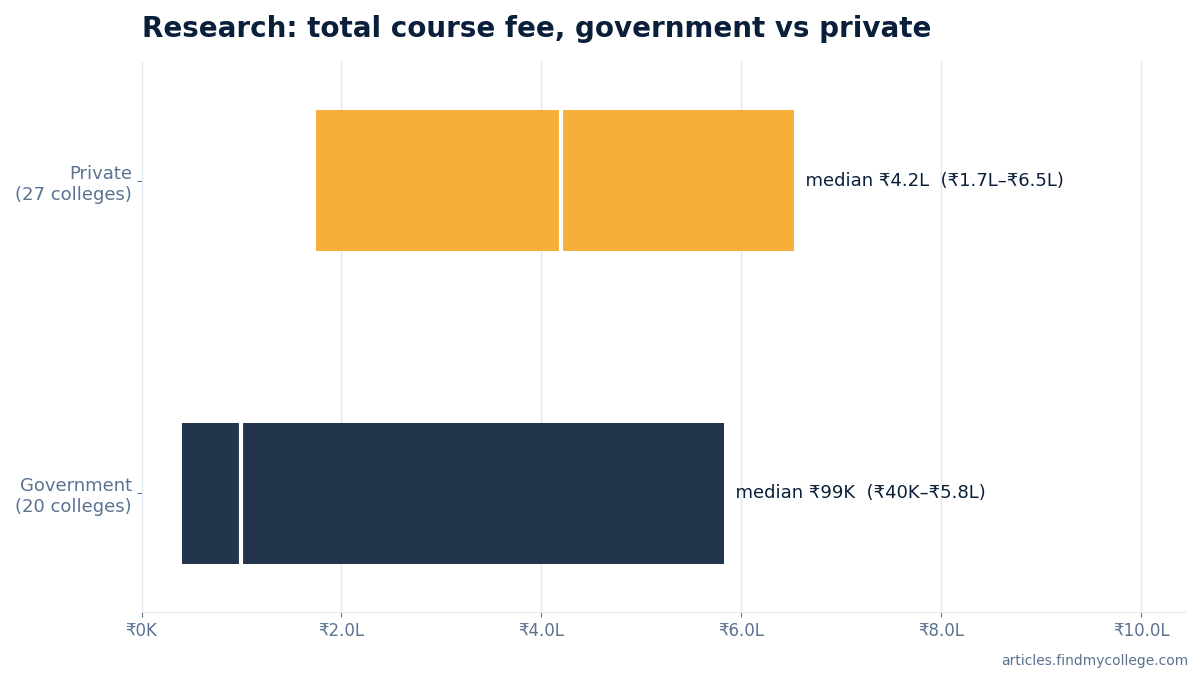
Students planning a research career can compare NIRF rankings, annual fee structures, domain specializations, and selection criteria across Indian institutions. At least 398 colleges offer Research programs in India, with median course fees ranging from ₹99,110 in government institutions to ₹4.20 lakh in private colleges.
| Parameter | Details |
|---|---|
| Top Ranked Research Institute | Indian Institute of Science (IISc), Bengaluru (NIRF 2025 Rank 1, Score 85.01) |
| Ranking Framework | National Institutional Ranking Framework (NIRF), Ministry of Education |
| Evaluation Parameters | 5 parameters: TLR, RPP, GO, OI, Peer Perception |
| Government College B.Sc Tuition Fee | ₹84,000 total (₹28,000/year at Govt Science College Ahmedabad) |
| Government College M.Sc Tuition Fee | ₹66,000 total (₹33,000/year at Govt Science College Ahmedabad) |
Top Research Colleges in India
The National Institutional Ranking Framework (NIRF) evaluates top research colleges in India using five standardized criteria. IISc Bengaluru secured the 1st rank in the NIRF Research Institutions category consistently across 2023, 2024, and 2025. Indian Institutes of Technology (IITs) occupy seven of the top ten positions in the national research rankings.
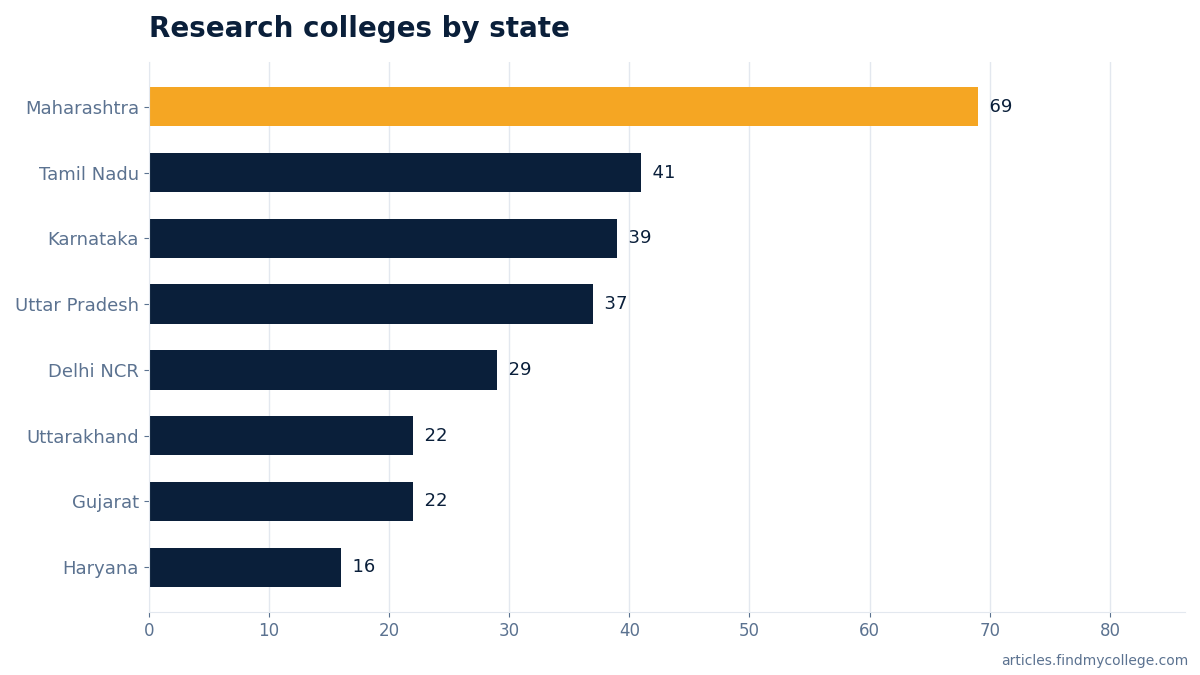
At least 398 colleges offer Research courses across India, including 27 government colleges and 60 private institutions. Geographically, Maharashtra has 69 colleges, Tamil Nadu has 41, Karnataka has 39, Uttar Pradesh has 37, Delhi NCR has 29, and Uttarakhand has 22.
| Institute Name | State | NIRF Score 2025 | NIRF Rank 2025 | NIRF Rank 2024 | NIRF Rank 2023 |
|---|---|---|---|---|---|
| IISc Bengaluru | Karnataka | 85.01 | 1 | 1 | 1 |
| IIT Madras | Tamil Nadu | 82.99 | 2 | 2 | 2 |
| IIT Delhi | Delhi | 80.42 | 3 | 3 | 3 |
| IIT Bombay | Maharashtra | 77.80 | 4 | 4 | 4 |
| IIT Kharagpur | West Bengal | 71.61 | 5 | 5 | 5 |
| IIT Kanpur | Uttar Pradesh | 69.80 | 6 | 7 | 6 |
| Homi Bhabha National Institute | Maharashtra | 69.39 | 7 | 6 | 15 |
| IIT Roorkee | Uttarakhand | 67.27 | 8 | 9 | 7 |
| Academy of Scientific and Innovative Research | Uttar Pradesh | 67.15 | 9 | 8 | 12 |
| IIT Guwahati | Assam | 64.18 | 10 | 10 | 9 |
Government Research Colleges
Government research institutes provide funded research facilities and specialized laboratories across specific scientific domains. Tata Institute of Fundamental Research (TIFR) in Mumbai achieved 10th rank in NIRF Research 2023 with a score of 62.66. Institutions such as the Bhabha Atomic Research Centre and Centre for Cellular and Molecular Biology lead specialized doctoral and post-doctoral studies.
| Name of Institute | Established | Location | Specialty Area |
|---|---|---|---|
| Academy of Scientific and Innovative Research | 2011 | Uttar Pradesh | Science and Technology |
| Advanced Centre for Treatment Research and Education in Cancer (ACTREC) | 1952 | Mumbai, Maharashtra | Cancer Research |
| All India Institute of Medical Sciences (AIIMS) | 1956 | New Delhi | Medical Sciences |
| Bhabha Atomic Research Centre | 1954 | Mumbai, Maharashtra | Atomic and Nuclear Research |
| Centre for Cellular and Molecular Biology | 1977 | Hyderabad, Telangana | Cellular and Molecular Biology |
| National Institute of Virology | 1952 | Pune, Maharashtra | Virology |
| Central Food Technological Research Institute | 1950 | Mysore, Karnataka | Food Science & Technology |
| Indian Space Research Organisation | 1969 | Bengaluru, Karnataka | Space Research |
| National Brain Research Institute | 1997 | Manesar, Haryana | Neuro and Brain Sciences |
| National Institute of Mental Health and Neurosciences | 1925 | Bengaluru, Karnataka | Mental Health |
Government colleges maintain affordable fee structures for undergraduate and postgraduate science programs. Among institutions with available fee metrics, the median total course fee for government research colleges is ₹99,110, with the middle half ranging between ₹40,210 and ₹5.83 lakh.
| College | City | Total Course Fee |
|---|---|---|
| Gujarat University | Ahmedabad | ₹10,000 |
| Panjab University | Chandigarh | ₹19,765 |
| Mumbai University | Mumbai | ₹28,237 |
| NIT Trichy | Tiruchirappalli | ₹30,000 |
| Delhi University | Delhi | ₹38,480 |
| Indian Institute of Technology Bombay | Mumbai | ₹45,400 |
| Hans Raj College | Delhi | ₹53,425 |
| Indian Institute of Technology Kharagpur | Kharagpur | ₹80,000 |
| Anna University | Chennai | ₹81,500 |
| Delhi Institute of Pharmaceutical Sciences and Research | Delhi | ₹96,220 |
Private Research Colleges
| College | City | Ownership | Total Course Fee | Average Package |
|---|---|---|---|---|
| Lal Bahadur Shastri Institute of Management | Delhi | Private | ₹16.60 lakh | 8 LPA |
| Thakur College of Science and Commerce | Mumbai | Private (aided) | ₹84,063 | 3.51 LPA |
| GM Institute of Technology | Davanagere | Private | ₹8.30 lakh | 3.14 LPA |
| Mahaveer Institute of Engineering & Technology | Meerut | Private | ₹1.24 lakh | 1 LPA |
At least 60 private colleges offer research programs, with a median fee of ₹4.20 lakh. In NIRF Research 2023, Vellore Institute of Technology ranked 11th with a score of 62.41, and Manipal Academy of Higher Education ranked 25th nationally.
Research Fees
Research program fees vary significantly by degree level, course specialization, and city location. Government Science College Ahmedabad charges ₹28,000 for the first year of B.Sc Biotechnology, leading to a total fee of ₹84,000 over 3 years. M.Sc in Environment Science and Technology has a first-year fee of ₹33,000 and a total fee of ₹66,000 over 2 years, while BCA General costs ₹29,000 in the first year and ₹87,000 total across 3 years.
| Course Name | Duration | Eligibility Criteria | First Year Fee | Total Fee |
|---|---|---|---|---|
| B.Sc Biotechnology | 3 Years | 10+2 | ₹28,000 | ₹84,000 |
| M.Sc Environment Science & Tech | 2 Years | Graduation | ₹33,000 | ₹66,000 |
| BCA General | 3 Years | 10+2 | ₹29,000 | ₹87,000 |
Major educational hubs offer multiple institutional options across diverse fee brackets for students pursuing scientific research degrees.
| City | Colleges | Fee Range | Well-known Options |
|---|---|---|---|
| Delhi | 29 | ₹38,480 – ₹16.60 lakh | Jamia Millia Islamia University, Delhi University |
| Pune | 24 | ₹1.33 lakh – ₹20.60 lakh | Dr. DY Patil Vidyapeeth, Symbiosis International University Pune |
| Bangalore | 22 | ₹1.00 lakh – ₹20.30 lakh | Christ University, Indian Institute of Science |
| Mumbai | 21 | ₹28,237 – ₹14.40 lakh | Indian Institute of Technology Bombay, Homi Bhabha National Institute |
| Greater Noida | 12 | ₹1.80 lakh – ₹26.64 lakh | Galgotias University, Gautam Buddha University |
| Ahmedabad | 11 | ₹10,000 – ₹18.40 lakh | Gujarat University, Dr. Babasaheb Ambedkar Open University |
How to Choose a Research College
Selecting a research college requires reviewing laboratory infrastructure, faculty publication records, and available institutional grants. Candidates should check whether an institution prioritizes basic science research or applied industrial engineering, as well as its historical performance in patent grants and global citations.
Financial considerations are equally vital. Applicants must compare tuition costs, available research stipends, project assistantships, and post-degree placement packages before confirming enrollment.
How to Apply for Research Admission in 2026: Step by Step
- Check Eligibility Criteria: Verify minimum qualification requirements, such as 10+2 for B.Sc and BCA courses or Graduation for M.Sc programs.
- Register on Institutional Application Portal: Submit online applications during specified registration windows, such as 17 Aug to 23 Aug 2026.
- Evaluate Institutional Rankings: Review NIRF research rankings, which assess institutions across five weighted parameters graded out of 100 points each.
- Select Course Duration: Choose suitable programs based on course lengths, such as 3-year B.Sc and BCA degrees or 2-year M.Sc degrees.
- Complete Fee Payment: Confirm admission by paying first-year tuition fees, such as ₹28,000 for B.Sc, ₹29,000 for BCA, or ₹33,000 for M.Sc.
Prospective students should verify course eligibility and review institutional NIRF rankings across five weighted parameters before applying. Admissions require submitting application forms during scheduled windows and settling first-year course fees.
FAQs
What are the top 10 research institutes in India as per NIRF 2025?
The top 10 research institutes in NIRF 2025 are IISc Bengaluru (#1), IIT Madras (#2), IIT Delhi (#3), IIT Bombay (#4), IIT Kharagpur (#5), IIT Kanpur (#6), HBNI (#7), IIT Roorkee (#8), AcSIR (#9), and IIT Guwahati (#10).
Which parameter has the highest importance in NIRF research institution rankings?
Research and Professional Practice (RPP) evaluates publications, citations, funding, and patents. The overall rank is determined by a weighted score across five parameters graded out of 100 points each.
What are some top specialized research institutes in India across key domains?
Specialized research institutes include BARC (Atomic and Nuclear Research), CCMB (Cellular and Molecular Biology), AIIMS (Medical Sciences), ISRO (Space Research), NIMHANS (Mental Health), and ACTREC (Cancer Research).
What is the fee structure for B.Sc and M.Sc courses in government science colleges?
At institutions like Government Science College Ahmedabad, B.Sc tuition fees total ₹84,000 (₹28,000/year) and M.Sc tuition fees total ₹66,000 (₹33,000/year).