UGC Releases New Internship and Research Guidelines for Undergraduate Courses Under NEP 2020
The University Grants Commission (UGC) has introduced new internship and research guidelines for undergraduate students across India. The move is aimed at improving practical learning, employability, and research exposure in higher education institutions.
The latest framework has been prepared in line with the National Education Policy (NEP) 2020 and will apply to universities and colleges offering undergraduate programs.
Under the new UGC guidelines, internships and research projects will become an important part of undergraduate education. Students pursuing three-year and four-year degree programs will now get opportunities to gain real-world experience alongside classroom learning. The commission believes that this initiative will help students develop industry skills, critical thinking, and research abilities before graduation.
UGC Internship Guidelines for Undergraduate Students
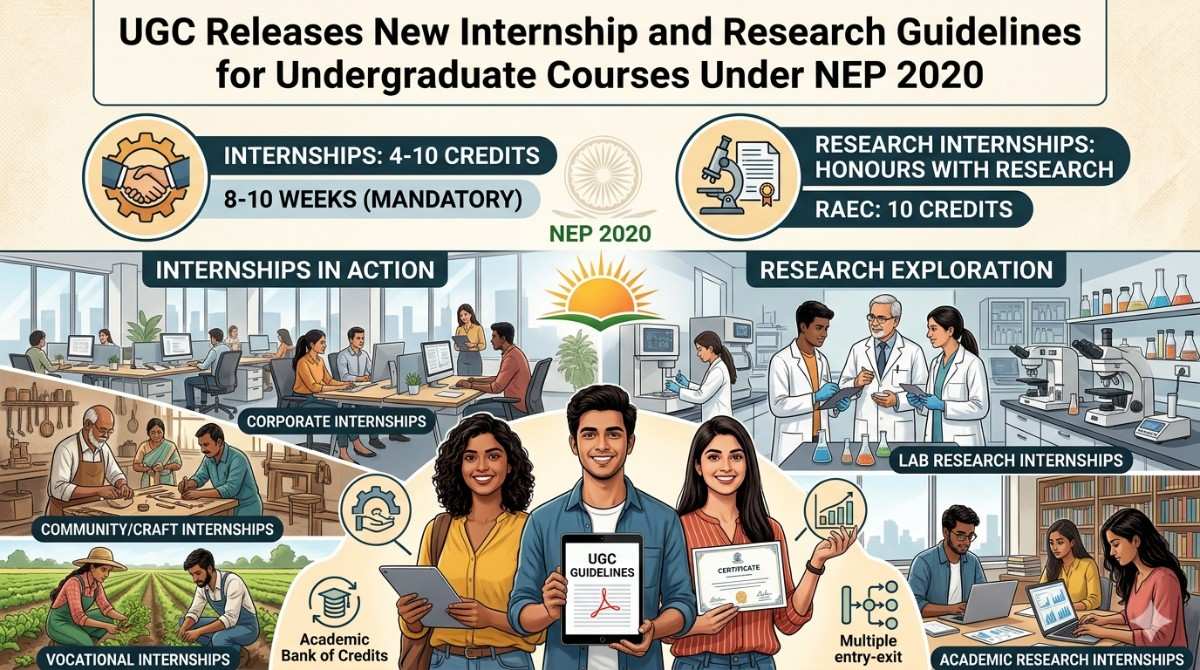
According to the UGC, students enrolled in undergraduate courses will have to complete internships carrying academic credits. The internships are expected to begin after the fourth semester. Students will need to complete internship work ranging from 60 to 120 hours depending on the programme structure.
The internship component will carry two to four credits and will contribute to the total credits required for graduation. Universities and colleges have been asked to integrate internships into the academic curriculum and ensure proper supervision and evaluation.
The UGC has clarified that internships can be completed in different sectors and organisations. Students may work with:
- Government departments
- Private companies
- Startups
- NGOs
- Research institutions
- Industries
- Community organisations
- Rural development projects
- Social welfare groups
The commission said that internships will help students understand workplace culture, communication skills, teamwork, and practical problem-solving.
UGC Releases New Internship and Research Guidelines for Undergraduate Courses
Focus on Research-Based Learning
The UGC has also given major importance to research internships under the new framework. Students enrolled in four-year undergraduate programmes with research will be required to complete a full-semester research project during the eighth semester.
The research project will carry 12 credits and include dissertation or thesis work under the supervision of faculty members or experts. Students will be expected to conduct research, collect data, analyse findings, and prepare reports based on their subject areas.
The UGC stated that undergraduate research exposure will help students build analytical and innovation skills at an early stage. It will also prepare students for higher studies, doctoral programmes, and research-based careers.
Research internships may involve:
- Laboratory work
- Surveys and field studies
- Data analysis
- Innovation projects
- Community research
- Interdisciplinary studies
The commission has advised institutions to encourage students to identify real-world problems and work on practical solutions through research activities.
Role of Universities and Colleges
The new UGC guidelines place major responsibility on universities and colleges for implementing internship and research programmes effectively. Every institution is expected to appoint a nodal officer to coordinate internship activities.
The nodal officer will help students connect with industries, organisations, and research institutions. Colleges and universities may also sign partnerships and Memorandums of Understanding (MoUs) with companies and organisations to expand internship opportunities.
Institutions have also been advised to train faculty members so they can mentor students during internships and research projects. The UGC stressed that internships should not become a formality and must provide meaningful learning experiences.
Benefits of the New UGC Guidelines
Education experts believe the new internship and research framework can transform undergraduate education in India. The policy focuses on experiential learning rather than only theoretical classroom teaching.
Some major benefits expected from the new guidelines include:
Improved Employability
Internships will help students gain practical exposure and industry-ready skills before entering the job market. Employers often look for candidates with work experience and communication skills, which internships can provide.
Better Research Skills
Research projects will encourage students to think critically, analyse problems, and work on innovative ideas. Early research exposure can motivate students to pursue higher education and academic careers.
Strong Industry-Academia Connection
The guidelines aim to reduce the gap between classroom learning and industry requirements. Collaboration between universities and industries may improve the quality of education and skill development.
Flexible Learning Opportunities
The UGC has allowed internships to be conducted in physical, online, or hybrid modes. Students may also work with national and international mentors depending on institutional approval.
NEP 2020 and Curriculum Changes
The internship and research framework is aligned with the National Education Policy 2020 and the Curriculum and Credit Framework for Undergraduate Programmes (CCFUP).
NEP 2020 promotes multidisciplinary and skill-based education. The policy encourages institutions to focus on practical learning, vocational exposure, and innovation-driven teaching methods.
The four-year undergraduate programme with research is considered one of the major reforms under NEP 2020. Students completing the research track will gain advanced academic exposure and may directly pursue PhD programmes in some cases.
Challenges in Implementation
While the new UGC guidelines have been widely welcomed, experts have also highlighted implementation challenges. Many colleges, especially in rural and remote areas, may struggle to arrange quality internships for all students.
There are concerns regarding:
- Availability of internship opportunities
- Lack of industry partnerships
- Limited research infrastructure
- Shortage of trained mentors
- Financial burden on students
Students from economically weaker backgrounds may face difficulties if internships are unpaid or located far from their hometowns. Experts have suggested that institutions and governments should provide financial support or stipends wherever possible.
Industry and Academic Reactions
Industry leaders and education experts have largely supported the UGC’s decision. Many companies believe that internships during undergraduate studies can help students become more skilled and confident before graduation.
Academic institutions have also started making changes in line with NEP reforms. Several universities are introducing internship-based learning, project work, and research-focused courses to improve student outcomes.
Experts say the guidelines can bring long-term improvements to India’s higher education system if implemented properly.

📰 More Education News
- Rajasthan Sanskrit University Admission 2026 Begins; Apply Online for JRRSU Courses By June 30May 28, 2026 • Simran
- CUET UG 2026 Rescheduled Exam Admit Card OUT at cuet.nta.nic.in; New Exam Date AnnouncedMay 28, 2026 • Simran
- MH CET LLB 3 Year Result 2026 @cetcell.mahacet.org (LIVE): Download Scorecard, 5 Year LLB Result Expected SoonMay 28, 2026 • Simran
- Maharashtra FYJC First Merit List 2026 on May 29; Where & How to Check Junior College Allotment Status?May 28, 2026 • Simran