What Diploma Means: UG vs PG Diploma Course Levels
To understand what diploma means in education, it refers to a practical, skill-focused academic program designed to provide targeted technical and professional training.
With total fees for PG Diploma programs ranging from Rs. 50,000 to Rs. 12,00,000 across Indian institutions, these qualifications offer a direct pathway into specialized workforce roles. Below is a detailed breakdown of eligibility criteria, fee structures, top colleges, and career pathways across UG and PG diploma levels.
| Parameter | Details |
|---|---|
| UG Diploma Duration | 1 to 3 Years (up to 4 years with 1-year internship) |
| PG Diploma Duration | 1 to 2 Years |
| UG Diploma Eligibility | 10th or 12th Class Pass |
| PG Diploma Eligibility | Bachelor’s Degree in relevant stream |
| PG Diploma Fee Range | Rs. 50,000 to Rs. 12,00,000 |
| B.Tech Lateral Entry Duration | 3 Years (Direct 2nd Year Admission) |
Diploma Courses (General) Eligibility
| Course Level / Specialization | Minimum Eligibility Criteria |
|---|---|
| PGD in Management (PGDM) | Bachelor’s Degree |
| PGD in Journalism & Mass Communication | Bachelor’s Degree in any stream |
| PGD in Hotel Management | Graduation from recognized institute |
IIT Gandhinagar requires a minimum of 55% marks in B.E./B.Tech/M.Sc for its 1-year PGDIIT in Engineering. NITIE requires at least 60% marks in graduation along with a valid GATE score for its 2-year PGDIE.
Diploma Courses (General) Admission Process
| Specialization | Duration | Eligibility Criteria | Entrance Exams / Selection |
|---|---|---|---|
| PGD in Management (PGDM) | 1 – 2 Years | Bachelor’s Degree | CAT, XAT, CMAT, GMAT, NMAT |
| PGD in Computer Applications (PGDCA) | 1 Year | Bachelor’s Degree | JMI Entrance Exam, ISI Written Test, University Merit |
| PGD in Journalism & Mass Communication | 1 Year | Bachelor’s Degree in any stream | IIMC Entrance Exam, Xavier University Online Test |
| PGD in Hotel Management | 1 Year | Graduation from recognized institute | Qualifying Examination Merit |
Postgraduate diploma admissions rely on graduation merit or competitive entrance examination scores depending on the specialization. Management candidates submit scores from exams like CAT or XAT, while engineering programs evaluate GATE scores or qualifying degree marks.
Diploma Courses (General) Syllabus and Subjects
| Diploma Program / Specialization | Key Subjects, Modules & Skills Covered |
|---|---|
| Digital Marketing Certification | SEO & SEM, Social Media Marketing, Google Ads & Meta Ads, Email Marketing, Content Strategy, Analytics & GA4, AI Powered Marketing Tools |
| PG Diploma in Data Science & AI | Python, SQL, ML, Power BI |
| Azure Cloud Computing | Azure, DevOps, cloud storage, microservices, deployment |
| PGD in Engineering | Industrial Engineering, Advanced Manufacturing Technology, Marine Engineering |
Diploma curricula focus on practical, industry-aligned skill building across specialized tracks. Programs are offered in annual or semester patterns depending on the discipline.
Diploma Courses (General) Fees
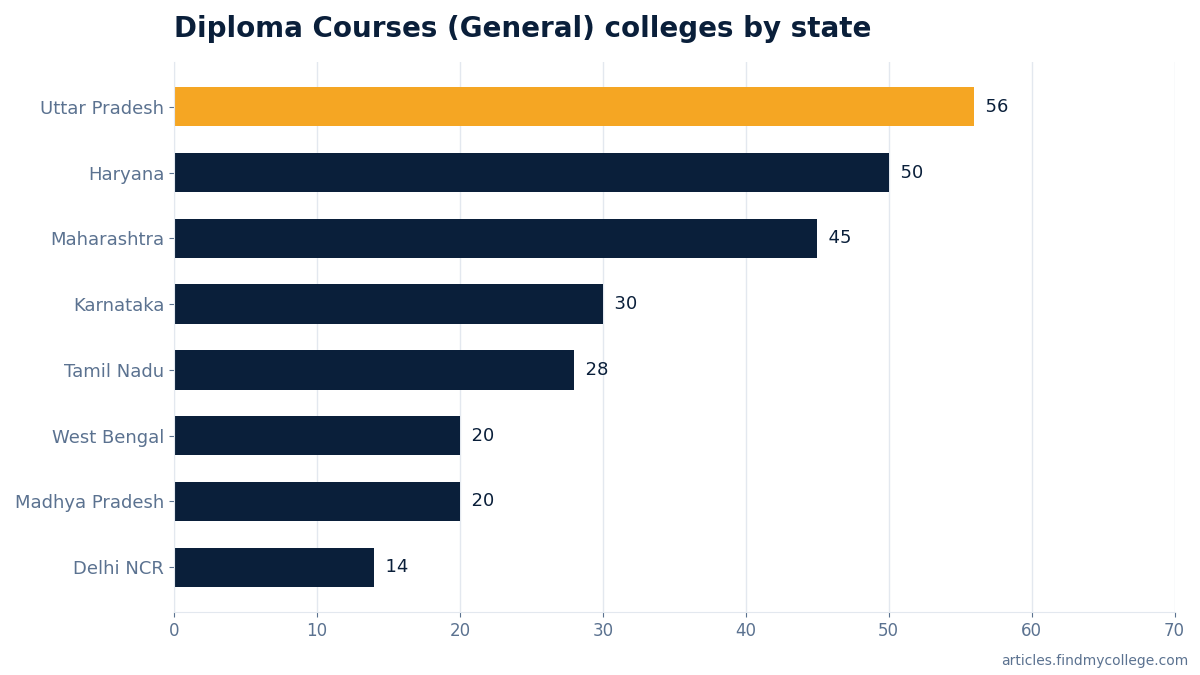
The total fee structure for diploma courses varies significantly across government institutions, private colleges, and field specializations. At least 351 colleges offer Diploma Courses (General) in India, comprising 10 government institutions and 186 private colleges. State-level distribution includes Uttar Pradesh with 56 colleges, Haryana with 50, Maharashtra with 45, Karnataka with 30, Tamil Nadu with 28, and West Bengal with 20 colleges.
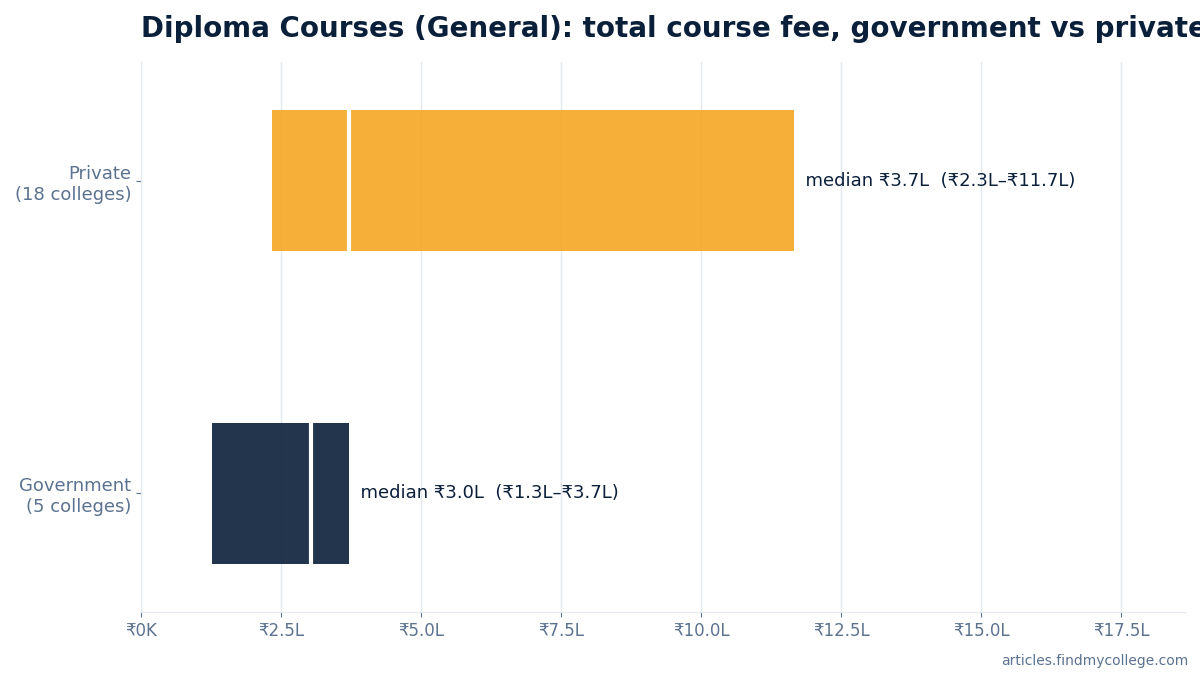
For government colleges, the median total course fee is ₹3.03 lakh, with the middle half ranging between ₹1.25 lakh and ₹3.71 lakh (based on 5 colleges with fee data). Private colleges have a median total course fee of ₹3.71 lakh, with the middle half spanning ₹2.33 lakh to ₹11.65 lakh (based on 18 colleges with fee data). Across India, total fees for PG Diploma programs specifically range from Rs. 50,000 to Rs. 12,00,000 depending on the institute and stream.
| College | City | Ownership | Total Course Fee |
|---|---|---|---|
| St. Mary’s College Shillong | Shillong | Government | ₹35,000 |
| Rajiv Gandhi University of Knowledge Technologies, Dr.APJ Abdul Kalam IIIT Ongole Campus | Ongole | Government | ₹2.16 lakh |
| Rajiv Gandhi University of Knowledge Technologies | Nuzvid | Government | ₹3.03 lakh |
| Shri Ram College of Commerce | Delhi | Government | ₹3.20 lakh |
| Mumbai University | Mumbai | Government | ₹4.23 lakh |
Top Diploma Courses (General) Colleges
| College | City | Ownership | Total Course Fee |
|---|---|---|---|
| Xavier Labour Relations Institute | Jamshedpur | Private | ₹25.90 lakh |
| Goa Institute of Management | North Goa | Private | ₹25.39 lakh |
| International Management Institute | Kolkata | Private | ₹2.50 lakh |
| Vishwa Vishwani Institute of Systems and Management | Hyderabad | Private | ₹8.10 lakh |
| B. P. Marine Academy | Raigarh | Private | ₹6.08 lakh |
| Lal Bahadur Shastri Institute of Management | Delhi | Private | ₹16.60 lakh |
| SIES College of Management Studies | Navi Mumbai | Private | ₹10.00 lakh |
| Asian School of Business Noida | Noida | Private | ₹18.70 lakh |
| Kohinoor Business School | Mumbai | Private | ₹6.10 lakh |
| International Institute of Veterinary Education & Research | Rohtak | Private | ₹1.80 lakh |
| City | Colleges Count | Fee Range | Well-known Options |
|---|---|---|---|
| Bangalore | 16 | ₹1.16 lakh – ₹5.02 lakh | Bangalore City College, Shushruti Institute of Management Studies |
| Delhi | 14 | ₹3.20 lakh – ₹16.60 lakh | Shri Ram College of Commerce, Lal Bahadur Shastri Institute of Management |
| Mumbai | 7 | ₹2.40 lakh – ₹6.60 lakh | Mumbai University, Kohinoor Business School |
| Pune | 6 | ₹3.02 lakh – ₹7.00 lakh | UEI Global Pune, Indira Group of Institute |
| Kolkata | 6 | ₹2.50 lakh – ₹7.20 lakh | International Management Institute, Madhyamgram B.Ed College |
| Rohtak | 6 | ₹1.80 lakh – ₹1.80 lakh | International Institute of Veterinary Education & Research, SS College of Education Rohtak |
Top NIRF-ranked institutions include Shri Ram College of Commerce in Delhi (₹3.20 lakh fee) and Mumbai University (₹4.23 lakh fee). Online options include Ahmedabad’s International Institute of Management and Technical Studies (₹1.41 lakh), University of Jammu, and Guru Nanak Dev University.
Diploma Courses (General) Career Scope and Salary
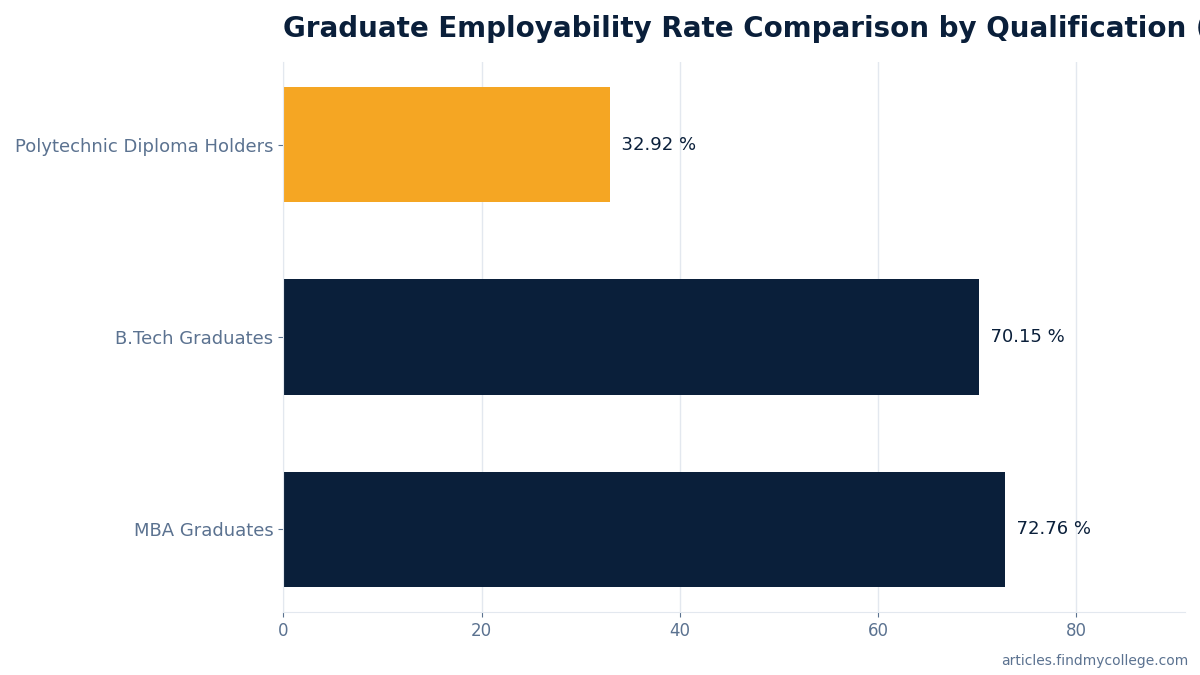
According to the India Skills Report 2026, 32.92% of polytechnic diploma holders are considered job-ready, compared to 70.15% for B.Tech graduates. Strategic higher education and upskilling pathways significantly improve career prospects and entry-level packages.
How to Apply for Diploma Courses (General) Admission in 2026: Step by Step
- Register and Appear for Applicable Entrance Exams: For management PGDM, take CAT, XAT, CMAT, or NMAT. For engineering PG diplomas, submit GATE scores or take CIPET JEE/CSIR-CMERI tests. For B.Tech Lateral Entry, register for state LEET exams (e.g., JEECUP, AP POLYCET, KCET LE).
- Fill Application Forms on College or Entrance Portals: Submit academic, personal, and contact details separately for each chosen postgraduate diploma or polytechnic institution.
- Participate in Counselling, Group Discussions, or Personal Interviews: Shortlisted candidates are selected based on qualifying examination merit, entrance exam performance, GD, and personal interview rounds.
- Complete Verification and Tuition Fee Payment: Verify original graduation or 10th/12th mark sheets and pay prescribed course fees, which range from Rs. 50,000 to Rs. 12,00,000 for PGD programs.
FAQs
What does diploma mean in education?
Undergraduate diplomas are taken after 10th or 12th, while Postgraduate (PG) diplomas require a completed bachelor’s degree.
Is a diploma course undergraduate (UG) or postgraduate (PG)?
A diploma can be either UG or PG. Standard polytechnic or technical diplomas taken after 10th/12th are UG level, whereas Post Graduate Diplomas (PGD/PGDM) are PG level qualifications requiring a bachelor’s degree.
What is a Post Graduate Diploma (PGD)?
A Post Graduate Diploma (PGD) is a 1 to 2-year program designed to provide in-depth practical knowledge in specific areas like Management, Engineering, Computer Applications, or Journalism after graduation.
How long is a diploma course in India?
UG diploma courses usually last 1 to 3 years (up to 4 years for semester engineering programs including a 1-year internship). PG diplomas generally take 1 to 2 years.
Which course is best after completing an engineering diploma?
B.Tech Lateral Entry is a top option as it admits diploma holders directly into the 2nd year of B.Tech. Other strong pathways include PG Diplomas in Data Science, Cloud certifications, or Digital Marketing.
What are the fees for PG Diploma courses in India?
Total fees for PG Diploma programs vary by specialization and institution, typically ranging from Rs. 50,000 to Rs. 12,00,000.