Industrial Design Course: Eligibility, Fees, Colleges and Scope
- 20 Dec 2026Anant Design Entrance Registration Closing
Online registrations for the Anant Design Entrance and Proficiency Test close on December 20, 2026. - 14 Dec 2026MIT-WPU CET Online Registration Closing
Applications for the MIT World Peace University Common Entrance Test close on December 14, 2026. - 10 Nov 2026CEED 2027 Registration Closing With Late Fee
Candidates applying for CEED 2027 can register online with a late fee until November 10, 2026. - 10 Nov 2026UCEED 2027 Registration Deadline With Late Fee
The extended registration window for UCEED 2027 closes on November 10, 2026 with late fee charges.
Industrial Design courses in India are available at UG (3-4 years), PG (2 years), Diploma (1-3 years), and PhD levels, with total fees ranging from INR 3,360 to INR 53.63 Lakh. Admissions are conducted through entrance exams like UCEED, NID DAT, CEED, NIFT Entrance, and CUET, with graduates earning an average starting salary of INR 8.5 LPA.
Below is a detailed breakdown of Industrial Design eligibility criteria, entrance exam requirements, total course fees, top institutes, course specialisations, and career opportunities in India.
| Parameter | Details |
|---|---|
| Course Duration | UG: 3-4 Years | PG: 2 Years | Diploma: 1-3 Years | PhD: 3-6 Years |
| Eligibility (UG) | Class 12 pass in any stream with minimum 50% aggregate (PCM required for BTech) |
| Eligibility (PG) | Bachelor’s degree in BDes/BSc or relevant field with minimum 60% aggregate |
| Popular Entrance Exams | UCEED, NID Entrance, CEED, NIFT Entrance, CUET UG, FDDI AIST, GATE, UGC NET |
| Course Fee Range | INR 3,360 to INR 53.63 Lakh |
| Average Starting Salary | INR 8.5 LPA |
What is Industrial Design
Industrial Design focuses on generating functional and aesthetically pleasing designs for mass-produced goods, devices, and objects used in daily life. Programs in this discipline are offered across undergraduate, postgraduate, diploma, and doctoral levels. Students can specialize in distinct sub-fields tailored to specific manufacturing sectors and design domains.
Specialisations include B.Des in Industrial Arts and Design Practices, B.Des in Lifestyle and Accessories Design, B.Des in Transportation Design, and Diploma in Furniture Design. While Industrial Design incorporates usability, manufacturability, and system design for mass production, Product Design primarily focuses on individual product aesthetics and user experience.
| Course Name | Duration | Eligibility Criteria | Key Institutes |
|---|---|---|---|
| B.Des in Industrial Design | 4 Years | 10+2 in any stream from a recognised board (min 50%) | Nirma University (Ahmedabad), Indus University (Ahmedabad) |
| B.Des in Transportation Design | 4 Years | 10+2 with min 50% + valid score in Design Aptitude Test (Tier 1 & 2) | World University of Design (Sonipat) |
| B.Des in Industrial Arts & Design Practices | 4 Years | 10+2 in any stream with minimum 50% aggregate | Srishti Manipal Institute of Art, Design and Technology (Bangalore) |
| Diploma in Furniture Design | 1-3 Years | Class 12 / Intermediate (Art as a subject preferred) | University of Lucknow, Neewara Academy of Design (Jaipur) |
Industrial Design Eligibility
To pursue Industrial Design in India, candidates must meet specific academic criteria based on the course level. Candidates from any stream (Arts, Commerce, Science) with at least 50% aggregate in Class 12 are eligible for B.Des in Industrial Design. However, B.Tech programs with an Industrial Design specialisation mandate Class 12 with Physics, Chemistry, and Mathematics.
Postgraduate eligibility requires a bachelor’s degree in B.Des, B.Sc, or a related discipline with at least 60% aggregate marks. For doctoral studies, an M.Des or M.Sc degree in a relevant discipline with a minimum of 50% aggregate from a UGC-approved university is required. Major entrance exams accepted across India include UCEED, NID DAT, CEED, NIFT Entrance, CUET UG, FDDI AIST, GATE, and UGC NET.
| Course Level | Minimum Qualification | Aggregate Marks | Accepted Entrance Exams |
|---|---|---|---|
| Undergraduate (B.Des / Diploma) | Class 12 pass from any stream (PCM mandatory for BTech) | 50% Aggregate | UCEED, NID DAT, CUET UG, NIFT Entrance, FDDI AIST |
| Postgraduate (M.Des / PG Diploma) | Bachelor’s degree in B.Des / B.Sc or relevant field | 60% Aggregate | CEED, GATE, NID DAT PG |
| Doctorate (PhD) | Master’s degree in M.Des / M.Sc or related discipline | 50% Aggregate | GATE, UGC NET |
Industrial Design vs Product Design
- Industrial Design: Covers broader systems, mass manufacturability, usability, and large-scale product environments. Total course fees typically range between INR 3 Lakh and INR 6 Lakh.
- Product Design: Primarily focuses on individual product aesthetics, user experience, and individual goods. Total course fees typically range between INR 2 Lakh and INR 5 Lakh.
While Industrial Design integrates usability, manufacturability, and overall system design for mass production, Product Design focuses on individual product aesthetics and user experience.
Top Industrial Design Colleges
| College | City | Ownership | Total course fee | NIRF rank |
|---|---|---|---|---|
| Manipal University Manipal | Manipal | — | ₹5.04 lakh | 3 (Overall, 2025) |
| Indian Institute of Technology Bombay | Mumbai | Government | ₹51,500 | 3 (Overall, 2024) |
| Indian Institute of Technology New Delhi | Delhi | Government | ₹1.60 lakh | 8 (Overall, 2025) |
| Vellore Institute of Technology Vellore | Vellore | — | ₹3.52 lakh | 14 (Overall, 2025) |
| Chandigarh University | Chandigarh | Private | ₹8.77 lakh | 19 (Overall, 2025) |
| Symbiosis International University Pune | Pune | University | ₹19.40 lakh | 24 (Overall, 2025) |
| Lovely Professional University | Jalandhar | Private | ₹3.00 lakh | 31 (Overall, 2025) |
| University of Petroleum and Energy Studies | Dehradun | — | ₹14.37 lakh | 45 (Overall, 2025) |
| Institute Name | Location | Key Programs Offered |
|---|---|---|
| Srishti Manipal Institute of Art, Design & Tech | Bangalore | B.Des in Industrial Arts and Design Practices |
| World University of Design | Sonipat | B.Des in Transportation Design / Industrial Design |
| Nirma University | Ahmedabad | B.Des in Industrial Design |
| Symbiosis International / Pearl Academy | Pune / Various | B.Des in Industrial / Product Design |
| University of Lucknow | Lucknow | Diploma in Furniture Design |
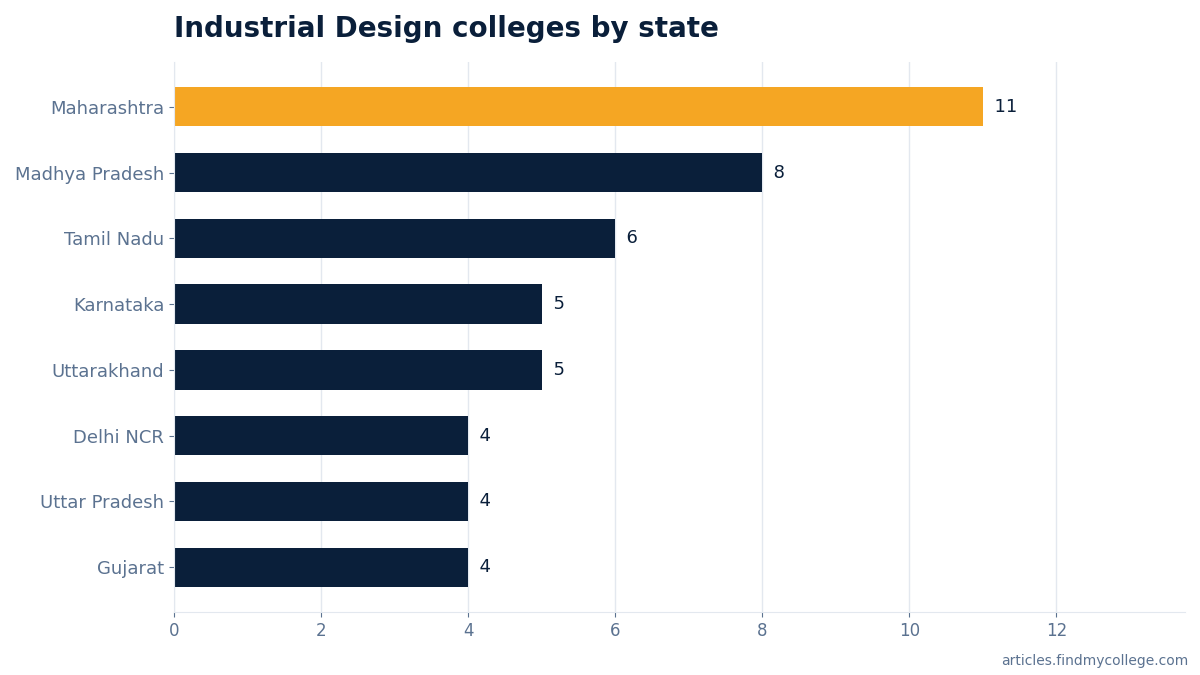
India features top government and private design institutes offering specialized programs in fields like Transportation Design, Lifestyle Accessories Design, and Furniture Design. Overall Industrial Design course fees across Indian private and government institutions range from INR 3,360 to INR 53.63 Lakh.
Industrial Design Career Scope and Salary
Industrial Design graduates find diverse opportunities across modern production, technology, and manufacturing sectors. The average starting salary for an Industrial Designer in India is INR 8.5 LPA.
Key hiring industries include Consumer Electronics, Automotive, Product Manufacturing, Retail and Consumer Goods, and specialized Design Consultancies. Popular job profiles include:
- Industrial Designer
- Product Designer
- Product Manager
- Industrial Design Researcher
- CAD Designer
How to Apply for Industrial Design Admission in 2026: Step by Step
- Check Eligibility Criteria: Verify Class 12 completion with at least 50% aggregate for UG (PCM required for BTech), or a relevant bachelor’s degree with 60% aggregate for PG.
- Register for Entrance Exams: Register and apply online for entrance tests such as UCEED, NID DAT, CEED, NIFT Entrance, CUET UG, or GATE.
- Appear for Entrance Examinations: Take the written entrance exam or multi-tier Design Aptitude Test (DAT Tier 1 and Tier 2) required by the institute.
- Participate in Selection Rounds: Shortlisted candidates appear for a written test or interview round based on entrance scores such as CEED.
| What to do | Where | Link |
|---|---|---|
| Compare colleges, fees and cutoffs | Industrial Design colleges in India | findmycollege.com |
Final selection for Industrial Design programs depends on entrance exam ranks, qualifying marks, and performance in institute interviews.