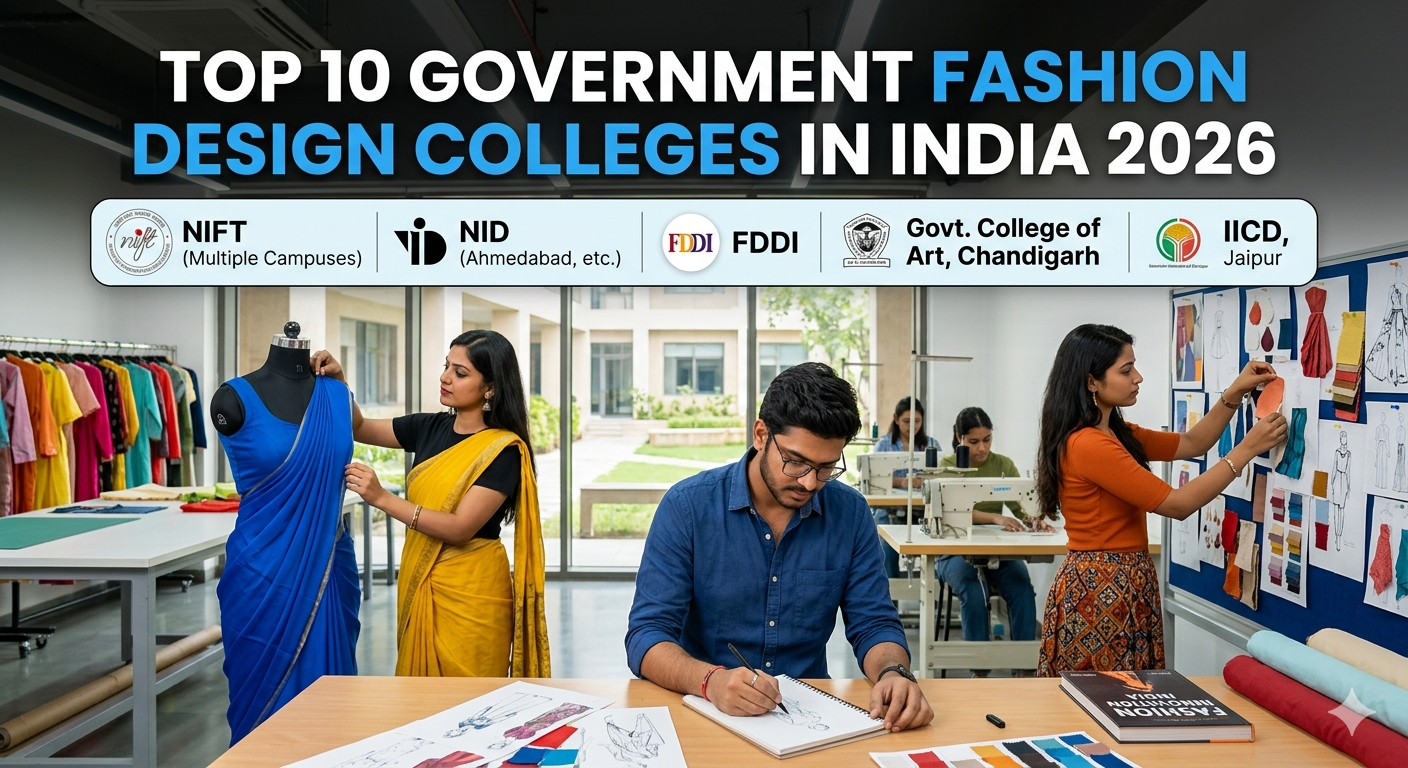
Top 10 Government Fashion Design Colleges in India 2026: Rankings, Fees & Admission Guide
Choosing the right government fashion design college in India is crucial for building a successful career in the fashion industry. In 2026, several prestigious institutes will offer high-quality education, experienced faculty, and strong industry exposure at affordable fees.
Government colleges are especially preferred for their credibility, structured curriculum, and excellent placement opportunities. From entrance exams like NIFT and NID to merit-based admissions, students have multiple pathways to secure a seat in top institutes. These colleges not only focus on design skills but also emphasize innovation, sustainability, and global fashion trends.
With state-of-the-art infrastructure and collaborations with leading fashion brands, students gain practical experience alongside theoretical knowledge. This list of the top 10 government fashion design colleges in India for 2026 will help aspirants explore the best options, compare courses, and make informed decisions for a successful future in fashion design.
India’s Top 10 Government Fashion Design Institutes: 2026 Rankings
Choosing a government fashion design institute in India is a wise step for students who want quality education, strong industry exposure, and good career opportunities at a reasonable cost. Institutes under the National Institute of Fashion Technology are considered the backbone of fashion education in the country. They are known for their modern curriculum, experienced faculty, and excellent placement support.
The most recent officially available data for college rankings is from 2025. These rankings are still highly relevant and give a clear idea of the best institutes in India.
| Overall Rank (2025) | Overall Rank (2024) | College | City | IQG (180) | ACE (300) | ILE (180) | PLD (240) | PCP (300) | O.S. (1200) | P.S. (800) | T.S. (2000) |
|---|---|---|---|---|---|---|---|---|---|---|---|
| 1 | 1 | NIFT New Delhi | New Delhi | 138.9 | 233 | 136.9 | 219.5 | 260.8 | 989.1 | 797 | 1786.1 |
| 2 | 3 | NIFT Bengaluru | Bengaluru | 151 | 231.4 | 116.2 | 182.1 | 248.9 | 929.6 | 774.9 | 1704.5 |
| 3 | 2 | NIFT Mumbai | Navi Mumbai | 135.8 | 207 | 116.1 | 198.4 | 247.7 | 905 | 787.4 | 1692.4 |
| 4 | 4 | NIFT Hyderabad | Hyderabad | 135.2 | 209.7 | 145.1 | 180.1 | 240.3 | 910.4 | 756.9 | 1667.3 |
| 5 | 5 | NIFT Chennai | Chennai | 131 | 227.5 | 123.7 | 207.2 | 223.1 | 912.5 | 751 | 1663.5 |
| 6 | 8 | NIFT Patna | Patna | 126.8 | 224.2 | 118.4 | 202 | 239.3 | 910.7 | 750 | 1660.7 |
| 6 | 6 | NIFT Gandhinagar | Gandhinagar | 138 | 247.5 | 139.5 | 182.9 | 216.1 | 924 | 736.7 | 1660.7 |
| 8 | 7 | NIFT Kolkata | Kolkata | 122.8 | 228.3 | 121 | 199.3 | 227.1 | 898.5 | 754 | 1652.5 |
| 9 | 10 | NIFT Jodhpur | Jodhpur | 124.5 | 219.4 | 153.5 | 181.4 | 217.3 | 896.1 | 689.8 | 1585.9 |
| 10 | 11 | NIFT Kannur | Kannur | 125.6 | 246.9 | 113.6 | 178 | 188.7 | 852.8 | 646.8 | 1499.6 |
Detailed Understanding of Ranking Parameters
These rankings are based on a combination of academic quality, infrastructure, and career outcomes. Each parameter plays an important role in evaluating the overall performance of a college:
- IQG (Intake Quality & Governance): Reflects the quality of students admitted and how well the institute is managed
- ACE (Academic Excellence): Focuses on teaching methods, faculty expertise, curriculum updates, and research work
- ILE (Infrastructure & Living Experience): Includes campus facilities like design labs, hostels, libraries, and overall student life
- PLD (Personality & Leadership Development): Measures how well students are trained in communication, leadership, and soft skills
- PCP (Placement & Career Progression): Evaluates placement records, internships, industry tie-ups, and salary growth
The Objective Score (O.S.) and Perceptual Score (P.S.) together form the Total Score (T.S.), which determines the final ranking.
Why Government Fashion Design Colleges Stand Out?
Government institutions offer several long-term benefits that make them highly competitive:
- Affordable Education: Fees are significantly lower compared to private design institutes
- Strong Industry Connections: Regular internships, workshops, and live projects with top fashion brands
- Recognised Degrees: High value in both Indian and international job markets
- Creative Exposure: Students participate in fashion shows, exhibitions, and design competitions
- Updated Curriculum: Focus on modern trends like sustainable fashion, digital design, and global fashion markets
Career Scope After Graduation
Graduates from top NIFT campuses have excellent career opportunities in various fields such as fashion design, textile design, fashion communication, styling, and retail management. Top recruiters include fashion houses, export companies, retail brands, and design studios.
Fresh graduates can expect starting salaries between ₹3 LPA and ₹6 LPA, while experienced professionals can earn much higher, depending on their specialisation and portfolio.
Government Fashion Design College Fees 2026: NIFT vs NID vs State
Pursuing a degree in fashion design through government institutions in India is an excellent way to receive industry-standard training while keeping costs manageable. For the 2026 academic year, the fee landscape varies significantly between premier national institutes and state-run colleges.
Below is a structured breakdown of the fees and categories for top government fashion design colleges in India.
Premier National Institutions (Tier 1)
These are autonomous bodies under the Central Government. They offer the highest placement packages and industry exposure but also charge higher tuition compared to state colleges.
| Institution | Campus | Est. Annual Fee (2026) | Total 4-Year B.Des Fee |
| NIFT | All 18 Campuses | ₹3,00,000 – ₹3,50,000 | ₹14.09 Lakh |
| NID | Ahmedabad, Bengaluru, Kurukshetra, etc. | ₹3,80,000 – ₹4,50,000 | ₹16.00 – ₹19.00 Lakh |
| FDDI | Noida, Hyderabad, Chennai | ₹2,30,000 – ₹2,80,000 | ₹9.50 – ₹11.50 Lakh |
State Government & Regional Colleges (Affordable Options)
For students looking for highly subsidized education, state-run colleges and polytechnics are the best options. These colleges often focus on fine arts and textile design.
| College Name | Location | Est. Annual Fee (2026) |
| Govt. College of Art | Chandigarh | ₹15,000 – ₹30,000 |
| Govt. Institute of Fashion Tech (GIFT) | Pune | ₹25,000 – ₹50,000 |
| Govt. College of Fashion Tech | Chennai | ₹25,000 – ₹35,000 |
| Ambedkar Institute of Technology (DSEU) | Delhi | ₹35,000 – ₹45,000 |
| Govt. Polytechnic Institute | Nagpur | ₹10,000 – ₹20,000 |
| Govt. College of Arts | Thiruvananthapuram | ₹15,000 – ₹25,000 |
| Jharkhand State Institute of Fashion Tech | Ranchi | ₹20,000 – ₹35,000 |
Fee Structure for Top Institutes
1. NIFT: The “Mid-Range” Premium
NIFT fees have seen a steady annual hike. For 2026, a first-semester student can expect to pay approximately ₹1,91,700 (including one-time security deposits and registration), with subsequent semesters averaging ₹1.5 to ₹1.8 Lakh.
2. NID: The Specialized Premium
While NID is a government institute, its fees are now comparable to private universities due to the intensive resources required for design education. NID Ahmedabad’s B.Des program is estimated at nearly ₹19 Lakh for the full 4-year duration, including hostel and mess.
3. Hidden Costs to Consider
Regardless of the tuition, fashion design students should budget for:
-
Material Costs: Fabrics, sewing kits, drafting tools, and high-end laptops for 3D modeling (can range from ₹20,000 to ₹50,000 annually).
-
Hostel & Mess: In cities like Delhi, Mumbai, or Ahmedabad, these can add ₹80,000 to ₹1.5 Lakh per year to your budget.
-
Portfolio/Jury Prep: Final year projects and runway shows often require additional self-funding.
Financial Aid & Scholarships
Most government colleges, especially NIFT (via the Sarthak Scholarship) and NID, offer significant fee waivers for students from EWS (Economically Weaker Sections) or SC/ST/OBC categories. Always check the specific college portal during the admission cycle for updated scholarship criteria.
NIFT vs NID 2026: Which is Better for Fashion Design?
Choosing between the National Institute of Fashion Technology (NIFT) and the National Institute of Design (NID) is one of the most important decisions for fashion design aspirants in India. Both are prestigious government institutes with strong reputations, but they differ in focus, teaching style, and career outcomes.
| Institute | Entrance Exam | Fees (Approx.) | Course Duration | Average Salary |
|---|---|---|---|---|
| NIFT, New Delhi | NIFT CET (GAT + CAT) | ₹2–4 lakh/year | 4 years (B.Des) | ₹4–8 LPA |
| NID, Ahmedabad | NID DAT (Prelims + Mains) | Govt./Institute-based (varies) | 4 years (B.Des) | ₹5–9 LPA |
Institute Overview
NIFT (National Institute of Fashion Technology)
Established in 1986 with its flagship campus in New Delhi, NIFT has expanded to 16 campuses across India. It is highly specialised in fashion design, textile design, and fashion management. NIFT focuses on industry-oriented learning, making it ideal for students who want direct entry into the fashion and retail industry.
NID (National Institute of Design)
Established in 1961, NID Ahmedabad is one of India’s oldest and most respected design institutes. Unlike NIFT, NID offers a broader design education, including industrial design, communication design, and textile & apparel design. It is known for its creative and research-driven approach.
Key Differences Between NIFT and NID
1. Course Focus
- NIFT is more fashion-specific (apparel, textiles, fashion communication)
- NID offers a wider design perspective with strong emphasis on creativity and innovation
2. Entrance Exams
- NIFT CET includes GAT (General Ability Test) and CAT (Creative Ability Test)
- NID DAT is more design-focused, testing creativity, problem-solving, and studio skills
3. Fees Structure
- NIFT has a structured fee system (₹2–4 lakh per year)
- NID fees vary but are generally comparable, sometimes slightly higher depending on the course
4. Learning Approach
- NIFT: Industry-driven, practical, and placement-focused
- NID: Conceptual, research-based, and innovation-oriented
5. Placements & Salary
- NIFT offers strong placement opportunities with fashion brands and retail companies
- NID graduates often explore diverse roles, including product design, UX/UI, and creative industries, with slightly higher average packages
Why NIFT Dominates Fashion Design Rankings?
NIFT colleges consistently rank among the top government fashion institutes in India because of:
- Strong government support and national presence
- Affordable fees compared to private design colleges
- Excellent placement records in fashion and retail sectors
- Wide network of campuses and alumni
Why NID Stands Out?
NID is known for:
- High emphasis on creativity and design thinking
- Strong global reputation and collaborations
- Diverse career opportunities beyond fashion
- Studio-based learning and innovation-driven projects
Admission Difficulty
Both NIFT and NID are highly competitive institutes. The selection rate is typically between 5% to 8%, making them among the toughest design entrance exams in India. Students need strong creative skills, problem-solving ability, and consistent preparation to secure admission.
Top Entrance Exams for Government Fashion Design Admissions 2026
Getting admission into top government fashion design colleges in India requires clearing specific entrance exams that test creativity, aptitude, and design thinking. Institutes like the National Institute of Fashion Technology (NIFT) and the National Institute of Design (NID) have their own national-level exams, making the admission process highly competitive.
Colleges and Their Entrance Exams
| College Name | Entrance Exam |
|---|---|
| National Institute of Fashion Technology (NIFT), New Delhi | NIFT Entrance Exam |
| National Institute of Fashion Technology (NIFT), Chennai | NIFT Entrance Exam |
| National Institute of Fashion Technology (NIFT), Patna | NIFT Entrance Exam |
| National Institute of Fashion Technology (NIFT), Gandhinagar | NIFT Entrance Exam |
| National Institute of Fashion Technology (NIFT), Hyderabad | NIFT Entrance Exam |
| National Institute of Fashion Technology (NIFT), Navi Mumbai | NIFT Entrance Exam |
| National Institute of Fashion Technology (NIFT), Kolkata | NIFT Entrance Exam |
Major Entrance Exams for Fashion Design 2026
To secure admission in top government institutes, students need to appear for one or more of the following exams:
- NIFT Entrance Exam (CET): Conducted for admission into all NIFT campuses. It includes GAT (General Ability Test) and CAT (Creative Ability Test).
- NID DAT (Design Aptitude Test): Required for admission into NID campuses. It focuses more on creativity, sketching, and problem-solving skills.
- CUET (Common University Entrance Test): Accepted by some universities offering design-related programs.
- FDDI Entrance Exam: Conducted by the Footwear Design and Development Institute for design courses in footwear and fashion merchandising.
- State-Level Entrance Exams: Some state universities conduct their own tests for fashion and design admissions.
Eligibility Criteria for 2026 Admissions
Students who want to apply for government fashion design colleges must meet basic eligibility requirements:
- Must have completed Class 12 (any stream – Arts, Science, or Commerce)
- Minimum marks criteria may vary by institute (generally around 50%)
- Students with a background in arts or design may have an advantage, but it is not mandatory
Selection Process
Admission is not based on written exams alone. Most top institutes follow a multi-stage selection process:
- Written Test: Entrance exam like NIFT or NID
- Situation Test / Studio Test: Practical assessment of creativity and design skills
- Personal Interview: Evaluates communication skills and interest in design
- Portfolio Review (in some cases): Students may need to showcase their creative work
Step-by-Step Admission Process for Government Fashion Colleges 2026
Securing admission to top government fashion design institutes in India, such as the National Institute of Fashion Technology (NIFT) and the National Institute of Design (NID), involves a structured process. Understanding each step clearly can help you prepare better and improve your chances of selection.
Step 1: Choose Your Program Type
Decide whether you want to pursue an Undergraduate (UG), Postgraduate (PG), or Diploma course.
- UG: B.Des, B.FTech
- PG: M.Des, MFM, M.FTech
Step 2: Check Eligibility Criteria
Before applying, make sure you meet the basic requirements:
- UG Courses: Must have completed Class 12 (any stream – Arts, Science, or Commerce)
- PG Courses: Must have completed graduation from a recognised university
- Some institutes may also have age limits or minimum marks criteria
Step 3: Apply for Entrance Exams
Most top government colleges conduct national-level entrance exams. Key exams include:
- NIFT Entrance Exam
- NID DAT (Design Aptitude Test)
- CEED (for PG design programs)
- Other state-level design entrance tests
Preparing with mock tests, previous year papers, and regular practice is essential.
Step 4: Appear for the Entrance Test
These exams usually test:
- Creative ability and sketching skills
- General knowledge and logical reasoning
- Observation and design thinking
Performance in these exams plays a major role in shortlisting candidates.
Step 5: Situation Test / Studio Test
Shortlisted candidates are invited for practical tests:
- NIFT: Situation Test (model-making, material handling)
- NID: Studio Test (hands-on creativity and problem-solving)
This stage evaluates your practical design skills.
Step 6: Personal Interview & Portfolio Submission
Some institutes may conduct interviews and ask for a portfolio.
- Portfolio should showcase sketches, creative work, and design projects
- Interview assesses communication skills, creativity, and passion for design
Step 7: Final Selection & Admission
Final selection is based on combined performance in:
- Entrance exam
- Practical test
- Interview/portfolio (if applicable)
Selected candidates can then complete document verification and pay the admission fee.
| Exam | Timeline | Syllabus | Tips |
|---|---|---|---|
| NIFT Entrance Exam | January 2026 | CAT, GAT, Situation Test | Work on creative problem solving |
| NID DAT | Jan (Prelims), Mar (Mains) | Drawing, creativity, observation | Build portfolio early |
| CEED | Jan | Logical, visual, design thinking | Take online mock tests |
| Pearl Academy Exam | Jan–July cycles | Aptitude + Interview | Showcase strong personal style |
| AIEED | Rolling | Logical + creative thinking | Focus on sketching speed & clarity |
Popular Fashion Design Courses Offered by Government Institutes 2026
Government fashion design colleges in India offer a wide range of courses at undergraduate, postgraduate, and diploma levels.
Institutes such as the National Institute of Fashion Technology (NIFT) and the National Institute of Design (NID) are known for their industry-focused curricula and diverse specialisations. These colleges provide quality education at affordable fees, making them a top choice for aspiring designers.
| College Name | Location | Popular Courses Offered | Typical Fees (Approx. per year) |
|---|---|---|---|
| National Institute of Fashion Technology (NIFT) | Multiple campuses (Delhi, Mumbai, Chennai, Bengaluru, Kolkata, etc.) | B.Des, M.Des, B.FTech (Apparel Production), MFM, M.FTech; Specialisations: Fashion Design, Textile Design, Accessory Design, Fashion Communication, Knitwear Design, Leather Design, Fashion & Lifestyle Accessories | ₹2–4 lakh (UG); ₹40,000–₹1.5 lakh (PG range) |
| National Institute of Design (NID) | Ahmedabad, Bengaluru | B.Des, M.Des; Specialisations: Animation Film Design, Graphic Design, Product Design, Textile Design, Interaction Design, Digital Game Design, Furniture & Interior Design, Film & Video Communication | Around ₹1.5 lakh (varies by campus; govt-regulated) |
| Footwear Design and Development Institute (FDDI) | Noida & other campuses | UG programs in Footwear Design, Fashion Design, and Accessories | ₹1.5–3 lakh |
| Government College of Art | Chandigarh | BFA, MFA in Fashion Design | ₹15,000–₹30,000 |
| Government Institute of Fashion Technology | Pune | Diploma & Degree programs in Fashion Design | ₹25,000–₹50,000 |
| Government College of Fashion Technology | Chennai | UG & PG Fashion Design programs | Around ₹30,000 |
| Dr. Ambedkar Institute of Technology | Delhi | B.Tech in Fashion Technology | Around ₹40,000 |
| Jharkhand State Institute of Fashion Technology | Ranchi | Diploma in Fashion Designing | ₹20,000–₹30,000 |
| Institute of Apparel Management | Gurugram | B.Sc in Fashion Design | Around ₹50,000 |
| Government College of Arts | Thiruvananthapuram | BFA in Fashion Design | ₹15,000–₹30,000 |
| Government Polytechnic Institute | Nagpur | Diploma in Fashion Technology | ₹10,000–₹20,000 |
Types of Fashion Design Courses Available
Government institutes offer different types of programs based on career goals:
1. Undergraduate Courses (UG)
- Bachelor of Design (B.Des)
- Bachelor of Fashion Technology (B.FTech)
- Bachelor of Fine Arts (BFA)
These courses usually have a duration of 3–4 years and focus on building strong design fundamentals, creativity, and technical skills.
2. Postgraduate Courses (PG)
- Master of Design (M.Des)
- Master of Fashion Management (MFM)
- Master of Fashion Technology (M.FTech)
- Master of Fine Arts (MFA)
PG courses help students specialise in advanced areas and improve career prospects in leadership, research, or niche design fields.
3. Diploma Courses
- Offered by polytechnic and state institutes
- Duration: 1–3 years
- Focus on practical skills like garment construction, pattern making, and basic design
These are ideal for students who want to enter the workforce quickly.
Popular Specialisations in Fashion Design
Students can choose from a variety of specialisations depending on their interests:
- Fashion Design
- Textile Design
- Accessory Design
- Fashion Communication
- Knitwear Design
- Leather Design
- Apparel Production
- Graphic & Interaction Design (more common in NID)
Why Choose Government Fashion Institutes?
- Affordable Fees: Much lower than private design colleges
- Recognised Degrees: High value in India and abroad
- Experienced Faculty: Industry experts and skilled professionals
- Strong Placements: Good connections with fashion brands and export houses
- Practical Exposure: Internships, workshops, and live projects
FAQs