Post Graduate Courses in India: Degrees, Admission & Scope
Nishit Kumar is a senior EdTech industry leader with over a decade of experience in building and scaling education platforms, shaping their product, content, and growth strategy. At…
Admissions require a bachelor’s degree with at least 50% aggregate marks (45% for reserved categories) and valid scores in entrance exams like CAT, CMAT, XAT, or MAT where applicable.
| Parameter | Details |
|---|---|
| Eligibility Criteria | Bachelor’s degree in any discipline with minimum 50% aggregate marks (45% for reserved categories) |
| Master’s Degree Duration | 1 to 3 years (MBA/MA/MSc: 1–2 years; MSc Data Science: 1.5–2 years; MCA: 2–3 years) |
| PG Diploma Duration | 6 to 12 months (or 1 year for specialized diplomas) |
| PG Certificate Duration | 2 to 4 months (typically around 60 credits) |
| Key Management Entrance Exams | CAT, CMAT, XAT, GMAT, SNAP, MAT, MICAT, HPU MAT, PU CET PG |
| Recognizing & Regulatory Bodies | UGC, AICTE, and NAAC accreditation |
| Salary Increment Impact | Master’s degree holders earn up to 20% higher salaries than bachelor’s degree holders, with ~80% in higher-level employment |
What is Post Graduate Courses
Postgraduate (PG) programs build advanced academic specializations, leadership capabilities, and technical expertise upon undergraduate foundations. Higher education institutions offer various formats tailored to different career timelines and research goals. Master’s degrees generally range from 1 to 3 years and require a mandatory thesis or capstone project. In contrast, Postgraduate Diplomas span 6 to 12 months across two terms, focusing on practical skills and career transitions without requiring a thesis.
For candidates seeking quick skill enhancement, Postgraduate Certificates (PgCert/PGC) take 2 to 4 months to complete approximately 60 credits, emphasizing immediate practical applicability.
Post Graduate Courses Eligibility
Eligibility for postgraduate courses in India requires candidates to hold a recognized bachelor’s degree in a relevant discipline. Most universities specify a minimum of 50% aggregate marks in undergraduate studies, with a relaxed threshold of 45% for reserved categories. Additional application documentation typically includes undergraduate transcripts, an updated CV or resume, a Statement of Purpose (SOP), academic or professional letters of recommendation, and a portfolio or research proposal for specialized tracks such as PhD, M.Arch, or design.
Management, technical, and professional qualifications frequently depend on scorecards from national, state, or university entrance exams.
| College | City | Ownership | Total course fee |
|---|---|---|---|
| Hansraj Jivandas College of Education | Mumbai | Private (aided) | — |
| Institute of Good Manufacturing Practices India | Noida | — | ₹18,000 |
| Indian Institute of Management Ranchi | Ranchi | — | ₹1.70 lakh |
| Calcutta Media Institute | Kolkata | — | ₹2.50 lakh |
Post Graduate Courses Syllabus and Subjects
| Course Name | Duration | Key Core Areas & Skills Gained | Target Roles / Career Paths |
|---|---|---|---|
| Master of Business Administration (MBA / PGDM) | 1–2 years | Marketing, Finance, HR, Operations, Entrepreneurship, Leadership | Senior Management, Consultant, Entrepreneur |
| MSc in Data Science | 1.5–2 years | Machine Learning, Python/R, Big Data Tools, Cloud Systems, Analytics | Data Scientist, ML Engineer, AI Consultant, BI Analyst |
| Master of Public Health (MPH) | 2 years | Epidemiology, Health Policy, Environmental Health, Biostatistics | Epidemiologist, NGO Project Manager, Healthcare Consultant |
| Master of Computer Applications (MCA) | 2–3 years | Software Engineering, Databases, Cloud Computing, AI, Web Dev | Software Engineer, Systems Analyst, App Developer, IT Consultant |
| Master of Laws (LLM) | 1–2 years | Corporate Law, Business Law, Cyber Law, International Law, IP | Corporate Lawyer, Legal Consultant |
| Master of Education (M.Ed) | 2 years | Educational Technology, Curriculum Leadership, Pedagogy | Academic Administrator, Educational Consultant, Curriculum Developer |
| PG Diploma in Hotel Management | 1 year | Hospitality Management, Practical Skills | Hotel Manager, Front Office Manager, General Manager, Chef |
Postgraduate curricula cover core academic theory, technical application, and field-specific specializations across academic and professional Master’s degrees. Engineering PG specializations cover domains like Computer Science, Civil, and Mechanical, while LLM tracks include Corporate, Cyber, and Business Law.
Post Graduate Courses Fees
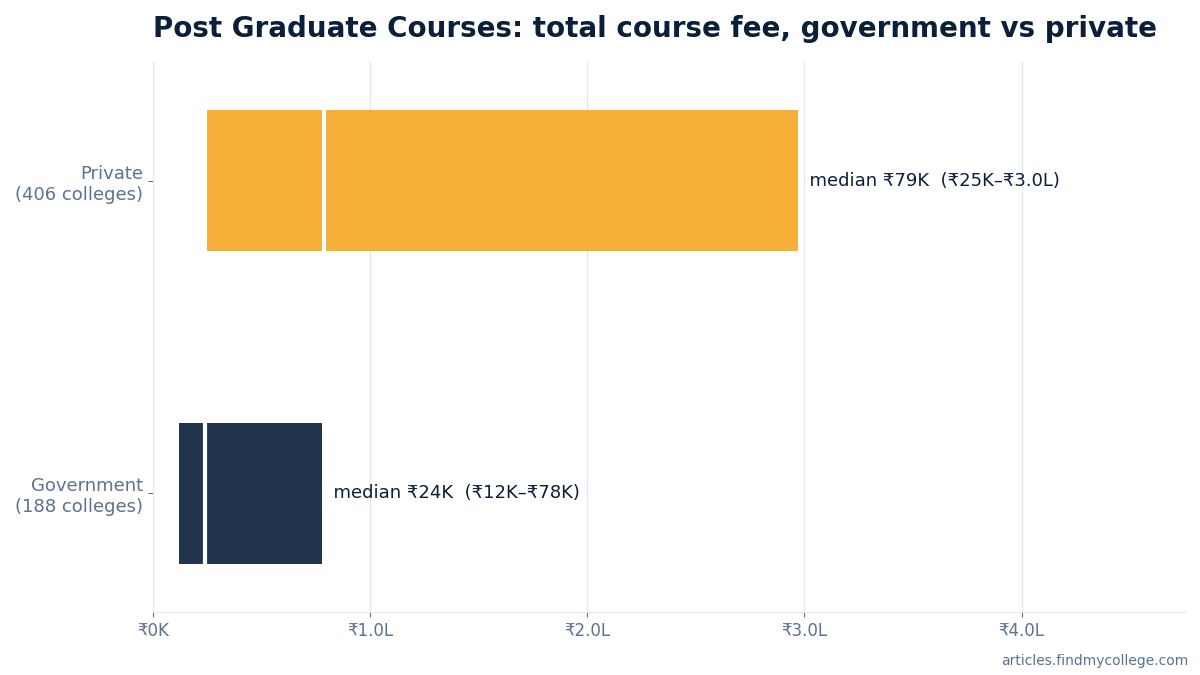
Course fees for postgraduate studies in India vary based on institutional ownership, infrastructure, and delivery mode. Among institutions with fee data, government colleges report a median total course fee of ₹24,000, with the middle half of fees ranging between ₹12,000 and ₹77,890 (based on 188 colleges). In contrast, private colleges reflect a median total course fee of ₹79,000, with the middle half ranging from ₹25,000 to ₹2.97 lakh (based on 406 colleges).
| College | City | Ownership | Total course fee |
|---|---|---|---|
| Indira Gandhi National Open University | Delhi | Government | ₹5,000 |
| Pt. Chiranji Lal Sharma Govt. P.G. College | Karnal | Government | ₹5,118 |
| Banaras Hindu University | Varanasi | Government | ₹5,164 |
| Dr. A.P.J. Abdul Kalam Technical University | Lucknow | Government | ₹5,170 |
| Mumbai University | Mumbai | Government | ₹5,350 |
| Jagiroad College | Marigaon | Government | ₹5,500 |
| Madhab Choudhury College | Barpeta | Government | ₹5,500 |
| WEGovernment Post Graduate College | Ambala | Government | ₹5,559 |
| Tihu College | Tihu | Government | ₹6,000 |
| Government College for Women Rohtak | Rohtak | Government | ₹6,040 |
Top Post Graduate Courses Colleges
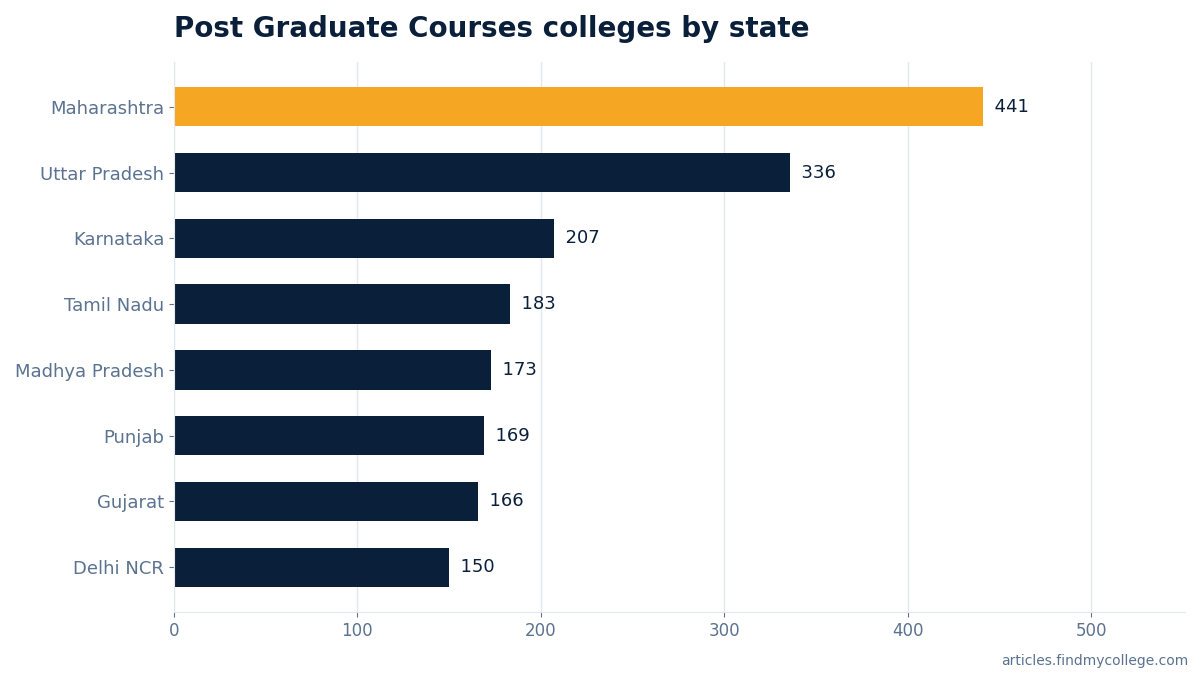
At least 2836 colleges offer Post Graduate Courses across India, comprising government 274 and private 750 institutions. Geographically, postgraduate institutions are distributed across major states, including Maharashtra with 441 colleges, Uttar Pradesh with 336, Karnataka with 207, Tamil Nadu with 183, Madhya Pradesh with 173, and Punjab with 169.
Premier national institutions are evaluated by NIRF rankings and placement records. Across 60 reporting colleges, the median average placement package stands at 4.29 LPA.
| College | City | Ownership | Total course fee | NIRF rank |
|---|---|---|---|---|
| Indian Institute of Technology Madras | Chennai | Government | ₹5.80 lakh | 1 (Overall, 2025) |
| Jawaharlal Nehru University | Delhi | Government | ₹20,245 | 2 (Overall, 2025) |
| Manipal University Manipal | Manipal | — | ₹25,000 | 3 (Overall, 2025) |
| Punjab Agricultural University | Ludhiana | — | ₹64,335 | 3 (Overall, 2025) |
| Jamia Millia Islamia University | Delhi | Government | ₹7,200 | 4 (Overall, 2025) |
| Delhi University | Delhi | Government | ₹34,900 | 5 (Overall, 2025) |
| Banaras Hindu University | Varanasi | Government | ₹5,164 | 6 (Overall, 2025) |
| Indian Institute of Technology Kharagpur | Kharagpur | Government | ₹25.00 lakh | 6 (Overall, 2025) |
| College | City | Ownership | Total course fee | Average package |
|---|---|---|---|---|
| Lal Bahadur Shastri Institute of Management | Delhi | Private | ₹16.60 lakh | 8 LPA |
| International School of Management Excellence | Bangalore | Private | ₹12.70 lakh | 7.5 LPA |
| Jagannath International Management School Kalkaji | Delhi | Private | ₹10.75 lakh | 7.37 LPA |
| New Delhi Institute of Management New Delhi | Delhi | Private | ₹9.75 lakh | 5.75 LPA |
| Siva Sivani Institute of Management | Hyderabad | Private | ₹8.40 lakh | 5.59 LPA |
| GL Bajaj Institute of Management and Research | Greater Noida | Private | ₹10.05 lakh | 5 LPA |
| International Institute of Business Studies | Bangalore | Private | ₹9.24 lakh | 5 LPA |
| St. Joseph’s College of Commerce | Bangalore | Private | ₹41,000 | 5 LPA |
| Great Lakes Institute of Management | Chennai | Private | ₹3.70 lakh | 4.81 LPA |
| Xavier Institute of Social Service | Ranchi | Private | ₹69,000 | 4.73 LPA |
| City | Colleges | Fee range | Well-known options |
|---|---|---|---|
| Mumbai | 155 | ₹5,350 – ₹13.50 lakh | Government Law College Mumbai, Homi Bhabha National Institute |
| Delhi | 150 | ₹5,000 – ₹18.27 lakh | Jamia Millia Islamia University, Delhi University |
| Bangalore | 140 | ₹13,000 – ₹17.45 lakh | Alliance University, Christ University |
| Pune | 134 | ₹18,000 – ₹18.00 lakh | Armed Forces Medical College, Fergusson College |
| Hyderabad | 82 | ₹10,000 – ₹21.65 lakh | International Institute of Information Technology Hyderabad, National Institute of Agricultural Extension Management |
| Chennai | 65 | ₹17,000 – ₹13.50 lakh | Indian Institute of Technology Madras, Madras Medical College |
| Jaipur | 60 | ₹8,000 – ₹19.20 lakh | University of Rajasthan, Banasthali Vidyapith |
| Kolkata | 59 | ₹8,000 – ₹12.21 lakh | Jadavpur University, Indian Institute of Management Kolkata |
Online Post Graduate Courses vs Traditional On-Campus Degrees
Online postgraduate programs approved by UGC, AICTE, and NAAC-accredited universities deliver curriculum via Learning Management Systems (LMS). Candidates holding a bachelor’s degree with 50% marks (45% for reserved categories) can enrol in flexible distance or online formats offered by institutions such as MITSDE (offering AICTE-approved PGDM programs equivalent to an MBA), IGNOU, NMIMS Global Access, Symbiosis Centre for Distance Learning (SCDL), and Amity University Online.
Short-Term PG Diplomas and Job-Oriented Certification Options
Short-term PG qualification routes focus on immediate skill enhancement and industry transition. Postgraduate Diplomas (6 to 12 months across two terms) offer focused training without requiring a dissertation thesis. Postgraduate Certificates (2 to 4 months, ~60 credits) cover practical applicability in niche fields.
Popular short-term specialization options include:
- PG Diploma in Hotel Management: A 1-year course covering hospitality management, front office operations, and guest relations, leading to roles such as Hotel Manager, Front Office Manager, General Manager, Chef, and Guest Relationship Manager.
- Digital Marketing PG Certification: Covers Search Engine Optimization (SEO), Social Media Marketing, Content Marketing, Web Analytics, and Email Marketing.
Post Graduate Courses Career Scope and Salary
Completing a postgraduate course enhances professional mobility and earning power. Salary levels for master’s degree graduates can be up to 20% higher than those for bachelor’s degree holders, with around 80% of master’s degree holders securing higher-level professional roles. Career outcomes by discipline include:
- Technology & Computer Applications: MCA graduates secure positions as Software Engineer, Systems Analyst, App Developer, and IT Consultant.
- Healthcare & Humanities: MPH graduates work as Epidemiologists, Healthcare Consultants, and NGO Project Managers, while MA in Psychology graduates transition into clinical psychologists, counselors, organizational psychologists, and researchers.
- Executive Doctorate Paths: Doctor of Business Administration (DBA) programs (3 to 4 years) enable senior professionals to merge advanced research with executive strategic management practice.
How to Apply for Post Graduate Courses Admission: Step by Step
- Check academic eligibility: Possess a bachelor’s degree in any discipline with a minimum of 50% marks (45% for reserved categories).
- Register for PG entrance exams: Apply for required entrance tests such as CAT, CMAT, XAT, GMAT, SNAP, MAT, MICAT, HPU MAT, or PU CET PG.
- Prepare admission documentation: Compile official undergraduate degree transcripts, updated CV/resume, Statement of Purpose (SOP), references, and portfolios or research proposals where relevant.
- Submit application forms: Apply directly to recognized universities or distance/online learning platforms such as MITSDE, IGNOU, NMIMS Global Access, SCDL, or Amity University Online.
Meeting basic academic eligibility and gathering required application documents like transcripts, SOPs, and resumes are key first steps. Applicants should choose among national entrance exams or direct applications to accredited institutions.
FAQs
What is considered a postgraduate degree?
A postgraduate degree is an advanced qualification pursued after a bachelor’s degree. It includes academic and professional Master’s degrees (such as MA, MSc, MBA, MCA, LLM), Postgraduate Diplomas (PGDM), and Doctorates (PhD, DBA).
What post-graduate diploma courses are available in India?
Popular PG Diplomas in India include PGDM, PGDHRM (Human Resources), PGDFM (Finance), and specialized diplomas in Hotel Management, Project Management, IT, and Operations.
Is MSc a 2 year course?
Yes, standard MSc degrees (such as MSc in Data Science) in India generally span 1.5 to 2 years, building upon scientific and technical undergraduate backgrounds.
Can I do masters in 6 months?
No, standard Master’s degrees in India take 1 to 3 years. However, short-term Postgraduate Certificates take 2 to 4 months, while Postgraduate Diplomas take 6 to 12 months.
What are PG courses in India?
PG courses in India are advanced programs taken after graduation. They comprise Master’s degrees (MBA, MSc, MCA, MA), PG Diplomas (PGDM), PG Certificates, and Doctoral degrees (PhD, DBA) accredited by bodies like UGC and AICTE.
What is an MSc salary?
Salaries for Master’s degree holders can be up to 20% higher than those for bachelor’s degree graduates, with around 80% of master’s degree holders securing higher-level professional roles.