Post Basic B.Sc Nursing Syllabus: Year-Wise Subjects & PDF
Nishit Kumar is a senior EdTech industry leader with over a decade of experience in building and scaling education platforms, shaping their product, content, and growth strategy. At…
The Post Basic B.Sc Nursing syllabus is a 2-year degree-upgrade curriculum prescribed by the Indian Nursing Council (INC). It covers 9 subjects in the 1st year (525 theory hours and 810 practical hours) and 6 subjects in the 2nd year (345 theory hours and 855 practical hours).
The curriculum transforms General Nursing & Midwifery (GNM) diploma holders into degree-holding professional nurses. Detailed breakdowns below outline year-wise subjects, practical hours, examination schemes, reference books, institutional fees, and step-by-step admission guidelines.
| Parameter | Details |
|---|---|
| Course Duration | 2 Academic Years (Regular) |
| Eligibility | 10+2 / Equivalent + General Nursing & Midwifery (GNM) Diploma + RNRM Registration with State Nursing Registration Council |
| 1st Year Subject Count | 9 Subjects (525 Theory Hours + 810 Practical Hours) |
| 2nd Year Subject Count | 6 Subjects (345 Theory Hours + 855 Practical Hours) |
| Minimum Attendance Requirement | 80% in Theory and Practicals to appear in exam; 100% in Practical/Clinical before degree award |
| Minimum Pass Marks | 50% in Theory and Practical separately (33% for qualifying English paper) |
| Course Total Fee Range | INR 2,965 to INR 6.15 Lakh (Govt: INR 3,000–60,000; Private: INR 20,000–6.15 Lakh) |
| Average Starting Salary | INR 3 LPA – INR 5 LPA |
Post Basic B.Sc Nursing Subjects Year-wise
| S.No. | Subject Title | Theory Hours | Practical Hours | Total Hours |
|---|---|---|---|---|
| 2 | Nutrition & Dietetics | 30 | 15 | 45 |
| 3 | Biochemistry & Biophysics | 60 | 0 | 60 |
| 4 | Psychology | 60 | 15 | 75 |
| 5 | Maternal Nursing | 60 | 240 | 300 |
| 6 | Child Health Nursing | 60 | 240 | 300 |
| 7 | Microbiology | 60 | 30 | 90 |
| 8 | Medical & Surgical Nursing | 90 | 270 | 360 |
| 9 | English (Qualifying) | 60 | 0 | 60 |
The first-year curriculum includes nine subjects covering basic sciences, foundational nursing skills, and clinical specialties. Teaching of Anatomy, Physiology, Pharmacology, and Pathology is integrated with clinical subjects throughout the course.
| S.No. | Subject Title | Theory Hours | Practical Hours | Total Hours |
|---|---|---|---|---|
| 1 | Sociology | 60 | 0 | 60 |
| 2 | Community Health Nursing | 60 | 240 | 300 |
| 3 | Mental Health Nursing | 60 | 240 | 300 |
| 4 | Introduction to Nursing Education | 60 | 75 | 135 |
| 5 | Introduction to Nursing Service Administration | 60 | 180 | 240 |
| 6 | Introduction to Nursing Research & Statistics | 45 | 120 | 165 |
The second year consists of six subjects focusing on advanced community health, mental health, administration, education, and research. Second-year practical examinations are conducted for Community Health Nursing, Mental Health Nursing, and a Research Project.
Post Basic B.Sc Nursing Practicals and Projects
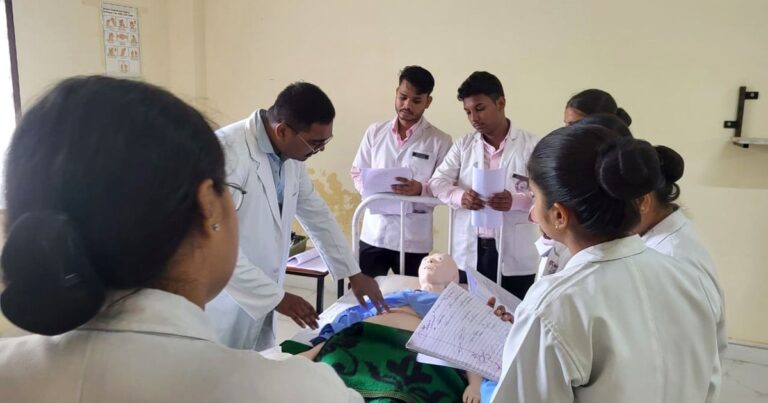
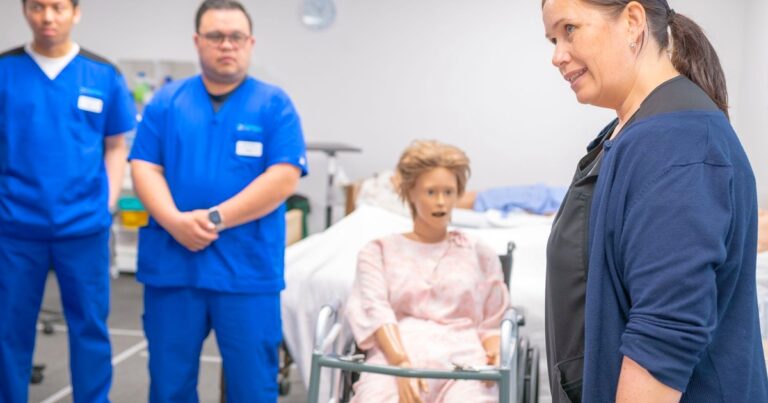
Practical training forms the majority of credit hours across both academic years.
In the first year, formal university practical examinations are conducted in three clinical domains:
- Medical & Surgical Nursing (270 clinical hours)
- Child Health Nursing (240 clinical hours)
- Maternal Nursing (240 clinical hours)
In the second year, candidates complete specialized practical evaluations and project defenses in three areas:
- Community Health Nursing (240 clinical hours)
- Mental Health Nursing (240 clinical hours)
- Nursing Research Project (120 project hours)
Books for Post Basic B.Sc Nursing
Candidates must secure at least 50% marks in internal assessment and university examinations combined to pass theory and practical papers separately. A minimum of 33% marks is required to pass the qualifying English examination.
Post Basic B.Sc Nursing Colleges and Fee Structure
At least 465 colleges offer Post Basic B.Sc Nursing across India, comprising government 25 and private 235 documented institutions. Government colleges feature a median total course fee of ₹1.00 lakh, with the middle half ranging between ₹37,000 and ₹1.51 lakh (based on 11 colleges with fee data). Private institutions record a median total fee of ₹1.46 lakh, with the middle half falling between ₹1.00 lakh and ₹2.00 lakh (based on 170 colleges with fee data).
Major states providing Post Basic B.Sc Nursing seats include Karnataka with 81 colleges, Tamil Nadu with 49, Uttar Pradesh with 48, Madhya Pradesh with 44, Gujarat with 32, and Kerala with 32 colleges.
| College | City | Ownership | Total course fee | NIRF rank |
|---|---|---|---|---|
| All India Institute of Medical Sciences New Delhi | Delhi | Government | — | 1 (Medical, 2025) |
| Post Graduate Institute of Medical Education & Research | Chandigarh | Government | ₹6,340 | 2 (Medical, 2025) |
| Christian Medical College Vellore | Vellore | Private | ₹77,746 | 3 (Medical, 2025) |
| Saveetha Institute of Medical and Technical Sciences | Chennai | — | ₹1.00 lakh | 11 (Medical, 2025) |
| Dr. DY Patil Vidyapeeth | Pune | — | ₹2.20 lakh | 12 (Medical, 2025) |
| Siksha ‘O’ Anusandhan University | Bhubaneswar | — | ₹2.40 lakh | 15 (Medical, 2025) |
| Madras Medical College | Chennai | Government | — | 16 (Medical, 2025) |
| SRM Institute of Technology | Kanchipuram | Private | ₹1.30 lakh | 18 (Medical, 2025) |
| Datta Meghe Institute of Medical Sciences | Wardha | — | ₹2.06 lakh | 20 (Medical, 2025) |
| College | City | Ownership | Total course fee |
|---|---|---|---|
| Post Graduate Institute of Medical Education & Research | Chandigarh | Government | ₹6,340 |
| Bhopal Memorial Hospital & Research Centre | Bhopal | Government | ₹10,200 |
| Indira Gandhi Medical College | Shimla | Government | ₹37,000 |
| Mother Teresa Post Graduate and Research Institute of Health Sciences | Pondicherry | Government | ₹59,250 |
| Eklavya University | Damoh | Government | ₹68,500 |
| Rajiv Gandhi University of Health Sciences | Bangalore | Government | ₹1.00 lakh |
| Rajasthan University of Health Sciences | Jaipur | Government | ₹1.00 lakh |
| GSVM Medical College | Kanpur | Government | ₹1.44 lakh |
| Government Medical College Thiruvananthapuram | Thiruvananthapuram | Government | ₹1.51 lakh |
| SIMET College of Nursing Palluruthy | Ernakulam | Government | ₹1.71 lakh |
Post Basic B.Sc Nursing Official PDF Syllabus and Examination Rules
- The official INC syllabus prescribes 15 subjects across 2 years, comprising 9 subjects in the first year and 6 subjects in the second year.
- Candidates must achieve at least 50% marks in both internal assessment and external university examinations combined for theory and practical papers separately to pass.
- For qualifying English, a candidate must secure a minimum of 33% marks to pass.
- RGUHS removed the mandatory requirement of 2 years work experience post-GNM for admission to Post Basic B.Sc Nursing.
- Male nurses trained before the integrated course can produce INC-approved training certificates in OT Techniques, Ophthalmic, Leprosy, TB, Psychiatric, Neurological, Community Health, Cancer, or Orthopedic Nursing in lieu of Midwifery.
Passing regulations require a minimum 50% combined score in theory and practical subjects separately. Universities like RGUHS have removed the two-year post-GNM work experience requirement for admission.
How to Apply for Post Basic B.Sc Nursing Admission in 2026: Step by Step
- Check Eligibility Criteria: Ensure completion of 10+2 / Higher Secondary along with a valid General Nursing & Midwifery (GNM) diploma and active RNRM registration with a State Nursing Registration Council.
- Register for Entrance Examination: Apply for national, state, or institute-level entrance exams such as AIIMS Post Basic B.Sc Nursing, PGIMER, RUHS PBBSC, IGNOU BSCN(PB), Kerala LBS, or CMC Vellore selection tests.
- Appear for Entrance Test / Merit Screening: Take the written exam covering Physics, Chemistry, Biology, Nursing Foundation, and General Knowledge topics, or get evaluated on GNM academic merit.
- Attend Counselling & Seat Allotment: Participate in online/offline counselling conducted by the university or state authority to choose the preferred nursing college based on entrance rank.
- Submit Documents & Complete Verification: Present Class 10/12 certificates, GNM marksheets/diploma certificate, State Nursing Council RNRM certificate, medical fitness certificate, and identity proof.
- Pay Course Admission Fees: Pay the required tuition fee (ranging from ~INR 2,965 in government institutes up to INR 6.15 Lakh in private colleges) to confirm the seat.
| What to do | Where | Link |
|---|---|---|
| Compare colleges, fees and cutoffs | Post Basic B.Sc Nursing colleges in India | findmycollege.com |
FAQs
What does PB BSc stand for in the context of nursing?
PB BSc stands for Post Basic Bachelor of Science in Nursing. It is a 2-year undergraduate degree upgrade program designed for registered GNM diploma nurses to gain a formal bachelor’s degree in nursing.
How many subjects are in post-basic BSc Nursing?
The INC curriculum prescribes 15 subjects in total across the 2-year program: 9 subjects in the 1st year (including qualifying English) and 6 subjects in the 2nd year.
What is the syllabus for the Post Basic BSc Nursing Entrance Exam 2026?
Admissions are based on entrance examinations conducted by universities or competent authorities like AIIMS, PGIMER, RUHS, IGNOU, and Kerala LBS, or on merit. NEET is not the standard common entrance exam for Post Basic B.Sc Nursing.
Which is better, BSc Nursing or post-basic BSc Nursing?
Basic B.Sc Nursing is a 4-year degree for fresh Class 12 students. Post Basic B.Sc Nursing is tailored specifically for GNM-qualified nurses seeking academic advancement and higher job roles within 2 years.
Can I download the 7th semester syllabus for BSc Nursing in PDF format?
Post Basic B.Sc Nursing is a 2-year course with 4 semesters and does not include a 7th semester. Basic B.Sc Nursing spans 4 academic years divided into 8 semesters.
How many subjects are there in MSc nursing?
As per INC guidelines, M.Sc Nursing includes 4 major subjects in the 1st year (Nursing Education, Advance Nursing Practice, Clinical Speciality-I, Nursing Research & Statistics) and 3 major components in the 2nd year (Nursing Management, Clinical Speciality-II, Dissertation).