Four IIT Bombay Faculty Members Recommended for Prestigious J.C. Bose Grant: Their Names, Qualifications, Research & More
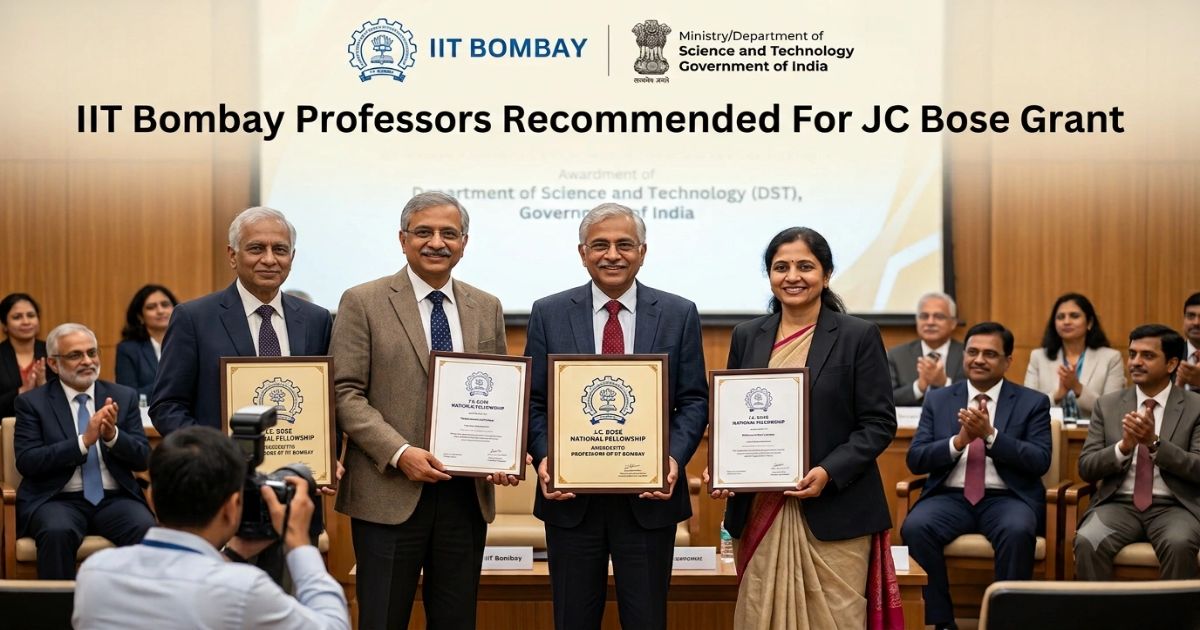
In a landmark recognition of scientific excellence, four faculty members from the Indian Institute of Technology Bombay (IIT Bombay) have been recommended for the prestigious J.C. Bose Grant. These include Prof. M. Ravikanth, Prof. Deepankar Choudhury, Prof. Ruchi Anand and Prof. Debabrata Maiti. Recommended by the Anusandhan National Research Foundation (ANRF), the grant stands as one of India’s highest honors for active researchers and scientists, offering Rs. 25 lakh per fellow annually.
List of IIT Bombay Faculty Members Selected for J.C. Bose Grant
| Faculty Member | Department | Primary Field of Specialization | Major Honours & Affiliations |
| Prof. M. Ravikanth | Chemistry | Porphyrins & Macrocyclic Molecules | Fellow of IASc & NASI |
| Prof. Deepankar Choudhury | Civil Engineering | Geotechnical Earthquake Engineering | Key developer of IS: 19117 Code |
| Prof. Ruchi Anand | Chemistry | Structural Biochemistry & Biosensors | Fellow of TWAS & INSA |
| Prof. Debabrata Maiti | Chemistry | Synthetic Organic Chemistry (C-H Activation) | Shanti Swarup Bhatnagar Awardee |
Research Contributions of Selected IIT Bombay Professors
The research contributions of the awardees address some of the most pressing scientific and structural challenges:
1. Prof. M. Ravikanth
-
Globally recognized for work on porphyrins, phthalocyanines, and macrocyclic molecules.
-
Breakthrough discoveries applied in chemical sensing, photochemistry, and functional material design.
-
Fundamental advances in supramolecular and modern inorganic chemistry.
2. Prof. Deepankar Choudhury
-
Expert in soil dynamics, foundation engineering, and earthquake-resistant structure design.
-
Developed fundamental international guidelines for combined pile-raft foundations.
-
Led the development of India’s engineering code IS: 19117 for seismic design.
3. Prof. Ruchi Anand
-
Investigates macromolecular crystallography to decode structural mechanisms of antibiotic resistance.
-
Pioneered structural design frameworks for diagnostic biosensors and targeted therapeutics.
-
Recipient of the National Women Bioscientist Award.
4. Prof. Debabrata Maiti
-
Leading innovator in C-H bond activation within synthetic organic chemistry.
-
Developed catalytic methods simplifying complex pharmaceutical and active ingredient syntheses.
-
Serves as Editor-in-Chief of the international chemistry journal Synlett.
What is the J.C. Bose Grant?
Named after the polymath Sir Jagadish Chandra Bose, the J.C. Bose Grant is a national honor created to retain and empower top-tier scientific talent within India. Unlike standard project-specific research grants, the J.C. Bose award is performance-oriented and flexible, providing researchers with autonomy over how research funds are deployed to drive innovation.
J.C. Bose Grant 2026: Key Details and Significance
Formerly recognized as the J.C. Bose National Fellowship, the grant honors senior Indian scientists who have maintained sustained academic rigor and continue to lead pioneering research initiatives across science and engineering disciplines.
| Key Aspect | Details |
| Awarding Body | Anusandhan National Research Foundation (ANRF) |
| Duration | 5 Years |
| Annual Research Grant | ₹25 Lakh per fellow annually |
| Institutional Support | Overhead grants provided to host institutions for infrastructure |
| Target Age Bracket | Active scientists aged between 45 and 65 years |
Eligibility and Selection Process for J.C. Bose Grant
Selection for the grant relies on rigorous peer review overseen by an expert committee formed under the ANRF.
-
Employment Status: Candidates must hold a regular academic or research position in an Indian institution.
-
Track Record: Candidates must demonstrate a continuous record of high-impact publications, patents, or technical innovations.
-
Age Qualification: Applicants must fall in the 45–65 age bracket.
-
Review Criteria: Evaluation centers on sustained research performance over the past 10 years, leadership in scientific mentorship, and national relevancy of future research proposals.
ANRF’s Role in Promoting Research Excellence in India
The Anusandhan National Research Foundation (ANRF) serves as the primary national apex body steering scientific research and development in India. By administering fellowship schemes like the J.C. Bose Grant, ANRF aims to:
-
Bridge the gap between foundational academia and industry-scale applications.
-
Provide high-value direct funding to eliminate bureaucracy for active scientists.
-
Elevate Indian academic institutions onto global research standings through sustained infrastructure grants.
Impact of J.C. Bose Grant Recognition on Researchers
The recognition and accompanying financial support deliver tangible benefits to the awardees and their research ecosystems:
-
Unrestricted Innovation: The 5-year flexible budget allows scientists to explore high-risk, high-reward research avenues without grant approval delays.
-
Scholarship Expansion: Direct support enables departments to recruit top-tier doctoral and post-doctoral scholars.
-
Infrastructure Enhancement: Institutional overhead grants upgrade specialized laboratory facilities.
-
Global Visibility: The fellowship boosts international collaboration opportunities for Indian laboratories.

📰 More Education News
- High-Voltage Drama at Uttarakhand Ayurved University: BAMS Students Climb Water Tank Over 4-Year Result DelayJul 30, 2026 • Simran
- TSLPRB Police Recruitment 2026: Notification Released for 7,437 Vacancies across Constable, SI, and Other PostsJul 30, 2026 • Simran
- TS EAMCET 2026 Final Phase Counselling Starts Tomorrow; Know What Follows NextJul 30, 2026 • Simran
- MAH BBA CAP 2026 Provisional Merit List Release Delayed: Check Latest Updates, Expected Schedule, and How to Raise GrievancesJul 30, 2026 • Simran