MHT CET 2027 Physics syllabus based on Class 11 and 12 curriculum
In short
- The MHT CET 2027 Physics syllabus will be based on the Maharashtra State Board curriculum of Class 11 and Class 12.
- Approximately 20% of questions in the MHT CET 2027 Physics paper will be from Class 11 topics, and nearly 80% from Class 12 chapters.
- The Maharashtra CET Cell is expected to release the MHT CET 2027 syllabus PDF for Physics, Chemistry, and Mathematics in the second week of October 2026.
- The MHT CET 2027 exam will be conducted in Computer Based Test (CBT) mode and will not feature a negative marking scheme.
- The MHT CET is the primary entrance criterion for admission to engineering, pharmacy, and agriculture degree programs in Maharashtra state universities and affiliated colleges.
The Maharashtra Common Entrance Test (CET) Cell today, 29 September 2026, confirmed the MHT CET 2027 Physics syllabus will align with the Maharashtra State Board curriculum for Class 11 and Class 12. This syllabus is crucial for candidates seeking admission to engineering, pharmacy, and agriculture degree programs in Maharashtra state universities and their affiliated colleges.
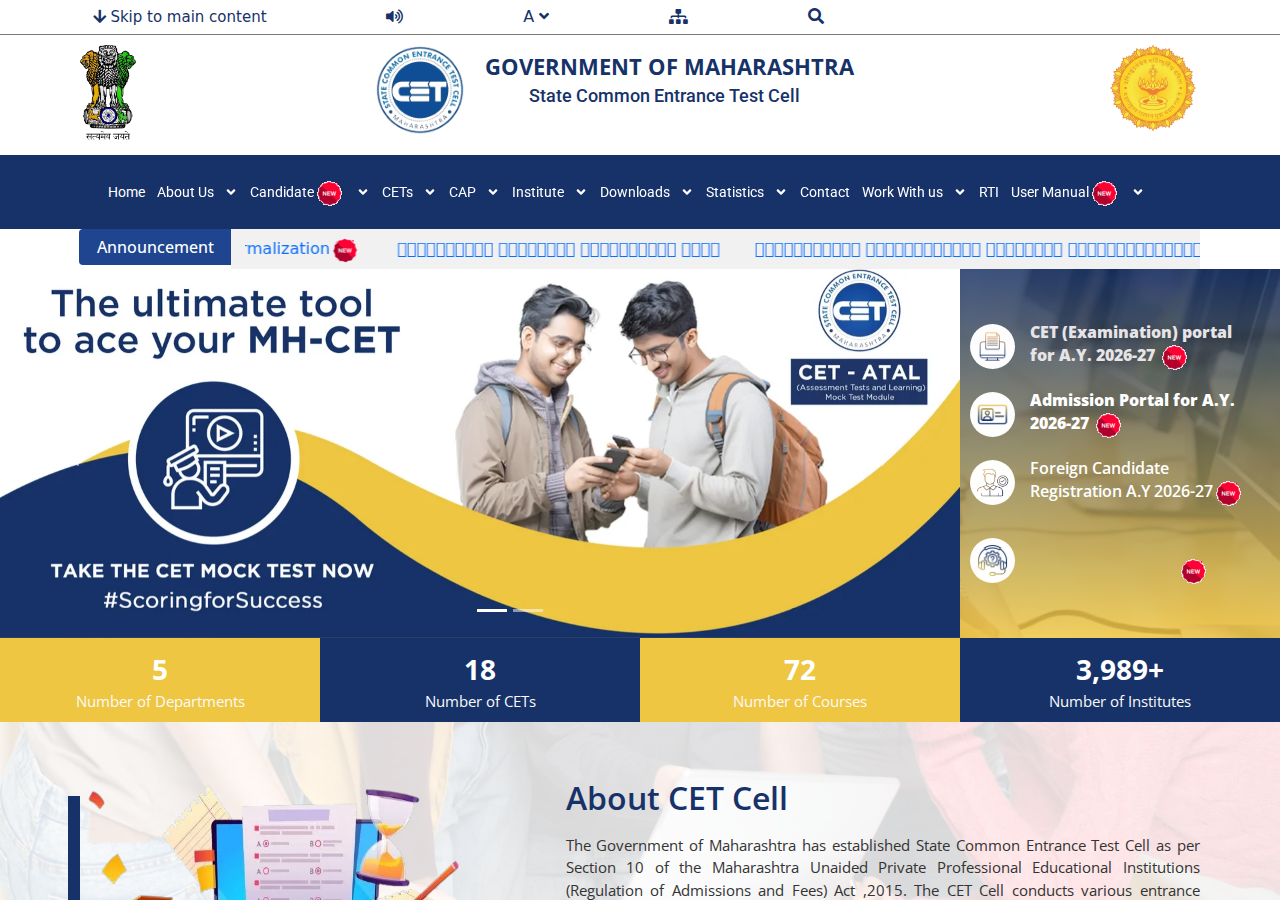
The official MHT CET 2027 syllabus PDF for Physics, Chemistry, and Mathematics is anticipated to be released soon, with an expected availability in the second week of October 2026 on the official portal, cetcell.mahacet.org. Any adjustments to the syllabus due to a slight shift in the exam calendar will be confirmed via an official notification.
MHT CET 2027 Physics Syllabus Structure and Weightage
The MHT CET 2027 Physics syllabus will draw approximately 20% of its questions from Class 11 topics and nearly 80% from Class 12 chapters. The syllabus includes selected chapters from the Maharashtra State Board Class 11 curriculum and the entire Class 12 syllabus as prescribed by the State Council of Educational Research and Training (SCERT), Maharashtra. High weightage chapters in Physics include Rotational Motion and Electromagnetic Induction and AC Circuits.
The Physics syllabus covers a broad range of topics, including mechanics, thermodynamics, oscillations, waves, electrostatics, current electricity, magnetic effects, optics, modern physics, semiconductors, and communication systems. The MHT CET Physics syllabus level is considered slightly easier compared to JEE Main, and the exam rewards conceptual clarity over mere formula memorisation. The MHT CET syllabus generally remains consistent, with changes introduced only when required, typically following updates in the Maharashtra State Board curriculum.
| Class 12 Physics Topics |
|---|
| Rotational Dynamics |
| Mechanical Properties of Fluids |
| Kinetic Theory of Gases and Radiation |
| Thermodynamics |
| Oscillations |
| Superposition of Waves |
| Wave Optics |
| Electrostatics |
| Current Electricity |
| Magnetic Fields Due to Electric Current |
| Magnetism |
| Electromagnetic Induction |
| Alternating Current |
| Dual Nature of Radiation and Matter |
| Structure of Atoms and Nuclei |
| Semiconductor Devices |
| Subject | Class 11 Topics (20% Weightage) | Class 12 Topics (80% Weightage) |
|---|---|---|
| Physics | Vectors & Error analysis, Motion in a plane, Laws of motion, Gravitation, Thermal properties of matter, Sound & waves, Optics basics, Electrostatics basics, Semiconductors | Electrostatics, Current electricity, Magnetic effects of current, Electromagnetic induction, Optics & wave optics, Modern physics, Electronic devices |
| Chemistry | Basic concepts of chemistry, Structure of atom, Chemical bonding, Redox reactions, States of matter, Hydrocarbons, Surface chemistry, Organic chemistry basics, Chemistry in everyday life | Solutions, Chemical kinetics, Periodic table trends, p-Block elements, d-Block elements, Alcohols, Amines, Carboxylic acids, Polymers |
| Mathematics (PCM only) | Trigonometry, Algebra & complex numbers, Permutations & combinations, Functions, Limits & continuity basics, Conic sections | Calculus (limits, derivatives, integrals), Matrices & determinants, Vector algebra, 3D geometry, Probability & statistics, Linear programming |
| Biology (PCB only) | Biomolecules, Respiration & energy transfer, Human nutrition, Excretion & osmoregulation | Genetics, Human physiology, Ecology, Evolutionary processes |
MHT CET 2027 Exam Pattern and Key Features
The MHT CET 2027 exam will be conducted in Computer Based Test (CBT) mode, featuring multiple-choice questions (MCQs) with four options each. There is no negative marking scheme for the MHT CET exam. The MHT CET 2027 syllabus is prescribed separately for Engineering (PCM) and Pharmacy & Agriculture (PCB) candidates.
For PCM candidates, the exam consists of 150 MCQs, while PCB candidates will face 200 MCQs. Both PCM and PCB papers carry a total weightage of 200 marks, with an exam duration of 180 minutes. The MHT CET 2027 will be conducted online across multiple sessions, with score normalisation applied.
| Particular | Details |
|---|---|
| Exam Mode | Computer-Based Test (CBT) |
| Subjects (Engineering) | Physics, Chemistry & Mathematics |
| Subjects (Pharmacy/Agriculture) | Physics, Chemistry & Biology |
| Syllabus Basis (Level of Questions) | Maharashtra State Board Class 11 & 12 |
| Class 11 Weightage | Approximately 20% |
| Class 12 Weightage | Approximately 80% |
| Question Type | Multiple Choice Questions (MCQs) |
| Paper | Subjects | No. of Questions | Marks | Duration | Stream |
|---|---|---|---|---|---|
| Paper 1 | Mathematics | 50 | 100 (2 marks each) | 90 minutes | PCM |
| Paper 2 | Physics + Chemistry | 50 + 50 | 100 + 100 | 90 minutes each | PCM + PCB |
| Paper 3 | Biology (Botany + Zoology) | 50 + 50 | 100 + 100 | 90 minutes each | PCB |
Recommended Preparation Resources
Candidates preparing for the MHT CET 2027 are advised to refer to official SCERT/MSBSHSE (Balbharati) textbooks. In addition, solving MHT CET previous-year question papers (PYQs) and attempting full-length mock tests are recommended. Creating short notes, formulas, and crucial reactions can aid in fast revision. It is also suggested to prioritise Class 12 content, dedicating approximately 80% of study time to these concepts, and to maintain a chapter-wise checklist for every subject.
Several reference books are commonly used by aspirants. For Physics, these include ‘Concepts of Physics (Vol 1 & 2)’ by Bharati Bhawan, ‘Objective Physics’ by Arihant, and ‘Fundamentals of Physics’ by Wiley. For Chemistry, ‘Physical Chemistry’ by G.R. Bathla, ‘Organic Chemistry’ by Pearson, and ‘Concise Inorganic Chemistry’ by Wiley are often consulted. Biology candidates may refer to ‘Objective Biology’ by Dinesh Publications, ‘Trueman’s Biology (Vol 1 & 2)’ by Trueman Publication, and the Maharashtra State Board Biology Textbook. For Mathematics, ‘Mathematics for MHT CET’ by Arihant, ‘Objective Mathematics’ by Dhanpat Rai, and ‘Problems Plus in IIT Mathematics’ by Bharati Bhawan are among the suggested resources.
| Book Name | Author/Publisher |
|---|---|
| Concepts of Physics (Vol 1 & 2) | Bharati Bhawan |
| Objective Physics | Arihant |
| Fundamentals of Physics | Wiley |
Further reading

📰 More Education News
- IGNOU PhD admit card 2026 out: download hall ticket before October 11 examSep 29, 2026 • Nishit Kumar
- JEE Advanced 2027 login to activate in April for registration, admit card, resultsSep 29, 2026 • Nishit Kumar
- MHT CET 2027 syllabus PDF expected in October: check Maths weightage, paper patternSep 29, 2026 • Nishit Kumar
- MHT CET 2027 Chemistry syllabus and high-weightage topics detailed for engineering and pharmacy admissionsSep 29, 2026 • Nishit Kumar