MBA Colleges in Delhi Without CAT 2026: Fee Structure & Direct Entry
Nishit Kumar is a senior EdTech industry leader with over a decade of experience in building and scaling education platforms, shaping their product, content, and growth strategy. At…
Candidates can pursue an MBA in Delhi without appearing for CAT by clearing alternative exams (such as MAT, XAT, CMAT, GMAT, ATMA, SNAP, or university-level tests) or via direct management quota admission based on undergraduate merit.
At least 106 colleges offer MBA programs in Delhi with course fees spanning from ₹50,000 to ₹13.50 lakh. Below is a comprehensive overview covering government options, private B-school fee structures, alternative entrance exams, management quota entry rules, eligibility criteria, and step-by-step admission procedures.
| Parameter | Details |
|---|---|
| Lowest Fee Option | Jamia Millia Islamia (₹44,000 – ₹53,340) |
| UG Marks Eligibility (General) | 50% to 65% aggregate marks |
| UG Marks Eligibility (Reserved) | At least 45% aggregate marks |
| Alternative National Exams | MAT, XAT, CMAT, GMAT, NMAT, ATMA, SNAP |
| Direct Entry Channel | Management Quota / Institution-Level Seats |
| Mandatory Regulatory Approvals | UGC or AICTE Recognition |
Government MBA Colleges in Delhi Without CAT
Government institutions in Delhi provide high-value, affordable MBA options for candidates seeking quality business education without taking CAT. Jamia Millia Islamia offers MBA programs at low expected fees ranging between ₹44,000 and ₹53,340, selecting candidates through its own university entrance exam followed by group discussion (GD) and personal interview (PI) rounds. Additionally, Ambedkar University charges expected MBA fees between ₹2.12 lakhs and ₹2.51 lakhs.
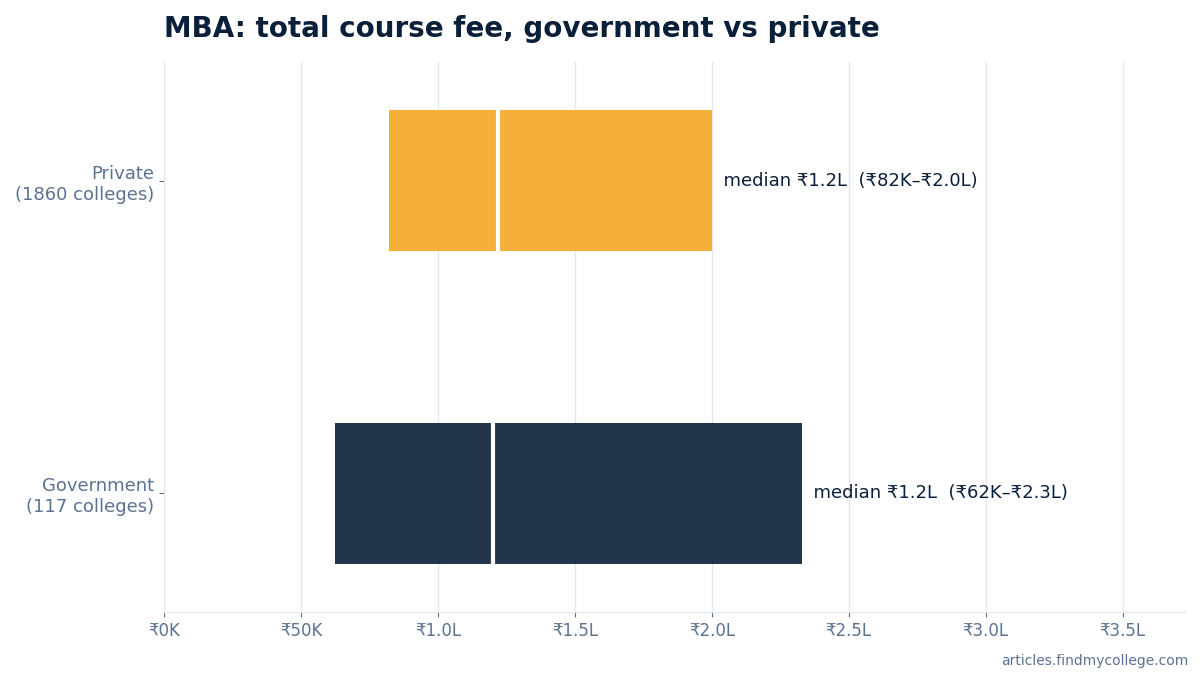
Across India, at least 4775 colleges offer MBA degrees, including 130 government colleges. Government MBA programs maintain a median total course fee of ₹1.20 lakh, with the middle half ranging between ₹62,400 and ₹2.33 lakh across 117 government colleges with fee data.
| College | City | Ownership | Total course fee | NIRF rank |
|---|---|---|---|---|
| Symbiosis Skills & Open University | Pune | — | ₹9.60 lakh | 1 (Overall, 2025) |
| Indian Institute of Technology Madras | Chennai | Government | ₹8.93 lakh | 1 (Overall, 2025) |
| Jawaharlal Nehru University | Delhi | Government | ₹6.04 lakh | 2 (Overall, 2025) |
| Indian Institute of Technology Bombay | Mumbai | Government | ₹7.16 lakh | 3 (Overall, 2024) |
| Manipal University Manipal | Manipal | — | ₹6.04 lakh | 3 (Overall, 2025) |
| Punjab Agricultural University | Ludhiana | — | ₹3.03 lakh | 3 (Overall, 2025) |
| Manipal Academy of Higher Education (MAHE) | Manipal | — | ₹2.92 lakh | 3 (University, 2025) |
| Jamia Millia Islamia University | Delhi | Government | ₹52,945 | 4 (Overall, 2025) |
| Indian Institute of Technology Kanpur | Kanpur | Government | ₹4.74 lakh | 5 (Overall, 2025) |
| Delhi University | Delhi | Government | ₹97,000 | 5 (Overall, 2025) |
Private MBA Colleges Offering Non-CAT Admissions
Private management institutes across Delhi NCR offer modern infrastructure, industry-aligned specializations, and flexible admission pathways. Shiv Nadar University charges ₹7.50 lakhs per year with a 5% to 8% revision in the second year. FORE School of Management accepts XAT, MAT, and ATMA scores, with overall program fees expected up to ₹23.24 lakhs.
At least 2146 private colleges offer MBA courses in India. Private MBA institutions feature a median total course fee of ₹1.22 lakh, with the middle half falling between ₹82,000 and ₹2.00 lakh across 1860 private colleges with fee data. Across 217 reporting business schools, the median average placement package is 3.42 LPA.
| College | City | Ownership | Total course fee | Average package |
|---|---|---|---|---|
| Loyola Institute of Business Administration | Chennai | Private | ₹7.46 lakh | 10.08 LPA |
| St. Albert’s College | Ernakulam | Private (aided) | ₹2.40 lakh | 9.8 LPA |
| N. L. Dalmia Institute of Management Studies and Research | Mumbai | Private | — | 7.54 LPA |
| Thiagarajar School of Management | Madurai | Private | ₹10.50 lakh | 6.39 LPA |
| Pune Institute of Business Management Pune | Pune | Private | ₹4.38 lakh | 6.12 LPA |
| City Engineering College | Bangalore | Private | ₹1.16 lakh | 6 LPA |
| School of Management Sciences Lucknow | Lucknow | Private | ₹1.41 lakh | 5.93 LPA |
| Indira Institute of Management | Pune | Private | ₹2.40 lakh | 5.64 LPA |
| Ishan Institute of Management and Technology | Greater Noida | Private | — | 5.5 LPA |
| Gian Jyoti Institute of Management and Technology | Mohali | Private | ₹1.97 lakh | 5.37 LPA |
MBA Fees Structure in Delhi NCR
MBA course fees in Delhi NCR vary significantly depending on university ownership, infrastructure, and entry channels. Conversely, established private management institutes charge higher fees, such as ₹7.50 lakhs per year at Shiv Nadar University and up to ₹23.24 lakhs at FORE School of Management.
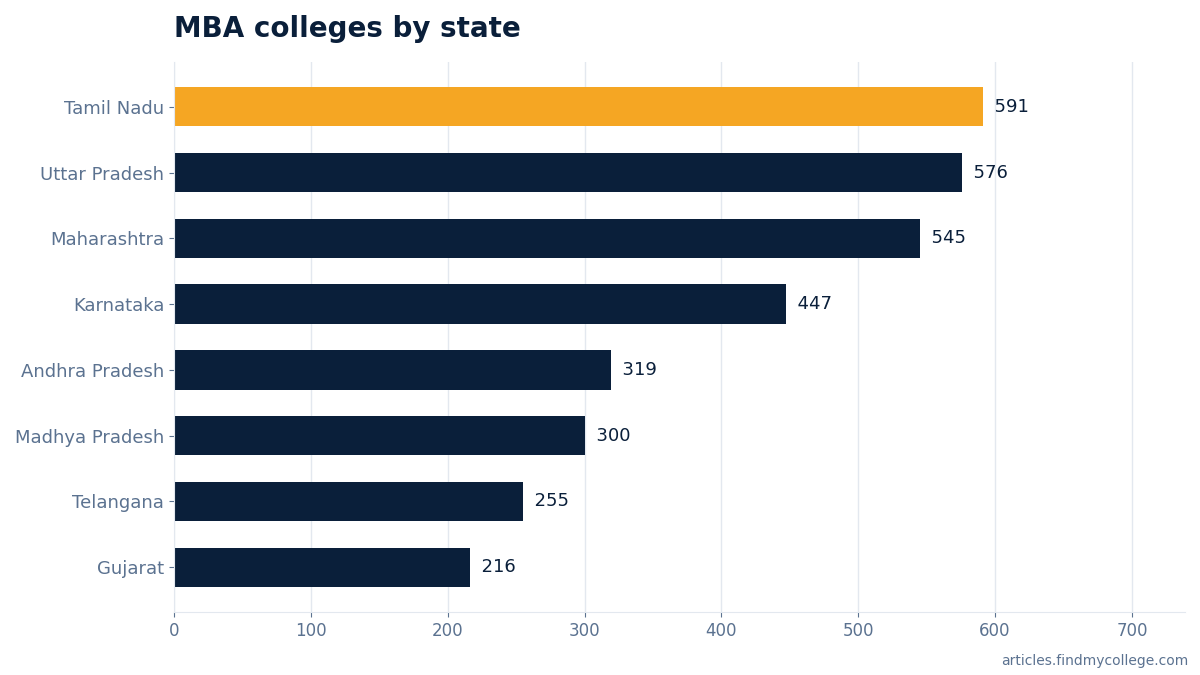
Delhi currently has at least 106 colleges offering MBA degrees with total course fees spanning between ₹50,000 and ₹13.50 lakh. Below is a comparative overview of MBA fees and college availability across major educational hubs in India.
| City | Colleges | Fee range | Well-known options |
|---|---|---|---|
| Bangalore | 274 | ₹24,390 – ₹22.00 lakh | Alliance University, Christ University |
| Pune | 214 | ₹40,000 – ₹20.64 lakh | Dr. DY Patil Vidyapeeth, MIT World Peace University |
| Hyderabad | 160 | ₹40,000 – ₹27.55 lakh | University of Hyderabad, NALSAR University of Law |
| Chennai | 153 | ₹40,750 – ₹12.55 lakh | Indian Institute of Technology Madras, Saveetha Institute of Medical and Technical Sciences |
| Coimbatore | 107 | ₹41,000 – ₹11.20 lakh | Amrita Vishwa Vidyapeetham, P.S.G College of Technology |
| Delhi | 106 | ₹50,000 – ₹13.50 lakh | Jamia Millia Islamia University, Delhi University |
| Bhopal | 104 | ₹45,600 – ₹11.80 lakh | Maulana Azad National Institute of Technology, VIT Bhopal University |
| Jaipur | 93 | ₹40,200 – ₹10.45 lakh | Manipal University Jaipur, Kautilya Institute of Technology and Engineering and School of Management |
Alternative Entrance Exams Accepted by Delhi B-Schools
- Non-CAT admissions utilize national tests like MAT, XAT, CMAT, GMAT, NMAT, ATMA, and SNAP, or institution-specific entrance tests.
- Jamia Millia Islamia conducts its own entrance exam followed by group discussion (GD) and personal interview (PI) for MBA admission.
- FORE School of Management accepts XAT, MAT, and ATMA scores, with fees expected up to ₹23.24 lakhs.
- Indian Institute of Foreign Trade (IIFT) accepts GMAT scores for specific non-CAT entry pathways, with fees listed up to ₹21.82 lakhs.
Appearing for CAT is not compulsory to pursue an MBA in Delhi. Applicants can qualify through other national-level tests or institute-specific entrance exams.
Direct MBA Admission Under Management Quota
- Management quota seats are institution-level seats filled directly based on qualifying undergraduate marks without entrance exam cutoff hurdles.
- Direct MBA admission saves 9 to 12 months of competitive entrance test preparation time.
- Candidates admitted under management quota are barred from institutional scholarships offered by the college or university.
- Average placement packages for direct management quota entry may be lower compared to placements secured by CAT-cleared candidates at top IIMs.
Management quota seats allow candidates to gain direct admission using undergraduate marks, saving 9 to 12 months of test prep time. However, candidates are barred from institutional scholarships and face potentially lower placement packages than CAT-cleared graduates.
Eligibility Criteria and MBA Admission Process
Candidates seeking non-CAT MBA admissions in Delhi must meet the academic qualifications set by regulatory bodies and individual B-schools. General category applicants must secure between 50% and 65% aggregate marks in graduation from a recognized university. Reserved category candidates require a minimum of 45% aggregate marks. Final year undergraduate students are also eligible to apply provisionally.
| Candidate Category | Minimum Graduation Aggregate Required | Special Considerations / Documents Needed |
|---|---|---|
| General Category | 50% to 65% aggregate marks | Recognized UG degree from UGC/AICTE approved university |
| Reserved Category | Minimum 45% aggregate marks | Valid Category Certificate (Original & Photocopy) required |
| Final Year Students | Appearing in final UG exams | Provisional admission subject to final mark sheet submission |
| Management Quota Applicants | Pass in recognized UG degree (50% min) | Direct entry without entrance exam score cutoffs |
How to Choose a MBA College in Delhi
Selecting an MBA college without CAT requires a careful evaluation of institutional approvals, total financial expenditure, and placement outcomes. Applicants should verify that target institutes carry valid UGC or AICTE recognition by visiting campuses directly or checking official university portals. Calculate your expected return on investment by comparing overall fees against placement statistics. While government colleges like Jamia Millia Islamia offer low fees between ₹44,000 and ₹53,340, private institutes such as SOIL Institute of Management (₹15.03 to ₹17.20 lakh) offer intensive industry exposure. Ensure you confirm scholarship rules, specialization options, and entrance exam requirements before finalizing your choice.
How to Apply for MBA Admission in 2026: Step by Step
- Check Basic Graduation Eligibility: Verify that you have completed graduation from a recognized university with a minimum of 50% to 65% aggregate marks (45% for reserved categories). Final year UG students are also eligible.
- Choose Entrance Exam Route or Direct Management Quota: Decide whether to apply using alternative exam scores (MAT, XAT, CMAT, GMAT, ATMA, SNAP, or Jamia university test) or directly via management quota seats.
- Shortlist UGC/AICTE Approved Colleges: Shortlist institutes matching your preferred specialization and budget. Contact colleges directly online or visit campuses to bypass unauthorized agents.
- Fill Application Form: Complete the online application form on the official website of the target college or register offline at the campus admissions counter.
- Attend GD and Personal Interview Rounds: Participate in Group Discussions and Personal Interviews conducted by institutes like Jamia Millia Islamia or private B-schools if mandated.
- Submit Mandatory Documents: Provide Class 10, 12, and UG mark sheets/certificates, valid government ID proof, passport-sized photos, and category certificates for verification.
- Pay Admission Fee to Confirm Seat: Upon selection in the merit list or management quota allotment, pay the prescribed admission fee to secure your seat.
| What to do | Where | Link |
|---|---|---|
| Compare colleges, fees and cutoffs | MBA colleges in India | findmycollege.com |
FAQs
Can I join an MBA without any entrance exam?
Yes, many Tier II, Tier III, and private MBA colleges in Delhi offer direct admission under institution-level or management quota seats based on your undergraduate academic performance without requiring entrance test scores.
Is entrance compulsory for MBA?
No, while top institutes like IIMs require entrance exams like CAT, several Delhi colleges accept non-CAT national exams (MAT, XAT, GMAT, CMAT, SNAP) or provide direct merit-based admission without an entrance exam.
Which MBA colleges in Delhi have low fees without CAT?
Jamia Millia Islamia offers MBA courses with fees ranging between ₹44,000 and ₹53,340, and Sri Guru Gobind Singh College of Commerce charges around ₹62,230, making them top low-cost choices.
Can I get a scholarship under management quota direct admission?
No, students who secure direct MBA admission under the management quota are generally barred from college or university scholarship schemes.
What is the minimum eligibility for direct MBA admission in Delhi?
General category candidates must have completed graduation with at least 50% to 65% aggregate marks, while reserved category candidates need a minimum of 45%.
What alternative entrance exams can I take instead of CAT?
You can take exams like XAT, MAT, CMAT, GMAT, NMAT, ATMA, SNAP, or individual university entrance tests such as the Jamia Millia Islamia entrance exam.