Machine Learning Syllabus: Core Subjects and Module Topics
- 1 Oct 2026LPUNEST 2027 registration ongoing till January 2027
LPUNEST 2027 registration is currently ongoing for B.Tech AI & ML admissions, with applications open till 15 January 2027.
The Machine Learning syllabus covers foundational mathematics, computer science fundamentals, supervised and unsupervised learning, deep learning, natural language processing, and practical capstone projects. In standard 4-year B.Tech AI & ML degree programs (such as NIELIT curricula), coursework spans 8 semesters with specialized laboratory work, electives, and industry internships.
Below is a complete breakdown of semester-wise subjects, core coding and mathematical modules, electives, practical lab requirements, recommended textbooks, top engineering colleges with fees, and salary expectations across India.
| Parameter | Details |
|---|---|
| Program Duration | 4 Years (8 Semesters) for B.Tech AI & ML; 3 to 6 Months for professional certification tracks |
| Eligibility Criteria | 10+2 Examination from a recognized board with Physics and Mathematics as compulsory subjects |
| Average B.Tech Course Fee | INR 1,00,000 to INR 1,50,000 per annum |
| Certification Course Fee | INR 18,000 to INR 45,000 |
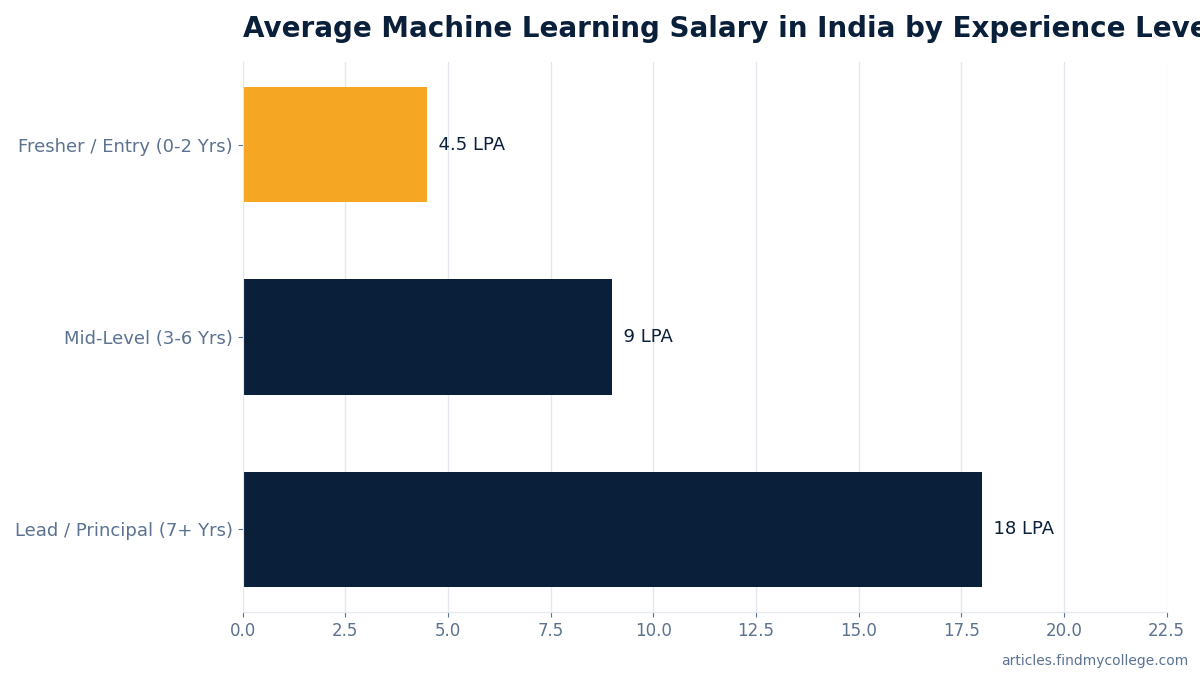
| Average Starting Salary | INR 10 LPA to INR 15 LPA for B.Tech graduates; INR 4.5 LPA to INR 7.5 LPA for entry-level certificate holders |
| Core Languages Taught | Python, Java, C, Lisp |
Machine Learning Practicals and Projects
- Projects & Internship: Minor Projects in Semesters IV and V, a Full Semester Industry / Research Internship in Semester VI, and Capstone Project Parts I and II in Semesters VII and VIII.
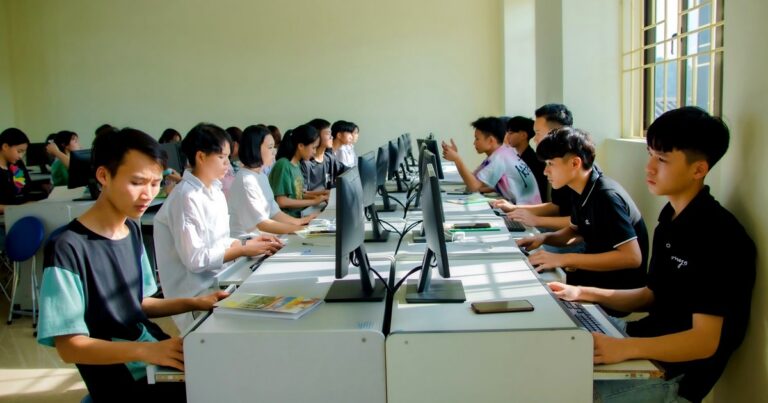
Hands-on laboratory training and real-world projects form a core component of the B.Tech AI & ML curriculum. Students gain practical experience progressing from foundational programming to advanced deep learning and full-semester industry internships.
Books for Machine Learning
| Book Title | Author(s) | Focus Area & Skill Level |
|---|---|---|
| Mathematics for Machine Learning | Marc Peter Deisenroth, A. Aldo Faisal, Cheng Soon Ong | Linear algebra, vector calculus, probability distributions (Foundational) |
| An Introduction to Statistical Learning | Gareth James, Daniela Witten, Trevor Hastie, Robert Tibshirani | Regression, classification, resampling, unsupervised learning (Beginner to Intermediate) |
| Introduction to Algorithms | T.H. Cormen, C.E. Leiserson, R.L. Rivest, C. Stein | Data structures, time complexity analysis, trees, heaps, and hashing |
| Elements of Discrete Mathematics A Computer Oriented Approach | C L Liu and D P Mohapatra | Discrete mathematics, combinatorics, and algebraic structures |
| Discrete Mathematics and its Applications | Kenneth H. Rosen | Discrete mathematics, graph theory, and recurrence relations |
| Advanced Engineering Mathematics | E. Kreyszig | Linear algebra, multivariate calculus, and differential equations |
Standard reference textbooks cover foundational linear algebra, discrete mathematics, algorithm design, and statistical learning required across undergraduate and postgraduate Machine Learning curricula.
Top Colleges for Machine Learning and Course Fees
At least 1808 colleges offer Machine Learning engineering programs across India, comprising government 46 and private 1064 institutes. Government colleges feature a median total course fee of ₹1.20 lakh, with the middle half ranging between ₹57,000 and ₹1.79 lakh (based on 33 colleges with fee data). Private colleges have a median total course fee of ₹2.67 lakh, with the middle half between ₹1.88 lakh and ₹3.94 lakh (based on 894 colleges with fee data).
Leading states providing these programs include Karnataka with 225 colleges, Tamil Nadu with 225, Andhra Pradesh with 208, Uttar Pradesh with 177, Maharashtra with 175, and Telangana with 170. Across 168 reporting colleges, the median average placement package stands at 3.51 LPA.
| College | City | Ownership | Total course fee | NIRF rank |
|---|---|---|---|---|
| Hindu College New Delhi | Delhi | University | ₹1.27 lakh | 1 (Overall, 2025) |
| Symbiosis Skills & Open University | Pune | — | ₹11.30 lakh | 1 (Overall, 2025) |
| Manipal Academy of Higher Education (MAHE) | Manipal | — | ₹2.20 lakh | 3 (University, 2025) |
| Manipal University Manipal | Manipal | — | ₹3.13 lakh | 3 (Overall, 2025) |
| Jamia Millia Islamia University | Delhi | Government | ₹42,950 | 4 (Overall, 2025) |
| Indian Institute of Technology Kharagpur | Kharagpur | Government | ₹43,800 | 6 (Overall, 2025) |
| Presidency College Bangalore | Bangalore | Private | ₹3.50 lakh | 7 (Overall, 2021) |
| SRM Institute of Technology | Kanchipuram | Private | ₹4.60 lakh | 11 (Overall, 2025) |
| College | City | Ownership | Total course fee |
|---|---|---|---|
| L.D. College of Engineering | Ahmedabad | Government | ₹8,190 |
| Zakir Husain College | Delhi | Government | ₹10,444 |
| Elphinstone College | Mumbai | Government | ₹16,044 |
| Government College of Engineering and Ceramic Technology | Kolkata | Government | ₹36,000 |
| Jamia Millia Islamia University | Delhi | Government | ₹42,950 |
| Indian Institute of Technology Kharagpur | Kharagpur | Government | ₹43,800 |
| Nalanda College of Engineering | Chandi | Government | ₹43,980 |
| Gujarat University | Ahmedabad | Government | ₹54,000 |
| University College of Engineering, Osmania University | Hyderabad | Government | ₹60,000 |
| KNM Government Arts and Science College Kanjiramkulam | Thiruvananthapuram | Government | ₹67,500 |
How to Apply for Machine Learning Admission in 2026: Step by Step
- Check eligibility criteria: Verify that you have passed 10+2 with Physics and Mathematics as compulsory subjects from a recognized board.
- Register for engineering entrance exams: Apply for university or state-level engineering entrance exams such as WBJEE or university-specific tests like LPUNEST (LPUNEST 2027 registration open till 15 January 2027).
- Submit online admission application: Fill out the application form on the institute portal or centralized portal during the active registration window.
- Participate in seat allotment counselling: Attend online or offline decentralised counselling rounds based on rank and merit lists (e.g., WBJEE counselling rounds).
- Complete document verification and fee payment: Submit 10+2 marksheets, identity proof, and pay the annual tuition fees (average INR 1,00,000 to INR 1,50,000 per annum).
| What to do | Where | Link |
|---|---|---|
| Compare colleges, fees and cutoffs | Machine Learning colleges in India | findmycollege.com |
FAQs
How many subjects are in ML?
Is ML math heavy?
Yes, Machine Learning is math-intensive. Core mathematical subjects include Linear Algebra, Multivariate Calculus, Vector Calculus, Differential Equations, Optimization Techniques, Discrete Mathematics, and Probability & Stochastic Processes.
Is AI ML harder than CSE?
AI & ML is a specialized branch of CSE that includes core CSE subjects (data structures, OS, algorithms) plus advanced mathematical concepts, optimization techniques, neural networks, and statistical modeling, making its coursework mathematically more intensive.
Can I learn ML in 1 year?
Yes, short-term professional certification bootcamps span 3 to 6 months covering Python, data manipulation (Pandas, NumPy), supervised learning, deep learning, and practical capstone projects, preparing learners for entry-level ML roles.
What subjects are included in AIML Engineering 1st year?
First-year AIML subjects include Mathematics-I & II, Physics, Chemistry, Communication Skills, Problem Solving & Programming in C, Mathematical Concepts for AI, Data Structures, Discrete Mathematical Structures, and Object-Oriented Programming.
Where can I download the Machine Learning syllabus PDF?
Official academic institutions such as NIELIT, BMSCE, GCECT, and state technical universities publish detailed semester-wise B.Tech and M.Tech AI & ML syllabus PDFs on their official websites.