Cyber Security Courses in Mumbai 2026: Colleges and Fee Structure
Nishit Kumar is a senior EdTech industry leader with over a decade of experience in building and scaling education platforms, shaping their product, content, and growth strategy. At…
- 5 Jul 2026IIT Kanpur conducts entrance test for B.Cyber 2026 program
IIT Kanpur announced the examination date for its new Senate-approved Bachelor’s in Cybersecurity (B.Cyber) program, evaluating candidates shortlisted via JEE Main.
With total academic program costs starting as low as ₹16,044 at government institutions like Elphinstone College, prospective students can evaluate degree structures, entrance exams, and placement outcomes. Below is a comprehensive breakdown of top colleges, course choices, fee comparisons, and admission steps across Mumbai.
| Parameter | Details |
|---|---|
| UG Degree Duration | 4 Years (B.Tech / B.E.) |
| PG Degree / Diploma Duration | 1 to 2 Years (M.Tech / M.Sc / PG Diploma) |
| Government College Annual Fee Range | ₹50,000 – ₹1,20,000 |
| Private University Annual Fee Range | ₹80,000 – ₹5,50,000 |
| Short-term Certificate Fee Range | ₹15,000 – ₹50,000 |
| Primary Entrance Exams | MHT-CET 2026 (PCM), JEE Main 2026 (Paper-1), DYPRAIT-ET 2026 |
Top Cyber Security Colleges
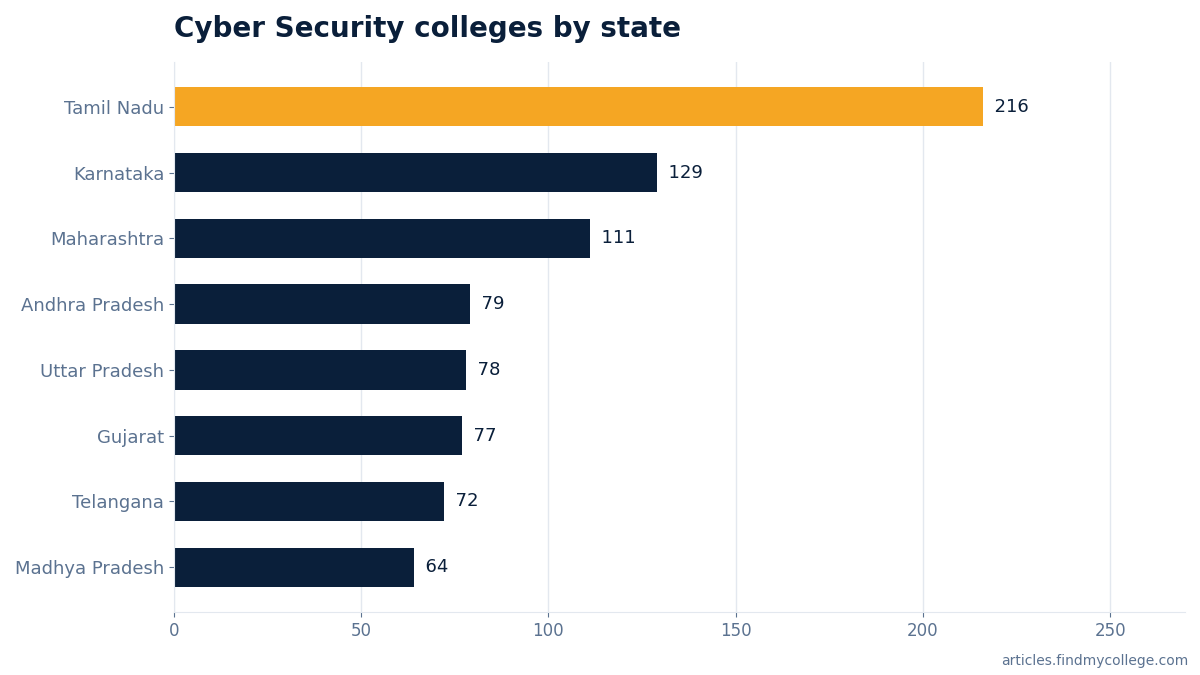
Mumbai houses top technical institutions and university departments offering specialized cyber security programs. At least 1185 colleges offer Cyber Security programs across India, with Maharashtra accounting for 111 colleges. Options range from 4-year B.Tech and B.E. degrees to 2-year M.Tech and M.Sc. tracks.
Top choices include IIT Bombay, VJTI, University of Mumbai, and private institutions like Ramrao Adik Institute of Technology (DY Patil University) and KJ Somaiya College of Engineering. Course curricula emphasize network defense, cryptography, cloud security, and digital forensics.
| College Name | Course Offered | Duration | First Year / Annual Fee |
|---|---|---|---|
| Indian Institute of Technology Bombay (IIT Bombay) | M.Tech in Cyber Security | 2 Years | INR 1,20,000 |
| Veermata Jijabai Technological Institute (VJTI) | M.Tech in Cyber Security | 2 Years | INR 1,00,000 |
| Narsee Monjee Institute of Management Studies (NMIMS) | M.Tech in Cyber Security | 2 Years | INR 90,000 |
| Sardar Patel Institute of Technology (SPIT) | M.Tech in Cyber Security | 2 Years | INR 65,000 |
| Thakur College of Engineering and Technology (TCET) | M.Tech in Cyber Security | 2 Years | INR 60,000 |
| KJ Somaiya College of Engineering | B.Tech in Cyber Security | 4 Years | INR 80,000 |
| Ramnarain Ruia College | B.E. in Engineering and Computer Science (Cyber Security) | 4 Years | INR 60,000 |
| Ramrao Adik Institute of Technology (DY Patil University) | B.Tech in Cyber Security (Digital Forensics) | 4 Years | INR 5,50,000 |
| Vishwakarma Institute of Technology, Mumbai | B.Tech in Cyber Security | 4 Years | INR 60,000 |
| University of Mumbai | M.Tech / M.Sc. in Cyber Security | 2 Years | INR 50,000 |
| SIES College of Arts, Science and Commerce | M.Sc. in Cyber Security | 2 Years | INR 60,000 |
| College | City | Ownership | Total course fee | NIRF rank |
|---|---|---|---|---|
| Symbiosis Skills & Open University | Pune | — | ₹8.50 lakh | 1 (Overall, 2025) |
| Manipal Academy of Higher Education (MAHE) | Manipal | — | ₹2.20 lakh | 3 (University, 2025) |
| Manipal University Manipal | Manipal | — | ₹15.37 lakh | 3 (Overall, 2025) |
| Indian Institute of Technology Kanpur | Kanpur | Government | ₹8.00 lakh | 5 (Overall, 2025) |
| Delhi University | Delhi | Government | ₹34,900 | 5 (Overall, 2025) |
| Presidency College Bangalore | Bangalore | Private | ₹3.50 lakh | 7 (Overall, 2021) |
| Amrita Vishwa Vidyapeetham | Coimbatore | — | ₹98,500 | 8 (Overall, 2025) |
| Indian Institute of Technology New Delhi | Delhi | Government | ₹3.81 lakh | 8 (Overall, 2025) |
Government Cyber Security Colleges
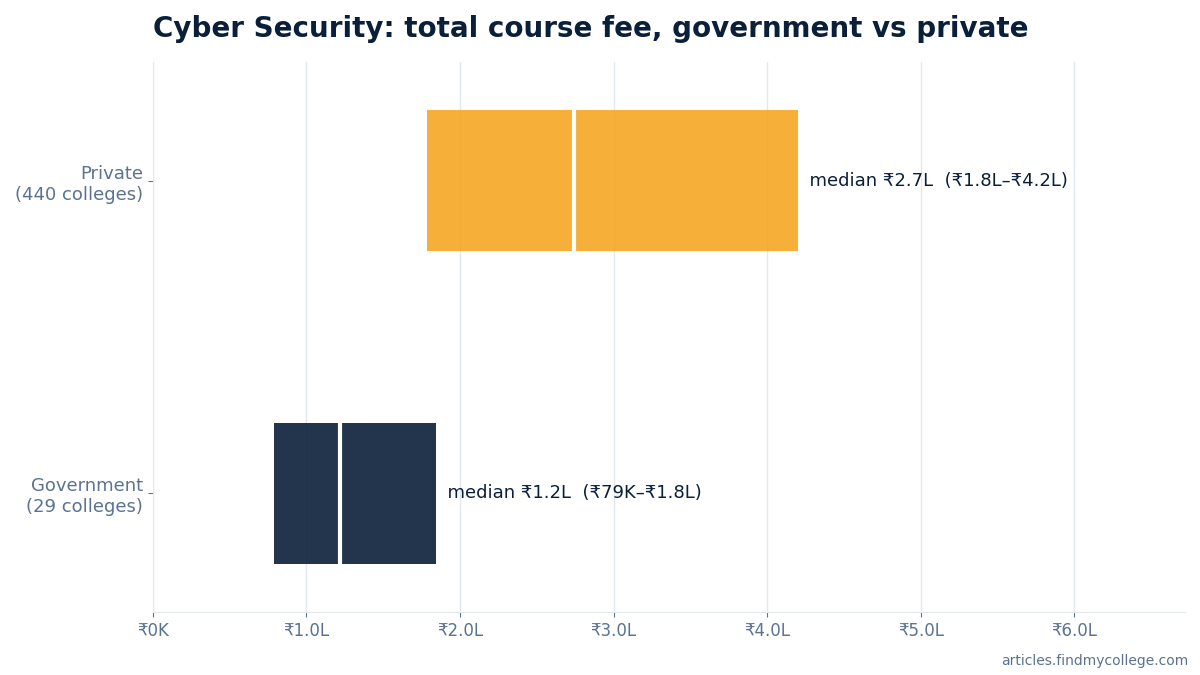
Government and government-aided institutions in Mumbai provide affordable higher education in cyber security. Across India, at least 40 government colleges offer cyber security courses, with a median total course fee of ₹1.22 lakh and the middle half falling between ₹79,180 and ₹1.84 lakh.
In Mumbai, University of Mumbai offers M.Tech and M.Sc. in Cyber Security at an annual fee of INR 50,000. IIT Bombay offers an M.Tech in Cyber Security with a first-year fee of INR 1,20,000, while VJTI charges INR 1,00,000 per year. SPIT offers M.Tech in Cyber Security at INR 65,000 per year. Tata Institute of Social Sciences (TISS) offers a 1-year Post Graduate Diploma in Cyber Security at INR 1,60,000 per annum, plus examination fees of INR 5,000 per annum and a refundable caution deposit of INR 5,000.
| College | City | Ownership | Total course fee |
|---|---|---|---|
| Elphinstone College | Mumbai | Government | ₹16,044 |
| Gujarat Technological University | Ahmedabad | Government | ₹25,000 |
| Delhi University | Delhi | Government | ₹34,900 |
| Birsa Institute of Technology Dhanbad | Dhanbad | Government | ₹47,378 |
| Kannur University | Kannur | Government | ₹47,730 |
| Government Holkar Science College | Indore | Government | ₹68,800 |
| Shaheed Sukhdev College of Business Studies | Delhi | Government | ₹77,560 |
| Anna University | Chennai | Government | ₹80,800 |
| College of Engineering Pathanamthitta | Pathanamthitta | Government | ₹1.00 lakh |
| Visvesvaraya Technological University | Belgaum | Government | ₹1.02 lakh |
Private Cyber Security Colleges
Private engineering colleges and universities offer industry-aligned degree tracks equipped with modern security labs. Nationwide, at least 539 private colleges offer cyber security programs, with a median total course fee of ₹2.74 lakh and a middle half between ₹1.78 lakh and ₹4.20 lakh.
In Navi Mumbai, Ramrao Adik Institute of Technology (RAIT), DY Patil University offers a B.Tech in Cyber Security (Digital Forensics) at INR 5,50,000 per year for 2026-27. KJ Somaiya College of Engineering offers a 4-year B.Tech in Cyber Security at INR 80,000 for the first year. Other options include NMIMS, which provides an M.Tech and PG Diploma in Cyber Security at INR 90,000 annually, and Welingkar Institute of Management, offering a 1-year PG Diploma at INR 85,000.
| College | City | Ownership | Total course fee | Average package |
|---|---|---|---|---|
| Delhi Technical Campus Greater Noida | Greater Noida | Private | ₹4.68 lakh | 5.45 LPA |
| Dayananda Sagar College of Engineering | Bangalore | Private | ₹3.35 lakh | 5.27 LPA |
| Aditya Institute of Technology and Management | Tekkali | Private | ₹1.32 lakh | 5.15 LPA |
| Global Institute | Amritsar | Private | ₹1.82 lakh | 5 LPA |
| Gayatri Vidya Parishad College of Engineering | Visakhapatnam | Private | — | 4.79 LPA |
| HMR Institute of Technology & Management | Delhi | Private | ₹3.32 lakh | 4.66 LPA |
| Tula’s Institute | Dehradun | Private | ₹6.81 lakh | 4.61 LPA |
| Dr. B.C. Roy Engineering College | Durgapur | Private | ₹2.32 lakh | 4.61 LPA |
| Bapatla Engineering College | Guntur | Private | ₹2.55 lakh | 4.26 LPA |
| RNS Institute of Technology | Bangalore | Private | ₹11.24 lakh | 4.23 LPA |
Diploma and PG Diploma Cyber Security Programs
For graduates and working professionals seeking quick skill upgrading, Mumbai features focused 6-month to 1-year diploma and PG diploma tracks. These courses deliver practical exposure to ethical hacking, vulnerability assessment, and digital investigation.
Institutes such as TISS, K. J. Somaiya Institute of Management, NMIMS, and Welingkar offer structured 1-year PG Diplomas. Specialized training centers like the Institute of Information Security (IIS), IIJT, NetTech India, and 4Achievers provide shorter 3-to-6-month programs with practical lab work.
| Institution / College | Course Name | Duration | Course / Annual Fee |
|---|---|---|---|
| Tata Institute of Social Sciences (TISS) | Post Graduate Diploma in Cyber Security | 1 Year | INR 1,60,000 |
| K. J. Somaiya Institute of Management | PG Diploma in Cyber Security | 1 Year | INR 1,00,000 |
| NMIMS | PG Diploma in Cyber Security | 1 Year | INR 90,000 |
| Welingkar Institute of Management | PG Diploma in Cyber Security | 1 Year | INR 85,000 |
| Institute of Information Security (IIS) | Diploma in Cyber Security | 6 Months | INR 30,000 – 50,000 |
| IIJT | Diploma in Cyber Security | 6 Months | INR 25,000 – 40,000 |
| NetTech India | Certified Professional Diploma in Cyber Security | 6 Months | INR 20,000 – 35,000 |
| 4Achievers | Master Program in Cyber Security | 5-6 Months | INR 32,000 – 45,000 |
Cyber Security Fees
Fee structures for cyber security courses depend heavily on college ownership, degree level, and infrastructure. Government institutions like University of Mumbai charge ₹50,000 per year, while premier institutions like IIT Bombay and VJTI range between ₹1,00,000 and ₹1,20,000 annually.
In contrast, private universities show wide variance. KJ Somaiya College of Engineering offers its B.Tech track at ₹80,000 for the first year, whereas RAIT (DY Patil University) charges ₹5,50,000 annually for its specialized digital forensics B.Tech. Short-term skill certificates range from ₹15,000 at online platforms up to ₹1,60,000 at institutes like Connecting Cyber Networks.
| City | Colleges | Fee range | Well-known options |
|---|---|---|---|
| Bangalore | 87 | ₹1.40 lakh – ₹48.00 lakh | Alliance University, Jain University |
| Chennai | 60 | ₹80,800 – ₹18.40 lakh | Saveetha Institute of Medical and Technical Sciences, Sri Ramachandra Institute of Higher Education and Research |
| Hyderabad | 53 | ₹1.10 lakh – ₹18.40 lakh | Jawaharlal Nehru Technological University Hyderabad, Woxsen University |
| Coimbatore | 47 | ₹98,500 – ₹4.84 lakh | Amrita Vishwa Vidyapeetham, P.S.G College of Technology |
| Pune | 44 | ₹90,000 – ₹12.00 lakh | MIT World Peace University, Symbiosis International University Pune |
| Bhopal | 29 | ₹1.10 lakh – ₹9.94 lakh | VIT Bhopal University, Lakshmi Narain College of Technology & Science Bhopal |
| Kolkata | 28 | ₹1.03 lakh – ₹9.03 lakh | Maulana Abul Kalam Azad University of Technology, Amity University Kolkata |
| Mumbai | 28 | ₹16,044 – ₹11.25 lakh | Tata Institute of Social Sciences Mumbai, Mumbai University |
Cyber Security Admission Process
Admission to undergraduate cyber security programs in Mumbai depends on candidate academic performance in Science subjects or standardized entrance exams. B.Tech programs typically require HSC (10+2) with Physics and Mathematics.
Institutions accept entrance test scores from state and national examinations. For example, RAIT accepts MHT-CET 2026 (PCM), JEE Main (Paper-1) 2026, SAT, and DYPRAIT-ET 2026. For PG Diplomas and Master’s degrees, applicants need a Bachelor’s degree in Computer Science, IT, Engineering, or a related domain.
How to Choose a Cyber Security College
Selecting the right cybersecurity program depends on your educational background, budget, and career goals. Applicants straight out of 12th standard often choose 4-year B.Tech programs for comprehensive theoretical foundations and campus placement support.
Working professionals or graduates seeking immediate practical entry into the IT workforce can opt for 1-year PG Diplomas from TISS or 3-to-6-month certificates from private institutes like IIS or 4Achievers. Distance and online modes also provide flexible learning options.
| College | City | Ownership | Total course fee |
|---|---|---|---|
| Lovely Professional University | Phagwara | — | ₹1.60 lakh |
| Amity University | Noida | — | ₹2.75 lakh |
| Bharati Vidyapeeth University | Pune | — | ₹1.48 lakh |
| JAIN (Deemed-to-be University) | Bengaluru | — | ₹1.50 lakh |
| Parul Institute of Engineering and Technology | Vadodara | University | ₹2.80 lakh |
| Manipal Academy of Higher Education (MAHE) | Manipal | — | ₹2.20 lakh |
| Shoolini University of Biotechnology and Management Sciences | Solan | — | ₹96,000 |
| Indian Institute of Information Technology Vadodara | Diu | — | ₹89,500 |
How to Apply for Cyber Security Admission in 2026: Step by Step
- Check Eligibility: For B.Tech/B.E., pass HSC (10+2) with Physics and Mathematics with minimum 45% marks (40% for reserved category) or a 3-year Diploma in Engineering with 50% marks. For PG Diploma, hold a Bachelor’s degree in CS/IT/Engineering or relevant domain.
- Register and Appear for Entrance Exam: Appear for state or national entrance tests such as MHT-CET 2026 (PCM), JEE Main 2026 (Paper-1), SAT, or university-specific tests like DYPRAIT-ET 2026.
- Apply on Portal: Submit online applications through university admission portals (e.g., DY Patil RAIT portal) or central CAP portals for Maharashtra engineering seats.
- Attend Counselling & Merit Allotment: Participate in document verification and merit list publishing. Lateral entry applicants with a diploma apply directly to the second year.
- Submit Documents and Pay Fees: Confirm admission by submitting marksheets, entrance scorecards, ID proof, and paying the required term fee.
| What to do | Where | Link |
|---|---|---|
| Compare colleges, fees and cutoffs | Cyber Security colleges in India | findmycollege.com |
FAQs
Is cyber security a good course?
Yes, cybersecurity is highly in-demand due to rapid digital transformation. It offers strong career prospects, high job security, and lucrative salary packages across IT, banking, and government sectors.
What is the cost of a cyber security course in Mumbai?
Government colleges charge ₹50,000 to ₹1,20,000 per year, private universities range from ₹80,000 to ₹5,50,000 annually, while short-term diploma/certificate courses cost between ₹15,000 and ₹1,60,000.
Is JEE compulsory for cyber security?
No, JEE Main is not mandatory everywhere. While accepted by many institutes, candidates in Maharashtra can also gain admission through MHT-CET, SAT, or university entrance exams like DYPRAIT-ET.
Can a 12th pass apply for cyber security?
Yes, students passing 12th standard with Physics, Mathematics, and required subjects can join B.Tech/B.E. programs. Short-term certificate/diploma courses are also accessible after high school.
Which is better, BCA or cyber security?
BCA provides broader computer application foundations, whereas a specialized B.Tech or diploma in Cyber Security provides focused hands-on training in ethical hacking, digital forensics, and network defense.
Is cyber security a high salary job?