Cybersecurity Courses Near Me 2026: Best Institutes and Colleges
Nishit Kumar is a senior EdTech industry leader with over a decade of experience in building and scaling education platforms, shaping their product, content, and growth strategy. At…
- 5 Jul 2026IIT Kanpur Conducts B.Cyber Admission Test
IIT Kanpur conducted its dedicated admission test for the newly introduced Bachelor in Cybersecurity (B.Cyber) program under the Wadhwani School of AI and Intelligent Systems. - 18 Mar 2026IIT Kanpur Releases 2026-27 Fee Structure
IIT Kanpur published its official fee structure document for first-year new students entering academic programs in 2026-27.
Cybersecurity courses in India include 4-year undergraduate engineering degrees like B.Tech in Cyber Security and IIT Kanpur’s B.Cyber, alongside specialized institute-led certification training across major tech hubs like Bangalore and Pune.
Students seeking cybersecurity degrees and certifications can compare top-ranked institutions, fee structures, city-wise training options, core syllabus modules, career growth, and admission guidelines for 2026.
| Parameter | Details |
|---|---|
| Program Types Offered | B.Tech in Cyber Security, Bachelor in Cybersecurity (B.Cyber), M.Tech, Professional Certifications |
| Course Duration | 4 Years (8 Semesters) for UG degrees; short-term to multi-month for professional training |
| Basic Eligibility (UG) | 10+2 with Physics, Chemistry, and Mathematics (PCM); minimum 50% aggregate (45% for reserved categories) |
| Key Entrance Exams | JEE Main, State Engineering Entrance Exams, IIT Kanpur B.Cyber Test |
| College | City | Ownership | Total course fee | NIRF rank |
|---|---|---|---|---|
| Symbiosis Skills & Open University | Pune | — | ₹8.50 lakh | 1 (Overall, 2025) |
| Manipal Academy of Higher Education (MAHE) | Manipal | — | ₹2.20 lakh | 3 (University, 2025) |
| Manipal University Manipal | Manipal | — | ₹15.37 lakh | 3 (Overall, 2025) |
| Indian Institute of Technology Kanpur | Kanpur | Government | ₹8.00 lakh | 5 (Overall, 2025) |
| Delhi University | Delhi | Government | ₹34,900 | 5 (Overall, 2025) |
| Presidency College Bangalore | Bangalore | Private | ₹3.50 lakh | 7 (Overall, 2021) |
| Amrita Vishwa Vidyapeetham | Coimbatore | — | ₹98,500 | 8 (Overall, 2025) |
| Indian Institute of Technology New Delhi | Delhi | Government | ₹3.81 lakh | 8 (Overall, 2025) |
Government Cyber Security Colleges
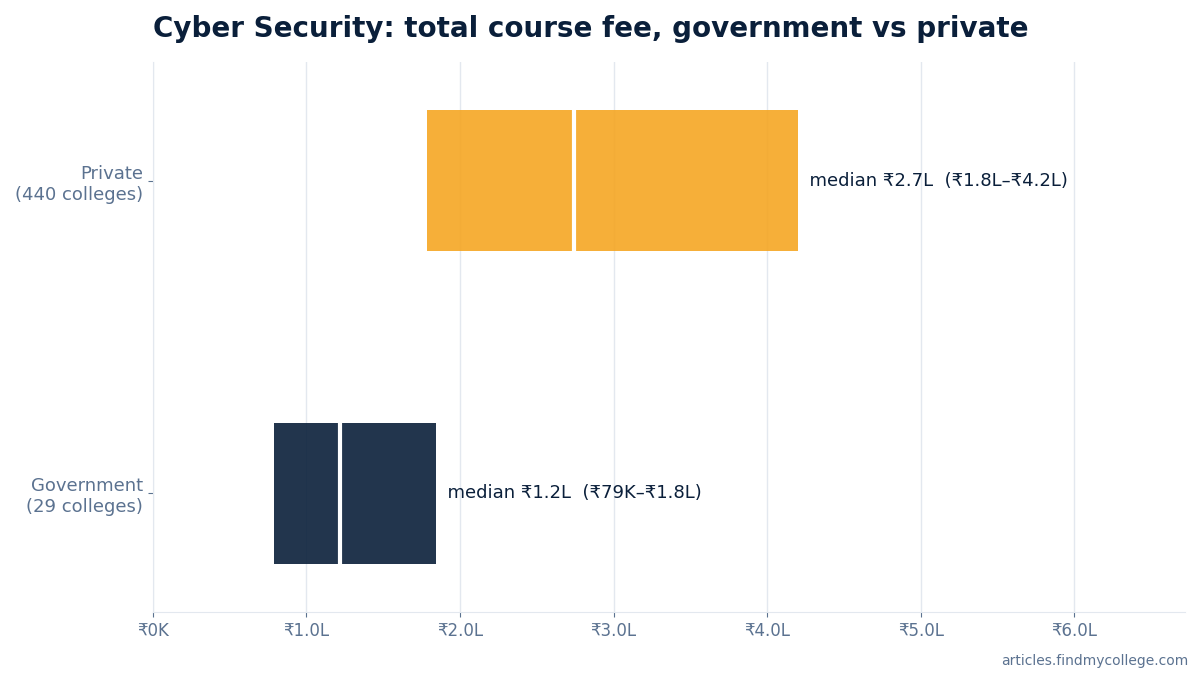
Government colleges offer accessible higher education in cybersecurity with highly affordable fee structures. At least 40 government colleges provide specialized cybersecurity degree and postgraduate tracks. Among 29 government colleges with published fee data, the median total course fee is ₹1.22 lakh, with the middle half ranging between ₹79,180 and ₹1.84 lakh.
Top government institutions include Elphinstone College in Mumbai with a total course fee of ₹16,044, Gujarat Technological University at ₹25,000, and College of Engineering Trivandrum (COE Trivandrum) at ₹25,200 total program fee. COE Trivandrum reports an average annual placement package of ₹5.25 Lakh. Additionally, Delhi University offers programs at a total fee of ₹34,900, while Birsa Institute of Technology Dhanbad charges ₹47,378.
| College | City | Ownership | Total course fee |
|---|---|---|---|
| Elphinstone College | Mumbai | Government | ₹16,044 |
| Gujarat Technological University | Ahmedabad | Government | ₹25,000 |
| Delhi University | Delhi | Government | ₹34,900 |
| Birsa Institute of Technology Dhanbad | Dhanbad | Government | ₹47,378 |
| Kannur University | Kannur | Government | ₹47,730 |
| Government Holkar Science College | Indore | Government | ₹68,800 |
| Shaheed Sukhdev College of Business Studies | Delhi | Government | ₹77,560 |
| Anna University | Chennai | Government | ₹80,800 |
| College of Engineering Pathanamthitta | Pathanamthitta | Government | ₹1.00 lakh |
| Visvesvaraya Technological University | Belgaum | Government | ₹1.02 lakh |
Private Cyber Security Colleges
At least 539 private colleges offer B.Tech, M.Tech, and specialized cybersecurity engineering programs. Based on 440 private colleges with fee data, the median total course fee is ₹2.74 lakh, with the middle half falling between ₹1.78 lakh and ₹4.20 lakh. Private universities invest heavily in practical training infrastructure, vendor certifications, and industry placement tie-ups.
Private colleges delivering strong graduate placement packages include Delhi Technical Campus Greater Noida (₹5.45 LPA average package at ₹4.68 lakh fee) and Dayananda Sagar College of Engineering in Bangalore (₹5.27 LPA average package at ₹3.35 lakh fee).
| College | City | Ownership | Total course fee | Average package |
|---|---|---|---|---|
| Delhi Technical Campus Greater Noida | Greater Noida | Private | ₹4.68 lakh | 5.45 LPA |
| Dayananda Sagar College of Engineering | Bangalore | Private | ₹3.35 lakh | 5.27 LPA |
| Aditya Institute of Technology and Management | Tekkali | Private | ₹1.32 lakh | 5.15 LPA |
| Global Institute | Amritsar | Private | ₹1.82 lakh | 5 LPA |
| Gayatri Vidya Parishad College of Engineering | Visakhapatnam | Private | — | 4.79 LPA |
| HMR Institute of Technology & Management | Delhi | Private | ₹3.32 lakh | 4.66 LPA |
| Tula’s Institute | Dehradun | Private | ₹6.81 lakh | 4.61 LPA |
| Dr. B.C. Roy Engineering College | Durgapur | Private | ₹2.32 lakh | 4.61 LPA |
| Bapatla Engineering College | Guntur | Private | ₹2.55 lakh | 4.26 LPA |
| RNS Institute of Technology | Bangalore | Private | ₹11.24 lakh | 4.23 LPA |
Cyber Security Fees
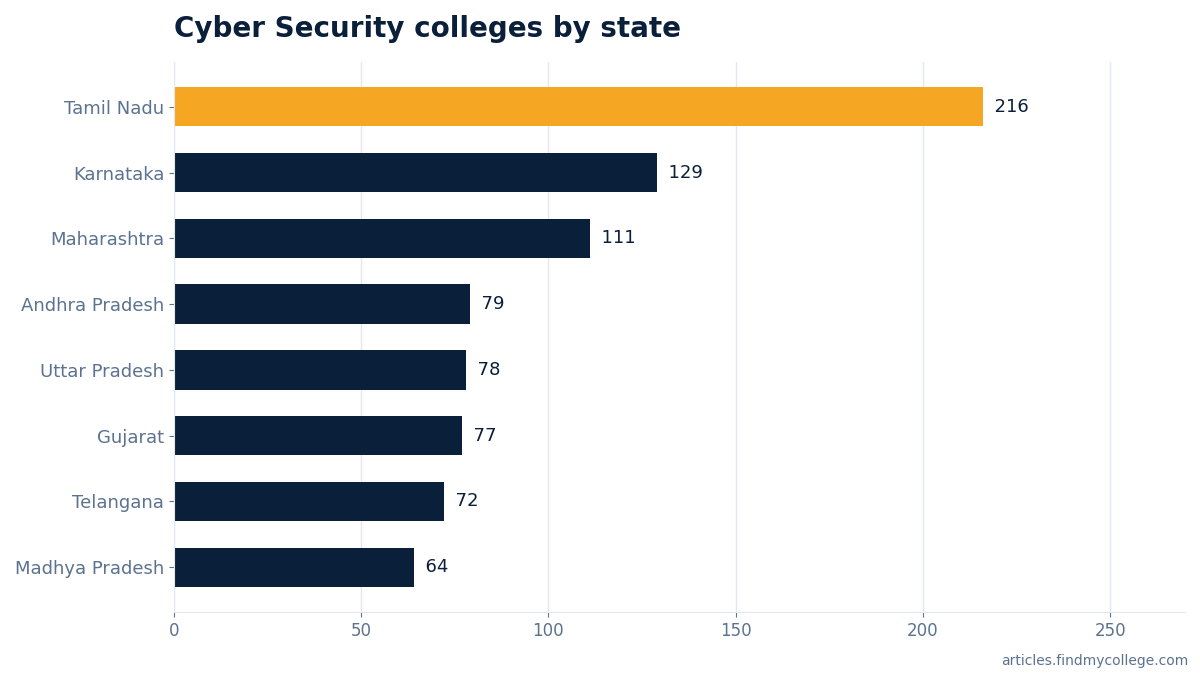
Tuition fees for cybersecurity degree courses vary widely depending on ownership, location, and infrastructure. State-wise availability shows heavy concentration in major technical hubs: Tamil Nadu leads with 216 colleges, followed by Karnataka with 129 colleges, Maharashtra with 111, Andhra Pradesh with 79, Uttar Pradesh with 78, and Gujarat with 77 colleges.
For flexible learning, distance and online cybersecurity credentials are offered by accredited institutions. Fees range from ₹89,500 at Indian Institute of Information Technology Vadodara (Diu campus) to ₹2.80 lakh at Parul Institute of Engineering and Technology.
| City | Colleges | Fee range | Well-known options |
|---|---|---|---|
| Bangalore | 87 | ₹1.40 lakh – ₹48.00 lakh | Alliance University, Jain University |
| Chennai | 60 | ₹80,800 – ₹18.40 lakh | Saveetha Institute of Medical and Technical Sciences, Sri Ramachandra Institute of Higher Education and Research |
| Hyderabad | 53 | ₹1.10 lakh – ₹18.40 lakh | Jawaharlal Nehru Technological University Hyderabad, Woxsen University |
| Coimbatore | 47 | ₹98,500 – ₹4.84 lakh | Amrita Vishwa Vidyapeetham, P.S.G College of Technology |
| Pune | 44 | ₹90,000 – ₹12.00 lakh | MIT World Peace University, Symbiosis International University Pune |
| Bhopal | 29 | ₹1.10 lakh – ₹9.94 lakh | VIT Bhopal University, Lakshmi Narain College of Technology & Science Bhopal |
| Kolkata | 28 | ₹1.03 lakh – ₹9.03 lakh | Maulana Abul Kalam Azad University of Technology, Amity University Kolkata |
| Mumbai | 28 | ₹16,044 – ₹11.25 lakh | Tata Institute of Social Sciences Mumbai, Mumbai University |
| College | City | Ownership | Total course fee |
|---|---|---|---|
| Lovely Professional University | Phagwara | — | ₹1.60 lakh |
| Amity University | Noida | — | ₹2.75 lakh |
| Bharati Vidyapeeth University | Pune | — | ₹1.48 lakh |
| JAIN (Deemed-to-be University) | Bengaluru | — | ₹1.50 lakh |
| Parul Institute of Engineering and Technology | Vadodara | University | ₹2.80 lakh |
| Manipal Academy of Higher Education (MAHE) | Manipal | — | ₹2.20 lakh |
| Shoolini University of Biotechnology and Management Sciences | Solan | — | ₹96,000 |
| Indian Institute of Information Technology Vadodara | Diu | — | ₹89,500 |
City-Wise Cybersecurity Institutes and Hubs
Beyond traditional 4-year degree programs, specialized coaching institutes across major metro cities offer short-term bootcamps, certification training, and hands-on laboratory experience. Bangalore and Pune serve as major centers for professional cybersecurity skill development due to proximity to corporate IT headquarters and SOC operations.
In Bangalore, Besant Technologies operates across key localities including BTM Layout, Marathahalli, HSR Layout, Electronic City, Indiranagar, Rajajinagar, Kalyan Nagar, Hebbal, and Jayanagar. Hacker School in Bangalore offers industry-oriented training leading to the Hacker School Certified Cyber Security Professional (HSCCSP) credential alongside preparation for CEH, CHFI, and CPENT certifications. In Pune, SevenMentor provides job-oriented cybersecurity training catering to tech corridors in Hinjawadi, Magarpatta, and Kharadi.
Complete B.Tech Cyber Security Course Syllabus and Practical Labs
| Semester / Phase | Core Technical Subjects | Practical Labs & Projects |
|---|---|---|
| Semesters 1 & 2 (Foundations) | Engineering Mathematics, Programming in C / Python, Digital Logic, Basic Electronics | Computer Fundamentals Lab, Engineering Graphics Workshop |
| Semesters 3 & 4 (Core IT & Basic Security) | Data Structures & Algorithms, OS, Computer Networks, DBMS, Cryptography & Network Security | Data Structures Lab, Computer Networks Lab, DBMS Lab, Cyber Security Lab |
| Semesters 5 & 6 (Advanced Security) | Ethical Hacking & Pen Testing, Cyber Laws & IT Act, Cloud Security, Digital Forensics, Malware Analysis | Ethical Hacking Lab, Forensics Investigation Lab, Minor Projects |
| Semesters 7 & 8 (Integration & Capstone) | DevSecOps, AI & ML in Cyber Security, SOC Practices, IoT Security, Threat Intelligence | Capstone Major Project, Industry Internship |
The 4-year B.Tech in Cyber Security blends computer science engineering fundamentals with specialized security training across 8 semesters. Practical training covers essential security tools including Kali Linux, Wireshark, Nmap, Metasploit, Burp Suite, and Splunk.
Essential Security Tools Mastered in Cybersecurity Programs
Modern cybersecurity programs emphasize hands-on mastery of industry-standard security tools. Mastery of these platforms prepares students for real-world roles in penetration testing, threat hunting, and security monitoring.
| Tool / Software | Primary Application Domain | Key Skill Learned |
|---|---|---|
| Kali Linux | Penetration Testing & Security Auditing | OS-based security testing and exploitation frameworks |
| Wireshark | Network Packet Analysis | Capturing and inspecting network traffic to identify anomalies |
| Nmap | Network Mapping & Vulnerability Scanning | Discovering open ports, services, and hosts on a network |
| Burp Suite | Web Application Security Testing | Identifying OWASP Top 10 web vulnerabilities |
| Splunk / SIEM | Security Operations Center (SOC) | Aggregating security logs and real-time threat monitoring |
Career Scope, Roles, and Salary Prospects in Cybersecurity
The cybersecurity industry in India is expanding rapidly due to widespread digital transformation and growing cloud infrastructure requirements. According to data from the Data Security Council of India, the domestic cybersecurity workforce requirement is projected to surpass 1 million professionals, growing at a compound annual growth rate (CAGR) of roughly 21.6%.
Fresh graduates entering the field receive starting salary packages typically ranging between ₹3.5 LPA and ₹7 LPA. Specific institutional outcomes vary: Rajadhani Institute of Engineering and Technology (RIET) records an average package of ₹3.01 Lakh, while COE Trivandrum averages ₹5.25 Lakh. With 5 to 7 years of professional experience, specialists secure ₹12 LPA to ₹15 LPA. Executive roles such as Chief Information Security Officer (CISO) or Senior Security Architect command packages between ₹25 LPA and ₹1 Crore or more.
How to Choose a Cyber Security College
Selecting the right institution requires evaluating both academic rigour and hands-on infrastructure. Key criteria include:
- Practical Laboratory Setup: Verify if the campus features dedicated hardware sandboxes, Security Operations Center (SOC) tools, and isolated malware analysis environments.
- Industry Certifications Alignment: Check whether the curriculum integrates external credential training such as CEH, CHFI, or CPENT alongside the degree syllabus.
- Faculty Expertise & Industry Exposure: Prioritize institutions with faculty engaged in active cybersecurity research, threat intelligence, or industry consulting.
- Placement Track Record: Review recent campus placement drives, average CTC figures, and recruiter profiles in risk advisory and security services.
- Tuition Fee vs ROI: Evaluate total course fees against historical starting salary ranges to ensure strong return on educational investment.
How to Apply for Cyber Security Admission in 2026: Step by Step
- Check Eligibility Criteria: Ensure you have completed 10+2 with Physics, Chemistry, and Mathematics (PCM) with a minimum aggregate of 50% (45% for reserved categories). Candidates for IIT Kanpur B.Cyber must have taken 5 subjects in 12th standard.
- Register and Appear for Entrance Exams: Apply and take national engineering entrance exams like JEE Main (2025/2026 sessions) or state-level tests (e.g., KEAM) or university-specific entrance assessments.
- Submit Portfolio / Evidence (For Special Programs): For specialized programs like IIT Kanpur B.Cyber, submit evidence of prior work done in cybersecurity alongside your best JEE Main score. Application fees are ₹1,600 for female, SC, ST, and PwD candidates, and ₹3,200 for all other candidates.
- Attend Institutional Selection / Hackathon Test: Shortlisted candidates for IIT Kanpur must appear for an in-person test and hackathon conducted at the New Core Lab, IIT Kanpur campus.
- Participate in Counselling and Seat Allotment: Attend centralized state counselling, JoSAA/CSAB (where applicable), or university-level interview and merit counselling rounds to secure seat allotment.
- Complete Document Verification and Fee Payment: Verify marksheets, identity proofs, category certificates, and pay the admission confirmation tuition fees at the respective college portal.
| What to do | Where | Link |
|---|---|---|
| Compare colleges, fees and cutoffs | Cyber Security colleges in India | findmycollege.com |
FAQs
Is JEE compulsory for cyber security?
No, JEE Main is not compulsory for all cybersecurity courses. While top programs like IIT Kanpur B.Cyber use JEE Main scores for shortlisting, many private universities and private institutes conduct their own entrance exams or offer merit-based direct admission.
Can a 12th pass apply for cyber security?
Yes, a 12th pass student with Physics, Chemistry, and Mathematics (PCM) and at least 50% aggregate marks can apply for 4-year undergraduate B.Tech in Cyber Security or B.Cyber degree programs.
What are cyber security course fees?
Cybersecurity course fees vary by institution type. Government colleges like COE Trivandrum charge around ₹25,200 total, while private colleges like SIRT Bhopal charge ~₹90,000 annually, and universities like SUAS Indore charge ₹2.75 Lakh per year.
Is cyber security a high salary field?
Yes, cybersecurity offers strong remuneration. Freshers start between ₹3.5 LPA and ₹7 LPA, mid-level experts with 5–7 years experience earn ₹12–15 LPA, and senior roles like CISO can exceed ₹25 LPA to ₹1 Crore.
Which colleges in Pune offer cyber security programs?
In Pune, engineering colleges offer specialized B.Tech programs, while leading training institutes like SevenMentor provide practical cybersecurity bootcamps with placement support targeting tech hubs like Hinjawadi and Magarpatta.
Where can I find cyber security coaching in Hyderabad or Bangalore?
Bangalore hosts prominent institutes like Besant Technologies (with branches in BTM Layout, Marathahalli, Electronic City) and Hacker School, offering hands-on training in ethical hacking, penetration testing, and SOC tools.