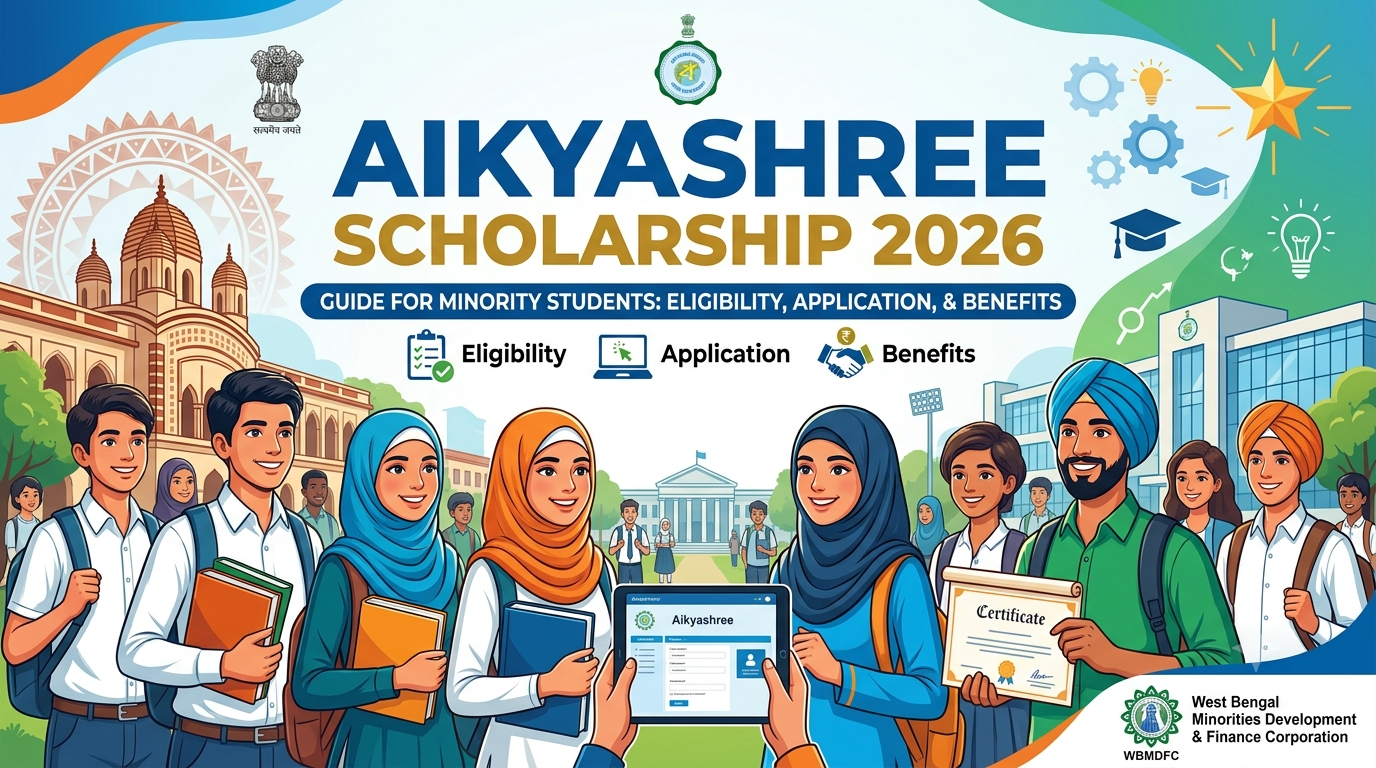
Aikyashree Scholarship 2026: Eligibility, Application, and Benefits for Minority Students
Aikyashree Scholarship is a major initiative by the Government of West Bengal—managed through the West Bengal Minorities Development & Finance Corporation (WBMDFC). This initiative of the Government of West Bengal mandates specific income criteria; for instance, the Pre-Matric Scholarship for students in Class 9 or 10 requires an annual family income not exceeding ₹2 lakh. Post-Matric Scholarship eligibility for OBC students (Class 11, 12, Graduation, or Postgraduation) sets an annual family income limit of ₹1 lakh, distinct from the ₹2 lakh limit for SC students and ₹2.5 lakh for ST students.
Aikyashree Scholarship 2026: Key Highlights
| Feature | Details |
| Scholarship Name | Aikyashree Scholarship Scheme 2026 |
| State / Territory | West Bengal |
| Nodal Authority | West Bengal Minorities Development & Finance Corporation (WBMDFC) |
| Target Audience | Students belonging to notified minority communities (Muslim, Christian, Sikh, Buddhist, Jain, and Parsi) |
| Eligible Education Levels | Class 1 to PhD (School, Diploma, UG, PG, Technical & Professional courses) |
| Sub-Schemes Included |
|
| Family Income Ceiling |
|
|
|
| Payment Method | Direct Benefit Transfer (DBT) into the student’s personal bank account |
| Official Website | wbmdfc.org / Aikyashree Portal |
People Also Read



Aikyashree Scholarship 2026: Financial Assistance for Class 1 to PHD Students
The Aikyashree Scholarship offers financial aid to students from Class 1 to PhD across West Bengal. This initiative supports financially weak students from various Minority communities, helping them pursue their education.
- Scholarship Name: Aikyashree Scholarship
- Administering Body: West Bengal Minority Development Finance Corporation (WBMDFC)
- Target Beneficiaries: Financially weak students of Minority communities
- Educational Levels: Class 1 to PhD
- Application Portal: WBMDFC Aikyashree Portal (wbmdfc.org)
- Family Annual Income Limit: Below ₹2,00,000 (2 Lakh)
The application deadline for the Aikyashree scholarship is 31 May 2026. You must be a West Bengal domicile to apply for this financial assistance.
| Level | Amount (Monthly) | Eligibility | Income Limit |
|---|---|---|---|
| Pre-Matric (Class 1–10) | ₹100–500 | Enrolled in recognized school | ₹2 Lakh/year |
| Post-Matric (Class 11–12) | ₹1,000 | 50%+ in Class 10 | ₹2 Lakh/year |
| UG (General) | ₹1,000–2,000 | 50%+ in Class 12 | ₹2 Lakh/year |
| UG (Technical/Professional) | ₹5,000 | 50%+ in Class 12 + entrance | ₹2 Lakh/year |
| PG | ₹2,000–5,000 | 50%+ in UG | ₹2 Lakh/year |
Aikyashree Scholarship 2026: Key Eligibility Criteria for West Bengal Minorities
To qualify for financial aid under the Aikyashree Scholarship 2026, applicants must satisfy a set of general conditions along with course-specific requirements set by the West Bengal Minorities Development & Finance Corporation (WBMDFC).
General Eligibility Criteria
-
Domicile: The applicant must be a permanent resident (domicile) of West Bengal.
-
Minority Community: The candidate must belong to one of the officially recognized minority communities: Muslim, Christian, Sikh, Buddhist, Jain, or Parsi.
-
Institutional Enrollment: The student must be enrolled in a recognized school, college, university, or technical institute located within West Bengal.
-
No Dual Benefits: The applicant should not be receiving any other government or private scholarship for the same course during the academic session.
Scheme-Specific Eligibility & Academic Requirements
1. Pre-Matric Scholarship Scheme
-
Class Covered: Class 1 to Class 10.
-
Academic Requirement: Must have passed the previous class (Class 1 students need only admission verification).
-
Family Income Limit: Maximum ₹2,00,000 per annum.
2. Post-Matric Scholarship Scheme
-
Class/Course Covered: Class 11, Class 12, Diploma, Undergraduate (UG), Postgraduate (PG), and PhD degrees.
-
Academic Requirement: Minimum 50% aggregate marks in the previous qualifying examination.
-
Family Income Limit: Maximum ₹2,00,000 per annum.
3. Merit-cum-Means (MCM) Scholarship Scheme
-
Course Covered: Professional and technical courses (e.g., Engineering, Medicine, Management, Law).
-
Academic Requirement: Minimum 50% marks in the Higher Secondary (10+2) or Graduation exam.
-
Family Income Limit: Maximum ₹2,50,000 per annum.
4. Swami Vivekananda Merit-cum-Means (SVMCM) Scheme for Minorities
-
Course Covered: Higher Secondary, Diploma, UG, PG, and PhD studies.
-
Academic Requirement:
-
HS & UG Levels: Minimum 60% marks in the qualifying exam.
-
PG Level (Arts/Commerce/Science): Minimum 53% marks in Honours subjects at graduation.
-
Engineering/Professional PG: Minimum 55% marks at the undergraduate level.
-
-
Family Income Limit: Maximum ₹2,50,000 per annum.
5. Talent Support Program (TSP)
-
Course Covered: Class 11 to PhD level.
-
Academic Requirement: Reserved for students who passed their last exam but scored below 50% marks (and thus do not qualify for Post-Matric).
-
Family Income Limit: Maximum ₹2,00,000 per annum.
How to Apply for the Aikyashree Scholarship 2026?
Applying for the Aikyashree Scholarship is done online through the official WBMDFC portal. The overall application workflow consists of four core phases: initial registration, profile submission, uploading documents, and institutional verification.
Step 1: Student Registration
-
Go to the official WBMDFC website (
wbmdfc.orgorwbmdfcscholarship.in) and click on Student’s Area. -
Click on Fresh Registration.
-
Select the District where your school, college, or university is located.
-
Enter your basic information: Name, Father’s Name, Date of Birth, Gender, Religion, Mobile Number, and Bank Account Details (IFSC Code & Account Number).
-
Click Submit and Proceed to complete your registration.
Step 2: Scheme Eligibility Scheme Allocation
-
Fill in your academic details, including the last exam passed, board/university name, passing year, total percentage secured, and family income.
-
The portal will automatically detect and list the specific schemes (such as Post-Matric, SVMCM, or MCM) you qualify for based on your entered data.
-
Select your scheme and click Submit & Proceed.
Step 3: Login and Application Completion
-
Check your registered mobile number/email for your User ID and Password.
-
Return to the portal and click Registered Student’s Login. Log in using your credentials and select your district.
-
Change your default password when prompted for security.
-
Fill out the full application form:
-
Basic Information: Address, domicile details, Aadhar number.
-
Academic Information: Present course name, institution, current year/semester, and tuition fee structure.
-
Bank Details Verification: Double-check your bank account number and IFSC code (funds are disbursed directly to this account via Direct Benefit Transfer).
-
Step 4: Upload Required Documents
Upload clear, scanned copies of the following documents in PDF/JPEG format:
-
Recent passport-size photograph
-
Marksheet of the last qualifying examination passed
-
Family Income Certificate (issued by a competent authority like a Block Development Officer or Gazetted Officer)
-
Bank passbook front page clearly showing your name, account number, and IFSC code
-
Proof of admission/fee receipt for the current academic session
-
Student’s Aadhar Card
-
Minority Community Certificate or Self-Declaration
Step 5: Final Preview, Submission, and Verification
-
Click Preview to review all your entered information carefully.
-
Click Final Submit & Lock Application. (Note: Once locked, changes cannot be made without getting the application unlocked by your institution).
-
Download and print the submitted application form along with the Institute Verification Form.
-
Submit the printed physical copy along with self-attested document copies to your school/college administrative office for online institutional verification.
Aikyashree Scholarship 2026: Selection Process
The selection process for the Aikyashree Scholarship 2026 relies on a multi-tier verification mechanism to ensure financial assistance reaches eligible minority students. Selection is based purely on merit, financial need, and strict document validation across multiple levels.
1. Institutional-Level Verification (First Screening)
-
Once you submit your application online, a hard copy along with self-attested documents must be submitted to your educational institution.
-
The Nodal Officer or Head of the Institution verifies:
-
Regular enrollment and attendance in the current session.
-
Correctness of marks obtained in the last qualifying examination.
-
Verification of submitted certificates (income, caste/minority declaration).
-
-
If valid, the institution approves and forwards the application on the portal to the district level.
2. District-Level Verification (District Level Committee)
-
The District Welfare Officer (DWO) or District Minority Officer reviews applications forwarded by institutions within that district.
-
This level performs cross-checks on family income certificates, domicile status, and checks for any duplicate applications or dual-scholarship claims across state schemes.
3. State-Level Final Approval (WBMDFC)
-
Applications cleared at the district level are sent to the West Bengal Minorities Development & Finance Corporation (WBMDFC).
-
The state board compiles final merit lists, particularly for high-value schemes like the Swami Vivekananda Merit-cum-Means (SVMCM) and Merit-cum-Means (MCM), based on academic percentage and available state budget allocation.
4. Direct Benefit Transfer (DBT) Disbursement
-
Once final approval is granted by WBMDFC, funds are disbursed directly into the selected student’s bank account via Direct Benefit Transfer (DBT).
-
Bank accounts are validated through PFMS (Public Financial Management System) to avoid transaction failures.
Selection Criteria for Renewal Applicants
For renewal candidates, selection is simplified:
-
Academic Performance: Must have secured pass marks (minimum 50% aggregate marks for most schemes, or 60% for SVMCM) in their previous year/semester exam.
-
Institutional Confirmation: Continuous enrollment proof verified by the current institution.
Aikyashree vs. SVMCM Scholarship 2026
The Aikyashree scholarship 2026, administered by WBMDFC, and the SVMCM scholarship, managed by the Higher Education Department, both support students in West Bengal. These schemes offer financial aid across various educational levels, from school to PhD, with distinct eligibility criteria and benefits. Understanding these differences helps you choose the right scholarship.
- Aikyashree Application Opening: Expected to open soon
- Aikyashree Administering Body: West Bengal Minorities’ Development and Finance Corporation (WBMDFC)
- SVMCM Administering Body: Higher Education Department
- Aikyashree Coverage: Class 1 to PhD
- SVMCM Coverage: Class 11 through PhD
- Aikyashree Minority Communities: Muslim, Christian, Sikh, Buddhist, Jain, and Parsee
While both scholarships serve students in West Bengal, their scope and financial requirements vary. The Aikyashree scholarship supports a broader range of classes, starting from Class 1, and targets specific minority communities. The SVMCM scholarship, however, begins from Class 11 and offers a monthly stipend.
| Criterion | Aikyashree Scholarship | SVMCM Scholarship |
|---|---|---|
| General Family Income Limit | ₹2 lakh (Pre-Matric/Post-Matric); ₹2.5 lakh (Merit-cum-Means/technical/professional) | ₹2.5 lakh |
| General Minimum Marks | 50% in last qualifying exam (higher for some professional courses) | 60% in last qualifying exam (HS/UG); separate cutoffs for research/PG |
| Benefit | — | Monthly stipend (₹1,000 to ₹8,000 depending on course) |
| SVMCM Minimum Marks (HS to Graduation) | 60% | N/A |
| SVMCM Minimum Marks (PG or Honours at Graduation) | 53% | N/A |
| SVMCM Minimum Marks (Engineering Courses at Graduation) | 55% | N/A |
| SVMCM Renewal Eligibility (HS to UG) | Minimum 60% aggregate marks (combined across both semesters) | N/A |
| SVMCM Renewal Eligibility (PG) | Minimum 50% aggregate marks (combined across both semesters) | N/A |
FAQs
Q1: What is the last date to apply for the Aikyashree Scholarship 2026?
The application deadline is set by the West Bengal Minorities Development & Finance Corporation (WBMDFC) and typically extends through the academic year. Applicants should regularly monitor the official portal (wbmdfc.org) for specific deadline extensions and phase updates.
Q2: Who is eligible for the Aikyashree Scholarship 2026?
Students who are permanent residents of West Bengal, belong to a notified minority community (Muslim, Christian, Sikh, Buddhist, Jain, or Parsi), and are enrolled in a recognized school, college, or university within the state qualify for the scheme.
Q3: What is the maximum family income limit for the Aikyashree Scholarship?
The annual income ceiling depends on the chosen scheme: up to ₹2.0 Lakh per annum for Pre-Matric, Post-Matric, and Talent Support Program (TSP), and up to ₹2.5 Lakh per annum for Swami Vivekananda Merit-cum-Means (SVMCM) and Merit-cum-Means (MCM) schemes.
Q4: How can I check my Aikyashree Scholarship application status online?
Visit wbmdfc.org or the official portal, click on the Track Application tab, select your district, and enter your Application ID along with your Date of Birth to view your real-time verification and disbursement status.
Q5: What minimum marks are required to get the Aikyashree Scholarship?
For Post-Matric and MCM schemes, students must score at least 50% marks in their previous exam. For the SVMCM scheme, 60% marks are required for HS/UG levels and 53%–55% for PG/Engineering. Students scoring below 50% can apply under the Talent Support Program (TSP).
Q6: How much money do students receive under the Aikyashree Scholarship?
Financial aid varies by educational level and course. Pre-Matric students receive between ₹1,100 and ₹11,000 per year, while higher education students under the SVMCM scheme can receive up to ₹60,000 annually.
Q7: Can students studying outside West Bengal apply for Aikyashree?
Generally, no. The scholarship requires students to be studying within institutions inside West Bengal. Exceptions are made only for students admitted to premier listed national institutes such as IITs, NITs, and IIMs outside the state.
Q8: Can I apply for Aikyashree along with another state or central government scholarship?
No. Beneficiaries can only hold one government scholarship at a time for a single course session. Applying for multiple state/central schemes concurrently can lead to the rejection of all applications.
Q9: How do I renew my Aikyashree Scholarship for the next academic year?
Existing recipients can log in to the portal using their existing Application ID and date of birth under the Renewal Application tab. You need to update your current year/semester marksheets, verify bank details, and re-submit the institution verification form.
Q10: What should I do if my bank account details or IFSC code change?
You must update your bank account details on the portal prior to institutional verification. Ensure the bank account is active, in the student’s name, and properly linked with Aadhaar to ensure smooth Direct Benefit Transfer (DBT) payments.