

Astrophysics Career Salary in India 2026: Sector Wise Pay Scale
Nishit Kumar is a senior EdTech industry leader with over a decade of experience in building and scaling education platforms, shaping their product, content, and growth strategy. At…
Experienced scientists in government space institutions earn between INR 8 LPA and INR 15 LPA, while specialized private sector roles can command packages up to INR 30-40 LPA.
Candidates evaluating an astrophysics career can explore compensation models across government research bodies, private space technology firms, individual academic specializations, and career designations. The detailed overview below outlines pay scales, major employers, and admission pathways for prospective scientists.
| Parameter | Details |
|---|---|
| Entry-Level Salary Range | INR 4 LPA – INR 6 LPA |
| IIA Scientist Monthly Salary (7th Pay Commission) | ₹56,100 – ₹1,77,500 per month |
| Top Indian Recruiters | ISRO, IIA, VSSC, Space Physics Laboratories, TIFR |
Astrophysics Salary by Job Role
Specific job designations reflect varying operational duties, ranging from theoretical research and data analysis to hardware support and teaching.
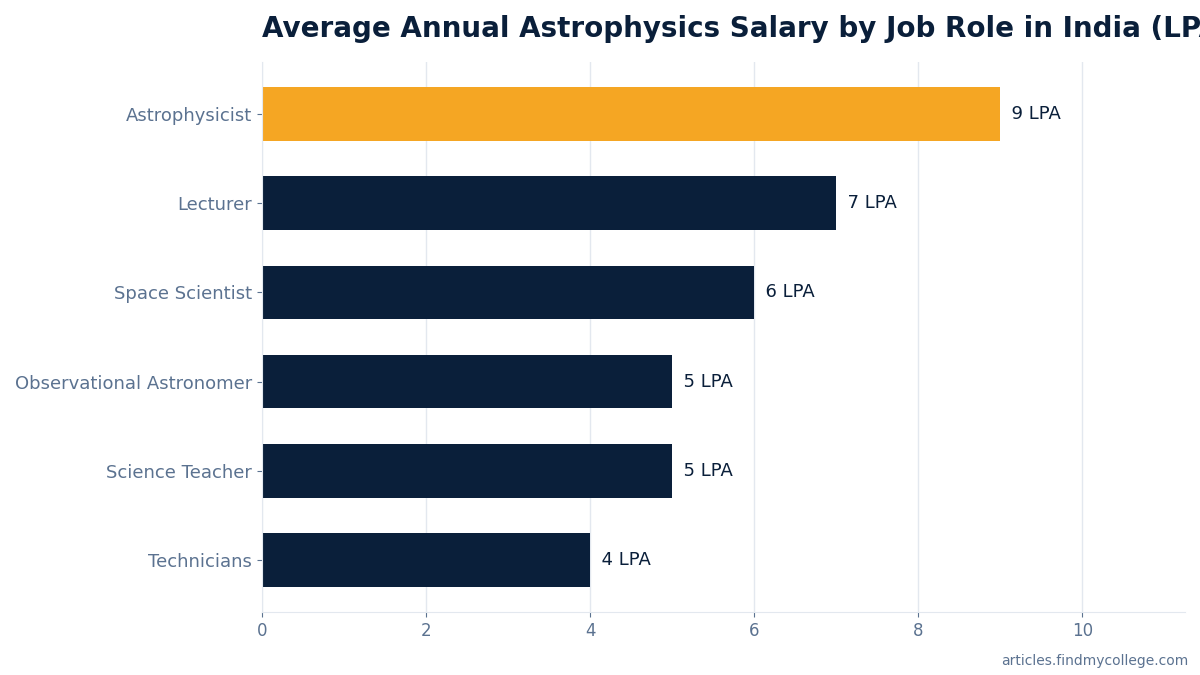
Space Scientists earn an average salary of INR 6 LPA, while Observational Astronomers and Science Teachers receive average packages of INR 5 LPA. Technical support professionals working within the astrophysics framework earn an average annual salary of INR 4 LPA.
| Designation | Average Annual Salary |
|---|---|
| Astrophysicist | INR 9 LPA |
| Lecturer | INR 7 LPA |
| Space Scientist | INR 6 LPA |
| Observational Astronomer | INR 5 LPA |
| Science Teacher | INR 5 LPA |
| Technicians | INR 4 LPA |
Astrophysics Salary in Government Sector vs Private Sector
| Post Category | Monthly Salary Scale | Additional Benefits |
|---|---|---|
| Scientist / Officer | ₹56,100 – ₹1,77,500 | HRA, Job Security, Pension |
| Engineer / Technical Staff | ₹35,000 – ₹1,12,400 | HRA, Central Govt Benefits |
| Clerk / Assistant (UDC/LDC) | ₹19,900 – ₹63,200 | HRA, Central Govt Benefits |
| MTS / Support Staff | ₹18,000 – ₹56,900 | HRA, Retirement Benefits |
In the private sector, average salaries for astrophysics graduates range between INR 4 LPA and INR 10 LPA. Meanwhile, government institutes like IIA provide 7th Pay Commission pay scales alongside benefits like HRA, job security, and pension.
Top Recruiters
Government space organizations and national research laboratories serve as premier employers for astrophysics professionals in India. Key recruiters include the Indian Space Research Organisation (ISRO), Vikram Sarabhai Space Centre (VSSC), Space Physics Laboratories, Space Applications Centres, and Tata Institute of Fundamental Research (TIFR). Non-governmental entities such as the Association of Bangalore Amateur Astronomers (ABBA) also recruit candidate talent.
International scientific organizations hiring astrophysics graduates include NASA, the Naval Research Laboratory, and the Space Telescope Science Institute. Depending on organization type and candidate work experience, starting salaries at international institutions range from INR 4 LPA to INR 10 LPA.
People Also Read




How to Increase Astrophysics Salary
| Astrophysics Specialization | Average Salary |
|---|---|
| Thermodynamics Waves | INR 10 LPA |
| Optics Modern Physics | INR 10 LPA |
| Fluid Mechanics | INR 10 LPA |
| Quantum Physics Relativity | INR 9 LPA |
| Newtonian Dynamics | INR 8 – 10 LPA |
| Electromagnetism | INR 4 LPA |
To increase earning potential, astrophysicists can specialize in high-paying areas like Thermodynamics Waves or Fluid Mechanics (INR 10 LPA) over Electromagnetism (INR 4 LPA). Gaining advanced degrees, moving to higher-paying employers, or managing junior staff also helps increase income potential.
How to Start Your Astrophysics Journey: Step by Step
- Complete Qualifying Graduation: Obtain a Bachelor’s degree (B.Sc / B.E / B.Tech) with a strong foundation in Physics, Mathematics, Chemistry, or Engineering.
- Pursue Master’s Postgraduate Degree: Earn an M.Sc or M.Tech degree in Physics, Astronomy, or a related scientific discipline.
- Obtain PhD Qualification: Complete a PhD in Astronomy or Astrophysics to qualify for scientific and research associate posts.
- Submit Application Form: Check recruitment notifications under the Careers or Opportunities section on official websites like iiap.res.in and fill out the online or offline application form.
- Clear Selection Process: Appear for Written Examination / Screening Test, Skill Test / Trade Test (for technical posts), and Interview (for scientific & officer posts).
| What to do | Where | Link |
|---|---|---|
| Compare colleges, fees and cutoffs | Astrophysics colleges in India | findmycollege.com |
Entry-level astrophysics positions such as Research Assistants or Junior Scientists receive annual salaries ranging from INR 4 LPA to INR 6 LPA.
FAQs
Do astrophysicists earn a lot in India?
Yes, astrophysicists earn competitive pay. Entry-level researchers earn INR 4-6 LPA, experienced scientists at research institutes earn INR 8-15 LPA, and top private sector roles offer up to INR 30-40 LPA.
What is the Astrophysicist salary in ISRO or IIA?
At institutes like IIA, Scientists and Officers receive a monthly salary of ₹56,100 to ₹1,77,500 under the 7th Pay Commission, plus HRA, pension, and central government allowances.
What is the average astrophysics career salary per month in India?
Which job profile in astrophysics gives the highest salary?
Specializations such as Fluid Mechanics, Thermodynamics Waves, and Optics Modern Physics command average salaries up to INR 10 LPA, while high-end private industry roles pay up to INR 30-40 LPA.
What are the top recruiters for astrophysics jobs in India?
Major Indian recruiters include ISRO, Indian Institute of Astrophysics (IIA), Vikram Sarabhai Space Centre (VSSC), Space Physics Laboratories, Space Applications Centres, and Tata Institute of Fundamental Research (TIFR).