B.Tech LLB Integrated Course Details 2026: Eligibility, Colleges, Scope, and Fees
BTech LLB in India is a 5-6 year integrated course offered by Mahindra University, UPES and other colleges. Find its eligibility, fees, entrance exams, syllabus, placements and other details here.
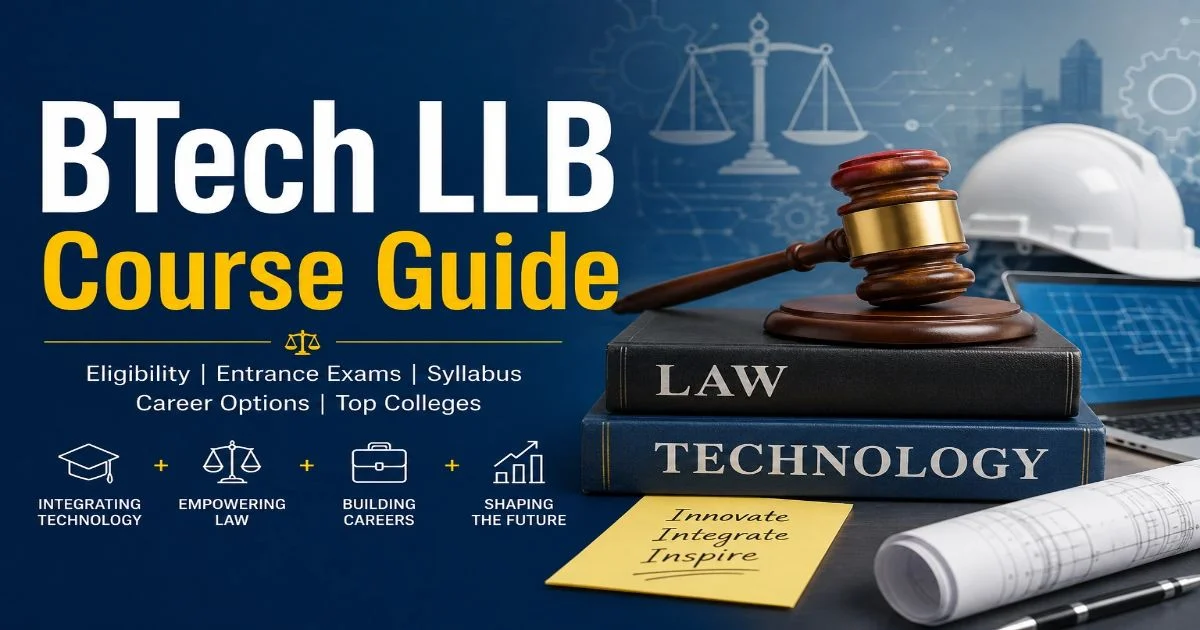
The concept of combining technology and law is gaining importance in today’s digital economy, particularly in areas like cyber law, intellectual property rights, and data privacy. BTech LLB integrated course is an emerging option in India. Presently, only a few colleges like Mahindra University and UPES offer this course. BTech LLB course in India typically spans 5-6 years. Students with 10+2 qualifications in PCM subjects are eligible for this course.
While admissions into BTech LLB are offered based on entrance exams, there is no standard code. Universities accept applications based on Engineering (JEE, JEE Mains, WBJEE, MHT CET) and Law (CLAT, MULET, SLAT, others) scores. This detailed course guide provides a complete overview of BTech LLB with top colleges, fees, eligibility, syllabus, entrance exams and more.
B.Tech LLB Admission Process
The admission process for the B.Tech LLB course in 2026 involves several key steps, from appearing for entrance exams to final enrollment. Prospective students must meet specific eligibility criteria, including academic qualifications and minimum marks, to secure a seat in this integrated program.
The general admission process for the B.Tech LLB program typically follows these stages:
- Step 1: Appear for Entrance Exams, such as JEE Main, CLAT, or LSAT India.
- Step 2: Submit applications online with Class 10 & 12 mark sheets and exam scores.
- Step 3: Universities release merit lists; shortlisted candidates may have interviews or counselling.
- Step 4: Receive admission offer, pay fees, and complete formalities for program enrollment.
BTech LLB Eligibility Criteria
General eligibility criteria for the btech llb course include academic qualifications and specific subject requirements.
| Criteria | Requirement |
| Academic Qualification | 10+2 (or equivalent) from a recognised board |
| Stream Requirement | Physics, Chemistry, Mathematics (PCM) often required in some institutes |
| Minimum Marks | ~45%–50% in 10+2 (varies by category & university) |
| Age Limit | No upper age limit in most exams |
| Entrance Exams Accepted | CLAT, SLAT, MH CET Law, CUET Law, other state exams |
| Admission Route | Through entrance exam + counselling |
| Eligibility Type | Direct 10+2 entry (not required to have BTech already) |
Top B.Tech LLB Colleges in India: Admissions, Fees & Rankings 2026
India currently has limited colleges for BTech LLB courses. It is a niche course combining technology and law, therefore, reducing the number of available options. Some of the top choices are listed below:
| College | Program | Admission Process | Fees (Approx.) | Ranking / Status | Notes |
| Mahindra University, Hyderabad | B.Tech–LL.B (Hons.) (6 years) | JEE Main / SAT / ACT + MU Law Entrance Test (MULET) | ~₹5 lakh/year + hostel (~₹2.1 lakh/year) | Emerging private university (tech-law niche) | One of the very few universities in India offering a structured B.Tech + LLB integrated dual degree |
| University of Petroleum and Energy Studies (UPES), Dehradun | Tech-law integrated pathways (Law + Technology specialisations) | UPESEAT / JEE / CLAT / LSAT (varies by program) | ~₹3.9–₹4.6 lakh total (varies) | Strong private university (law + energy/cyber focus) | Focus on cyber law, IP law, energy law; not always a strict B.Tech+LLB structure |
| Symbiosis Law School (SIU), Pune | BA LLB / BBA LLB with tech electives | SLAT | ~₹3–5 lakh/year | Top-tier private law university | No B.Tech LLB, but strong cyber/IP law ecosystem |
| Amity University, Noida | BA LLB / BSc LLB (with tech/cyber electives) | CUET / CLAT / Amity JEE | ~₹2–3 lakh/year | Large private university | Offers interdisciplinary law + technology subjects but not B.Tech LLB |
| Chandigarh University | BA LLB / BBA LLB (IT & cyber law focus) | CUCET | ~₹1.8–2.5 lakh/year | Emerging private university | Cyber law and IT law specialization tracks |
Mahindra University BTech LLB Programme
For those considering Mahindra University’s B.Tech LLB program in 2026, specific eligibility and entrance requirements apply.
| Aspect | Details |
| Programme Name | B.Tech–LL.B (Hons.) |
| University | Mahindra University, Hyderabad |
| Duration | 6 years (integrated dual degree) |
| Programme Type | Interdisciplinary program combining Engineering + Law |
| Academic Qualification | Must qualify in JEE (Main) 2026 or secure a valid JEE (Main) rank |
| Entrance Requirements | Must qualify in Mahindra University Law Entrance Test (MULET) 2026 |
| MULET 2026 Exam Date | 25 January 2026 |
| Application Deadline (Next Round) | 9 May 2026 |
| Final Application Deadline | 9 July 2026 |
| International Curriculum Eligibility | Applicants with international qualifications must submit UGC equivalence certificate by 30 August 2026 |
| Entrance Exam Pattern (MULET) | English, Logical Reasoning, GK, Mathematics, Legal Reasoning (MCQ-based) |
| Academic Structure | Engineering foundation + core law subjects (constitutional law, contract law, IP law, dispute resolution) |
| Focus Areas | Cyber law, AI law, data protection, intellectual property law, technology regulation |
| Career Outcomes | Corporate lawyer, IP consultant, compliance officer, legal analyst, policy advisor, tech-law specialist |
| Fee Structure | ~₹3,00,000 per year academic fees + ~₹2,10,000 hostel/mess (optional) |
| Key USP | One of the very few universities in India offering a structured B.Tech–LL.B (Hons.) dual degree |
MULET Entrance Exam Pattern
Students looking to pursue BTech LLB from Mahindra University must clear the MULET entrance exam. Here are the exam pattern and details:
Exam Structure
| Detail | Value |
| Total questions | 90 multiple-choice questions |
| Total marks | 90 |
| Marking scheme | 1 mark per question |
| Negative marking | 0.25 marks deducted for each incorrect answer |
Exam Sections
| Section | Number of Questions |
| English Knowledge and Skills | 20 questions |
| Logical Reasoning | 25 questions |
| General Knowledge and Current Affairs | 20 questions |
| Mathematics | 15 questions |
| Legal Reasoning | 10 questions |
B.Tech LLB Syllabus 2026: Core Subjects & Specializations Offered
The B.Tech–LL.B (Hons.) syllabus in India is not uniform across universities, but it is designed as an interdisciplinary curriculum combining engineering foundations with core legal education, focusing on areas such as cyber law, intellectual property rights, and technology regulation.
| Category | Subjects / Areas Covered | Description |
| Engineering Foundation | Mathematics, Physics, Programming (C/C++/Python), Data Structures, DBMS, Operating Systems, Computer Networks | Builds technical and analytical engineering base in early years |
| Core Engineering Subjects | Software Engineering, AI & Machine Learning basics, Cybersecurity, Computer Architecture, Electronics fundamentals | Provides applied technical knowledge relevant to tech-law domains |
| Core Law Subjects | Constitutional Law, Contract Law, Criminal Law, Administrative Law, Family Law, Jurisprudence, Law of Torts | Forms the legal foundation of the degree |
| Procedural & Practical Law | Civil Procedure Code, Criminal Procedure, Evidence Law, Drafting, Pleading, Moot Court | Focuses on courtroom practice and legal drafting skills |
| Technology Law Subjects | Cyber Law, Internet Law, Data Protection Law, IT Act, Digital Evidence, Technology Regulation | Core area linking law with modern digital systems |
| Corporate & Commercial Law | Company Law, Labour Law, Taxation Law, Competition Law, Banking & Insurance Law | Prepares students for corporate legal careers |
| IP & Innovation Law | Intellectual Property Rights, Patent Law, Copyright Law, Technology Transfer Law | Important for engineering + innovation careers |
| Emerging Specializations | AI Law, Blockchain Law, FinTech Law, Cyber Forensics, Digital Governance | Focus on evolving legal-tech ecosystem |
| Electives | Data Mining, Embedded Systems, Real-Time Systems, E-commerce Law, International Trade Law | University-specific optional courses |
| Practical Training | Internships, Moot Courts, Research Projects, Legal Clinics | Mandatory for experiential learning |
B.Tech LLB Career Scope & Salary Prospects in India 2026
The B.Tech LLB course offers remarkable career scope in India with diverse opportunities available in large numbers across various reputed organizations. Salaries can range from Rs. 6-16 LPA based on profile, experience and other factors.
| Job Role | Key Recruiters | Salary Range (Per Annum) |
| Patent Engineer | Tech companies, R&D firms, IP consultancies, law firms (e.g., AZB & Partners, Khaitan & Co.) | ₹6–10 LPA |
| Patent Attorney | IP law firms, multinational corporations, innovation-driven companies | ₹7–15 LPA |
| Legal Advisor | Corporates, PSUs, banks, consulting firms, startups | ₹5–12 LPA |
| Corporate Lawyer | Top law firms (Trilegal, Cyril Amarchand Mangaldas), MNCs, in-house legal teams | ₹8–20 LPA |
| Cyber / Technology Lawyer | IT companies (TCS, Infosys, Wipro), fintech firms, cybersecurity companies | ₹6–15 LPA |
| Prosecutor / Judicial Path | State Public Prosecution Departments, Judiciary Services (via exams) | ₹6–16 LPA |
B.Tech LLB vs BA LLB vs BBA LLB
| Feature | B.Tech LLB | BA LLB | BBA LLB |
| Type of Program | Rare integrated Tech + Law dual degree | Standard integrated Arts + Law degree | Standard integrated Business + Law degree |
| Duration | 6 years (only in a few universities such as Mahindra University) | 5 years | 5 years |
| Availability in India | Very limited (only 1–2 institutions) | Widely offered (NLUs, state, private universities) | Widely offered |
| Core Focus | Engineering/technology + law | Humanities, social sciences + law | Business, management + law |
| Best Suited For | Cyber law, AI law, IP law, tech policy | Litigation, judiciary, UPSC, legal practice | Corporate law, business law, firms |
| Entrance Exams | JEE/SAT + law entrance (university-specific) | CLAT, AILET, SLAT, MH CET Law, CUET Law | Same as BA LLB (CLAT/SLAT/MH CET/CUET Law) |
| Curriculum Strength | Strong technical + legal integration (niche) | Strong legal foundation and theory | Strong corporate and commercial law focus |
| Career Opportunities | Tech lawyer, cyber law specialist, compliance roles | Advocate, judge, legal advisor, civil services | Corporate lawyer, in-house counsel, law firms |
| Industry Recognition | Limited / emerging | High nationwide recognition | High nationwide recognition |
| Popularity | Very low | Very high | Very high |
Frequently Asked Questions
1. What is B.Tech LLB and who should pursue it?
B.Tech LLB is a 5–6 year integrated dual degree combining engineering and law. It is ideal for students interested in cyber law, AI law, intellectual property rights, and careers at the intersection of technology and legal systems.
2. What are the eligibility criteria for B.Tech LLB in India?
Candidates must complete 10+2 with Physics, Chemistry, and Mathematics (PCM) in most institutes. Minimum marks generally range from 45%–50%. Some universities may also require qualification in engineering and law entrance exams.
3. Which entrance exams are required for B.Tech LLB admission?
There is no single national exam. Admissions are based on combinations like JEE Main, state engineering exams, CLAT, LSAT–India, SLAT, or university-specific tests such as MULET for Mahindra University or UPESEAT for University of Petroleum and Energy Studies.
4. What are the career opportunities after B.Tech LLB?
Graduates can work as corporate lawyers, patent attorneys, cyber law experts, legal consultants, or compliance officers. Top recruiters include law firms, IT companies, fintech firms, and multinational corporations offering competitive salary packages.
5. Is B.Tech LLB better than BA LLB or BBA LLB?
B.Tech LLB is a niche course focused on technology and law, best for careers in cyber law, AI law, and IP law. BA LLB and BBA LLB are more common and better suited for litigation or corporate legal careers.