Bachelor of Design (BDes) 2026: Admission, Duration & Colleges
BDes Full Form & Course Duration
The BDes Full Form is Bachelor of Design, an undergraduate course typically lasting 4 years.
- Course Level: Undergraduate
- Course Structure: Divided into 8 semesters
- Course Focus: Creating designs, experiences, solving problems creatively, experimenting with ideas, thinking out of the box, and learning from mistakes.
- Year 1 Curriculum: Learning basics of design, improving imagination and drawing skills, using colours, and creating visual delight from creative thinking.
- Year 2 Curriculum: Introduction to specialisation, learning to apply fundamental knowledge to solve problems or make visual impacts, and choosing a major interest for specialisation.
- Year 3 Curriculum: Advancing skills, working on real projects, and guidance from industry experts.
- Year 4 Curriculum: Internship, choosing mentors, and building a final portfolio/project.
BDes Admission Process 2026: Step-by-Step Guide
The Bachelor of Design (BDes) is a premier professional undergraduate degree for those looking to enter the world of innovation, aesthetics, and functional creation. For the 2026 academic cycle, the admission process is rigorous, involving a blend of academic merit, creative aptitude testing, and personal evaluation.
Phase 1: Understanding Eligibility & Prerequisites
Before applying, candidates must ensure they meet the specific academic and age requirements set by the leading design councils and institutes.
Phase 2: The Step-by-Step Admission Journey
The journey from applicant to design student involves several critical milestones. Missing a single step can disqualify a candidate from the top-tier institutes.
-
Check Eligibility: Research specific colleges (like NID, IITs, or NIFT) as some may have slight variations in minimum percentage or age relaxations for reserved categories.
-
Fill Application Forms: Most applications for the 2026 cycle open in late 2025. Ensure you complete the forms, upload necessary documents, and pay the registration fees before the deadlines.
-
Appear for Entrance Exams: This is the most crucial stage. Design admissions are rarely based on Class 12 marks alone; you must clear national or institutional entrance tests.
-
Await Results & Shortlisting: Colleges will release a merit list or cutoff. If you meet the score requirements, you will be invited for the next round (Studio Tests or Interviews).
-
Develop a Portfolio: Top-tier design schools require a Solid Portfolio. This is a curated collection of your best creative work, sketches, 3D models, or photography that showcases your unique perspective.
-
Counselling & Fee Payment: Final selection is followed by a counselling session where seats are allocated based on rank and preference. To secure your spot, you must pay the admission fees within the stipulated timeframe.
Phase 3: Major Design Entrance Exams 2026
Mark your calendars. The 2026 design season is packed with competitive exams. Below is the schedule for the primary entrance tests:
Pro Tip: While your entrance exam score gets you through the door, your Portfolio is what defines your identity as a designer during the interview stage. Start documenting your creative process early!
People Also Read


Top 15 BDes Colleges in India 2026: Rankings & Fees
India’s design education landscape is expansive, featuring a total of 455 colleges. This network includes 24 government/public institutions and 327 private establishments. For students pursuing a Bachelor of Design (BDes), the financial investment varies significantly based on the institution’s prestige and infrastructure, with total fees ranging from as low as INR 11,438 to as high as INR 22,09,000.
1. Premier Government Design Institutions
Government colleges are often the first choice for design aspirants due to their subsidized fee structures, rigorous entrance standards (like UCEED and NID DAT), and massive industry reputation.
| Best Government Colleges | Estimated BDes Course Fees |
| Jamia Millia Islamia (JMI) | INR 4.18 Lakh |
| Netaji Subhas University of Technology (NSUT) | INR 4.46 Lakh |
| The Maharaja Sayajirao University of Baroda | INR 5.85 Lakh |
| Gujarat University | INR 6 Lakh – 7.2 Lakh |
| Delhi Technological University (DTU) | INR 7.4 Lakh |
| IIT Delhi | INR 8 Lakh |
| IDC – IIT Bombay | INR 8 Lakh |
| IIT Hyderabad | INR 8 Lakh |
| Guru Gobind Singh Indraprastha University (GGSIPU) | INR 9.95 Lakh |
| National Institute of Design (NID), Ahmedabad | INR 18.04 Lakh |
2. National Institute of Fashion Technology (NIFT) Rankings
NIFTs are the backbone of fashion and lifestyle design in India. While they share a centralized curriculum, fees can fluctuate based on campus location and specific specializations.
| NIFT Campus | Estimated BDes Course Fees |
| NIFT Patna | INR 90,000 – INR 12.96 Lakh |
| NIFT Kolkata | INR 5.45 Lakh – 12.96 Lakh |
| NIFT Bangalore | INR 5.63 Lakh – 12.96 Lakh |
| NIFT Mumbai | INR 5.63 Lakh – 12.96 Lakh |
| NIFT Hyderabad | INR 6.07 Lakh – 12.96 Lakh |
| NIFT Gandhinagar | INR 6.07 Lakh – 12.96 Lakh |
| NIFT Shillong | INR 8.58 Lakh – 11.74 Lakh |
| NIFT Chennai | INR 9.02 Lakh – 12.96 Lakh |
| NIFT Jodhpur | INR 12.34 Lakh |
| NIFT Delhi | INR 12.96 Lakh |
| NIFT Kannur | INR 12.96 Lakh |
3. Deep Dive: The Industry Leaders
Two institutions consistently dominate national and international rankings, serving as the benchmark for design excellence in India.
National Institute of Design (NID), Ahmedabad
NID Ahmedabad remains the pinnacle of design education.
-
National Ranking: Ranked #1 by IIRF and Outlook-ICARE (2024).
-
Global Standing: Placed within the top 51-100 art and design institutes globally by QS World University Rankings.
-
Total Investment: The 4-year BDes program fees typically range between INR 16.8 Lakh and INR 17.1 Lakh.
NIFT Navi Mumbai
Specializing in fashion and technology, the Mumbai campus is a hub for industry networking.
-
Rankings: Ranked #2 nationally by India Today (2024) and consistently holds the #1 spot in Maharashtra.
-
Total Investment: The 4-year BDes/B.FTech program costs between INR 13.42 Lakh and INR 14.09 Lakh.
Choosing the right college in 2026 involves balancing the Course Duration (4 years), the Syllabus (ranging from Communication to Industrial Design), and the eventual Salary & Scope.
Note: While government colleges like IITs and NIDs have higher entry barriers through competitive exams, they offer the highest Return on Investment (ROI) in terms of campus placements and global recognition.
BDes Syllabus 2026: Core Subjects & Specializations Offered
The BDes curriculum is meticulously crafted to transform creative flair into professional expertise. Over a 4-year course duration, the syllabus transitions from foundational artistic principles to highly technical, industry-specific applications. Whether you are aiming for Product Design, Communication Design, or UI/UX, the first year serves as a “Foundation Year” to build a common design vocabulary.
1. Semester-Wise Core Subjects (General Structure)
The 2026 academic structure follows a progressive learning curve, ensuring students master the basics before moving into complex digital and management-oriented modules.
| Semester | Core Subject Focus | Key Learning Areas |
| 1st | Foundation I | Basics of Design, Drawing & Illustration, Design Theory, Material Exploration |
| 2nd | Foundation II | Elements of Design, Color Theory, Visual Communication, 2D & 3D Design |
| 3rd | Technical Skills | Digital Media Tools, Typography, User-Centered Design, Design Thinking |
| 4th | Theory & Context | History of Design, Ergonomics, Interface Design, Design Research |
| 5th | Specialization I | Advanced Branding, Photography, Professional Design Software Skills |
| 6th | Specialization II | Complex Design Systems, Strategic Portfolio Development |
| 7th | Industry Immersion | Internship / Industry Training, UI/UX, Motion Graphics / CAD Modeling |
| 8th | Final Assessment | Final Design Project, Design Management, Professional Practice |
2. Major Specializations Offered
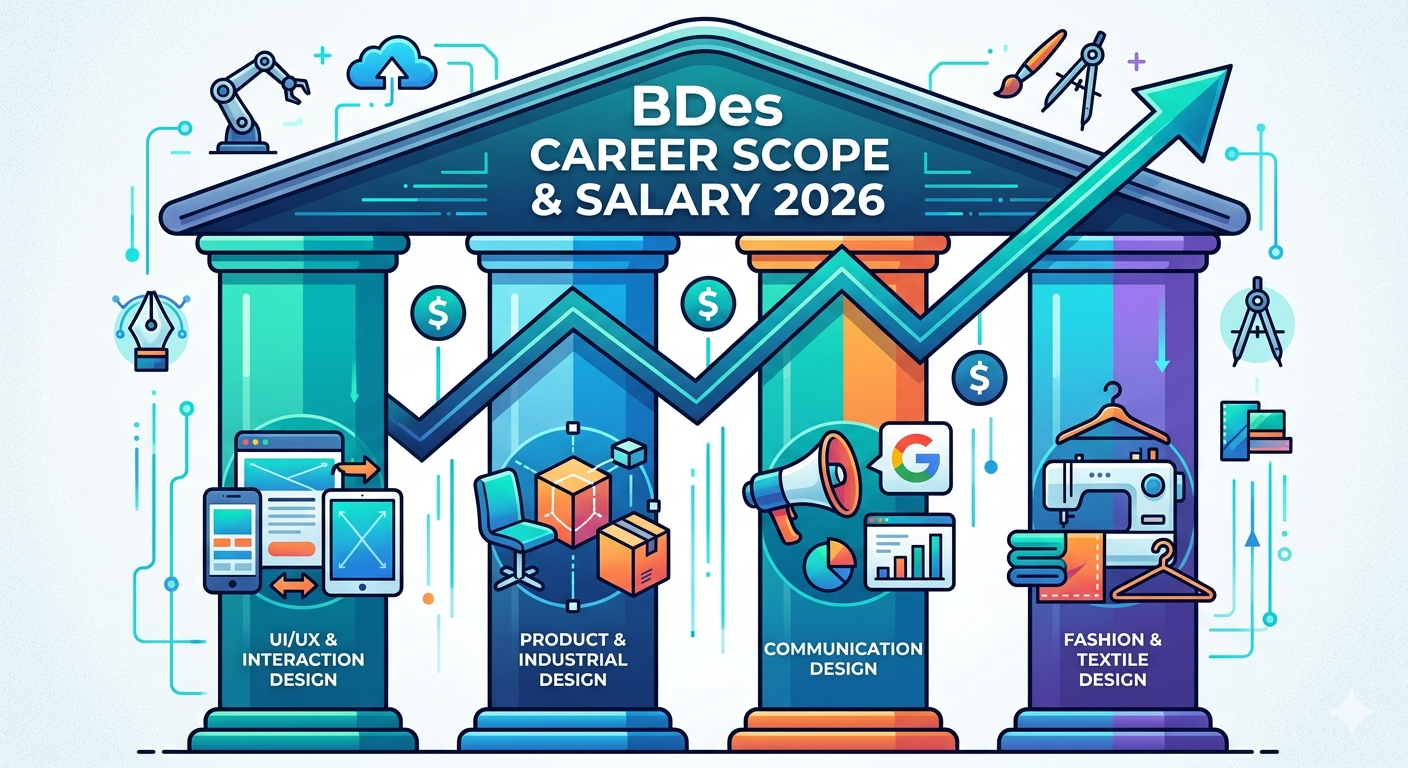
In the latter half of the program, students choose a specialization that aligns with their career goals. These pathways define the “Scope” of the degree:
-
Communication Design: Focuses on visual storytelling, graphic design, and advertising.
-
UI/UX Design: Concentrates on the user interface and experience for digital products, apps, and websites.
-
Product Design: Deals with the ergonomics, aesthetics, and functionality of physical products and consumer goods.
-
Fashion & Textile Design: Explores apparel construction, fabric innovation, and garment aesthetics.
3. Progressive Curriculum Philosophy
As highlighted in the BDes: Full Form, Course Duration, Admission 2026, Colleges, Syllabus, Salary & Scope overview, the program is divided into three distinct phases:
-
Foundational Phase (Sem 1-2): Breaking down preconceived notions of art and understanding the scientific principles of “Design” (balance, rhythm, and scale).
-
Specialization Phase (Sem 3-6): Students dive deep into their chosen niche, mastering tools like Adobe Creative Suite, Rhino, or Figma.
-
Professional Phase (Sem 7-8): Bridging the gap between academia and the market. The mandatory Industry Internship and Final Design Project allow students to solve real-world problems, often leading directly to high-paying placements.
Note: While the core structure remains consistent across most top institutes like NID and IITs, elective subjects may vary. For example, some colleges may offer specialized modules in Sustainable Design or Virtual Reality (VR) Design as early as the 5th semester.
BDes Salary & Career Scope 2026
The BDes degree in 2026 offers expansive career horizons, blending creative innovation with high-tech applications to provide lucrative opportunities across diverse industries, from digital interfaces to sustainable product manufacturing.
| Job Role | Industry / Sector | Job Description | Average Salary (INR/Year) |
| Graphic Designer | Advertising, Digital Media, Publishing | Create visual content for branding, marketing, and digital platforms | ₹3 – ₹5 LPA |
| UX/UI Designer | IT, Tech, Mobile Apps, Web Design | Design user-friendly digital interfaces and enhance user experience | ₹4 – ₹8 LPA |
| Fashion Designer | Fashion Houses, Retail Brands | Design clothing lines, accessories, and monitor fashion trends | ₹3.5 – ₹7 LPA |
| Product Designer | Consumer Goods, Industrial Design | Design and improve physical products for functionality and aesthetics | ₹4 – ₹9 LPA |
| Interior Designer | Architecture Firms, Real Estate | Plan interior spaces for homes, offices, and commercial properties | ₹3 – ₹6 LPA |
| Animation Designer | Media, Gaming, Film Industry | Create animated graphics, characters, and scenes for videos and games | ₹3 – ₹6.5 LPA |
| Textile Designer | Fashion, Textile Industries | Design patterns, prints, and fabric structures for garments and upholstery | ₹3 – ₹5.5 LPA |
| Design Consultant | Freelance / Agencies | Offer design solutions across branding, packaging, and visual identity | ₹4 – ₹7 LPA |
| Multimedia Artist | Digital Marketing, Film, Gaming | Combine graphics, video, sound, and text for multimedia projects | ₹3.5 – ₹6.5 LPA |
| Art Director | Media, Advertising Agencies | Lead creative teams and manage visual styles of campaigns or productions | ₹6 – ₹12 LPA |
The career scope and earning potential for graduates of BDes are significant, with an overall average salary ranging from INR 4 LPA to INR 6 LPA, supported by a design industry growth rate of 23% to 25% per year in India.
BDes Course Fees 2026: Government vs Private Colleges & Scholarships
Navigating the financial landscape of design education in 2026 requires an understanding of the vast disparity between institutional types. With over 450 BDes colleges across India—comprising approximately 321 private institutions and 64 government/public colleges—the total expenditure for a 4-year degree can range from a nominal INR 3,360 to a premium INR 54 Lakh.
1. The NIFT Fee Structure (2026)
The National Institute of Fashion Technology (NIFT) remains a top choice for students. While the tuition is standardized, the overall cost varies based on campus facilities, hostel availability, and location-specific overheads.
| NIFT Campus | BDes Course Fees (Total Estimate) |
| NIFT Patna | INR 90,000 – INR 12.96 Lakh |
| NIFT Kolkata | INR 5.45 Lakh – 12.96 Lakh |
| NIFT Bangalore | INR 5.63 Lakh – 12.96 Lakh |
| NIFT Mumbai | INR 5.63 Lakh – 12.96 Lakh |
| NIFT Hyderabad | INR 6.07 Lakh – 12.96 Lakh |
| NIFT Gandhinagar | INR 6.07 Lakh – 12.96 Lakh |
| NIFT Shillong | INR 8.58 Lakh – 11.74 Lakh |
| NIFT Chennai | INR 9.02 Lakh – 12.96 Lakh |
| NIFT Jodhpur | INR 12.34 Lakh |
| NIFT Delhi | INR 12.96 Lakh |
| NIFT Kannur | INR 12.96 Lakh |
2. Best Government Colleges & Financial Outlook
Government institutions are highly sought after for their subsidized fees and high “Return on Investment” (ROI). Typically, these colleges charge between INR 1 Lakh and INR 5 Lakhs, though premier institutes like IITs and NIDs feature a higher fee bracket due to their advanced laboratory and studio infrastructure.
| Best Government Colleges | Total BDes Course Fees |
| Jamia Millia Islamia | INR 4.18 Lakh |
| Netaji Subhas University of Technology | INR 4.46 Lakh |
| The Maharaja Sayajirao University of Baroda | INR 5.85 Lakh |
| Gujarat University | INR 6 Lakh – 7.2 Lakh |
| Delhi Technological University (DTU) | INR 7.4 Lakh |
| IIT Delhi | INR 8 Lakh |
| Industrial Design Centre (IDC) – IIT Bombay | INR 8 Lakh |
| IIT Hyderabad | INR 8 Lakh |
| Guru Gobind Singh Indraprastha University | INR 9.95 Lakh |
| National Institute of Design (NID), Ahmedabad | INR 18.04 Lakh |
3. Government vs. Private Institutions
When considering the Admission 2026 cycle, students must weigh the prestige and costs of public versus private establishments.
-
Government/Public Colleges: Usually range from INR 1 Lakh to 5 Lakhs. These seats are limited and require high ranks in exams like UCEED or NID DAT.
-
Private Colleges: Generally charge between INR 4 Lakhs and INR 10 Lakhs, with some elite private design schools reaching up to INR 54 Lakh. They often offer more niche specializations and global exchange programs.
4. Scholarships and Financial Aid
To make design education accessible, both the government and private institutions offer various financial relief programs:
-
Merit-Based Scholarships: Awarded to students with exceptional entrance exam ranks or high CGPA during the course.
-
Means-cum-Merit Scholarships: Specifically designed for students from economically weaker sections (EWS) who demonstrate academic excellence.
-
NIFT “Sarthak” Scheme: Provides financial assistance to students whose parental income falls below a certain threshold.
-
Institutional Waivers: Many private colleges offer up to 50–100% tuition fee waivers for top performers in their respective institutional tests.
Final Note: When evaluating the BDes: Full Form, Course Duration, Syllabus, Salary & Scope, always factor in hidden costs such as design materials, high-end laptops for rendering, and software subscriptions, which are essential for a design student’s toolkit.
FAQs
1. What is the eligibility for BDes admission in 2026?
Candidates must complete Class 12 from any stream (Science, Commerce, or Arts) with a minimum of 50% aggregate marks. Applicants should generally be under 24 years of age by August 1st, 2026, though some institutes offer age relaxations for reserved categories.
2. Which are the top entrance exams for BDes in India?
The most prestigious entrance exams include UCEED (for IITs), NID DAT (for National Institutes of Design), and NIFT Entrance Exam (for fashion technology). Other significant tests include CUET for central universities and FDDI AIST for footwear and lifestyle design.
3. Can Arts and Commerce students apply for BDes?
Yes, BDes is an interdisciplinary degree. Unlike B.Tech, it welcomes students from Science, Arts, and Commerce streams. The admission focus is on creative aptitude, visualization skills, and design thinking rather than specific high school subjects or scientific backgrounds.
4. What is the average fee for a BDes course in India?
BDes fees vary widely. Government colleges typically charge between INR 1 Lakh and INR 5 Lakhs. Premier institutes like NID or IITs range from INR 8 Lakh to INR 18 Lakh, while private universities can cost up to INR 54 Lakh.
5. How important is a portfolio for BDes admission? A portfolio is critical for the second stage of admissions at top colleges like NID and various private design schools. It showcases your creative journey, technical skills, and problem-solving ability, allowing faculty to evaluate your potential beyond entrance exam scores.
6. What are the high-paying specializations in BDes?
Currently, UI/UX Design, Interaction Design, and Product Design offer the highest starting salaries due to the booming tech industry. Other lucrative fields include Communication Design and Fashion Technology, especially for those graduating from top-tier institutes like IIT-Bombay or NID.
7. Is there an age limit for BDes admission in 2026?
For most premier government institutes like NID and NIFT, the upper age limit is 24 years for General category candidates as of August 1, 2026. However, many private universities do not enforce a strict age limit for their design programs.
8. What is the duration of the BDes program?
The Bachelor of Design (BDes) is a four-year full-time undergraduate professional degree. It is divided into eight semesters, typically beginning with a foundational year followed by three years of specialized study, industry internships, and a final year graduation project.
9. What is the difference between BDes and BFTech?
BDes focuses on the creative and aesthetic aspects of design, such as apparel or product styling. BFTech (Bachelor of Fashion Technology) is more technical and managerial, focusing on garment production, quality control, and the machinery used in the textile industry.
10. What kind of jobs can I get after a BDes degree?
Graduates can work as UI/UX Designers, Graphic Designers, Product Stylists, Fashion Consultants, or Art Directors. The scope is vast, with opportunities in tech firms, advertising agencies, manufacturing industries, and fashion houses, or even starting an independent design studio.