BAMS Syllabus: Professional Year Subjects and Sanskrit Paper
Nishit Kumar is a senior EdTech industry leader with over a decade of experience in building and scaling education platforms, shaping their product, content, and growth strategy. At…
- 22 Oct 2026BAMS Academic Curriculum and Professional Examination Guidelines Updated
Updated curriculum outlines 4 Professional academic phases covering basic Ayurvedic sciences, modern clinical integration, Sanskrit language studies, and 12-month rotating hospital internship.
The BAMS syllabus spans 5 years and 6 months (4.5 years of academic study divided into 4 Professional years, plus a 1-year compulsory rotating internship) regulated by the Central Council of Indian Medicine (CCIM/NCISM). The curriculum covers core Ayurvedic philosophy, Rachana & Kriya Sharir, Dravyaguna, Rasashastra, Kayachikitsa, Shalya Tantra, Panchakarma, and compulsory Sanskrit.
At least 237 colleges offer BAMS in India, with government course fees having a median of ₹79,515 and private institution fees reaching a median of ₹10.67 lakh. Below is the complete year-wise subject list, Sanskrit exam pattern, practical project details, core reference textbooks, and step-by-step admission guidelines.
| Parameter | Details |
|---|---|
| Course Duration | 5.5 Years (4.5 Years Academic + 1 Year Compulsory Internship) |
| Regulatory Body | Central Council of Indian Medicine (CCIM) / NCISM |
| Eligibility | 10+2 in PCB (Physics, Chemistry, Biology) with minimum 50% aggregate marks |
| Admission Exam | NEET UG |
| Average Course Fee | INR 200,000 to INR 300,000 per year |
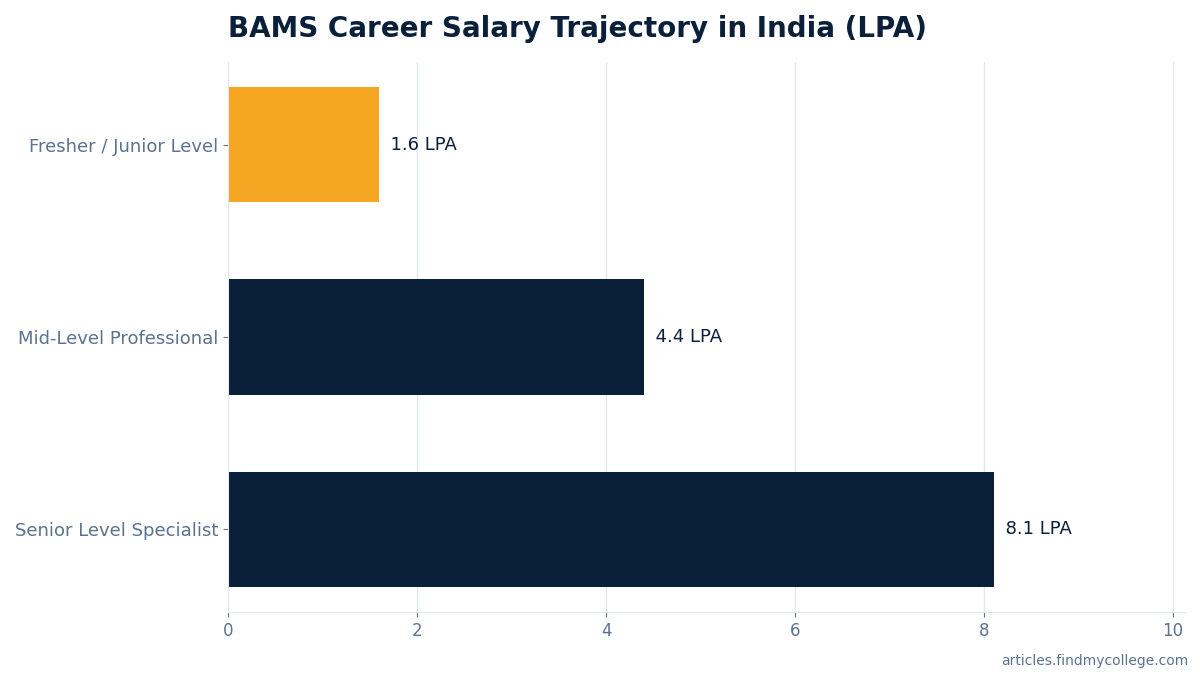
| Starting Salary Range | INR 0.6 LPA to INR 1.6 LPA (Fresher) up to INR 8.1 LPA (Senior) |
BAMS Subjects Year-wise
The BAMS subject progression builds a strong base in human structure and function before advancing to disease pathology, herbal therapeutics, and clinical treatments. Students must maintain at least 75% attendance in theory and practical classes separately, alongside securing a minimum of 35% in internal assessments to qualify for university examinations.
The 1st Professional year introduces five foundational subjects. Padartha Vigyan and Ayurveda Itihas covers Ayurvedic philosophy, Darshana Nirupana, Dravya, Guna, Karma, Pramana, and historical milestones across 2 theory papers of 100 marks each (150 total teaching hours). Kriya Sharir (Physiology) and Rachana Sharir (Anatomy) both carry 2 theory papers and practical assessments, covering human organ systems, Sira, Dhamani, Srotas, Kostha, Garbha Shaarira, embryology, Doshas, Prakriti, Dhatus, and Malas. Maulik Siddhant Avum Ashtang Hridaya comprises 1 theory paper on Ashtang Hridaya Sutra Sthana principles.
| Subject Code / Name | Subject Title | Theory Papers | Teaching Hours | Focus Area |
|---|---|---|---|---|
| 1.1 | Padartha Vigyan and Ayurveda Itihas | 2 Papers (100 Marks Each) | 150 Hours | Ayurvedic philosophy, Darshana Nirupana, Dravya, Guna, Karma, Pramana, and history |
| 1.2 | Sanskrit | 1 Paper | Included in 1st Proff | Grammar, translation, reading classical Samhita texts and Ayurvedic terminology |
| 1.3 | Kriya Sharir | 2 Papers | Theory & Practical | Human physiology, Doshas, Prakriti, Dhatus, Malas, and biological system functions |
| 1.4 | Rachana Sharir | 2 Papers | Theory & Practical | Human anatomy, Sira, Dhamani, Srotas, Kostha, Garbha Shaarira, and embryology |
| 1.5 | Maulik Siddhant Avum Ashtang Hridaya | 1 Paper | Theory | Basic principles of Ashtang Hridaya Sutra Sthana and core Ayurvedic concepts |
The 2nd Professional BAMS year runs for 12 months split into two 6-month terms. Dravyaguna Vigyan includes 2 theory papers (100 marks each) and 200 practical/viva marks (400 total marks across 200 lecture hours and 200 practical hours). Rasashastra and Bhaishajya Kalpana carries 2 theory papers (100 marks each) and 200 practical/viva marks across 400 total teaching hours. Agad Tantra, Vyavahar Ayurved Evum Vidhi Vaidyak comprises 1 theory paper (100 marks) and 50 practical/viva marks (200 lecture hours and 100 practical hours). Charak Samhita (Purvardha – Sutra Sthan) carries 1 theory paper of 100 marks with 200 lecture hours and no practical exam.
The 3rd Professional year shifts focus toward clinical diagnostic methodology, preventive medicine, maternal health, and pediatrics across five specialized subjects.
| Subject Name | Core Modules Covered | Practical / Clinical Component |
|---|---|---|
| Roga Nidana & Vikriti Vigyan | Dosh Dushyadi Vigyan, Nidana Panchaka, Pathology, Lab diagnostics | Clinical diagnostics, laboratory tests, patient examination |
| Swasthavritta & Yoga | Dinacharya, Ritucharya, Janapadodhwamsa, Naturopathy, Yoga, Hygiene | Practical yoga sessions, diet planning, field visits |
| Prasuti Tantra & Stri Roga | Garbha Vigyana, Obstetrics, Parturition, Gynecological disorders | Labour room clinical exposure, gynecological case history |
| Kaumarbhritya Parichaya | Child growth & development, Neonatal care, Balagraha, Bal Chikitsa | Pediatric clinical examination, vaccination awareness |
| Charak Samhita (Uttarardha) | Chikitsa Sthana, Kalpa Sthana, Siddhi Sthana detailed text study | Therapeutic scriptural analysis and clinical case correlation |
The 4th Professional BAMS year focuses on clinical treatment procedures, surgical skills, eye/ENT care, and research techniques. Kayachikitsa carries 2 theory papers (100 marks each) and 100 practical/viva marks divided into case records (20 marks), long case (20 marks), short case (10 marks), and viva voce (50 marks). Paper I covers Bheshaja, Kriya Kaala, Dvividhopakrama, Shadavidhopakrama, Jwara management, and Rasavaha/Raktavaha Srotas disorders, while Paper II details disorders of Pranavaha, Udakavaha, Annavaha, Mamsavaha, Medovaha, Asthi-Majjavaha, Shukravaha, Mutravaha, and Purishavaha Srotas alongside Vata Vyadhi and Manasa Roga.
| Subject Title | Theory Papers | Practical / Viva Marks | Key Clinical & Theoretical Focus |
|---|---|---|---|
| Kayachikitsa | 2 Papers (100 Marks Each) | 100 Marks (Long Case, Short Case, Viva) | Internal medicine, Jwara, Srotas disorders, Vata Vyadhi, Rasayana, Vajikarana |
| Shalya Tantra | 2 Papers | Practical / Viva | Surgical principles, Shastra, Poorva/Pradhana/Paschat Karma, Kshara Sutra, Marma |
| Shalakya Tantra | 2 Papers | Practical / Viva | Diseases of eye, ear, nose, throat, head, and neck (above clavicle), Kriya Kalpa |
BAMS Electives and Specialisations
| Specialisation Branch | Focus Area | Key Clinical & Theoretical Focus |
|---|---|---|
| Kayachikitsa | General Ayurvedic Internal Medicine | Internal medicine, Jwara, Srotas disorders, Vata Vyadhi, Rasayana, Vajikarana |
| Shalya Tantra | Ayurvedic Surgery & Para-surgical procedures | Surgical principles, Shastra, Poorva/Pradhana/Paschat Karma, Kshara Karma, Marma |
| Shalakya Tantra | ENT, Ophthalmology, Head & Neck Disorders | Diseases of eye, ear, nose, throat, head, and neck (above clavicle), Kriya Kalpa |
| Prasuti & Stri Roga | Obstetrics & Gynaecology | Garbha Vigyana, Obstetrics, Parturition, Gynecological disorders |
| Kaumarbhritya | Ayurvedic Paediatrics | Child growth & development, Neonatal care, Balagraha, Bal Chikitsa |
| Dravyaguna Vigyan | Ayurvedic Pharmacology & Materia Medica | Pharmacology, materia medica, Rasa, Karma, and Dravyas |
BAMS graduates can pursue postgraduate specialisations across 13 disciplines, including Padartha Vigyan, Sharir Rachana, Sharir Kriya, Swasthavritta, Agad Tantra, Roga Nidana, and Charak Samhita.
BAMS Practicals and Projects
- Documentation of traditional folk medicine practices
- Critical examination of medical theories in ancient Sanskrit literature
- Drug-drug interaction studies between herbal formulations and modern pharmaceuticals
Books for BAMS
Students rely on traditional classical Samhitas along with modern textbook commentaries authored by senior Ayurvedic academicians to master both theoretical philosophy and modern medical integration.
| Professional Year / Subject | Book Title | Author / Publisher | Key Usage |
|---|---|---|---|
| BAMS 1st Year (Sanskrit) | Sanskrita Ayurveda Sudha | Dr. B. L. Gaur | Core text for 1st-year Sanskrit paper |
| BAMS 1st Year (Padartha Vigyan) | A Textbook of Padartha Vijnana Evam Ayurveda Itihasa | Dr. Dingari Lakshmana Chary | Fundamentals of philosophy & history |
| BAMS 1st Year (Rachana Sharir) | Ayurvedic Human Anatomy / Illustrated Rachna Sharir | Prof. Dr. Giridhar M. Kanthi | Human anatomy with Ayurvedic integration |
| BAMS 2nd Year (Nidana) | Madhava Nidanam (2 Volumes) | Prof. K. R. Srikantha Murthy | Diagnostic pathology reference |
| BAMS 3rd & 4th Year (Surgery) | Sushruta Samhita (3 Volumes Set) | Prof. K. R. Srikantha Murthy | Surgical principles and Marma science |
| BAMS 4th Year (Kayachikitsa) | Kayachikitsa according to NCISM | Dr. M S Thiru | Final year internal medicine guidebook |
BAMS Colleges and Fee Structure
Government colleges offer highly subsidized education, with a median total course fee of ₹79,515 and the middle half of institutions charging between ₹55,233 and ₹4.36 lakh (based on 12 reporting government colleges). Private institutions have a median total course fee of ₹10.67 lakh, with the middle half ranging between ₹8.16 lakh and ₹12.53 lakh (based on 78 reporting private colleges).
| College | City | Ownership | Total course fee | NIRF rank |
|---|---|---|---|---|
| Banaras Hindu University | Varanasi | Government | ₹51,595 | 6 (Medical, 2025) |
| Dr. DY Patil Vidyapeeth | Pune | — | ₹24.00 lakh | 12 (Medical, 2025) |
| Datta Meghe Institute of Medical Sciences | Wardha | — | ₹37.27 lakh | 20 (Medical, 2025) |
| DY Patil University Navi Mumbai | Navi Mumbai | — | ₹50.67 lakh | 45 (Medical, 2022) |
| Bharati Vidyapeeth Deemed University | Pune | — | ₹22.00 lakh | 59 (Overall, 2025) |
| Guru Gobind Singh Indraprastha University | Delhi | — | ₹3.72 lakh | 93 (Overall, 2025) |
| Yenepoya University Mangalore | Mangalore | — | ₹21.57 lakh | 95 (Overall, 2024) |
| KLE University | Belgaum | — | ₹24.75 lakh | 101 (Overall, 2023) |
| Goa University | North Goa | — | ₹6.55 lakh | 101 (Overall, 2023) |
| College | City | Ownership | Total course fee |
|---|---|---|---|
| Ayurvedic and Unani Tibbia College | Delhi | Government | ₹10,700 |
| Kaviraj Ananta Tripathy Sharma Ayurveda College & Hospital | Ganjam | Government | ₹43,519 |
| Banaras Hindu University | Varanasi | Government | ₹51,595 |
| Government Ayurveda College | Thiruvananthapuram | Government | ₹66,150 |
| Government Ayurveda College Tripunithura | Ernakulam | Government | ₹66,150 |
| Vaidyaratnam P.S. Varier Ayurveda College | Malappuram | Government | ₹79,450 |
| Government Ayurveda College Pariyaram | Kannur | Government | ₹79,580 |
| Madhya Pradesh Medical Science University | Jabalpur | Government | ₹1.93 lakh |
| Rajiv Gandhi University of Health Sciences | Bangalore | Government | ₹3.41 lakh |
| R.A. Podar Ayurved Medical College | Mumbai | Government | ₹4.68 lakh |
How to Apply for BAMS Admission in 2026: Step by Step
- Evaluate Course Duration: BAMS is an undergraduate medical program covering traditional Ayurvedic principles and modern medical science across 5 years and 6 months, including 4.5 years of academic study and a 12-month compulsory rotating internship.
- Review Government College Fees: For government colleges offering BAMS, the median total course fee is ₹79,515, with the middle half ranging between ₹55,233 and ₹4.36 lakh.
- Review Private College Fees: For private colleges offering BAMS, the median total course fee is ₹10.67 lakh, with the middle half ranging between ₹8.16 lakh and ₹12.53 lakh.
- Consider State College Distribution: Candidates can explore options across states, including Karnataka (43 colleges), Uttar Pradesh (40), Gujarat (25), Madhya Pradesh (24), Maharashtra (23), and Kerala (19).
- Check Exam Eligibility Rules: Enrolled students must secure a minimum of 75% attendance in theory and practicals separately and at least 35% in internal assessments to be eligible for university examinations.
- Understand Academic Curriculum Phases: The CCIM divides the BAMS academic curriculum into four distinct phases: First Professional, Second Professional, Third Professional, and Fourth Professional years.
| What to do | Where | Link |
|---|---|---|
| Compare colleges, fees and cutoffs | BAMS colleges in India | findmycollege.com |
BAMS combines traditional Ayurvedic principles with modern medical science across a 5.5-year duration. Program completion requires passing four professional academic phases and finishing a 12-month compulsory rotating internship.
FAQs
What subjects are included in the first year of BAMS?
The 1st Professional BAMS year includes Padartha Vigyan and Ayurveda Itihas, Sanskrit, Kriya Sharir (Physiology), Rachana Sharir (Anatomy), and Maulik Siddhant Avum Ashtang Hridaya.
Is Sanskrit paper compulsory in BAMS 1st year?
What subjects are taught in BAMS final year?
BAMS 4th (final) year subjects are Kayachikitsa (Internal Medicine), Panchakarma, Shalya Tantra (Surgery), Shalakya Tantra (ENT & Ophthalmology), and Research Methodology and Medical Statistics.
How long is the total BAMS course duration?
BAMS has a total duration of 5 years and 6 months (5.5 years), comprising 4.5 years of academic study across 4 Professional phases and a 12-month compulsory rotating internship.
What are the core books recommended for BAMS students?
Primary texts include Charaka Samhita, Sushruta Samhita, Madhava Nidanam, ‘Sanskrita Ayurveda Sudha’ by Dr. B. L. Gaur, and ‘A Textbook of Padartha Vijnana’ by Dr. D. L. Chary.
Can BAMS graduates practice surgical procedures?
BAMS training includes theoretical and clinical components of Shalya Tantra (surgery and Kshara Karma).