
Bachelor of Banking and Insurance (BBI) India 2026 Overview
Nishit Kumar is a senior EdTech industry leader with over a decade of experience in building and scaling education platforms, shaping their product, content, and growth strategy. At…
Latest update: Bachelor of Banking and Insurance 2026 admissions & dates updated. Read more ›
Welcome to the comprehensive overview of the Bachelor of Banking and Insurance (BBI) program in India for the academic year 2026. This page is designed for prospective students and their parents, offering a deep dive into what BBI entails, its career prospects, eligibility criteria, and more. The BBI course is a specialized undergraduate degree tailored for students aspiring to build a career in the dynamic financial services sector, specifically banking, insurance, and other related domains.
What is the Bachelor of Banking and Insurance (BBI) Course?
The Bachelor of Banking and Insurance (BBI) is a three-year undergraduate degree program that provides students with a strong foundation in banking operations, insurance principles, financial markets, and risk management. It combines theoretical knowledge with practical skills, preparing graduates for various roles within the financial industry.
The curriculum is designed to cover essential aspects such as financial accounting, business law, economics, investment analysis, and various types of insurance (life, general, health). The program aims to develop analytical, problem-solving, and decision-making skills crucial for success in the fast-evolving financial sector.
What is the eligibility for Bachelor of Banking and Insurance (BBI) in India for 2026?
To be eligible for the Bachelor of Banking and Insurance (BBI) program in India for 2026, candidates typically need to have completed their 10+2 (or equivalent) examination from a recognized board, with a strong preference for students from the Commerce stream. While some colleges may accept students from Science or Arts streams, a background in Commerce is highly advantageous.
- Minimum Marks: Most colleges require a minimum aggregate score of 45-50% in the 10+2 examination. Some premier institutions might set a higher bar, often around 55-60%.
- Age Limit: Generally, there is no upper age limit for BBI admission, but some universities might have specific age criteria.
- Entrance Exams: While many colleges offer direct admission based on 10+2 merit, some reputed institutions, particularly those affiliated with central or state universities, may conduct their own entrance examinations (e.g., CUET, SET, NPAT, or university-specific tests).
What is the typical syllabus and subjects covered in BBI?
The BBI syllabus is structured to provide a comprehensive understanding of banking and insurance concepts over six semesters. It includes core subjects, electives, and practical components like projects and internships.
Semester-wise BBI Subjects (Illustrative)
| Semester | Core Subjects | Key Learning Areas |
|---|---|---|
| I | Financial Accounting, Business Economics, Principles of Management, Business Communication | Foundational accounting, economic principles, management basics, effective communication. |
| II | Business Law, Quantitative Methods, Principles of Banking, Organizational Behavior | Legal framework for business, statistical tools, banking fundamentals, workplace dynamics. |
| III | Corporate Accounting, Financial Management, Direct & Indirect Taxation, Principles of Insurance | Advanced accounting, financial decision-making, tax regulations, insurance basics. |
| IV | Cost Accounting, International Banking & Finance, Life Insurance, Marketing of Banking & Insurance | Cost analysis, global financial operations, specific life insurance products, marketing strategies. |
| V | Auditing, Risk Management, General Insurance, Investment Banking & Financial Services | Audit procedures, identifying & mitigating risks, non-life insurance, investment services. |
| VI | Financial Reporting & Analysis, Rural Banking & Microfinance, Project Work/Internship, Ethics & Governance | Interpreting financial statements, banking in rural areas, practical industry exposure, professional ethics. |
People Also Read




How much does Bachelor of Banking and Insurance (BBI) cost in India (2026 fee ranges)?
The cost of pursuing a Bachelor of Banking and Insurance (BBI) in India for 2026 varies significantly based on the type of institution (government vs. private) and its reputation. Generally, government colleges are more affordable than private ones.
- Government Colleges/Universities: Annual fees can range from INR 10,000 to INR 50,000. These institutions are often subsidized, making them highly accessible.
- Private Colleges/Universities: Annual fees typically range from INR 50,000 to INR 2,50,000 or even higher for top-tier private institutions. These fees often include better infrastructure, industry tie-ups, and placement support.
- Additional Costs: Students should also budget for examination fees, study materials, hostel accommodation (if applicable), transportation, and personal expenses.
Is Bachelor of Banking and Insurance (BBI) worth it for jobs in India? What are the career prospects and salary outcomes?
Yes, the Bachelor of Banking and Insurance (BBI) is highly worth it for jobs in India, offering excellent career prospects in a consistently growing sector. Graduates are well-prepared for entry-level positions in banks, insurance companies, financial consultancies, and other financial institutions.
Career Prospects after BBI
- Banking Sector: Roles such as Probationary Officer (PO), Bank Clerk, Loan Officer, Relationship Manager, Financial Analyst, Credit Analyst.
- Insurance Sector: Positions like Insurance Agent/Advisor, Underwriter, Claims Adjuster, Risk Manager, Actuarial Analyst (with further specialization).
- Financial Services: Opportunities in wealth management, investment advisory, stockbroking firms, mutual funds, and financial planning.
- Other Roles: Financial Consultant, Business Development Executive, Customer Service Executive in financial institutions.
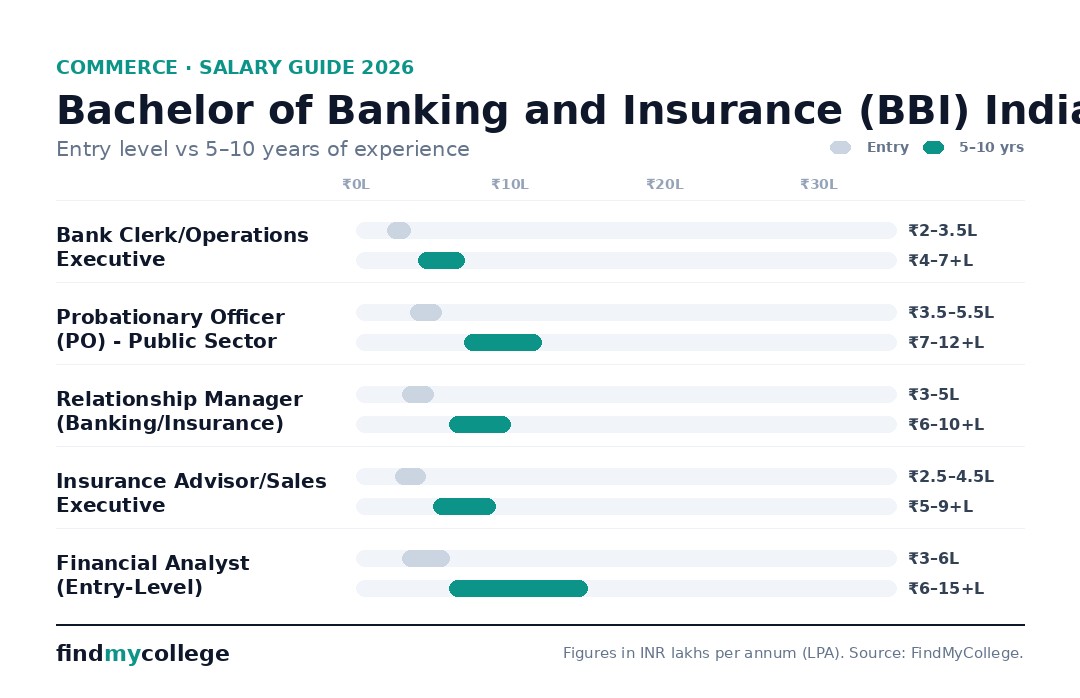
Typical Salary Outcomes (Entry-Level, Annual)
| Job Role | Average Entry-Level Salary Range (INR Lakhs per annum) | Potential Growth (Mid-Career) |
|---|---|---|
| Bank Clerk/Operations Executive | 2.0 – 3.5 | 4.0 – 7.0+ |
| Probationary Officer (PO) – Public Sector Banks | 3.5 – 5.5 | 7.0 – 12.0+ |
| Relationship Manager (Banking/Insurance) | 3.0 – 5.0 | 6.0 – 10.0+ |
| Insurance Advisor/Sales Executive | 2.5 – 4.5 | 5.0 – 9.0+ |
| Financial Analyst (Entry-Level) | 3.0 – 6.0 | 6.0 – 15.0+ |
Salaries can significantly increase with experience, higher qualifications (like an MBA in Finance or Actuarial Science), and specialized certifications (e.g., NISM, IRDAI certifications).
How does BBI compare to B.Com, BBA, and BMS?
BBI is a specialized commerce degree, distinct from general commerce (B.Com) and broader management degrees (BBA/BMS), by focusing specifically on the banking and insurance sectors.
- B.Com (Bachelor of Commerce): This is a general commerce degree offering a broad understanding of accounting, finance, economics, and business. It provides a wider range of career options but lacks the specialized depth of BBI in banking and insurance.
- BBA (Bachelor of Business Administration): BBA focuses on general management principles, leadership, and business operations across various industries. While it covers some finance, it’s less specialized than BBI for the financial services sector.
- BMS (Bachelor of Management Studies): Similar to BBA, BMS also emphasizes management skills and business acumen. It might offer more quantitative and analytical rigor than a general BBA but still doesn’t match BBI’s industry-specific focus.
Key Difference: If a student is certain about a career in banking or insurance, BBI offers a direct and more tailored pathway. If they prefer broader options or are unsure about their specialization, B.Com, BBA, or BMS might be more suitable initially, allowing for specialization at the postgraduate level.
What are the admission process and key dates for BBI in 2026?
The admission process for BBI in 2026 typically involves applying to colleges directly or through common entrance exams, followed by merit-based selection or interviews.
General Admission Process:
- Application: Fill out online or offline application forms for desired colleges/universities.
- Entrance Exam (if applicable): Appear for university-specific or national-level entrance tests (e.g., CUET for central universities, SET for Symbiosis, NPAT for NMIMS).
- Merit List/Counseling: Colleges release merit lists based on 10+2 scores and/or entrance exam performance. Shortlisted candidates are called for counseling.
- Interview/Group Discussion (optional): Some top colleges may conduct personal interviews or group discussions.
- Document Verification & Fee Payment: Final admission upon successful document verification and payment of the first installment of fees.
Tentative Key Dates for BBI Admissions 2026 (Illustrative):
- Application Window: March – May 2026
- Entrance Exams (if applicable): May – June 2026
- Merit List/Results: June – July 2026
- Counseling/Interviews: July 2026
- Commencement of Classes: August 2026
Note: These dates are indicative and vary by institution. Always refer to the official college websites for precise schedules.
What are the top colleges offering BBI in India?
Several reputable colleges and universities across India offer the Bachelor of Banking and Insurance (BBI) program. Some of the well-known institutions include:
- University of Mumbai (various affiliated colleges like HR College of Commerce and Economics, KC College)
- University of Delhi (some affiliated colleges may offer similar specialized B.Com programs)
- Symbiosis International University (through its constituent colleges like Symbiosis College of Arts and Commerce, Pune)
- Narsee Monjee Institute of Management Studies (NMIMS), Mumbai
- Christ University, Bangalore
- Amity University (various campuses)
- Various state universities and their affiliated colleges across major cities like Pune, Bangalore, Chennai, Kolkata, etc.
When choosing a college, consider factors like faculty expertise, industry tie-ups, placement records, infrastructure, and accreditation.
Frequently Asked Questions
Can Science or Arts students pursue BBI?
While BBI is primarily designed for Commerce students, some colleges may accept Science or Arts stream students, often with a requirement to complete foundational commerce subjects during the first year or having achieved a higher aggregate percentage in their 10+2 examination. It’s best to check the specific eligibility criteria of your desired college.
Is an internship compulsory in BBI?
Yes, most BBI programs include a compulsory internship component, typically in the final year or during semester breaks. This practical exposure is crucial for gaining industry experience, understanding real-world banking and insurance operations, and enhancing employability.
What are the higher study options after BBI?
After completing BBI, students have excellent options for higher studies, including an MBA in Finance, M.Com in Banking and Finance, PGDM in Banking and Financial Services, or specialized courses like Actuarial Science, Chartered Financial Analyst (CFA), or Certified Financial Planner (CFP). These postgraduate qualifications significantly boost career prospects and earning potential.
Are there any entrance exams for BBI?
While many colleges offer BBI admission based on 10+2 merit, some prominent universities and private institutions conduct their own entrance exams. Examples include CUET (for central universities), SET (Symbiosis Entrance Test), NPAT (NMIMS Programs After Twelfth), and various university-specific aptitude tests. Always check the admission brochure of your target colleges.
What skills are essential for a BBI student?
Essential skills for a BBI student include strong analytical abilities, numerical proficiency, good communication skills (both written and verbal), attention to detail, problem-solving capabilities, and a keen interest in financial markets and economic trends. Computer literacy, especially with spreadsheet software, is also highly beneficial.
Is BBI a good alternative to B.Com for a banking career?
Yes, BBI is often considered a superior alternative to a general B.Com for students specifically aiming for a career in banking or insurance. Its specialized curriculum provides a deeper and more relevant understanding of the industry, potentially giving graduates an edge in entry-level roles and reducing the need for extensive on-the-job training in core areas.