BFSI Course Fees 2026: Fee Structure and Duration
- 11 Nov 2026CFA 2026 November Level 1 Exam Window Opens
The CFA 2026 November Level 1 examination window is scheduled to take place from 11 November to 17 November 2026. - 18 Aug 2026CFA 2026 August Level 1 Exam Conducted
The August window for the CFA 2026 Level 1 examination was held from 18 August to 24 August 2026.
BFSI (Banking, Financial Services, and Insurance) course fees across Indian institutions range from ₹19,944 to ₹3.22 lakh depending on program level, college type, and specialisation. Programs are offered across Undergraduate, Postgraduate, UG Diploma, and Apprenticeship levels, with 790 colleges offering Finance and 514 colleges offering Sales & Marketing specialisations.
Candidates can review educational requirements, entrance test schedules, fee structures in government and private institutions, city-wise college options, and admission steps below.
| Parameter | Details |
|---|---|
| Course Levels | UG, PG, UG Diploma, Apprenticeship |
| UG Eligibility | Class 12th in Commerce stream (Mathematics mandatory) |
| PG Eligibility | Commerce Graduation (Mathematics mandatory) |
| Key Entrance Exams | CAT, GMAT, MAT, XAT, CUET, NMIMS NPAT, CSEET, CFA |
| Government Recruitment Exams | IBPS PO, SBI PO, IBPS Clerk, SBI Clerk |
| Top Specialisation | Finance (790 Colleges) |
BFSI Course Fees in Government Colleges
Government institutions in India offer cost-effective education for candidates seeking specialized financial qualifications. Total course fees in government colleges start at ₹19,944 and reach up to ₹80,700 depending on university infrastructure and course duration. State institutions such as Pithapur Rajah’s Government College in Godavari and Government College of Arts Science and Commerce Sanquelim in North Goa deliver accessible academic options for students.
| College | City | Ownership | Total course fee |
|---|---|---|---|
| Pithapur Rajah’s Government College | Godavari | Government | ₹19,944 |
| Government College of Arts Science and Commerce Sanquelim | North Goa | Government | ₹24,415 |
| Calicut University | Calicut | Government | ₹36,655 |
| Dr. A.P.J. Abdul Kalam Technical University | Lucknow | Government | ₹80,700 |
| College | City | Ownership | Total course fee |
|---|---|---|---|
| Stella Maris College | Chennai | Private (aided) | ₹1.39 lakh |
| Moradabad Institute of Technology | Moradabad | Private | ₹1.72 lakh |
| Holy Cross College (Autonomous) Tiruchirappalli | Tiruchirappalli | Private (aided) | ₹78,960 |
| DAV Institute of Engineering and Technology | Jalandhar | Private | ₹2.51 lakh |
| Aditya Degree College Rajahmundhry | Rajahmundhry | Private | ₹59,100 |
| R.B. Institute of Management Studies | Ahmedabad | Private | ₹1.15 lakh |
| SRM Business School | Lucknow | Private | ₹1.10 lakh |
| Shri Labhubhai Trivedi Institute of Engineering & Technology | Rajkot | Private | ₹1.22 lakh |
| Ness Wadia College of Commerce | Pune | Private (aided) | ₹90,000 |
| Pirens Institute of Business Management and Administration | Ahmednagar | Private | ₹54,000 |
Top BFSI Course Colleges and Fees
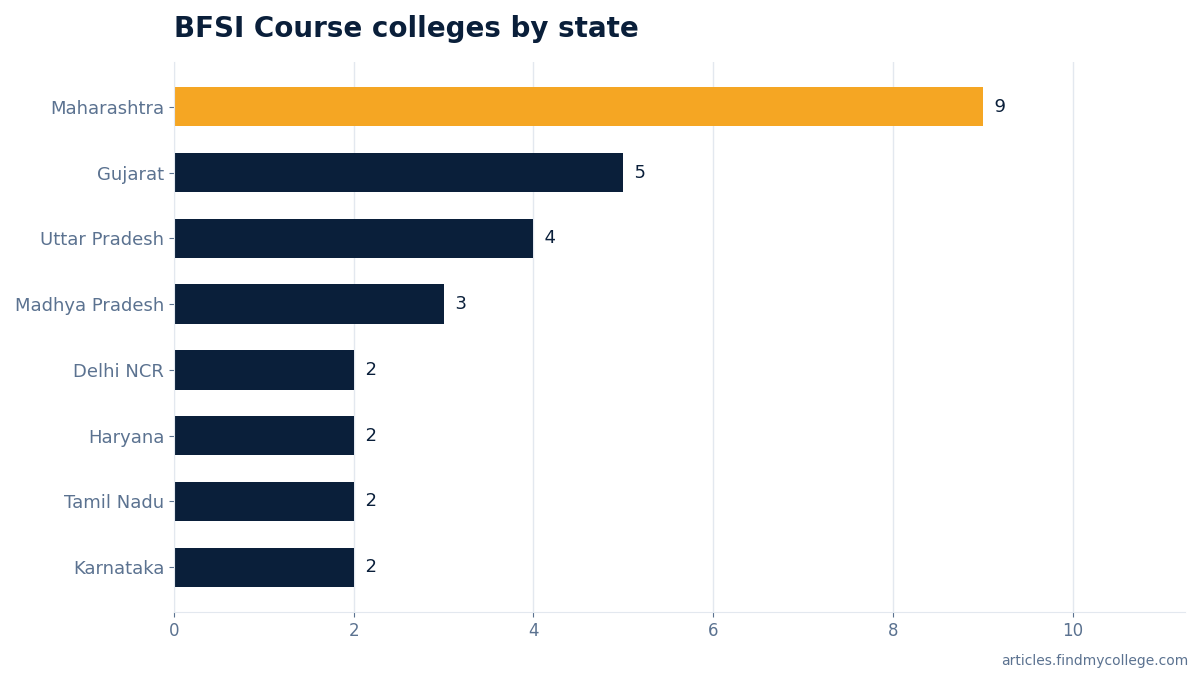
At least 38 colleges offer BFSI courses in India, comprising at least 4 government institutions and 11 private colleges. States with a high concentration of institutions include Maharashtra with 9 colleges, Gujarat with 5, Uttar Pradesh with 4, Madhya Pradesh with 3, Delhi NCR with 2, and Haryana with 2. Prominent national universities and autonomous institutions also feature in NIRF rankings.
| College | City | Ownership | Total course fee | NIRF rank |
|---|---|---|---|---|
| Calicut University | Calicut | Government | ₹36,655 | 38 (Overall, 2025) |
| Stella Maris College | Chennai | Private (aided) | ₹1.39 lakh | 41 (Overall, 2025) |
| Jamia Hamdard University | Delhi | — | ₹2.40 lakh | 47 (Overall, 2025) |
| Holy Cross College (Autonomous) Tiruchirappalli | Tiruchirappalli | Private (aided) | ₹78,960 | 52 (Overall, 2025) |
| Tata Institute of Social Sciences Mumbai | Mumbai | — | ₹90,000 | 72 (Overall, 2025) |
| Nitte University | Mangalore | — | ₹3.22 lakh | 80 (Overall, 2025) |
| Kalinga University | Raipur | — | ₹82,000 | 101 (Overall, 2023) |
| City | Colleges | Fee range | Well-known options |
|---|---|---|---|
| Pune | 4 | ₹90,000 – ₹90,000 | Ness Wadia College of Commerce, PIBM Skills |
| Mumbai | 3 | ₹90,000 – ₹1.61 lakh | Tata Institute of Social Sciences Mumbai, Harkisan Mehta Foundation Institute of Media, Research and Analysis |
| Delhi | 2 | ₹2.40 lakh – ₹2.40 lakh | Jamia Hamdard University, American Academy of Financial Management |
| Moradabad | 2 | ₹81,700 – ₹1.72 lakh | Moradabad Institute of Technology, MIT Group of Institution |
| Rajkot | 2 | ₹1.20 lakh – ₹1.22 lakh | Shri Labhubhai Trivedi Institute of Engineering & Technology, Drona Foundation |
| Lucknow | 2 | ₹80,700 – ₹1.10 lakh | Dr. A.P.J. Abdul Kalam Technical University, SRM Business School |
| Bhopal | 2 | ₹60,000 – ₹60,000 | SCOPE Global Skills University, Aryavart University |
| North Goa | 1 | ₹24,415 – ₹24,415 | Government College of Arts Science and Commerce Sanquelim |
Eligibility Criteria for UG, PG, and Diploma BFSI Courses
- Undergraduate Degree: Candidates must pass Class 12th or equivalent in the Commerce stream from a recognized board or university. Mathematics is mandatory.
- Postgraduate Degree: Candidates must be a Commerce graduate or equivalent from a recognized university. Mathematics is mandatory.
- UG Diploma: Admissions to undergraduate diploma programmes in BFSI are generally granted on a merit basis.
- Apprenticeship: Eligibility requires completion of Class 10, Class 12, graduation, postgraduation, or a diploma in finance, commerce, or business administration, alongside meeting age criteria and pre-apprenticeship training requirements.
Mathematics is a mandatory subject for candidates pursuing undergraduate and postgraduate degree courses in BFSI.
Top Specialisations Offered in Indian BFSI Institutes
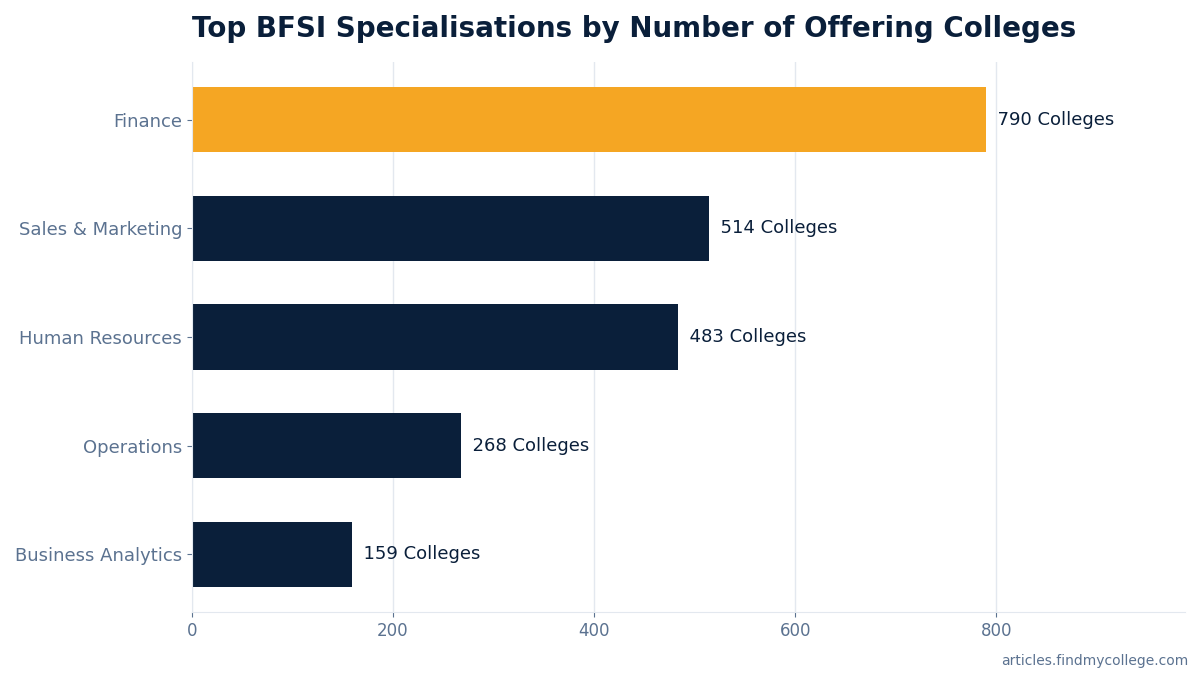
Finance remains the most widely available specialization across Indian colleges, followed by Sales & Marketing, Human Resources, Operations, and Business Analytics.
| Specialisation | Number of Colleges |
|---|---|
| Finance | 790 |
| Sales & Marketing | 514 |
| Human Resources | 483 |
| Operations | 268 |
| Business Analytics | 159 |
Major Entrance Exams for Admission to BFSI Programmes
| Exam Name | Exam Information | Accepting Institutions / Details |
|---|---|---|
| CAT / GMAT / MAT / XAT | Entrance exam | IMI, ISB, and IIMP |
| LUACMAT | Entrance exam | Lucknow University Associated Colleges Management Admission Test |
| SPSAT | Entrance exam | Sir Padampat Singhania Admission Test |
| CUET | Entrance exam | Accepted for BFSI course admissions |
| NMIMS NPAT | Entrance exam | Accepted for BFSI course admissions |
| CSEET | Entrance exam | Accepted for BFSI course admissions |
| CFA | Professional course exam | Accepted for BFSI course admissions |
Institutions like IMI, ISB, and IIMP accept entrance exam scores including CAT, GMAT, MAT, and XAT for admissions.
Tax Benefits and Financial Regulations Covered in BFSI
| Income Tax Act Section | Benefit Scope | Deduction / Exemption Details |
|---|---|---|
| Section 80C | Life Insurance Premium | Up to INR 1.5 Lacs deduction from taxable income |
| Section 80D | Health Insurance Premium | Tax deduction on premium paid |
| Section 10 (10D) | Life Insurance Policy Payouts | Tax-exempted for policyholder or nominee |
Under Section 80C of the Income Tax Act, premiums paid for life insurance qualify for a deduction of up to INR 1.5 Lacs from taxable income. Section 80D provides deductions on health insurance premiums, while payouts are tax-exempt under Section 10 (10D).
How to Apply for BFSI Course Admission in 2026: Step by Step
- Register for relevant entrance exams: Apply for accepted entrance exams such as CUET, NMIMS NPAT, CSEET, or management tests like CAT, GMAT, MAT, and XAT.
- Submit applications to target colleges: Apply directly to institutions like IMI, ISB, IIMP, or Lucknow University associated colleges.
- Appear for entrance examination: Sit for your chosen entrance test during its designated exam window (e.g., CFA Level 1 from 11 Nov to 17 Nov 2026).
- Participate in counselling or merit list process: Attend merit-based selection or counseling rounds (such as LUACMAT counselling) based on entrance scores.
- Complete document verification and fee payment: Submit required academic documents and complete seat acceptance fee payment to confirm BFSI course admission.
| What to do | Where | Link |
|---|---|---|
| Compare colleges, fees and cutoffs | BFSI Course colleges in India | findmycollege.com |
FAQs
What all comes under the BFSI sector?
The BFSI (Banking, Financial Services, and Insurance) sector covers banking operations, financial management, insurance policies, investment strategies, risk management, computer applications, and information technology in finance.
Is the BFSI course worth it?
Pursuing a BFSI course equips candidates with essential skills in financial markets, risk management, regulatory compliance, and asset management, preparing them for beginner to leadership roles in financial services.
How to join BFSI?
Candidates can join BFSI courses at UG, PG, UG Diploma, or Apprenticeship levels by fulfilling eligibility requirements (Class 12 Commerce or Commerce Graduation) and clearing entrance exams like CUET, NPAT, or CAT.
Is mathematics mandatory for BFSI courses?
Mathematics is mandatory for both undergraduate and postgraduate BFSI degree courses, as strong numerical and critical thinking skills are required for financial analysis and management.
Which entrance exams are accepted for BFSI courses?
Top entrance exams include CUET, NMIMS NPAT, CSEET, CFA, LUACMAT, and management exams like CAT, GMAT, MAT, and XAT for institutions such as IMI, ISB, and IIMP.
What major bank recruitment exams can I take after BFSI studies?
Popular government recruitment exams in the banking sector include IBPS PO, IBPS Clerk, SBI PO, and SBI Clerk.