BHMS Distance Education India 2026: Online Course Guide
Latest update: Bachelor of Homeopathic Medicine & Surgery 2026 admissions & dates updated. Read more ›
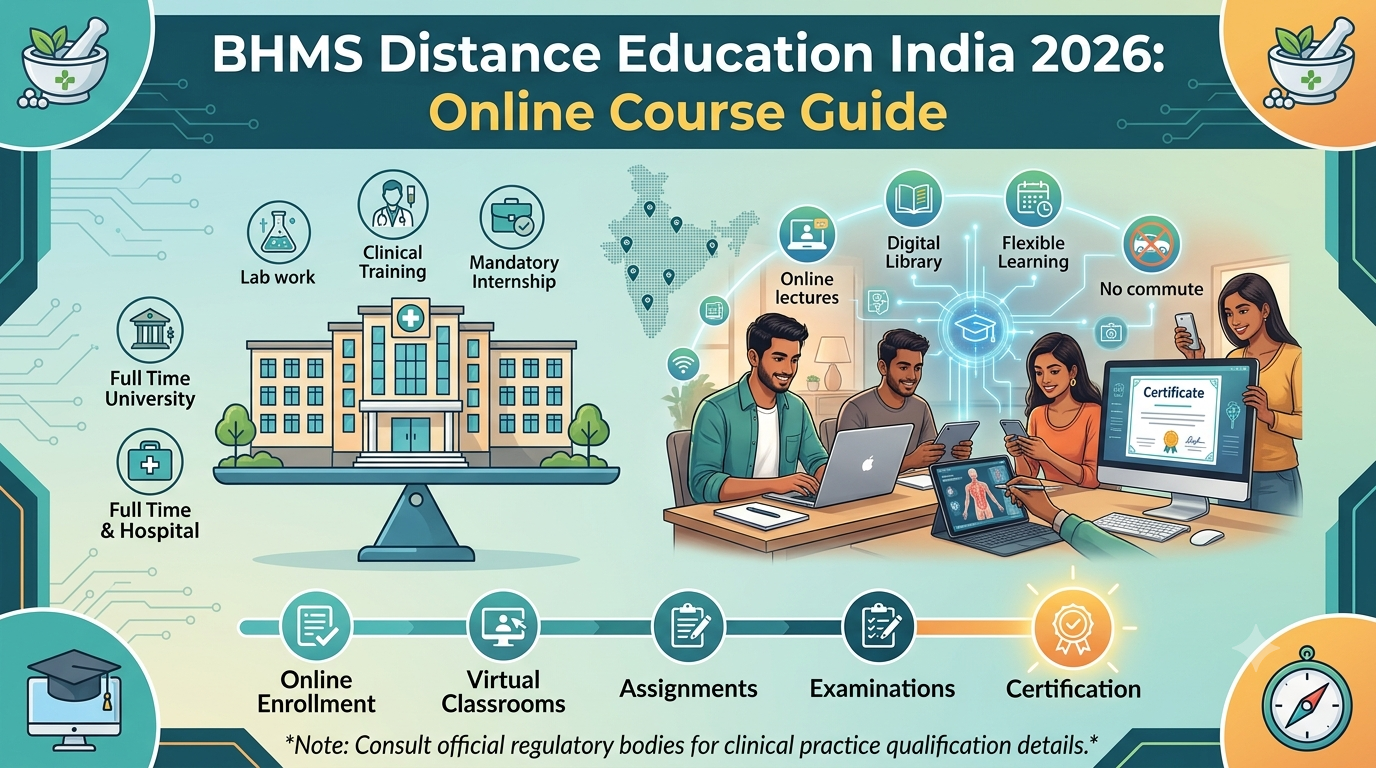
A practitioner-qualifying Bachelor of Homeopathic Medicine and Surgery (BHMS) degree cannot be earned via distance learning or online modes in India. According to regulations set by the National Commission for Homoeopathy (NCH) and the Ministry of AYUSH, BHMS is strictly a 5.5-year regular, full-time campus program (including a mandatory 1-year clinical internship) requiring mandatory laboratory work, hospital rotations, and NEET-UG qualification. Any distance-learning BHMS degree is legally unrecognized and invalid for clinical practice in India.
However, online and distance modes are available for short-term certificates and PG diplomas—such as Clinical Research, Homeopathic Pharmacy, and Healthcare Management—designed to help existing healthcare professionals, BHMS graduates, and holistic wellness enthusiasts upskill without practicing clinical medicine.
Is BHMS Distance Education Legal in India in 2026?
No, earning a practitioner-qualifying Bachelor of Homeopathic Medicine and Surgery (BHMS) degree through distance learning or correspondence is not legal in India. The regulatory framework set by the National Commission for Homoeopathy (NCH)—formerly the Central Council of Homoeopathy (CCH)—and the Ministry of AYUSH explicitly mandates that clinical medical degrees must be delivered through regular, full-time campus education.
Any distance education university or institute promising a valid practitioner degree via distance learning in 2026 is operating outside official AYUSH guidelines. Graduating from an unapproved distance program leaves students ineligible for state medical council registration, rendering them legally unable to practice medicine or prescribe remedies.
Top Online & Distance Courses in Homeopathy (Valid Options)
Although you cannot earn a clinical BHMS degree online, several legitimate distance and online courses exist for upskilling, research, and non-clinical practice:
| Course Type | Popular Specializations | Best Suited For | Career Outcome |
| Postgraduate Diplomas | Clinical Research, Healthcare Management, Pharmacovigilance | BHMS Graduates, Science Graduates | Clinical Research Associate, Health Administrator |
| Certificate Courses | Homeopathic Pharmacy, First Aid & Wellness | Pharmacists, General Public, Health Enthusiasts | Pharmacy Assistant, Wellness Consultant |
| Short-Term Online Modules | Classical Homeopathy, Repertory Software Usage | Registered Medical Practitioners | Skill Enhancement & Continuing Medical Education (CME) |
Regular BHMS vs. Online Homeopathy Courses: Key Differences
While online education and distance learning offer great flexibility for skill-building, they cannot replace a recognized clinical medical degree. Understanding the core differences between a regular, full-time Bachelor of Homeopathic Medicine and Surgery (BHMS) and online certificate courses is essential before enrolling in any program:
| Parameter | Regular Full-Time BHMS Degree | Online / Distance Homeopathy Courses |
| Primary Goal |
To train certified, practicing Homeopathic Doctors (Physicians). |
To offer basic upskilling, personal wellness knowledge, or administrative certificates. |
| Duration & Structure |
5.5 Years Total:
• 4.5 Years of academic coursework
• 1 Year compulsory rotatory clinical internship. |
3 Months to 1 Year (depends on the certification module). |
| Governing Bodies |
Fully governed & accredited by the National Commission for Homoeopathy (NCH) and the Ministry of AYUSH. |
Offered by private academies, online portals, or foreign distance learning associations (Not recognized by NCH/AYUSH). |
| Admission Basis |
Mandatory NEET-UG qualification and centralized counseling participation. |
Direct admission based on 10+2, graduation, or open enrollment. |
| Clinical Training | Extensive Hands-on Training: Cadaver dissections, pathology lab tests, hospital OPD/IPD duty, case-taking, and live remedy preparation. | Theory-Only: Video lectures, online reading materials, e-assignments, and webinars. |
| Legal Practice Rights |
Yes: Graduates receive a registration number from the State Medical Council to practice medicine legally. |
No: Does not grant legal rights to diagnose patients, prescribe remedies, or set up a medical clinic. |
Eligibility & Entrance Exam Requirements for BHMS Admission
Admission to an official full-time BHMS degree program in India follows strict criteria defined by the National Commission for Homoeopathy (NCH) and the National Testing Agency (NTA). Prospective students must satisfy all of the following requirements:
1. Educational Qualifications
-
Qualifying Exam: Candidates must have passed the 10+2 (Higher Secondary) or equivalent examination from a recognized central or state board.
-
Core Subjects: Compulsory subjects include Physics, Chemistry, Biology (or Biotechnology), and English. Candidates must pass each subject individually.
2. Minimum Qualifying Marks (PCB Aggregate)
-
General Category: Minimum 50% aggregate marks in Physics, Chemistry, and Biology combined.
-
Reserved Categories (SC/ST/OBC): Minimum 40% aggregate marks in PCB subjects.
-
Persons with Disabilities (PwD): Minimum 45% aggregate marks for General-PwD candidates.
3. Age Limit
-
Minimum Age: The applicant must be at least 17 years old on or before December 31 of the admission year.
-
Upper Age Limit: As per current NEET guidelines, there is no upper age restriction for appearing in the exam or applying for BHMS admissions.
4. Mandatory Entrance Examination (NEET-UG)
-
Exam Requirement: Clearing the National Eligibility cum Entrance Test (NEET-UG) is mandatory for admission to both government and private homeopathic colleges across India.
-
Qualifying Percentile: Candidates must secure the minimum qualifying percentile in NEET-UG (typically 50th percentile for General/EWS and 40th percentile for SC/ST/OBC).
-
Counseling Process: Seat allocation takes place through official state-level (85% quota) and central All India Quota (15% AIQ through AACCC) counseling rounds based strictly on NEET rank and merit.
| Eligibility Parameter | Requirement Details |
| Qualifying Examination | Passed 10+2 (Class 12) or equivalent from a recognized Central/State Board. |
| Mandatory Subjects | Compulsory pass in Physics, Chemistry, Biology/Biotechnology, and English (individually passed). |
| Minimum PCB Aggregate Marks |
• General / EWS Category: Minimum 50% in PCB combined. • SC / ST / OBC Categories: Minimum 40% in PCB combined. • General-PwD Category: Minimum 45% in PCB combined. |
| Age Limit |
• Minimum Age: At least 17 years old by December 31 of the admission year. • Upper Age Limit: No upper limit (as per current Supreme Court & NTA guidelines). |
| Mandatory Entrance Exam | NEET-UG qualification is compulsory (No direct/distance admissions permitted). |
| NEET Qualifying Percentile |
• General / EWS: 50th Percentile • SC / ST / OBC: 40th Percentile • General-PwD: 45th Percentile |
| Counseling Authority |
• 15% All India Quota (AIQ): AYUSH Admissions Central Counseling Committee (AACCC) • 85% State Quota: Respective State AYUSH Counseling Authorities |
How Much Does a Full-time BHMS Program Cost in India (2026)?
The cost of a full-time BHMS program varies significantly between government and private institutions. Government colleges generally have lower fees due to subsidies, while private colleges charge higher tuition.
| Institution Type | Annual Tuition Fee (INR) | Hostel & Other Charges (Annual, INR) | Total Annual Cost (INR) |
|---|---|---|---|
| Government Colleges | ₹20,000 – ₹1,00,000 | ₹10,000 – ₹50,000 | ₹30,000 – ₹1,50,000 |
| Private Colleges | ₹1,00,000 – ₹4,00,000 | ₹50,000 – ₹1,50,000 | ₹1,50,000 – ₹5,50,000 |
These figures are estimates for 2026 and can vary based on the specific college, its location, and facilities. The total course fee for 5.5 years would be a multiple of these annual costs, plus examination fees and other miscellaneous expenses.
Admission Process for BHMS Program
The admission process for the Bachelor of Homeopathic Medicine and Surgery (BHMS) program in India follows a structured, multi-step workflow governed by the National Testing Agency (NTA) and the Ayush Admissions Central Counseling Committee (AACCC) under the Ministry of AYUSH.
Syllabus and Curriculum for BHMS
The BHMS curriculum is comprehensive, covering both foundational medical sciences and specialized homeopathic subjects. It is structured over 4.5 years of academic study followed by a 1-year compulsory internship.
Key Subjects in the BHMS Curriculum
- Pre-Clinical: Anatomy, Physiology, Biochemistry
- Para-Clinical: Pathology, Microbiology, Forensic Medicine & Toxicology, Community Medicine
- Clinical & Homeopathic Specific: Organon of Medicine with Homeopathic Philosophy, Homeopathic Materia Medica, Repertory, Practice of Medicine, Surgery, Obstetrics & Gynaecology, Pediatrics, Homeopathic Pharmacy
Career Prospects and Salary Expectations after BHMS
A BHMS degree opens up various career opportunities in the healthcare sector. Graduates can work as practitioners, consultants, researchers, or educators.
| Job Role | Description | Average Annual Salary (INR) |
|---|---|---|
| Homeopathic Doctor/Practitioner | Private practice, clinical consultation, treating patients with homeopathic remedies. | ₹2,50,000 – ₹8,00,000+ (highly dependent on experience & practice location) |
| Medical Officer (Government) | Working in government dispensaries, hospitals, or public health programs. | ₹4,00,000 – ₹7,00,000 |
| Lecturer/Professor | Teaching in homeopathic medical colleges. Requires postgraduate qualification (MD in Homoeopathy). | ₹3,00,000 – ₹10,00,000+ |
| Researcher | Engaged in clinical trials, drug proving, and scientific research in homeopathy. | ₹3,00,000 – ₹7,00,000 |
| Consultant (Pharmaceuticals) | Working with homeopathic pharmaceutical companies for product development, quality control, or sales. | ₹3,50,000 – ₹9,00,000 |
Salaries can significantly increase with experience, specialization (e.g., MD in Homoeopathy), and establishing a successful private practice. Many BHMS graduates also pursue higher education like MD (Hom.) or MPH (Master of Public Health) to enhance their career prospects.
Is BHMS Worth It For Jobs and Career Growth in India?
Yes, BHMS is a worthwhile career path for those genuinely interested in holistic healthcare and homeopathy. While initial salaries might be moderate compared to allopathic doctors, the field offers significant growth potential, especially with specialization and establishing a strong practice. The demand for alternative medicine, including homeopathy, is steadily growing in India and globally, creating stable career opportunities.
Career growth often involves pursuing an MD in Homoeopathy for specialization, opening a successful private clinic, or joining government health services. The satisfaction of providing holistic care and contributing to patient well-being is a significant non-monetary benefit.
Top Colleges for BHMS in India
Some of the top and well-regarded institutions for BHMS in India include (but are not limited to):
- National Institute of Homoeopathy (NIH), Kolkata
- Maharashtra University of Health Sciences (MUHS), Nashik (affiliated colleges)
- Dr. D.Y. Patil Homoeopathic Medical College & Research Centre, Pune
- Smt. Chandaben Mohanbhai Patel Homoeopathic Medical College, Mumbai
- Government Homeopathic Medical College, Bengaluru
- Father Muller Homoeopathic Medical College, Mangaluru
- Bharati Vidyapeeth Deemed University, Pune
- Homoeopathic Medical College and Hospital, Chandigarh
Prospective students should always verify the current recognition status of any college with the National Commission for Homoeopathy (NCH) before applying.