
Biomedical Engineering Scope: Job Roles, Career Options and Growth
Nishit Kumar is a senior EdTech industry leader with over a decade of experience in building and scaling education platforms, shaping their product, content, and growth strategy. At…
Biomedical Engineering offers an expanding career scope spanning medical device design, healthcare, biotech, biopharma, and bioinformatics. Entry-level salaries range from ₹3.5 LPA to ₹8 LPA for B.Tech graduates and ₹5 LPA to ₹10 LPA for Integrated M.Tech graduates.
Below is an overview of career pathways, salary trends, top recruiters, higher studies, government job options, and admission steps.
| Parameter | Details |
|---|---|
| B.Tech Entry Salary Range | ₹3.5 to ₹8 LPA |
| Integrated M.Tech Entry Salary Range | ₹5 to ₹10 LPA |
| B.Tech Course Duration | 4 Years |
| Integrated M.Tech Course Duration | 5 Years |
| Key Government Research Agencies | DRDO, CSIR, Public Health Departments |
| Highest Paying Functional Domains | Regulatory Affairs, Clinical Research, Biotech Business Development |
Biomedical Engineering Scope in India
Emerging key focus areas in bioengineering include CRISPR gene editing, nanobiotechnology, environmental remediation, and bioinformatics. Scope extends across pharmaceutical development, computational biology, precision agriculture, and clinical diagnostics.
| Industry Sector | Key Focus Areas & Applications | Example Companies / Organization Types |
|---|---|---|
| Biotech & Biopharma | Fermentation tech, therapeutic products, drug discovery | Biocon, Novozymes, Syngene, Serum Institute |
| Healthcare & Hospitals | Diagnostics, medical device design, ICU technology, biosensors | Hospitals, Diagnostic centers, Device manufacturers |
| Agriculture Technology | Precision farming, GM crops, biofertilizers | Agri-tech research firms & startups |
| Environmental Technology | Bioremediation, wastewater treatment, zero-liquid discharge systems | Waste management companies, green tech startups |
| IT & Bioinformatics | AI/ML in genomics, healthcare analytics, precision medicine | Tech firms, Genomic data analysis companies |
| College | City | Ownership | Total course fee | NIRF rank |
|---|---|---|---|---|
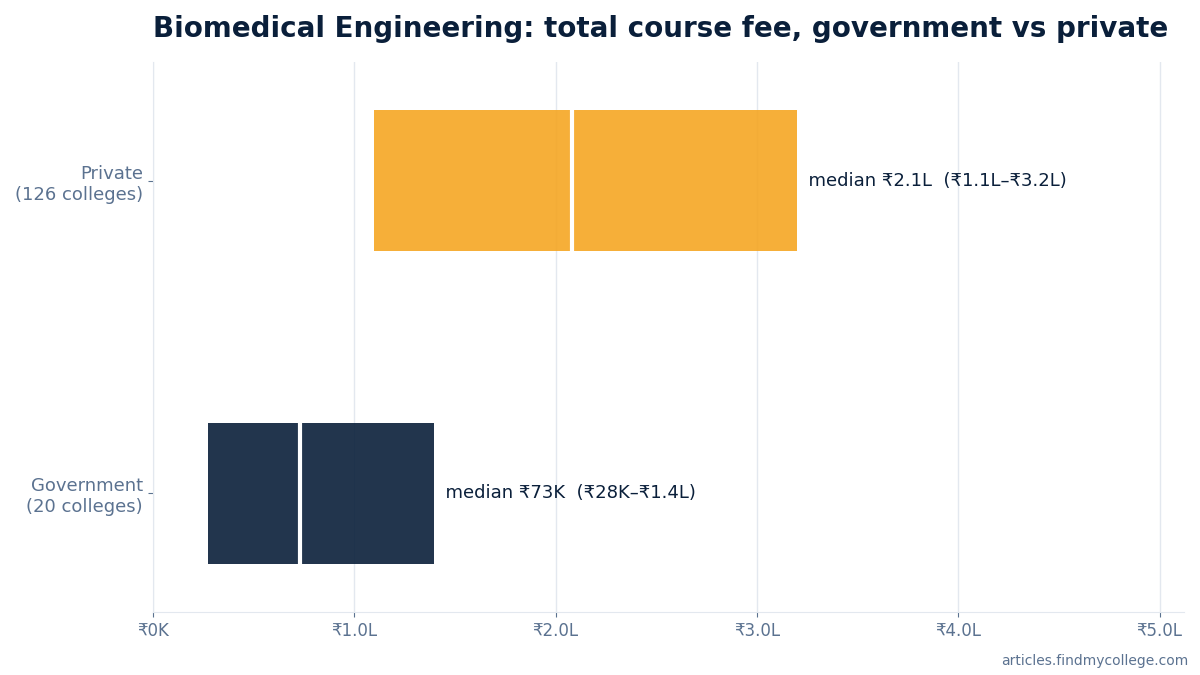
| Indian Institute of Technology Madras | Chennai | Government | ₹49,200 | 1 (Overall, 2025) |
| Indian Institute of Technology Bombay | Mumbai | Government | ₹51,500 | 3 (Overall, 2024) |
| Indian Institute of Technology Kanpur | Kanpur | Government | ₹84,040 | 5 (Overall, 2025) |
| Indian Institute of Technology Roorkee | Roorkee | — | ₹90,300 | 6 (Overall, 2025) |
| Indian Institute of Technology Kharagpur | Kharagpur | Government | ₹43,800 | 6 (Overall, 2025) |
| Indian Institute of Technology New Delhi | Delhi | Government | ₹1.79 lakh | 8 (Overall, 2025) |
| Amrita Vishwa Vidyapeetham | Coimbatore | — | ₹4.00 lakh | 8 (Overall, 2025) |
| Jadavpur University | Kolkata | Government | ₹9,960 | 9 (Overall, 2025) |
| National Institute of Technology Rourkela | Rourkela | — | ₹68,500 | 9 (Overall, 2025) |
| College | City | Ownership | Total course fee |
|---|---|---|---|
| L.D. College of Engineering | Ahmedabad | Government | ₹8,190 |
| Government Engineering College Gandhi Nagar | Gandhi Nagar | Government | ₹9,100 |
| Jadavpur University | Kolkata | Government | ₹9,960 |
| Visvesvaraya Technological University | Belgaum | Government | ₹17,420 |
| Muzaffarpur Institute of Technology | Muzaffarpur | Government | ₹22,120 |
| Indian Institute of Technology Kharagpur | Kharagpur | Government | ₹43,800 |
| Indian Institute of Technology Madras | Chennai | Government | ₹49,200 |
| Indian Institute of Technology Bombay | Mumbai | Government | ₹51,500 |
| University College of Engineering, Osmania University | Hyderabad | Government | ₹60,000 |
| Indian Institute of Technology Varanasi | Varanasi | Government | ₹62,380 |
| College | City | Ownership | Total course fee | Average package |
|---|---|---|---|---|
| Shri Govindram Seksaria Institute of Technology and Science | Indore | Private (aided) | ₹4.36 lakh | 7.21 LPA |
| Padmasri Dr. BV Raju Institute of Technology | Hyderabad | Private | ₹5.40 lakh | 4.25 LPA |
| Vidyalankar Institute of Technology | Mumbai | Private | ₹2.68 lakh | 3.62 LPA |
| Rajiv Gandhi Institute of Technology Mumbai | Mumbai | Private | — | 3.44 LPA |
| Sri Venkateswara College of Engineering and Technology Chittoor | Chittoor | Private | ₹2.11 lakh | 3.37 LPA |
| SNS College of Technology | Coimbatore | Private | ₹2.20 lakh | 3.31 LPA |
| ACS College of Engineering | Bangalore | Private | ₹6.60 lakh | 2.99 LPA |
| Sri Siddhartha Institute of Technology | Tumkur | Private | ₹4.47 lakh | 2.92 LPA |
| Vel Tech Multi Tech Dr. Rangarajan Dr. Sakunthala Engineering College | Chennai | Private | ₹2.60 lakh | 2.65 LPA |
| Rajadhani Institute of Engineering and Technology Attinga | Thiruvananthapuram | Private | — | 2.38 LPA |
| City | Colleges | Fee range | Well-known options |
|---|---|---|---|
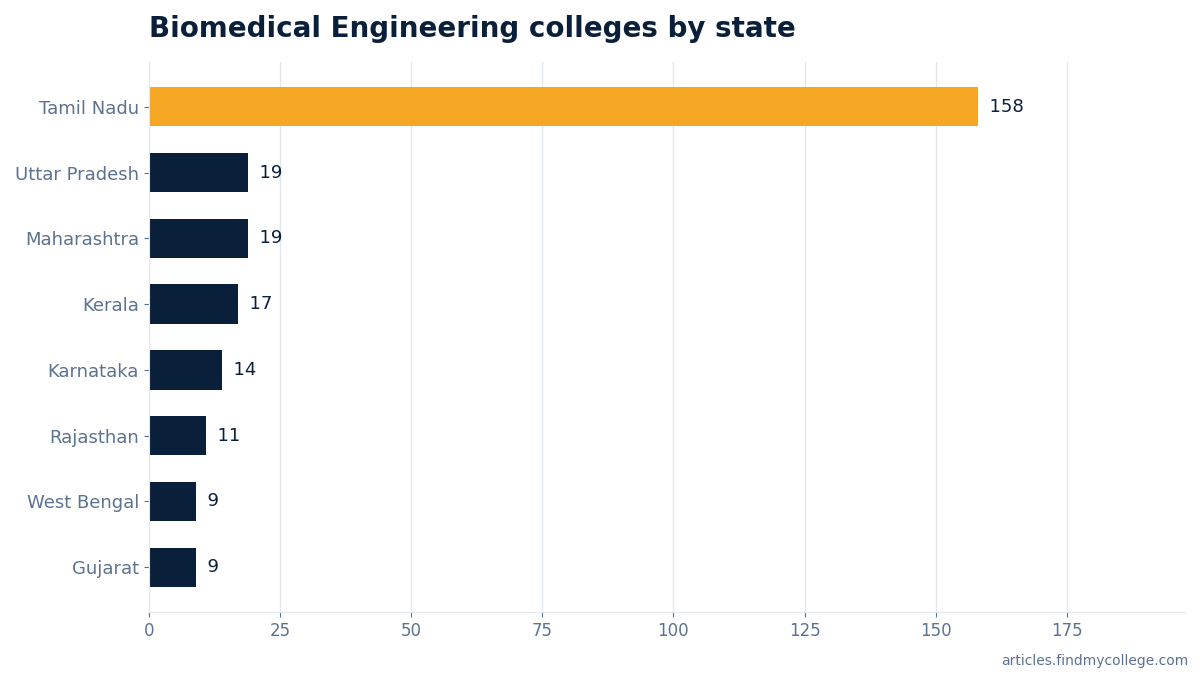
| Chennai | 39 | ₹49,200 – ₹11.60 lakh | Indian Institute of Technology Madras, Saveetha Institute of Medical and Technical Sciences |
| Coimbatore | 27 | ₹70,000 – ₹18.00 lakh | Amrita Vishwa Vidyapeetham, P.S.G College of Technology |
| Salem | 13 | ₹80,000 – ₹4.59 lakh | Vinayaka Mission’s Research Foundation VMRF, Sona College of Technology |
| Namakkal | 12 | ₹1.00 lakh – ₹8.39 lakh | Paavai Engineering College (Autonomous), Paavai College of Engineering, Pachal |
| Tiruchirappalli | 12 | ₹1.06 lakh – ₹5.10 lakh | Shivani Engineering College, M.A.M College of Engineering |
| Kanyakumari | 8 | ₹80,000 – ₹3.00 lakh | Noorul Islam University, Loyola Institute of Technology and Science |
| Kolkata | 7 | ₹9,960 – ₹5.00 lakh | Jadavpur University, Maulana Abul Kalam Azad University of Technology |
| Thiruvananthapuram | 6 | ₹1.22 lakh – ₹5.02 lakh | APJ Abdul Kalam Technological University, Rajadhani Institute of Engineering and Technology Attinga |
Job Roles after Biomedical Engineering
Graduates take up technical, operational, and research profiles based on their focus area. Biomedical engineers work on medical device design and healthcare technology, while genetic engineers work in research labs, gene therapy, and agriculture. Bioprocess engineers operate within biopharma companies focusing on fermentation technology.
| Job Profile | Industry / Core Function |
|---|---|
| Biomedical Engineer | Healthcare, medical device design |
| Genetic Engineer | Research labs, gene therapy, and agriculture |
| Research Scientist | Pharma companies, academic institutions |
| Bioprocess Engineer | Biopharma, fermentation technology |
| Environmental Biotechnologist | Waste management, green tech startups |
| Bioinformatics Analyst | Genomic data analysis, drug development |
| Healthcare Data Scientist | AI-enabled healthcare systems, diagnostics |
Biomedical Engineering Salary
Salary packages vary depending on academic qualification, hands-on lab experience, and functional specialization. B.Tech Bioengineering graduates receive entry-level salary packages ranging from ₹3.5 to ₹8 LPA. Integrated M.Tech graduates in Bioengineering earn starting salaries between ₹5 and ₹10 LPA. Roles in regulatory affairs, clinical research, and biotech business development offer some of the highest salaries in bioengineering.
Higher Studies after Biomedical Engineering
Higher education allows graduates to specialize in advanced technical or managerial branches. Academic post-graduation pathways include M.Sc. in Industrial Biotechnology (2 Years), M.Sc. in Bioinformatics (2 Years), M.Sc. in Clinical Research (2 Years), and Ph.D. in Bioengineering (Minimum 3 Years).
| Program Name | Duration | Focus Area |
|---|---|---|
| B.Tech in Bioengineering | 4 Years | Fundamentals of bioengineering, lab skills, industry readiness |
| Integrated M.Tech in Bioengineering | 5 Years | Interdisciplinary research and innovation |
| M.Sc. in Industrial Biotechnology | 2 Years | Biopharma and industrial-scale biotechnology |
| M.Sc. in Bioinformatics | 2 Years | Genomics, computational biology |
| M.Sc. in Clinical Research | 2 Years | Clinical trials, regulatory affairs, drug development |
| Ph.D. in Bioengineering | Min. 3 Years | Advanced research in healthcare and sustainability |
Is Biomedical Engineer a Good Career Choice?
Biomedical Engineering is a viable career path due to strong industry demand across biopharma, medical technology, and computational biology. B.Tech Bioengineering graduates receive entry-level salary packages ranging from ₹3.5 to ₹8 LPA, while Integrated M.Tech graduates in Bioengineering earn starting salaries between ₹5 and ₹10 LPA. Roles in regulatory affairs, clinical research, and biotech business development offer some of the highest salaries in bioengineering. Emerging key focus areas in bioengineering include CRISPR gene editing, nanobiotechnology, environmental remediation, and bioinformatics.
How to Start a Career as Biomedical Engineering: Step by Step
- Choose an academic program: Select a 4-year B.Tech in Bioengineering for fundamental skills or a 5-year Integrated M.Tech program for interdisciplinary research.
- Gain practical experience: Build hands-on lab experience in key areas such as CRISPR gene editing, nanobiotechnology, bioinformatics, or environmental remediation.
- Pursue higher studies: Specialize through 2-year M.Sc. programs in Industrial Biotechnology, Bioinformatics, or Clinical Research, or pursue a Ph.D. in Bioengineering.
- Explore career profiles: Apply for job roles such as Biomedical Engineer, Genetic Engineer, Bioprocess Engineer, Bioinformatics Analyst, or Healthcare Data Scientist.
- Apply to corporate and government recruiters: Target private firms like Biocon, Syngene, Thermo Fisher, and GSK, or government agencies like DRDO and CSIR.
| What to do | Where | Link |
|---|---|---|
| Compare colleges, fees and cutoffs | Biomedical Engineering colleges in India | findmycollege.com |
B.Tech graduates receive entry-level salary packages ranging from ₹3.5 to ₹8 LPA, whereas Integrated M.Tech graduates earn ₹5 to ₹10 LPA. Roles in regulatory affairs, clinical research, and biotech business development offer some of the highest salaries.
FAQs
Is biomedical engineer a good career?
Yes, B.Tech Bioengineering graduates receive entry-level salary packages ranging from ₹3.5 to ₹8 LPA, with career opportunities across healthcare, biopharma, genetic engineering, and bioinformatics.
Does biomedical engineering have a good salary?
Yes, entry-level B.Tech salaries range from ₹3.5 to ₹8 LPA, while Integrated M.Tech graduates earn ₹5 to ₹10 LPA. Roles in regulatory affairs, clinical research, and biotech business development offer even higher packages.
What job can I get after biomedical engineering?
Graduates can work as Biomedical Engineers, Genetic Engineers, Research Scientists, Bioprocess Engineers, Environmental Biotechnologists, Bioinformatics Analysts, and Healthcare Data Scientists.
How to get a government job after biomedical engineering?
Government recruiters hiring bioengineering graduates include research agencies like DRDO, CSIR, and public health departments.
What are the courses available in Bioengineering?
Available courses include 4-year B.Tech in Bioengineering, 5-year Integrated M.Tech, 2-year M.Sc. options (Bioinformatics, Industrial Biotechnology, Clinical Research), and Ph.D. programs.