

B.Sc Physics Salary in India 2026: Fresher to Experienced Pay Scale
Nishit Kumar is a senior EdTech industry leader with over a decade of experience in building and scaling education platforms, shaping their product, content, and growth strategy. At…
Latest update: B.Sc in Physics 2026 admissions & dates are being updated. Read more ›
A B.Sc Physics salary in India for a fresher typically ranges from Rs 2.5 lakh to Rs 6 lakh per annum (LPA) in 2026, with an average around Rs 3-4 LPA. Pay rises sharply with skills and specialisation: graduates who move into data analytics, data science, research or semiconductor and technology roles can reach Rs 8-25 LPA and beyond within a few years. This page breaks down the B.Sc Physics salary by role, experience, sector and location, and shows exactly how to boost your earning potential.
B.Sc Physics Salary in India: Quick Answer
After a B.Sc in Physics, entry-level salaries in India usually fall in the Rs 2.5-6 LPA band, or roughly Rs 20,000-50,000 per month. The exact figure depends on your job role, employer type (private, PSU or academic), city and any add-on skills such as programming or data tools. The core physics degree opens the door; certifications and internships decide how high the starting number goes.
For the full picture of the course itself, see our B.Sc Physics course overview, which covers duration, eligibility, fees and admission.
B.Sc Physics Salary by Experience Level
Salary grows steadily with experience, and the biggest jumps come when a graduate adds a specialisation or a post-graduate qualification. The table below shows typical annual pay ranges across a career.
| Experience Level | Years | Approx. Salary Range (per annum) |
|---|---|---|
| Fresher / Entry-level | 0-2 years | Rs 2.5-6 LPA |
| Junior / Early career | 2-4 years | Rs 4-8 LPA |
| Mid-level | 4-7 years | Rs 6-12 LPA |
| Senior / Specialised | 7+ years | Rs 10-25 LPA+ |
Ranges are indicative and vary by employer, city and skill set. Sources: GetMyUni, CollegeSearch, PayScale (2025-2026).
B.Sc Physics Salary by Job Role
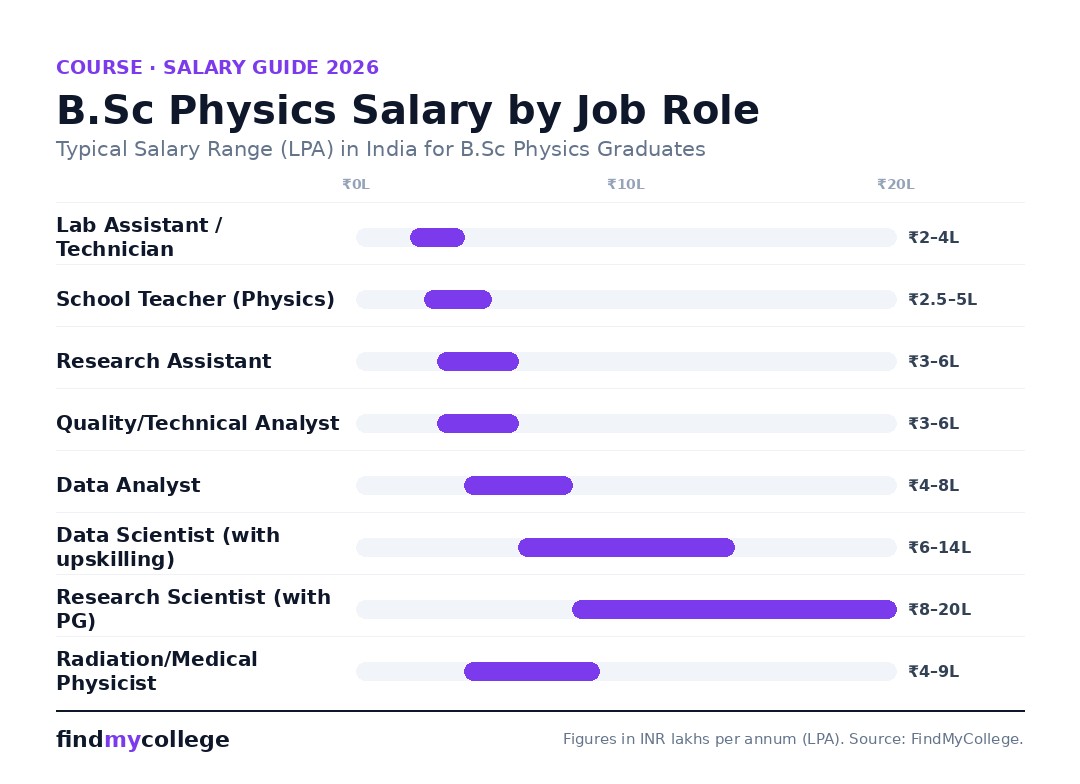
Job role is the single biggest driver of B.Sc Physics salary. Traditional physics jobs such as lab assistant or teacher sit at the lower end, while data-driven and technology roles pay the most. The table below lists common career paths for B.Sc Physics graduates and their typical starting-to-mid salary bands.
| Job Role | Typical Salary Range (per annum) |
|---|---|
| Lab Assistant / Technician | Rs 2-4 LPA |
| School Teacher (Physics) | Rs 2.5-5 LPA |
| Research Assistant | Rs 3-6 LPA |
| Quality/Technical Analyst | Rs 3-6 LPA |
| Data Analyst | Rs 4-8 LPA |
| Data Scientist (with upskilling) | Rs 6-14 LPA |
| Research Scientist (with PG) | Rs 8-20 LPA+ |
| Radiation/Medical Physicist | Rs 4-9 LPA |
Data science and research scientist figures generally require additional training or a master’s/PhD. Sources: GetMyUni, CollegeSearch, 6figr, Indeed (2025-2026).
Why data and tech roles pay more
Physics graduates are strong at mathematics, modelling and problem-solving, which makes them a natural fit for analytics and data science. Employers in these newer fields pay a premium, so a B.Sc Physics graduate who learns Python, SQL and statistics can often out-earn peers who stay in traditional lab or teaching roles. Choosing the right electives matters here; our B.Sc Physics syllabus guide shows which computational and mathematical papers build these skills.
B.Sc Physics Salary by Sector
Government and PSU jobs offer stable pay with strong benefits, while private industry and technology firms offer higher ceilings for skilled candidates. The table compares typical sectors.
| Sector | Typical Salary Range (per annum) | Notes |
|---|---|---|
| Government / PSU (e.g. DRDO, ISRO, BARC support roles) | Rs 3-7 LPA | Fixed pay scales, job security, added allowances |
| Academic / Teaching | Rs 2.5-6 LPA | Higher with PG/PhD and permanent posts |
| Private industry (manufacturing, electronics) | Rs 3-8 LPA | Depends on role and technical skills |
| IT / Data / Analytics | Rs 4-14 LPA | Highest growth for upskilled graduates |
B.Sc Physics Salary by City
Metro cities pay more than smaller towns, mainly because of the concentration of technology, research and analytics employers. As a rough guide, salaries in Bengaluru, Hyderabad, Pune, Mumbai and the Delhi-NCR region tend to sit 15-30% above the national average for the same role, while tier-2 and tier-3 cities are usually slightly below it. Cost of living should be weighed against these higher offers.
How to Increase Your B.Sc Physics Salary
The fastest way to raise your B.Sc Physics salary is to pair the degree with in-demand technical skills or a higher qualification. Practical steps include:
- Learn data skills – Python, SQL, Excel, statistics and machine-learning basics open analytics and data-science roles paying Rs 4-14 LPA.
- Pursue an M.Sc or specialised PG – a master’s in Physics, Astrophysics, Electronics or Data Science lifts research and scientist salaries into the Rs 8-20 LPA band.
- Do internships early – hands-on lab, R&D or industry internships lead to better first offers.
- Target high-growth sectors – semiconductors, aerospace, AI and renewable energy reward physics graduates well.
- Consider competitive exams – clearing exams for PSUs, ISRO, DRDO or teaching (NET/SET) unlocks stable, well-paid government roles.
Where you study also shapes your first salary. Explore B.Sc colleges in India and the broader list of top Science colleges in India to compare placements and reputation before you enrol.
B.Sc Physics vs Higher Studies: Salary Impact
A stand-alone B.Sc Physics degree suits entry-level jobs, but the highest salaries almost always follow further study. Graduates who complete an M.Sc, an MBA, or a specialised data/technology programme typically move from the Rs 2.5-6 LPA fresher band into Rs 6-15 LPA roles much faster. If research is the goal, a PhD is often essential for scientist positions at national labs and universities.
Explore more on FindMyCollege
Related pages for B.Sc in Physics aspirants on findmycollege.com:
Frequently Asked Questions