
BTech Marine Engineering 2026: IMU CET, Top Colleges, Scope & Merchant Navy Salary
BTech Marine Engineering is a 4-year professional engineering degree that trains students to design, operate, and maintain the mechanical and electrical systems of ships, submarines, and other marine vessels. It’s the backbone of the Merchant Navy, where engineers ensure that massive ships—carrying people, cargo, or oil—safely cross oceans through precision engineering and round-the-clock operations.
Unlike conventional branches, Marine Engineering combines mechanical engineering, electrical systems, and naval architecture with maritime science. Students learn about ship design, propulsion systems, thermodynamics, control engineering, and even the workings of engine rooms onboard vessels.
In 2026, the field is evolving fast with DG Shipping’s updated training standards, automation in ship machinery, and the global shift toward green marine technology. With opportunities both at sea and onshore—ranging from shipbuilding and ports to offshore energy—Marine Engineering continues to attract adventurous and technically minded students who want a career that quite literally takes them across the world’s oceans.
What is BTech in Marine Engineering?
BTech Marine Engineering is a 4-year undergraduate program regulated by the Directorate General of Shipping (DG Shipping), Government of India, and offered primarily through the Indian Maritime University (IMU) and other DG Shipping-approved institutes. The program focuses on producing licensed marine engineers who can work onboard merchant ships or in shore-based marine industries.
Students are trained in the marine tech curriculum, which blends classroom learning, laboratory work, and rigorous onboard training. The course covers everything from ship design and marine propulsion systems to electrical machinery, thermodynamics, and control systems—ensuring that graduates can handle both engineering and operational challenges at sea.
Key Highlights:
- BTech Marine Engineering Duration: 4 Years (8 Semesters)
- Eligibility: 10+2 with Physics, Chemistry, Mathematics (minimum 60% aggregate) and English (50%); medical fitness as per DG Shipping norms
- Admission Process: Through IMU CET 2026, conducted by the Indian Maritime University
- Regulatory Body: Directorate General of Shipping (DG Shipping), Ministry of Ports, Shipping & Waterways
- Training Component: Mandatory onboard internship and simulator training for engine room operations
BTech Marine Engineering Syllabus Breakdown
The Marine Tech Curriculum for BTech Marine Engineering is designed to blend mechanical, electrical, and naval engineering principles with real-world maritime operations. It’s one of the most structured and practical engineering programs in India, closely aligned with DG Shipping standards (2026 update) and International Maritime Organisation (IMO) guidelines.
Across four years, students move from learning core engineering fundamentals to mastering ship machinery, propulsion systems, and onboard operations. Practical training plays a huge role—students spend extensive hours in workshops, simulators, and ship visits, preparing them for life at sea.
| Year | B Tech Marine Engineering Subjects | Core Learning Outcomes |
| Year 1 – Foundation in Marine & Mechanical Sciences | – Engineering Mathematics, Physics & Chemistry – Engineering Drawing & Workshop Practice – Basic Thermodynamics & Mechanics – Introduction to Ship Technology | Builds fundamental understanding of engineering sciences and introduces the basics of ship systems and mechanics. |
| Year 2 – Core Marine Systems & Ship Design | – Fluid Mechanics & Hydraulics – Marine Materials and Strength of Ships – Applied Thermodynamics – Ship Construction and Stability – Electrical Machines & Control Engineering | Develops knowledge of ship design principles, marine structures, and propulsion systems with emphasis on engineering applications. |
| Year 3 – Advanced Marine Engineering & Operations | – Marine Power Plants & Heat Engines – Marine Electrical Systems – Marine Refrigeration & Air Conditioning – Ship Fire Prevention, Safety & Environmental Studies – Marine Control Systems & Automation | Focuses on advanced shipboard systems, automation, and safety management under DG Shipping and IMO standards. |
| Year 4 – Practical Training & Project Work | – Marine Machinery Operation & Maintenance – Internship / Onboard Training (6–12 months) – Final Year Project (Innovation in Ship Design or Marine Systems) | Applies classroom knowledge through real-world training and research; prepares students for Merchant Navy and shipyard roles. |
Note: The 2026 DG Shipping curriculum update includes modules on green propulsion systems, ship automation, and maritime sustainability, aligning India’s training standards with global maritime technology trends.
How to join BTech Marine Engineering after 12th?
Admission to BTech Marine Engineering programs in India primarily happens through the IMU CET (Indian Maritime University Common Entrance Test) — the national-level entrance exam conducted by the Indian Maritime University (IMU), Chennai. It’s the official gateway to all IMU campuses and many DG Shipping-approved affiliated institutes.
The exam tests a student’s conceptual clarity in Physics, Chemistry, Mathematics, and English, ensuring that only technically strong and medically fit candidates join the marine profession.
IMU CET 2026: Important Dates (Tentative Schedule)
| Event | Expected Dates (2026) | Details |
| Application Form Release | April 2026 (1st week) | Online registration begins on the official IMU website (imu.edu.in). |
| Last Date to Apply | May 2026 (mid-month) | Candidates must complete the form, upload documents, and pay fees online. |
| Admit Card Release | May 2026 (last week) | Downloadable from the IMU portal using application credentials. |
| Exam Date | June 2026 (1st or 2nd week) | Conducted in computer-based mode across multiple Indian cities. |
| Result Declaration | June 2026 (3rd week) | IMU releases rank list and scorecards. |
| Counselling & Seat Allotment | July 2026 | Centralised online counselling for IMU campuses and participating institutes. |
🧮 IMU CET 2026 Exam Pattern
| Section | Subjects | No. of Questions | Marks |
| 1 | Physics | 50 | 50 |
| 2 | Chemistry | 25 | 25 |
| 3 | Mathematics | 50 | 50 |
| 4 | English | 25 | 25 |
| 5 | General Knowledge & Aptitude | 50 | 50 |
| Total | 200 Questions | 200 Marks |
- Exam Mode: Computer-Based Test (CBT)
- Duration: 3 hours
- Type: Multiple Choice Questions (MCQs)
- Marking Scheme: +1 for correct answer, no negative marking (as per recent trends)
- Medium: English only
🎓 BTech Marine Engineering Eligibility Criteria
| Criteria | Requirements |
| Educational Qualification | 10+2 (or equivalent) with Physics, Chemistry, and Mathematics (PCM) and a minimum 60% aggregate in PCM and 50% in English (in Class 10 or 12). |
| Age Limit | Minimum 17 years and maximum 25 years as of August 2026 (age relaxation up to 5 years for SC/ST). |
| Medical Fitness | Candidates must be physically and mentally fit, certified by a DG Shipping-approved doctor. Eye-sight must be 6/12 in each eye or better; colour blindness is not permitted. |
| Marital Status | Only unmarried candidates are eligible to apply. |
| Nationality | Indian nationals or Overseas Citizens of India (OCI) are eligible. |
BTech Marine Engineering Cut Off
The BTech Marine Engineering cut off represents the minimum rank or score required to gain admission into top maritime institutes in India. Since most admissions are conducted through IMU CET (Indian Maritime University Common Entrance Test), the cut-off varies every year depending on factors like seat intake, exam difficulty, and candidate performance.
| Institute / Campus | General Category | OBC / EWS | SC / ST |
|---|---|---|---|
| IMU Chennai Campus | 500 – 1,200 | 1,200 – 2,000 | up to 4,000 |
| IMU Kolkata Campus | 1,200 – 2,500 | 2,500 – 3,500 | up to 5,000 |
| IMU Mumbai (Marine Engineering & Research Institute) | 700 – 1,800 | 1,800 – 2,800 | up to 4,500 |
| Tolani Maritime Institute (via IMU CET) | 1,500 – 3,000 | 3,000 – 4,000 | up to 6,000 |
| AMET University, Chennai | 3,000 – 5,000 | 5,000 – 6,500 | up to 8,000 |
BTech Marine Engineering Fees
Pursuing a BTech in Marine Engineering involves not just academic training but also specialised maritime facilities, simulators, and onboard practice sessions, which makes the fee structure slightly higher than traditional engineering branches. However, considering the global career scope and high ROI, the investment often pays off within just a few years of sailing experience.
💰 Average Fee Range (2025–26)
-
Government/IMU Campuses: ₹2.5 – ₹4.5 lakh per year
-
Private & Deemed Universities: ₹4 – ₹8 lakh per year
-
Total 4-Year Cost: ₹10 – ₹18 lakh (including hostel and training charges)
Some maritime institutes also include uniform, medical tests, and DG Shipping certification costs in their annual fee structure. A few sponsored cadet programs by shipping companies even cover tuition and offer a stipend during training.
🎓 Example Fee Comparison
| College / University | Annual Fees (Approx.) | Notable Features |
|---|---|---|
| IMU Chennai (Government) | ₹2.75 – ₹3.5 Lakh | Centralised IMU campus, DG Shipping approved, onboard simulator training |
| Tolani Maritime Institute (TMI), Pune | ₹6.5 – ₹7.5 Lakh | Industry-sponsored cadetships, strong placement tie-ups |
| AMET University, Chennai | ₹5.5 – ₹6.5 Lakh | Offers Marine + Naval Architecture electives |
| Vels School of Maritime Studies | ₹4.5 – ₹5.5 Lakh | DG Shipping approved, good ROI for Merchant Navy aspirants |
| International Maritime Institute (IMI), Noida | ₹6 – ₹7 Lakh | Partnerships with global shipping firms, advanced training labs |
🧭 Scholarships & Financial Aid
-
IMU & DG Shipping Scholarships: Based on entrance exam rank or merit.
-
Company-Sponsored Cadet Programs: Some shipping lines like Anglo-Eastern, Fleet Management, and Great Eastern sponsor full course fees and ensure placement.
-
State & Central Government Schemes: For SC/ST and EWS category students under maritime training.
Top BTech Marine Engineering Colleges in India
India has a strong maritime education ecosystem, anchored by Indian Maritime University (IMU) and several DG Shipping–approved private institutes. These colleges train students to become competent marine engineers who can serve on ships, in shipyards, and in global marine industries.
All listed institutions below follow DG Shipping guidelines, ensuring graduates are eligible for onboard training and Certificates of Competency (CoC)—the licenses required to work as marine engineers in the Merchant Navy.
BTech Marine Engineering Government College
The Indian Maritime University (IMU)—a central university under the Ministry of Ports, Shipping & Waterways—is India’s primary authority for maritime education. It conducts IMU CET 2026 for admissions.
| IMU Campus | Location | Key Highlights | Approx. Fees (₹) |
| IMU Kolkata (MERI) | Taratala, West Bengal | The oldest and most reputed marine institute in India, known for shipboard training excellence. | ₹3.5–4 lakh per year |
| IMU Mumbai Port Campus | Mumbai, Maharashtra | Located at India’s shipping hub, with strong industry linkages and placement support. | ₹3–3.5 lakh per year |
| IMU Chennai Campus | Chennai, Tamil Nadu | Offers advanced simulators and marine workshops; known for academic rigour. | ₹3.5–4 lakh per year |
| IMU Visakhapatnam Campus | Andhra Pradesh | Focuses on engineering research and maritime design innovation. | ₹3–3.8 lakh per year |
| IMU Navi Mumbai (Marine Engineering & Research Institute) | Navi Mumbai, Maharashtra | Formerly MERI Mumbai, it specialises in propulsion systems and automation. | ₹4–4.5 lakh per year |
Top BTech Marine Engineering Private Colleges in India
Apart from IMU, several private maritime institutions in India offer BTech/BE in Marine Engineering, maintaining DG Shipping standards and strong placement records.
| College Name | Location | Affiliation / Approval | Highlights & Recruiters |
| Tolani Maritime Institute (TMI) | Pune, Maharashtra | Affiliated with IMU, DG Shipping–approved | State-of-the-art simulators, partnerships with Maersk, Chevron, and NYK Line. |
| Samundra Institute of Maritime Studies (SIMS) | Lonavala, Maharashtra | DG Shipping–approved, tied with IMU | 100% placement record; Anglo-Eastern partnership ensures onboard training post-graduation. |
| AMET University (Academy of Maritime Education & Training) | Chennai, Tamil Nadu | Deemed-to-be University, DG Shipping–approved | Offers integrated BTech + onboard training; strong links with shipping giants. |
| VELS School of Maritime Studies | Chennai, Tamil Nadu | VELS University, DG Shipping–approved | Known for practical exposure, modern workshops, and simulator-based teaching. |
| Great Eastern Institute of Maritime Studies (GEIMS) | Lonavala, Maharashtra | Affiliated to IMU, DG Shipping–approved | Backed by Great Eastern Shipping, excellent placement assistance and onboard training. |
| HIMT College (Hindustan Institute of Maritime Training) | Chennai, Tamil Nadu | DG Shipping–approved, IMU-affiliated | Known for experienced faculty and hands-on marine workshops. |
| Coimbatore Marine College (CMC) | Coimbatore, Tamil Nadu | IMU-affiliated, DG Shipping–approved | Offers BTech Marine Engineering with campus placement tie-ups. |
BTech Marine Engineering Jobs & Salary in the Merchant Navy
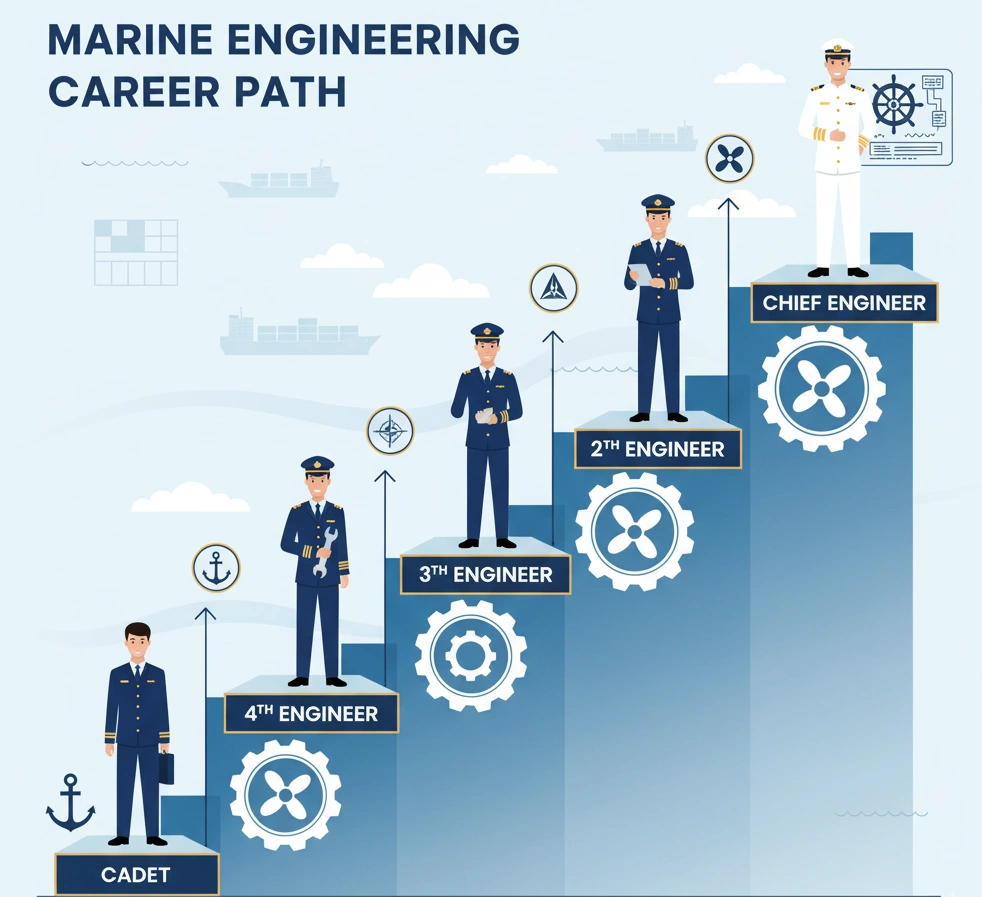
A career in Marine Engineering is one of the most dynamic and high-paying paths for engineering graduates who want to work beyond the confines of land. After completing a DG Shipping–approved BTech Marine Engineering program, graduates can join the Merchant Navy as Trainee Marine Engineers (Engine Cadets) and progress through well-defined ranks all the way up to Chief Engineer—the senior-most technical officer aboard a ship.
Industry Scope & Future Demand
The global maritime industry is expanding steadily, and with it, the demand for trained marine engineers. Over 90% of global trade moves by sea, and as shipping fleets modernise, the industry needs engineers skilled in automation, green propulsion systems, and marine sustainability.
By 2026, India’s maritime sector is set for rapid modernisation under the DG Shipping and IMO (International Maritime Organisation) initiatives. New guidelines promote eco-friendly ship designs, LNG and hybrid propulsion systems, and advanced safety standards—all requiring technically advanced marine engineers.
Key growth drivers:
- Expansion of India’s merchant shipping fleet and shipbuilding projects under “Make in India.”
- Rising global demand for sea trade and seafarers due to post-pandemic supply chain diversification.
- Introduction of green and smart ships with automated monitoring systems, AI-driven navigation, and sustainable fuel technologies.
- Emerging opportunities in offshore wind energy platforms, cruise liners, and maritime robotics.
BTech Marine Engineering Salary per Month
| Rank | Experience | BTech Marine Engineering Salary Per Month(₹) | Role Overview |
| Trainee Marine Engineer (Cadet) | 0–1 year | ₹50,000 – ₹1,00,000 | Hands-on machinery operations and maintenance under supervision. |
| 4th Engineer | 1–3 years | ₹1.2 – ₹2 lakh | In charge of fuel systems, pumps, and auxiliary engines. |
| 3rd Engineer | 3–5 years | ₹2 – ₹3 lakh | Oversees boilers, purifiers, compressors, and engine safety checks. |
| 2nd Engineer | 5–8 years | ₹3 – ₹5 lakh | Second in command in the engine room; responsible for daily technical operations. |
| Chief Engineer | 8–12+ years | ₹8 – ₹12 lakh (on foreign vessels) | Head of engine department; manages the ship’s complete propulsion and power systems. |
Onshore career options:
After sea service, marine engineers often move into:
- Ship design & manufacturing (L&T Shipbuilding, Cochin Shipyard)
- Port operations & logistics
- Marine equipment firms and classification societies (DNV, ABS, Lloyd’s Register)
- Offshore oil, gas, and renewable energy companies
With such diversity, Marine Engineering offers both high financial rewards and global mobility, unmatched by most land-based professions.
BTech Marine Engineering Placement
Marine engineers are recruited globally by shipping companies, fleet management firms, and offshore energy corporations. Most top institutes—especially IMU campuses, TMI, SIMS, and AMET—have direct placement pipelines with these recruiters.
Leading Merchant Navy Recruiters:
- Maersk Line (Denmark) – One of the world’s largest container shipping companies, hiring Indian cadets for technical officer roles.
- Anglo-Eastern Ship Management – Offers training-to-placement programs in partnership with SIMS.
- Fleet Management Ltd. – Operates over 600 vessels; provides excellent career growth from cadet to senior engineer.
- Great Eastern Shipping Company (GE Shipping) – India’s largest private sector shipping company with its own training institute (GEIMS).
- MSC (Mediterranean Shipping Company) – Leading global recruiter for international cargo vessels.
- Synergy Marine Group – Rapidly growing employer for next-generation green ships.
- Chevron Shipping, MOL, NYK Line, Wallem, and Bernhard Schulte Shipmanagement – Prominent global shipping companies hiring Indian graduates.
BTech Marine Engineering Placement Stats (Top Colleges):
| Institute | Placement Rate (Approx.) | Average Onboard Training Package (₹/month) | Top Recruiters |
| IMU (All Campuses) | 85–90% | ₹50,000 – ₹90,000 | Maersk, MSC, Fleet Management |
| Tolani Maritime Institute (TMI) | 95% | ₹70,000 – ₹1,00,000 | Chevron, NYK Line |
| Samundra Institute of Maritime Studies (SIMS) | 100% | ₹90,000 – ₹1,20,000 | Anglo-Eastern |
| AMET University | 80–85% | ₹50,000 – ₹80,000 | Synergy Marine, Great Eastern |
| Great Eastern Institute (GEIMS) | 100% | ₹1,00,000+ | Great Eastern Shipping |
Fees & ROI: Is Marine Engineering Worth It in 2026?
Pursuing a BTech in Marine Engineering is an investment in a globally mobile and high-paying profession. While the course fees are higher than traditional engineering branches, the return on investment (ROI) is among the strongest in the field of engineering, especially for those who choose to sail in the Merchant Navy.
| Type of College | Examples | Total Course Fees (4 Years) | Notes |
| Government / IMU Campuses | IMU Kolkata, IMU Chennai, IMU Mumbai Port | ₹12 – ₹16 lakh total | Includes tuition, hostel, and simulator training. Subsidised by the government. |
| Private DG Shipping–Approved Colleges | TMI Pune, SIMS Lonavala, AMET University | ₹15 – ₹25 lakh total | Includes modern simulators, workshops, and placement training. |
| Sponsored / Company-Supported Cadet Programs | Anglo-Eastern, Great Eastern, Fleet Management | ₹0 – ₹10 lakh (partly or fully sponsored) | Cadets are sponsored by companies and receive onboard training after course completion. |
ROI Analysis: Merchant Navy Payback Timeline
| Career Stage | Average Annual Income (₹) | Cumulative Payback | ROI Timeline |
| During Onboard Training (1 year) | ₹6 – ₹10 lakh | Partial recovery of fees | 1 year |
| 4th Engineer (Years 2–3) | ₹12 – ₹18 lakh | Full recovery of total investment | 2–3 years |
| 3rd Engineer (Years 4–5) | ₹20 – ₹25 lakh | 2–3× return on total cost | 4–5 years |
| Chief Engineer (10+ years) | ₹80 lakh – ₹1 crore+ | Long-term exponential returns | 10 years |
Within 2–3 years of joining active sea duty, most marine engineers recover their total academic investment. Therefore, it makes it one of the most financially rewarding engineering degrees in India.
Conclusion: Why BTech in Marine Engineering is a Smart Career Move in 2026
A BTech in Marine Engineering is more than just a degree — it’s a ticket to a global career at sea and beyond. As international trade and maritime logistics continue to expand, skilled marine engineers remain indispensable to keeping the world’s shipping fleet moving.
By 2026, the maritime industry will be entering a transformative era — with automation, green fuel technologies, and smart ship systems redefining how ships are built and operated. Engineers who adapt to these advancements will find themselves at the forefront of innovation, earning high salaries and unmatched professional exposure.
In short, if you’re someone who thrives on challenge, travel, and technical mastery, Marine Engineering offers one of the best ROI-driven careers in engineering today.
FAQs
What is the eligibility for BTech in Marine Engineering?
Students must have passed Class 12 with Physics, Chemistry, and Mathematics (PCM) and secured at least 60% aggregate marks, along with 50% in English. Candidates must also meet medical and eyesight standards set by the Directorate General of Shipping (DG Shipping).
Is IMU CET mandatory for Marine Engineering admission?
Yes, for admission to IMU campuses and its affiliated colleges, students must qualify for the IMU CET entrance exam. However, some private colleges also accept JEE Main or conduct their own tests.
What is the starting salary after completing Marine Engineering?
Fresh cadets earn between ₹6 – ₹10 lakh per year during onboard training. After gaining experience, salaries rise sharply, reaching ₹20 lakh+ annually within a few years.
What are the top companies that hire Marine Engineers in India?
Leading recruiters include Anglo-Eastern, Fleet Management, Great Eastern, Maersk Line, Synergy Marine, and MSC. Many also offer sponsorship programs during the course.
What is the job role of a Marine Engineer in the Merchant Navy?
A Marine Engineer oversees the maintenance and operation of ship machinery, including engines, boilers, pumps, and power systems, ensuring safe and efficient voyages.
Can Marine Engineers work onshore later in their career?
Yes. After sea experience, many professionals transition to ship design firms, classification societies, port authorities, offshore oil rigs, or maritime education and research roles.






I COMPLETED DIPLOMA ECE, AM I ELEIGIBLE FOR IMU CET?